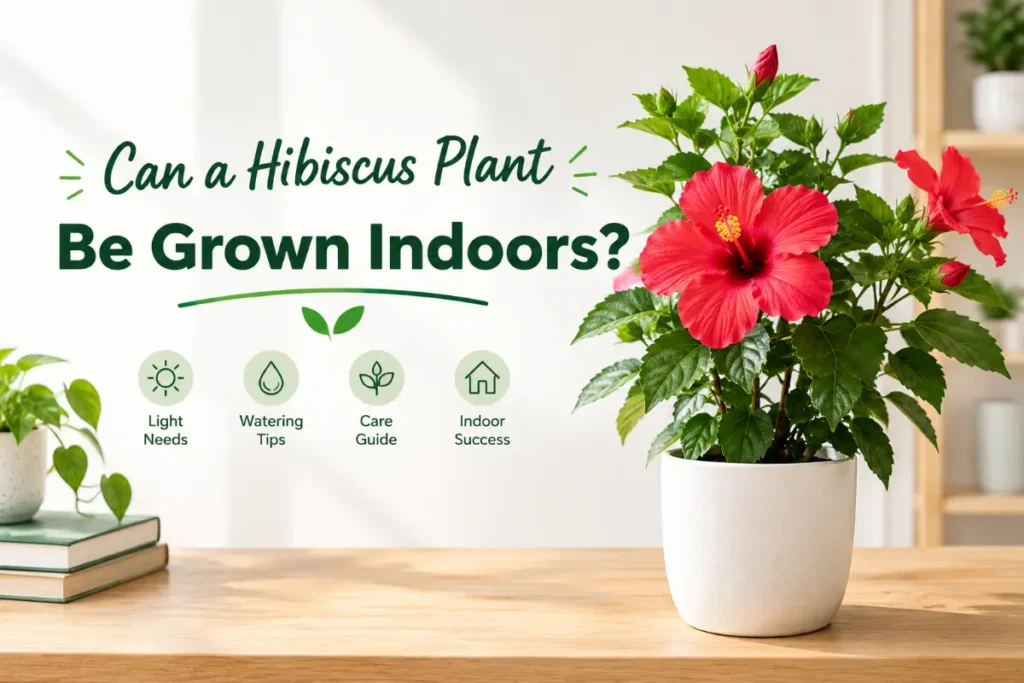
Can a hibiscus plant be grown indoors? Absolutely — and done well, indoor hibiscus is among the most spectacular flowering houseplants you can keep, producing enormous trumpet-shaped blooms in shades of red, orange, yellow, pink, and white throughout much of the year. Tropical hibiscus (Hibiscus rosa-sinensis) is the species best suited to indoor culture, a warm-climate shrub that actually prefers the stable warmth of indoor spaces to the temperature fluctuations of temperate outdoor conditions.
The key to indoor hibiscus success is understanding the plant’s origins and needs. Hibiscus is a tropical plant that evolved under intense sun, warm humid air, and regular rainfall. Given sufficient bright light, consistent warmth, appropriate watering, and regular feeding, hibiscus thrives and flowers generously indoors. Neglected or poorly positioned, it drops buds, produces no flowers, and declines rapidly.
This guide covers variety selection, positioning for maximum light, watering and feeding schedules, humidity management, pruning for bushy growth and prolific flowering, and dealing with the pests that commonly affect indoor hibiscus.
Understanding Tropical vs Hardy Hibiscus
The most important distinction when planning indoor hibiscus growing is between tropical hibiscus and hardy hibiscus — these are fundamentally different plants with very different requirements.
Tropical hibiscus (Hibiscus rosa-sinensis) is the species suited to indoor growing. It is a tender evergreen shrub originating from tropical Asia, producing the classic large funnel-shaped flowers in an enormous range of colours and bi-colour combinations. Tropical hibiscus cannot tolerate frost and grows best at temperatures above 15 degrees Celsius year-round. As an indoor plant, it is perfectly at home in the stable warmth of a heated home.
Hardy hibiscus includes species such as Hibiscus syriacus (rose of Sharon) and Hibiscus moscheutos (swamp rose mallow). These are cold-tolerant garden plants that die back in winter in temperate climates. Hardy hibiscus is not suitable for indoor growing in the long term — it needs the outdoor cold cycle to perform properly and becomes stressed without it.
Hibiscus sabdariffa (roselle) is a tropical annual species grown for its edible calyces used to make hibiscus tea and the deep red hibiscus drinks popular across many cultures. It can be grown indoors from seed and completes its life cycle in one season, making it different from the perennial tropical hibiscus kept as a long-term houseplant.
For permanent indoor growing with spectacular repeated flowering, tropical hibiscus (Hibiscus rosa-sinensis) is the correct plant. Named cultivars in a wide range of colours are widely available from garden centres and specialist tropical plant nurseries.
Light Requirements for Indoor Hibiscus
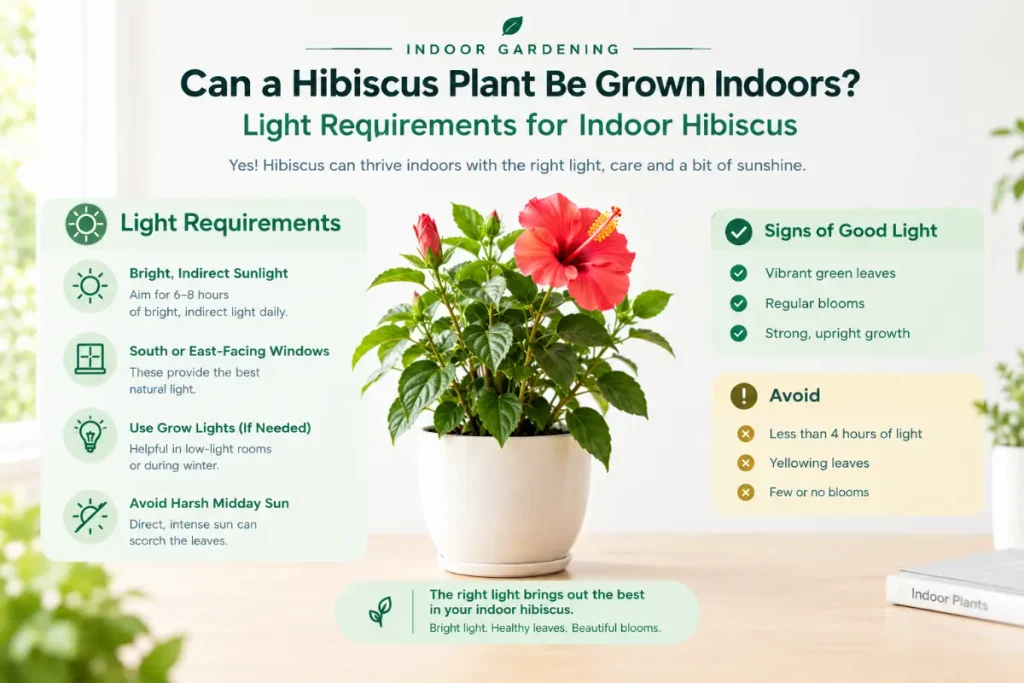
Light is the primary factor determining whether indoor hibiscus flowers or not. Hibiscus is a full-sun tropical plant that needs the brightest available position in your home — a south or west-facing window with several hours of direct sunlight daily is the minimum for reliable flowering.
A position that receives four to six hours of direct sun daily supports good flowering. Less than this, and the plant may grow vegetatively but produce few or no flowers. Buds may form but abort and fall before opening — a frustrating pattern that is almost always the result of insufficient light.
If your home cannot provide adequate direct sunlight, a full-spectrum LED grow light is a practical solution. Position the light 20 to 30 centimetres above the plant and run for 14 to 16 hours daily. Modern LED grow lights designed for flowering plants provide the full spectrum and light intensity hibiscus needs and can maintain excellent flowering year-round regardless of window orientation.
Signs of insufficient light include sparse, widely spaced leaves, a leggy open growth habit, bud drop before flowers open, and reluctance to produce new flower buds. Improving the light situation is the first response to any of these symptoms.
Temperature and Humidity
Tropical hibiscus thrives at temperatures between 18 and 27 degrees Celsius — comfortably within the normal range of most heated homes through the year. It can tolerate temperatures as low as 10 to 12 degrees Celsius briefly but growth slows significantly below 15 degrees, and any exposure to frost is fatal.
The most damaging temperature event for indoor hibiscus is cold draughts. A position near a frequently opened door, a poorly sealed window, or an air conditioning vent can expose the plant to cold air blasts that cause rapid and extensive bud and leaf drop. Choose a position with stable temperatures away from cold draught sources.
Hibiscus appreciates higher humidity than most homes provide naturally, particularly in winter when central heating creates dry indoor air. Low humidity causes leaf edges to brown and crisp, and can contribute to spider mite infestations, which thrive in dry conditions.
Raise humidity around indoor hibiscus by placing the pot on a tray of pebbles filled with water — as the water evaporates, humidity around the plant increases. Alternatively, mist the foliage lightly with water (avoiding open flowers) or use a small electric humidifier near the plant. Grouping hibiscus with other moisture-loving plants also naturally raises local humidity through transpiration.
Compost, Containers, and Repotting
Hibiscus grows best in a well-draining, nutrient-rich compost. Unlike lavender and other Mediterranean plants that prefer lean growing conditions, hibiscus is a greedy feeder that performs best in rich compost with regular additional feeding.
Use a high-quality peat-free multipurpose compost enriched with additional perlite or grit at roughly 20 percent volume to improve drainage. Good drainage is important — hibiscus does not tolerate waterlogging — but it needs a richer growing medium than drought-adapted plants.
Choose containers that are proportionate to plant size. Hibiscus performs better slightly pot-bound than in a very large container with excessive compost volume. A container 3 to 5 centimetres larger in diameter than the root ball is appropriate. Ensure generous drainage holes at the base.
Repot in spring every two to three years or when roots visibly circle the inside of the pot. Move up one container size, use fresh compost, and water in well. Spring repotting coincides with the plant’s active growth period and minimises stress.
Watering Indoor Hibiscus
Hibiscus needs consistent, regular watering — it does not tolerate the extended dry periods that Mediterranean plants prefer, but equally dislikes waterlogging. The goal is evenly moist compost that never dries out completely and never becomes sodden.
Check the compost by pushing a finger into the top 2 to 3 centimetres. Water when this layer feels dry. In summer during active growth and flowering, this may mean watering every three to five days. In winter when growth slows, watering frequency reduces to once every seven to ten days.
Use water at room temperature — hibiscus is sensitive to cold water and watering with very cold water can cause leaf yellowing and bud drop, particularly in winter. Allow tap water to stand for an hour before use if your tap water is very cold or heavily chlorinated.
Overwatered hibiscus shows yellowing leaves, dropping leaves, and a generally unhealthy appearance. Underwatered hibiscus wilts and drops leaves rapidly — it signals drought stress quickly and clearly. The plant recovers well from brief drought if watered promptly, but prolonged drought causes extensive leaf and bud drop.
Feeding Indoor Hibiscus
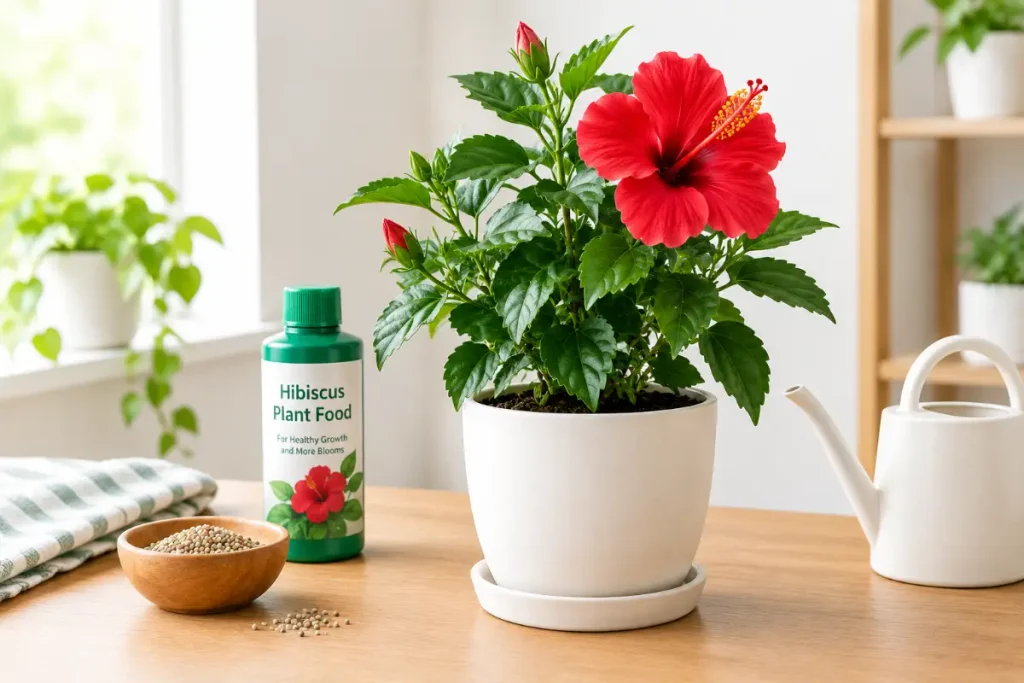
Hibiscus is a heavy feeder and regular fertilising is essential for good flowering indoors. A well-fed hibiscus produces a continuous succession of flowers through the growing season. An underfed plant grows slowly and produces few or no flowers.
During the active growing and flowering season (spring through early autumn), feed with a high-potassium liquid fertiliser every one to two weeks. Tomato fertilisers work well, as their potassium-heavy formulation promotes flowering over leafy growth. Avoid high-nitrogen fertilisers that produce excessive leafy growth at the expense of flowers.
In late autumn and winter, reduce feeding to once a month with a half-strength balanced fertiliser, or stop feeding entirely if the plant is in very low light and barely growing. Resume regular feeding in spring as growth and light levels increase.
Yellowing leaves on an otherwise healthy plant (good light, appropriate watering, appropriate temperature) often indicate nutrient deficiency. A dose of a balanced liquid fertiliser including trace elements usually resolves this within two to three weeks.
Pruning for Bushy Growth and More Flowers
Pruning is one of the most effective tools for maintaining compact, bushy indoor hibiscus that produces abundant flowers. Hibiscus flowers on new growth — stems produced in the current season — so pruning that stimulates vigorous new growth also increases flower production.
In late winter or early spring, before the main growing season begins, cut all main stems back by one-third to one-half. This removes old, partially bare stems and stimulates multiple new shoots from below each cut point, creating a bushier plant with many more flowering stems than an unpruned specimen.
Through the growing season, pinch out soft growing tips on long stems to encourage branching. Each pinch creates two or more new shoots where there was previously one, progressively increasing the number of potential flowering stems. Regular pinching in late spring creates a denser, more floriferous plant through summer.
Remove spent flowers promptly by pulling or snipping the faded bloom from the stem. This keeps the plant looking tidy and prevents energy being directed into seed production. Hibiscus flowers last only one to three days before dropping naturally, so deadheading is a regular rather than occasional task.
Common Pests of Indoor Hibiscus
Indoor hibiscus is susceptible to several common houseplant pests, and regular inspection helps catch problems before they become severe.
Spider mites are the most frequent and damaging pest. They thrive in warm, dry conditions and produce fine webbing on the underside of leaves. Affected leaves develop a mottled, pale, or bronzed appearance. Raise humidity around the plant, mist the undersides of leaves with water, and treat with insecticidal soap or neem oil spray. Repeat treatment weekly for three to four weeks to break the mite life cycle.
Aphids cluster on soft new growth and flower buds, sucking sap and causing distortion. Remove by hand, spray with insecticidal soap, or use a pyrethrin-based spray. Aphids are less persistent than spider mites on indoor hibiscus but can cause significant bud drop if a large infestation develops.
Whitefly produces clouds of tiny white insects when the plant is disturbed and causes yellowing and weakening of affected leaves. Yellow sticky traps catch adult whitefly. Insecticidal soap or neem oil applied to the undersides of leaves kills larvae and eggs. Consistent treatment over several weeks is needed as whitefly eggs are resistant to contact sprays.
Scale insects appear as small brown or grey waxy bumps attached to stems and leaf undersides. They are immobile and easy to overlook until populations are large. Remove manually with a cotton swab dipped in rubbing alcohol, then treat with neem oil. Scale can be persistent and may require several treatment rounds.
Growing Hibiscus Indoors from Seed
While most indoor hibiscus plants are purchased as established specimens or propagated from cuttings, growing hibiscus from seed indoors is an interesting project and the only practical approach for growing hibiscus sabdariffa (roselle) for tea production.
Tropical hibiscus seed germinates readily at temperatures of 21 to 27 degrees Celsius without special pre-treatment. Sow seeds 6 to 8 millimetres deep in moist seed compost, cover the container with a propagator lid or clear plastic bag, and place in a warm position — on a heat mat or on top of a radiator (not directly on the radiator surface) works well. Germination typically occurs within one to two weeks.
Hibiscus seedlings grow quickly in warm, bright conditions. Prick out into individual pots once large enough to handle and grow on under bright light. Young plants reach flowering size in four to six months from seed under good conditions.
Hibiscus rosa-sinensis does not come reliably true from seed — named varieties with specific colours or flower forms are best propagated from cuttings to ensure offspring match the parent. Open-pollinated seed produces plants with variable flower characteristics, which can be appealing as a surprise but disappointing if you expected a specific colour.
For Hibiscus sabdariffa grown for culinary use, the red calyces that form after flowering are harvested to make hibiscus tea, agua de Jamaica, and various hibiscus-infused drinks and foods. This is an annual species that grows vigorously from seed in one season, producing its harvest by late summer or early autumn. It makes a fascinating and productive indoor growing project for gardeners interested in growing food indoors — which is discussed throughout this grow lights for indoor tomato plants post for those using supplemental lighting to support tropical food crops.
Winter Care for Indoor Hibiscus
Winter is the period when indoor hibiscus requires the most careful management. The combination of lower natural light, shorter days, and the dry heat of central heating creates conditions that hibiscus finds stressful.
The most important winter adjustment is reducing watering frequency significantly. Growth slows in winter even with supplemental lighting, and the plant uses water much more slowly. Continuing to water at summer frequency leads rapidly to root rot. Check the compost carefully before each watering and allow more drying time between waterings than in summer.
Maintain warmth above 15 degrees Celsius at all times. Avoid placing hibiscus near windows that become very cold at night in winter — if the glass is icy on the outside, the air immediately around the plant inside can drop to damaging temperatures. Pull the plant back from the window on cold nights.
A grow light that extends the day length to 14 hours in winter significantly reduces winter dormancy and maintains flowering through the season. Without supplemental lighting, some reduction in flowering through the shortest days is normal and not a cause for concern.
Watch closely for spider mites in winter — the dry heat of central heating is their ideal environment, and populations can explode quickly on a stressed or light-deprived plant. Inspect the undersides of leaves weekly and act at the first sign of infestation.
Propagating Indoor Hibiscus from Cuttings
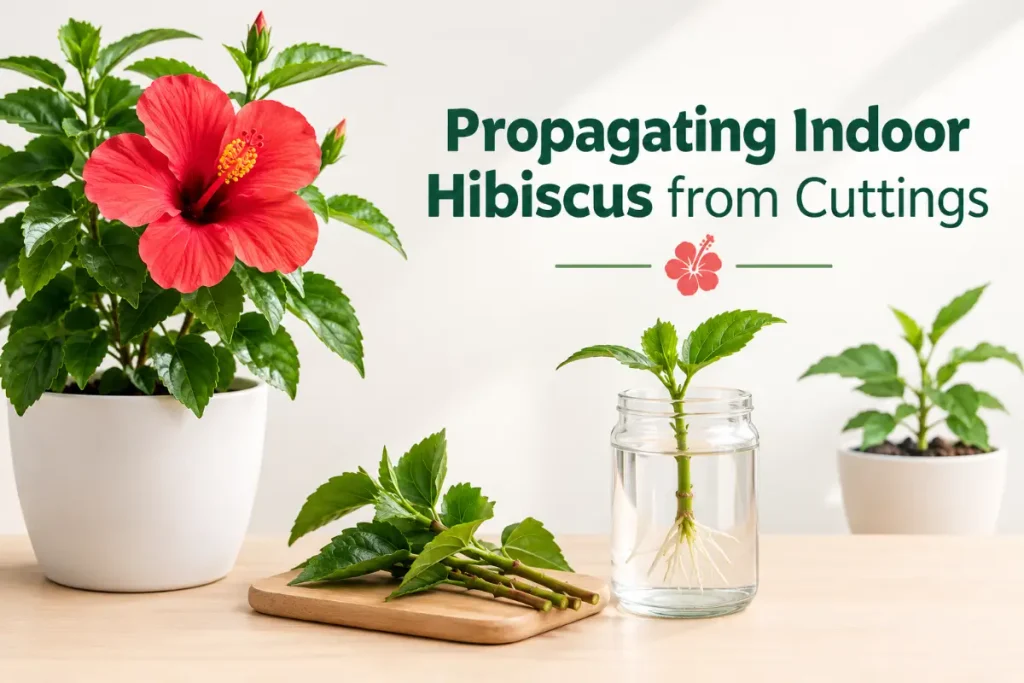
Propagating hibiscus from cuttings is the most reliable way to produce new plants that are genetically identical to a parent plant you admire. It is also a useful way to rejuvenate old, woody plants by replacing them with vigorous young specimens grown from the best growth of the parent.
Take cuttings in late spring or early summer from non-flowering shoot tips. Each cutting should be 10 to 15 centimetres long with at least two or three pairs of leaves. Remove the lower leaves, leaving only one or two pairs at the top. Dip the cut end in rooting hormone powder or gel and insert into a pot of moist, free-draining compost — equal parts multipurpose compost and perlite works well.
Enclose the cutting in a clear polythene bag or place under a propagator lid to maintain humidity while roots develop. Place in a warm position (21 to 24 degrees Celsius) with bright indirect light — not direct sun at this stage, which can cause wilting and failure before roots form.
Roots typically develop in three to five weeks. Gently tug the cutting to check for resistance indicating root development. Once rooted, remove the bag or lid and begin hardening the cutting to normal indoor air. Transfer to a slightly larger pot with regular compost and begin treating as an established plant.
Conclusion
Indoor hibiscus is entirely achievable and enormously rewarding for gardeners prepared to meet the plant’s needs for bright light, warmth, consistent watering, and regular feeding. The spectacular flowers it produces — each bloom large, vivid, and eye-catching — make it one of the most striking flowering plants you can grow indoors. For detailed guidance on hibiscus varieties, soil preparation, and long-term care, the Royal Horticultural Society’s hibiscus growing guide is an excellent reference covering all aspects of hibiscus culture in accessible detail.
The difference between thriving indoor hibiscus and a struggling one usually comes down to light. Get that right first, and everything else follows.
FAQs
Can tropical hibiscus live indoors permanently?
Yes, tropical hibiscus (Hibiscus rosa-sinensis) is well suited to permanent indoor growing. It is a frost-tender tropical shrub that actually prefers the stable warmth of indoor conditions to outdoor temperature fluctuations in temperate climates. With adequate light, consistent watering, and regular feeding, it can live and flower indoors for many years.
Why is my indoor hibiscus dropping buds?
Bud drop in indoor hibiscus is almost always caused by one of three factors: insufficient light, temperature fluctuations or cold draughts, or inconsistent watering. Check all three. Move the plant to the brightest available position, away from cold draught sources, and water consistently so the compost never dries out completely between waterings.
How often does indoor hibiscus flower?
A well-cared-for indoor hibiscus in good light flowers almost continuously through spring, summer, and early autumn, with individual flowers lasting one to three days before dropping and new buds opening in succession. In winter, flowering slows but may continue if light levels are maintained with a grow light and temperatures remain warm.
What is the best fertiliser for indoor hibiscus?
A high-potassium liquid fertiliser — such as a tomato fertiliser — applied every one to two weeks during the growing season is ideal. Potassium promotes flowering over leafy growth. Avoid high-nitrogen fertilisers that produce excessive leaf growth at the expense of flowers. Reduce feeding frequency in winter.
Does indoor hibiscus need direct sunlight?
Yes, hibiscus needs direct sunlight for best performance — at least four to six hours daily from a south or west-facing window. It can survive in bright indirect light but produces significantly fewer flowers and is more vulnerable to bud drop. A full-spectrum grow light is a practical alternative if sufficient direct sunlight is not available.
How big does indoor hibiscus get?
Indoor hibiscus can grow to 1 to 2 metres in height if unpruned, but is easily kept smaller through regular pruning. Annual hard pruning in late winter keeps container hibiscus at a manageable size of 50 to 90 centimetres while promoting bushy growth and prolific flowering. Container size also limits ultimate plant size — a smaller pot produces a smaller plant.
Can I put my indoor hibiscus outside in summer?
Yes, indoor hibiscus benefits greatly from spending summer outdoors in a sheltered, sunny position once temperatures are reliably above 15 degrees Celsius at night. The stronger natural light, fresh air, and natural humidity of outdoor conditions promotes vigorous growth and prolific flowering. Bring the plant back indoors before autumn temperatures drop below 12 to 15 degrees Celsius.
Why are my hibiscus leaves turning yellow indoors?
Yellowing hibiscus leaves indoors have several possible causes: overwatering, cold water or cold draughts, nutrient deficiency, or natural older leaf drop. Check watering first — consistently wet compost is the most common cause. If watering seems appropriate, try a balanced liquid fertiliser with trace elements to address possible deficiency. Natural yellowing and drop of oldest leaves is normal and not a concern if only a few leaves are affected.
How do I increase humidity for indoor hibiscus?
Place the pot on a tray of pebbles filled with water — evaporation raises local humidity without waterlogging the compost. Misting the foliage lightly (avoiding open flowers) helps short-term. Grouping hibiscus with other plants naturally raises humidity through collective transpiration. A small electric humidifier near the plant is the most reliable solution in very dry indoor conditions.
When should I repot indoor hibiscus?
Repot in spring every two to three years, or when roots are visibly circling the inside of the pot or growing through drainage holes. Move up one container size (3 to 5 centimetres larger in diameter) using fresh, nutrient-rich, well-draining compost. Avoid repotting during flowering or in winter when the plant is resting.