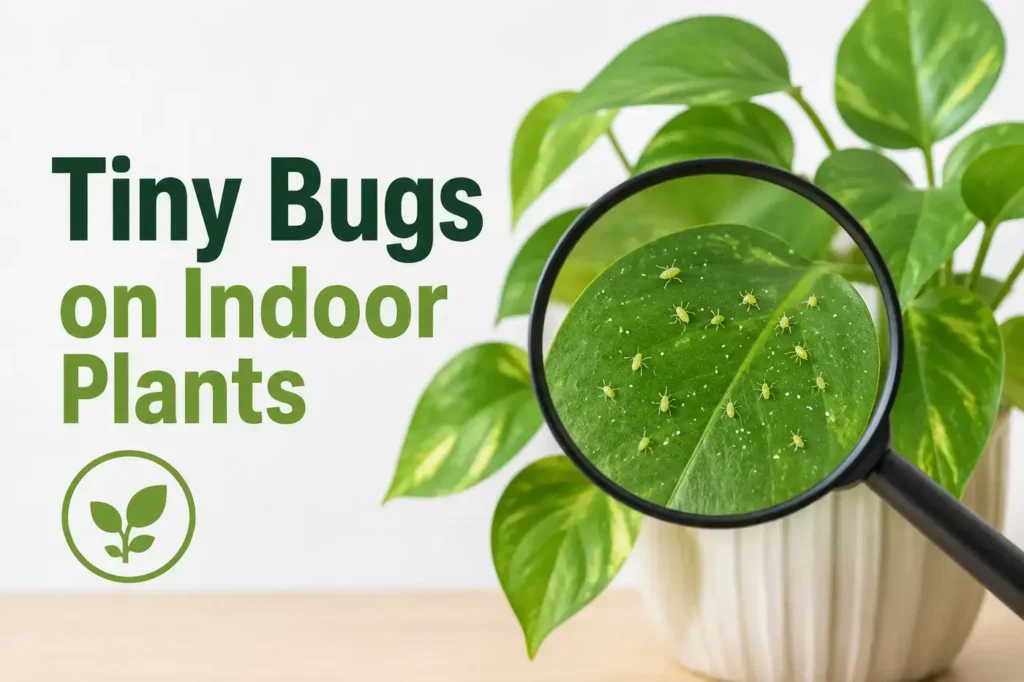
Spotting tiny bugs on indoor plants is one of those moments that sends most plant owners straight to the internet. They are small enough to be easy to miss but numerous enough that by the time you notice them, there are usually a lot more than you initially think. The critical question is not just what they are but whether they are actually damaging your plant or simply living in the soil environment without causing any harm. Tiny bugs on indoor plants fall into both categories, and treating a harmless decomposer the same way you treat a destructive aphid infestation wastes time and risks damaging your plant with unnecessary chemical exposure.
This guide covers 10 of the most common tiny bugs found on indoor plants, how to identify each one accurately, whether it causes real damage, and exactly how to treat the ones that do.
Quick Answer
The most common tiny bugs found on indoor plants are aphids, spider mites, fungus gnats, whiteflies, mealybugs, thrips, scale insects, springtails, soil mites, and shore flies. Of these, aphids, spider mites, whiteflies, mealybugs, thrips, and scale insects cause plant damage and need treatment. Fungus gnat larvae damage roots while adults are harmless. Springtails and most soil mites are beneficial decomposers requiring no treatment. Identify the bug accurately before choosing any treatment method.
Why Accurate Identification Matters Before Treatment
Reaching for the nearest spray the moment you see any small insect on your plant is the most common mistake indoor gardeners make with pest control. Different insects require completely different treatment approaches, and a spray that eliminates one pest species does nothing to another.
Spider mites, for example, thrive in dry conditions and are best treated with high-humidity environments and neem oil. Fungus gnats require letting the soil dry out completely between waterings since their larvae cannot survive in dry soil. Treating spider mites with the same approach used for fungus gnats makes the spider mite problem worse while failing to address the gnats. Getting the identification right before doing anything else saves weeks of wasted treatment time.
10 Tiny Bugs Found on Indoor Plants
1. Aphids
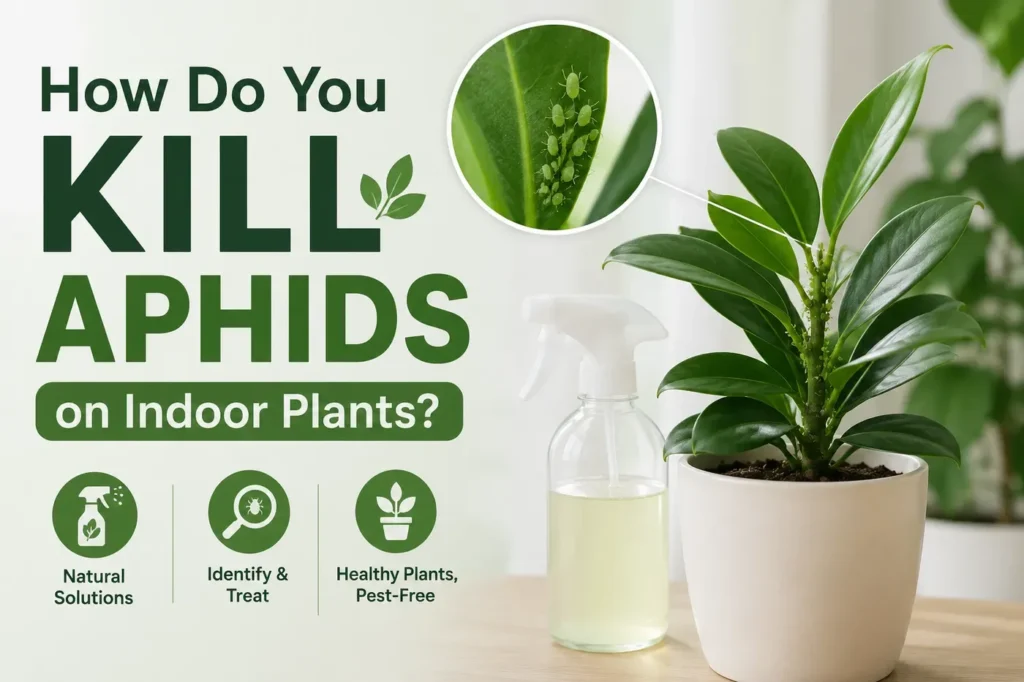
Aphids are among the most common tiny bugs found on indoor plants and one of the most immediately recognizable once you know what to look for. They are soft-bodied, pear-shaped insects between 1 and 3 millimeters long that appear in dense clusters rather than as isolated individuals. They come in green, black, yellow, brown, pink, and white depending on the species, but the clustering behavior is consistent across all of them.
You will find aphids most densely packed on new growth at stem tips, along the undersides of young leaves, and in the joints where leaves attach to stems. These are the areas with the highest sap concentration, which is what aphids feed on by piercing plant tissue with their needle-like mouthparts.
Damage they cause: Leaf curling, puckering, and distortion. Stunted new growth. Yellowing leaves that drop prematurely. Sticky honeydew residue on leaves and surrounding surfaces. Black sooty mold growing on top of that residue.
Confirming identification: Turn leaves over and look along the central vein. Check stem tips and new growth. Look for sticky residue on leaves or surrounding surfaces. Look for ants moving up and down stems since ants farm aphids for their honeydew.
Treatment: Manual removal of visible clusters followed by dish soap spray applied every 3 to 4 days for two full weeks. For larger infestations, neem oil spray every 5 to 7 days provides broader coverage with residual hormonal disruption. The complete step-by-step treatment process for every level of aphid infestation is covered in how to get rid of aphids on indoor plants.
2. Spider Mites
Spider mites are so small that most people do not realize they have them until the damage becomes visible. Individual spider mites are barely visible to the naked eye at 0.5 millimeters or less, appearing as tiny moving dots, usually red, brown, or yellow, on the undersides of leaves. The first sign most plant owners notice is not the mites themselves but the damage they leave behind.
Look for fine stippling on leaf surfaces, which appears as tiny pale or yellow dots where mites have pierced the leaf tissue and removed cell contents. In more advanced infestations, look for fine webbing on leaf undersides and between stems that looks like tiny spider webs but finer and less structured.
Damage they cause: Stippled, bronzed, or silvery leaf appearance. Fine webbing on leaf undersides and stem junctions. Progressive leaf yellowing and dropping. Stunted growth in severe infestations.
Conditions that encourage them: Dry air and warm temperatures. Spider mites specifically thrive in the low-humidity conditions common in heated indoor spaces during winter, which is why infestations often peak in January and February in homes with central heating running continuously.
Treatment: Neem oil spray is the most effective organic option, applied every 5 to 7 days for three weeks. Increase indoor humidity by misting plants or using a humidifier since spider mites struggle in high humidity above 60%. Predatory mites like Phytoseiulus persimilis are the most effective biological control for severe infestations. Avoid using the same spray repeatedly since spider mites develop resistance faster than most other indoor plant pests.
3. Fungus Gnats
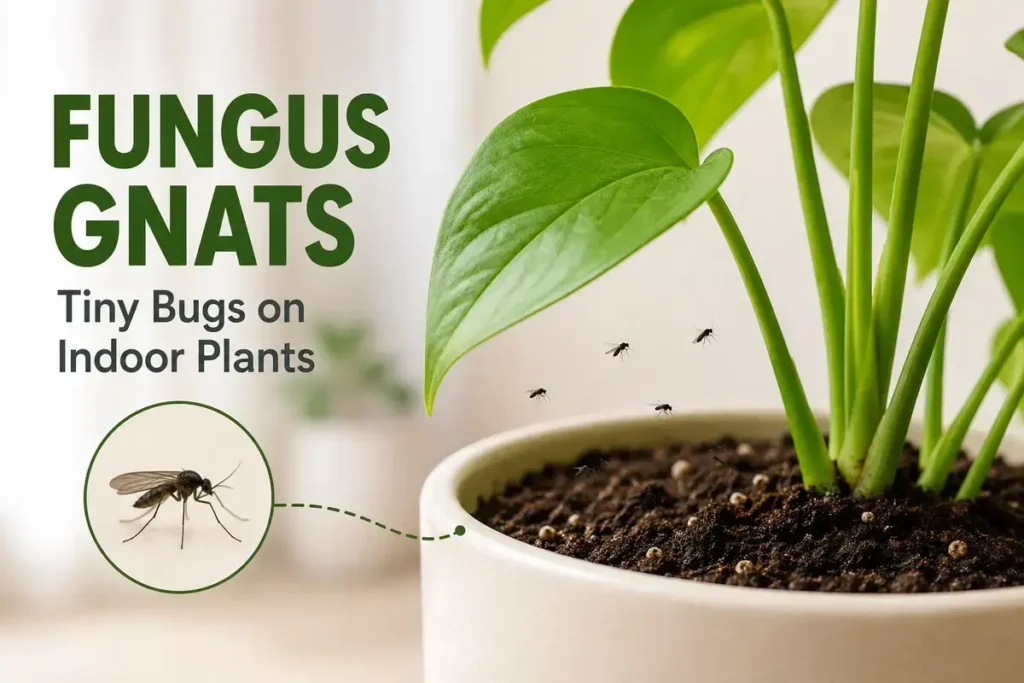
Fungus gnats are tiny, dark-bodied flies about 2 to 3 millimeters long that hover around the soil surface of indoor plants and fly up in small clouds when you water or disturb the pot. They are one of the most frequently encountered indoor plant pests and also one of the most misunderstood because it is the larval stage rather than the adult flies that causes plant damage.
The adult fungus gnat is annoying but completely harmless to plants. The larvae, which are tiny white thread-like creatures with a shiny black head capsule living in the top 2 to 3 inches of soil, feed on plant roots. Light feeding on an established plant causes minimal visible damage. Heavy larval populations in young plants or seedlings cause wilting, yellowing, and growth stunting as root damage accumulates.
Confirming it is fungus gnats: Press a piece of raw potato cut side down into the top inch of soil and leave for 24 hours. Fungus gnat larvae are attracted to potato starch. Pull it up and check the underside for tiny white worms.
What encourages them: Consistently wet soil is the single biggest driver of fungus gnat infestations. Larvae cannot survive in dry soil and adults will not lay eggs in it. A plant that dries out adequately between waterings rarely develops a serious gnat problem.
Treatment: Let soil dry completely between waterings. Apply hydrogen peroxide drench (1 part 3% hydrogen peroxide to 4 parts water) weekly for three weeks to kill larvae in the soil. Place yellow sticky traps at soil level to catch adults and reduce egg-laying. For a complete breakdown of every soil-dwelling bug species including fungus gnat larvae versus other soil inhabitants, bugs in indoor plant soil covers identification and treatment for each one in full detail.
4. Whiteflies
Whiteflies are tiny white flying insects about 1 to 2 millimeters long that live on the undersides of leaves and fly up in a small white cloud when the plant is disturbed. They look like miniature moths and are most commonly found on hibiscus, poinsettia, tomatoes, fuchsia, and other soft-leaved plants with high sap content.
Like aphids, whiteflies feed by piercing leaf tissue and extracting sap. They also excrete honeydew, which leads to the same sooty mold issues that heavy aphid infestations produce. What makes whiteflies particularly challenging to control is that they are strong fliers that move between plants easily and lay eggs in batches on leaf undersides that are difficult to reach with sprays.
Damage they cause: Yellowing leaves, honeydew residue, sooty mold, stunted growth, premature leaf drop in heavy infestations
Treatment: Yellow sticky traps catch flying adults between spray applications and are essential for monitoring infestation levels. Commercial insecticidal soap spray applied every 4 to 7 days targets nymphs and adults on leaf surfaces. For whitefly populations that have not responded to soap spray, spinosad products like Captain Jack’s Deadbug Brew are significantly more effective. Consistent treatment for a full three weeks is necessary since whitefly eggs on leaf undersides hatch continuously and each new generation needs to be caught before it matures.
5. Mealybugs
Mealybugs are one of the easiest indoor plant pests to identify visually because they produce a distinctive white waxy or cottony coating that makes them look like tiny pieces of cotton fluff on stems and leaf joints. They cluster in protected areas including leaf axils, stem junctions, and the base of the plant where leaves meet the main stem.
Despite their cottony appearance, mealybugs are sap-feeding insects that cause significant damage through both direct feeding and the honeydew they excrete. They are slow-moving and easy to spot once you know what to look for, but their waxy coating makes them resistant to many standard spray treatments since water-based sprays bead off rather than penetrating to the insect.
Damage they cause: Yellowing, wilting, distorted growth, honeydew residue, sooty mold, and eventual plant death in severe long-term infestations
Treatment: Rubbing alcohol applied directly with a cotton swab is the most effective immediate treatment because the alcohol dissolves the waxy protective coating that water-based sprays cannot penetrate. Dip a cotton swab in 70% isopropyl rubbing alcohol and apply it directly to each mealybug cluster. Follow with neem oil spray applied to the whole plant every 5 to 7 days to catch any mealybugs the manual treatment missed and to address eggs in crevices.
6. Thrips
Thrips are slender, tiny insects about 1 to 2 millimeters long that are difficult to see clearly without magnification because they move fast and hide in flower petals and tight leaf junctions. They appear as tiny dark or pale slivers moving across plant surfaces, often most visible on light-colored flowers where their dark bodies contrast against the petal.
Thrips damage plants through a distinctive rasping feeding method. Rather than piercing and sucking like aphids, thrips scrape leaf and petal surfaces and consume the contents of the damaged cells. This produces a characteristic silvery, streaked, or bronzed appearance on leaf surfaces that looks different from the stippling of spider mites or the distortion caused by aphids.
Damage they cause: Silvery or bronze streaking on leaves and petals, distorted flower development, black fecal spots on leaf surfaces, premature flower drop
Treatment: Thrips are notoriously difficult to control with standard soap and neem oil sprays because they move fast, hide effectively, and their pupal stage occurs in the soil where above-ground sprays cannot reach. Spinosad-based sprays are the most effective organic option, targeting thrips at multiple life stages including the soil-dwelling pupal stage. Blue sticky traps (thrips are more attracted to blue than yellow) alongside spinosad spray provides the most complete treatment approach. For the full range of spray options and which products handle thrips most effectively, indoor plant spray for bugs covers every spray option matched to each pest in detail.
7. Scale Insects
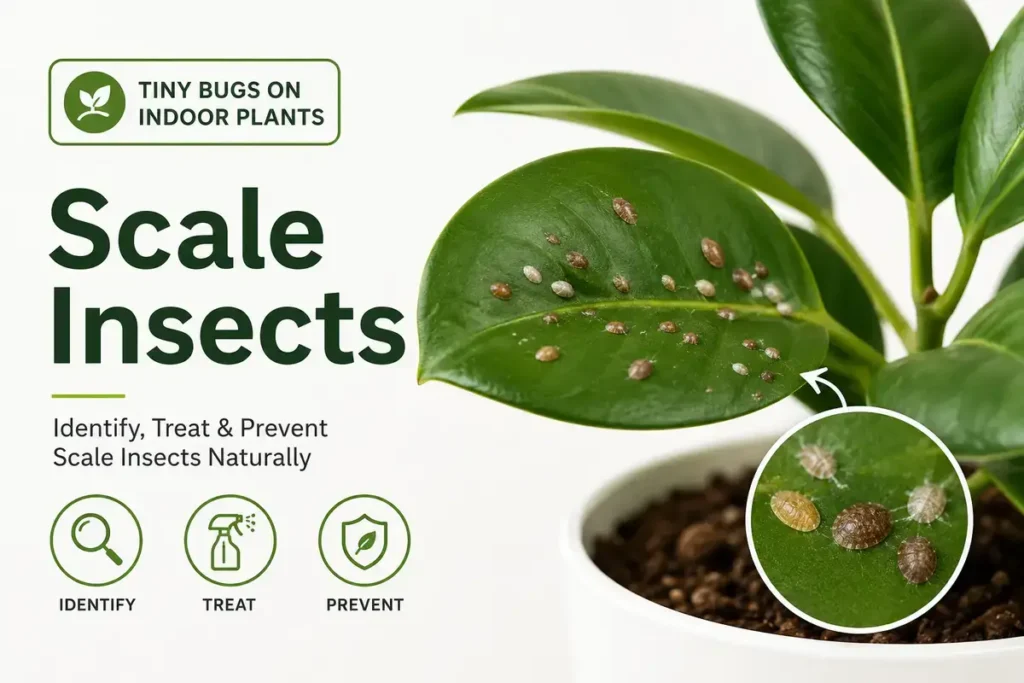
Scale insects are one of the most unusual-looking indoor plant pests because adults do not look like insects at all. They appear as small bumps, shells, or waxy discs attached permanently to stems and the undersides of leaves. There are two main types: soft scale, which produces a waxy coating but can be crushed relatively easily, and armored scale, which produces a hard protective shell that makes it significantly more resistant to spray treatments.
The bumps scale insects produce are often mistaken for part of the plant itself, particularly on plants with naturally textured or bumpy stems. The key test is trying to scrape one off with a fingernail. Scale insects scrape off and leave a mark on the stem surface. Natural plant bumps do not.
Damage they cause: Yellowing, wilting, honeydew production, sooty mold, branch dieback in heavy infestations
Treatment: Soft scale crawlers (the mobile juvenile stage) are susceptible to insecticidal soap and neem oil spray. Adult soft scale can be removed manually with a soft brush dipped in rubbing alcohol. Armored scale adults are resistant to most sprays and manual removal is the most effective approach, followed by neem oil application to prevent new crawler generations from establishing.
8. Springtails
Springtails are one of the most frequently misidentified indoor plant bugs because their jumping behavior when disturbed is alarming enough to make most people assume they are harmful. They are tiny, 1 to 2 millimeters long, white, grey, or dark, and jump by snapping a forked appendage under their body.
Despite appearances, springtails are completely harmless to plants. They are decomposers that feed exclusively on fungi, algae, and decaying organic matter in the soil. They do not feed on plant roots, stems, or leaves at any stage of their life cycle. Their presence in large numbers actually indicates healthy organic soil activity rather than a pest problem.
Do they need treatment? No. Springtails cause zero plant damage.
If their presence is bothering you: Let the soil dry out more between waterings. Springtail populations collapse rapidly when soil moisture decreases since they require constant moisture to survive. No chemical treatment is needed or appropriate. For a complete explanation of which soil inhabitants are harmful versus beneficial, do indoor plants attract bugs covers the distinction between pest species and harmless soil organisms in detail.
9. Soil Mites
Soil mites appear as tiny white, tan, or translucent specks moving slowly across the soil surface or on the underside of pots near drainage holes. They are present in virtually every organic soil environment and in indoor potting mix they are almost always beneficial decomposers feeding on fungi, bacteria, and decaying plant material.
The vast majority of soil mite species found in indoor plant soil cause no plant damage whatsoever and are a normal part of healthy soil ecology. A small number of root-feeding mite species do exist, but these are much less common in typical indoor plant situations and cause a distinctive pattern of wilting and decline that does not match obvious surface pest activity.
Do they need treatment? For the beneficial decomposer species that represent the overwhelming majority of soil mites found indoors: no. For the rare root-feeding species causing unexplained plant decline: repot into fresh sterile potting mix and treat with a neem oil soil drench.
10. Shore Flies
Shore flies are frequently confused with fungus gnats because they are similar in size, dark in color, and also hover around indoor plants. The reliable visual distinction is that shore flies are stockier and darker than fungus gnats and have five distinctive white spots on their wings that fungus gnats lack. Shore flies also tend to run quickly across the soil surface rather than hovering above it.
Shore flies feed on algae growing on the soil surface and pot edges rather than on plant roots. They cause less direct plant damage than fungus gnats but can spread plant pathogens between pots as they move through a collection, making them worth addressing in homes with multiple plants.
Treatment: The same approach works for shore flies as for fungus gnats. Allow soil to dry out between waterings to eliminate the moist algae-covered surface they feed on. Improve air circulation around plants to reduce algae growth on soil surfaces. Yellow sticky traps catch adults. The distinction between shore flies and fungus gnats matters for treatment since the hydrogen peroxide larval drench effective for gnat larvae is not the primary treatment for shore flies whose larvae do not cause the same root damage.
How to Inspect Your Plants Properly
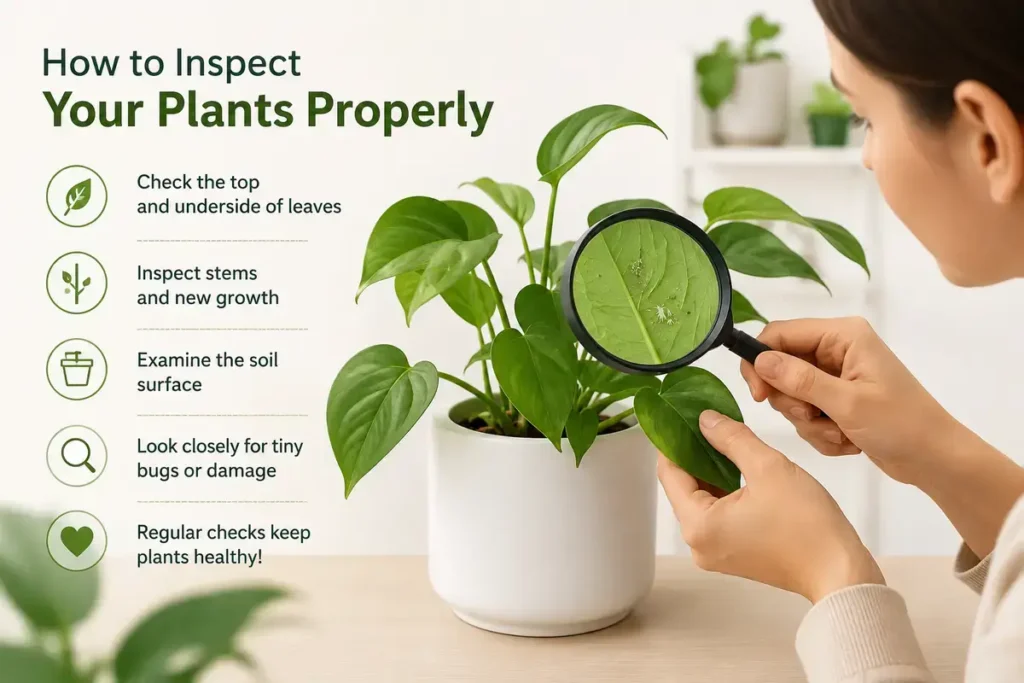
Finding tiny bugs requires looking in the right places since most pest species actively avoid the visible top surfaces of leaves where casual inspection would notice them.
Check the undersides of leaves along the central vein and at the edges where aphids, spider mites, and whiteflies concentrate. Look at stem junctions and leaf axils where mealybugs and scale insects shelter. Examine new growth at stem tips where aphid colonies typically start. Check the soil surface and around the pot drainage holes where soil-dwelling insects are most visible. Look for indirect signs including sticky residue on leaves or surrounding surfaces, fine webbing between leaves, silvery or bronze leaf discoloration, and tiny black fecal spots on leaf surfaces.
A weekly two-minute inspection of your most vulnerable plants using this approach catches pest problems at the earliest stage when a single soap spray application is typically enough to resolve them completely.
General Treatment Principles That Apply to Every Tiny Bug
Identify before treating. Every pest species on this list responds to different treatments. Getting the identification wrong means applying the wrong treatment and losing valuable time while the infestation grows.
Isolate immediately. The moment you confirm a damaging pest, move the affected plant away from neighboring plants. Aphids, spider mites, and whiteflies spread between plants faster than most people realize.
Treat every plant in the area. By the time you notice an infestation on one plant, neighboring plants almost always have early-stage populations that are not yet visible. Treating all nearby plants simultaneously prevents reinfection.
Complete the full treatment cycle. Stopping treatment when visible insects disappear is the most common reason infestations return. Eggs survive most spray applications and hatch within days of treatment ending. Continue treating for a full two weeks after visible insects are gone to catch newly hatched generations before they reproduce.
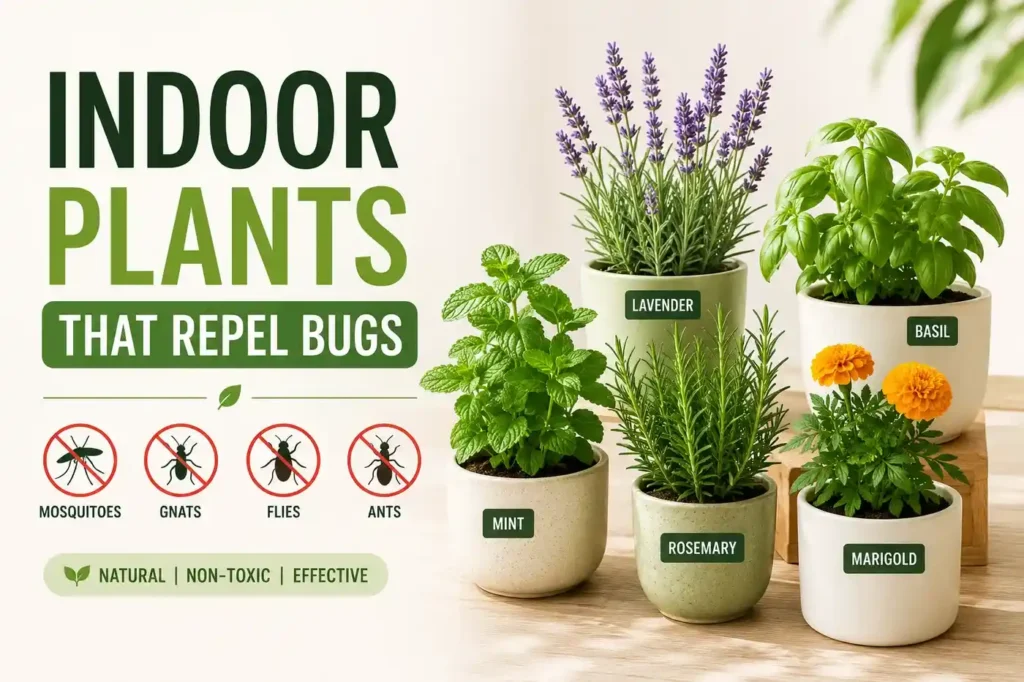
Address underlying conditions. Overwatered soil, insufficient light, and poor nutrition all create stressed plants that attract pests preferentially. Fixing the underlying condition makes every spray treatment more effective and reduces the frequency of future infestations. Growing bug-repelling companion plants nearby adds another layer of natural deterrence. The complete list of plants that deter the most common indoor pests is covered in indoor plants that repel bugs.
Conclusion
Tiny bugs on indoor plants range from the genuinely destructive to the completely harmless, and the treatment response should reflect that distinction. Aphids, spider mites, mealybugs, whiteflies, thrips, and scale insects cause real damage and need prompt, consistent treatment. Springtails and most soil mites are harmless decomposers doing useful work in your potting mix and need nothing except perhaps better watering practices if their numbers bother you. Fungus gnats and shore flies fall in the middle, with larvae causing varying degrees of root damage while adults are primarily a nuisance.
Take two minutes to identify what you are actually dealing with before opening any spray bottle. Check leaf undersides, stem junctions, soil surfaces, and new growth systematically. Identify the pest accurately, match the treatment to the species, apply it to every plant in the area on a consistent schedule for two full weeks, and the overwhelming majority of tiny bug problems on indoor plants resolve completely without complicated multi-product chemical regimens.
Frequently Asked Questions
How do I identify tiny white bugs on my indoor plants?
Tiny white bugs on indoor plants are most commonly mealybugs, soil mites, springtails, or whitefly nymphs depending on where you find them. Mealybugs appear as white cottony clusters on stems and leaf joints. Soil mites and springtails appear as tiny white specks moving across the soil surface, with springtails jumping when disturbed. Whitefly nymphs are flat, oval, and almost transparent on leaf undersides. Location is the most reliable first clue: white bugs on stems and leaves suggest mealybugs or whiteflies, white bugs in the soil suggest mites or springtails.
What are the tiny black bugs on my indoor plant soil?
Tiny black bugs moving across the soil surface of indoor plants are most commonly fungus gnat adults, shore flies, or rove beetles. Fungus gnats are slender and hover above the soil. Shore flies are stockier with visible white wing spots and run quickly across the soil surface. Rove beetles are fast-moving predatory beetles that are actually beneficial. If they fly up when you disturb the pot, they are almost certainly fungus gnats or shore flies. If they stay on the soil surface and move quickly without flying, they may be rove beetles that are helping rather than harming your plant.
Are tiny red bugs on indoor plants dangerous?
Tiny red moving specks on indoor plants, particularly on leaf undersides, are almost certainly spider mites. Spider mites are one of the most damaging tiny bugs found on indoor plants, causing stippled leaf discoloration, fine webbing, and progressive leaf drop. They thrive in warm, dry indoor conditions and spread quickly between plants in a collection. Treat immediately with neem oil spray applied every 5 to 7 days for three weeks and increase humidity around affected plants.
How do I get rid of tiny bugs on indoor plants naturally?
The most effective natural treatments for tiny bugs on indoor plants are dish soap spray (1 teaspoon Dawn in 1 quart water) for soft-bodied surface insects, neem oil spray (2 tablespoons neem oil, 1 teaspoon dish soap, 1 quart warm water) for broad spectrum control, hydrogen peroxide drench (1 part 3% hydrogen peroxide to 4 parts water) for soil-dwelling larvae, and rubbing alcohol applied with a cotton swab for mealybugs and scale. Each targets different pest types, so identifying the bug first determines which natural treatment to use.
Why do my indoor plants keep getting tiny bugs?
Recurring tiny bug infestations despite treatment typically come down to four causes: treatment stopped before the full two-week cycle needed to catch newly hatched eggs, a neighboring plant was left untreated and continuously reinfests treated plants, the plant is stressed from overwatering, poor light, or inadequate nutrition and is attracting pests through stress signals, or new plants are introduced without quarantine and bring fresh pest populations into the collection. Addressing all four factors simultaneously rather than just repeating spray treatment resolves persistent infestations in the majority of cases.
Can tiny bugs on indoor plants spread to humans?
No. Every tiny bug species commonly found on indoor plants is exclusively a plant feeder or soil decomposer. None of them bite, sting, or feed on humans or animals. Fungus gnat adults can be annoying when flying near your face, but they are harmless. The only human health consideration with indoor plant bugs is the sprays used to treat them, not the bugs themselves.