
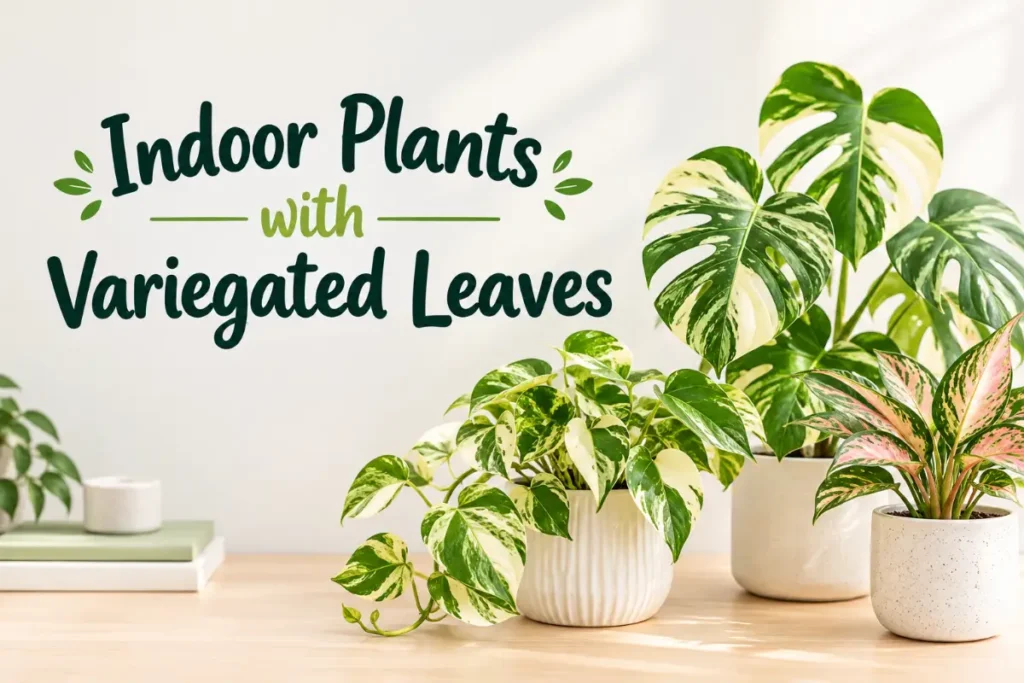
Variegation — the patterning of leaves in two or more colours — is one of the most sought-after qualities in indoor plants. Whether it is the bold white-and-green splash of a Monstera albo, the golden marbling of a Scindapsus pictus, or the precise geometric striping of a Calathea orbifolia, indoor plants with variegated leaves offer a visual richness that solid-green foliage simply cannot match.
This guide covers the best varieties of indoor plants with variegated leaves across different sizes and light levels, explains the science behind variegation, and provides practical care guidance — including the specific considerations that apply to variegated plants, which differ in some important ways from their all-green relatives.
What Causes Variegation in Plants?
Variegation occurs when some areas of leaf tissue lack the chlorophyll-producing plastids (chloroplasts) that make plant tissue green. The white or cream areas contain little or no chlorophyll; the yellow or gold areas have reduced chlorophyll or alternative pigments; only the green areas are fully photosynthetically active.
There are three primary types:
Chimeric variegation is the most common and most prized type in houseplants. It arises from a genetic mutation in certain cells during the plant’s development, creating a mix of normal (green) and mutant (white) cells in the same plant. Monstera deliciosa ‘Albo Variegata’, Philodendron ‘White Wizard’, and many Hoya variegated forms are chimeric. Because the mutation is in the cellular development rather than the plant’s core DNA, chimeric variegation is often unstable — sections of a plant can revert to solid green, and propagating from green reverted sections produces all-green plants.
Stable genetic variegation is encoded in the plant’s genome itself, meaning every cell carries the instruction for the pattern. Caladiums, Tradescantia, and many Dracaena varieties carry stable genetic variegation that reproduces reliably from seed or cuttings.
Pattern variegation from structural differences in leaf tissue — such as the silver markings on Scindapsus pictus, which result from air pockets between cell layers reflecting light — is technically not true variegation but produces similarly striking effects.
The practical implication: chimeric variegated plants (Monstera albo, many Philodendrons) require specific care and propagation approaches; stable variegation (Calathea, Tradescantia) is more forgiving and reproduces predictably.
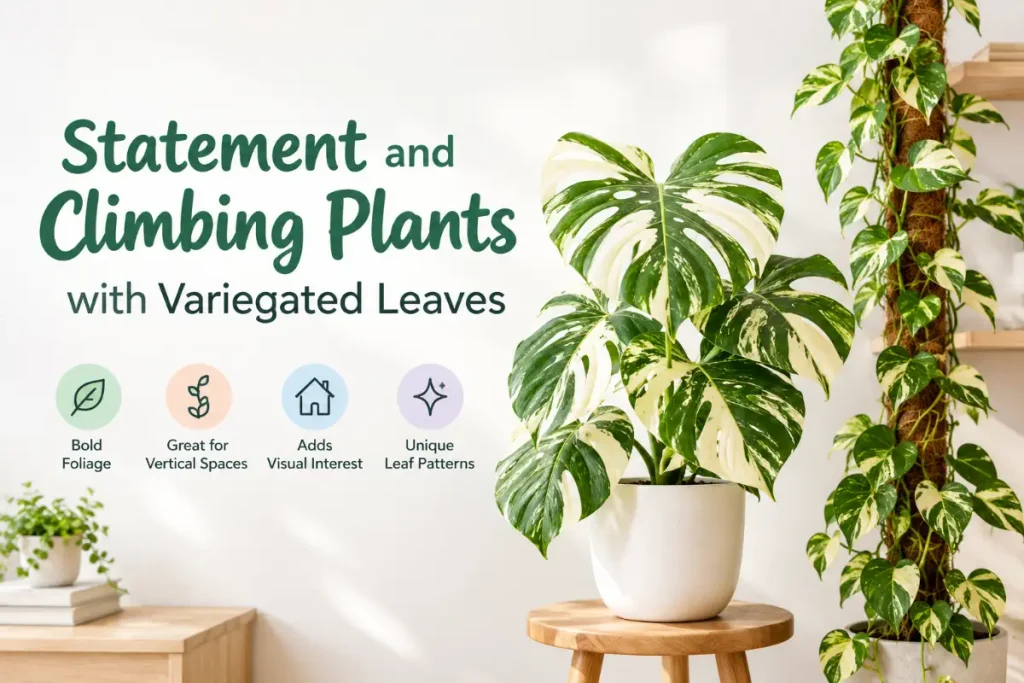
Best Varieties: Statement and Climbing Plants
Monstera deliciosa ‘Albo Variegata’ (Variegated Monstera)
The most sought-after and widely discussed variegated houseplant of the past decade, the variegated Monstera produces the characteristic split leaves of the standard Monstera splashed with irregular white sectors — sometimes a whole half-leaf of pure white, sometimes subtle marbling throughout. No two leaves are identical. Plants can cost hundreds of pounds because they must be propagated vegetatively (chimeric variegation does not come true from seed) and grow slowly.
Care: Bright indirect light is essential — more than a standard Monstera needs, because the white sections contain no chlorophyll and the plant has less photosynthetic capacity overall. Water when the top 5 cm dries. High humidity (60%+) produces the best growth. Prune sections that revert to solid green to encourage variegated new growth.
Pothos (Epipremnum aureum) Variegated Forms
The humble Pothos has been cultivated into a range of variegated forms that are among the most accessible and forgiving indoor plants with variegated leaves:
- ‘Golden Pothos’: Classic yellow-and-green marbling; extremely tough and tolerant.
- ‘Marble Queen’: Heavily cream-and-white variegated, more striking but slightly slower-growing.
- ‘N’Joy’: Crisp white-and-green blocks of colour rather than marbling.
- ‘Manjula’: Ruffled leaves with cream, white, and green variegation — one of the most decorative forms.
Care: Tolerant of lower light than most variegated plants, though variegation is most vivid in bright indirect light. Water when the top 3 cm dries. Feed fortnightly in growing season. One of the easiest of all indoor plants with variegated leaves — excellent for beginners.
Philodendron Variegated Forms
Philodendrons have produced some of the most dramatic variegated forms in the houseplant world:
- ‘White Wizard’: Deep green leaves splashed with crisp white — chimeric, unstable, and expensive.
- ‘Brasil’: Yellow-and-green variegated heart-leaf Philodendron — stable, affordable, and fast-growing.
- ‘Pink Princess’: Dark green and deep burgundy-pink variegation — striking and increasingly available.
Care: Bright indirect light for the most vivid variegation. Water when the top 3–4 cm dries. High humidity suits them well. Pinch growing tips for bushier growth on trailing varieties.
Scindapsus pictus (Satin Pothos)
Not a true Pothos but closely related, Scindapsus pictus has thick, velvety leaves with silver markings that catch the light differently depending on viewing angle. ‘Argyraeus’ has small silver spots; ‘Exotica’ has large, dramatic silver sections covering most of the leaf surface. Relatively slow-growing but long-lived and low-maintenance.
Care: Tolerates moderate indirect light but silver markings are most intense in bright indirect light. Water when the top 3 cm dries — Scindapsus is more drought-tolerant than true Pothos. Avoid overwatering.
Best Varieties: Medium-Sized Plants
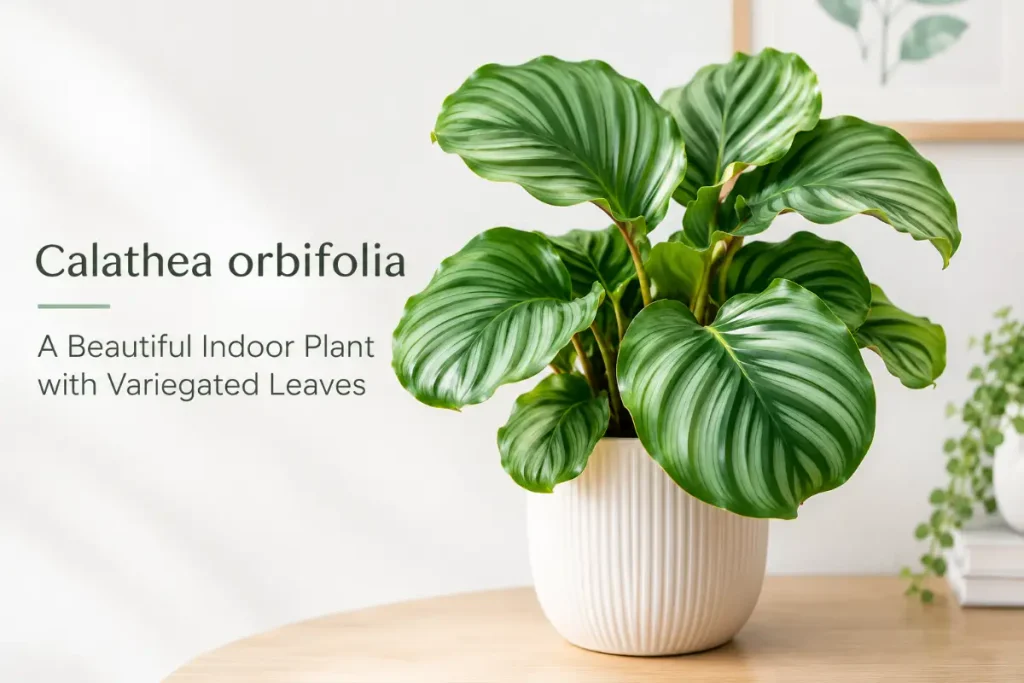
Calathea orbifolia
Large, round leaves with precise silver-green stripe patterning make Calathea orbifolia one of the most architecturally striking of all indoor plants with variegated leaves. The pattern is stable genetic variegation — consistent and reliable across propagation. Grows to 60–80 cm in good conditions.
Care: Bright indirect light — never direct sun, which bleaches the stripes. Distilled or rainwater strongly preferred; sensitive to fluoride and chlorine in tap water, which causes brown leaf margins. High humidity essential (above 60%). Keep compost consistently moist but never waterlogged.
Dieffenbachia (Dumb Cane)
Dieffenbachia produces large, upright leaves in bold variegated patterns — typically cream or white centres fading to spotted or mottled green edges. ‘Camille’ has almost entirely cream leaves with a narrow green border; ‘Compacta’ is more compact with heavy spotting in cream and white.
Care: Tolerates lower light than most variegated plants. Water when the top 3 cm dries. Note: Dieffenbachia sap is an irritant — always wash hands after handling and keep away from children and pets.
Hoya Variegated Forms
Hoyas are long-lived, slow-growing plants with waxy leaves — and several produce striking variegated forms. Hoya carnosa ‘Krimson Queen’ has green leaves edged in cream-white; ‘Krimson Princess’ reverses this with a white or pink centre and green edges. Hoya obovata ‘Splash’ has silver-splashed dark green leaves.
Care: Bright indirect light for best variegation and to encourage the clusters of waxy, fragrant flowers Hoyas are known for. Water when the compost dries — Hoyas are semi-succulent and susceptible to root rot if kept wet. Do not remove the flower spurs (peduncles) after flowering — they re-bloom from the same spur next season.
Aglaonema Variegated Forms
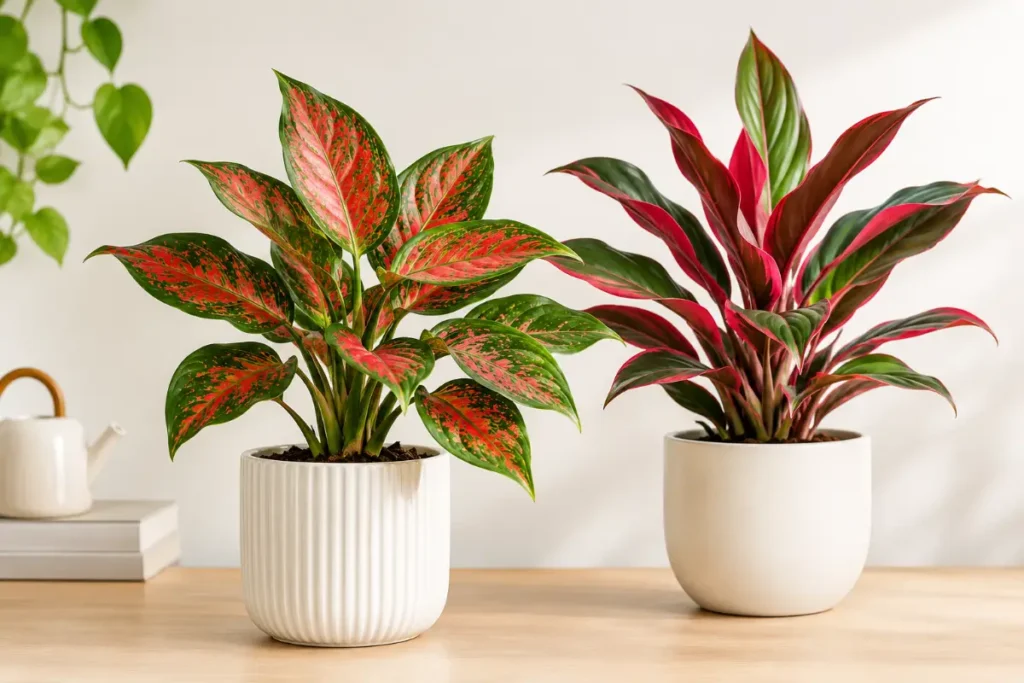
Beyond their red and pink cultivars, many Aglaonema also produce striking green-and-silver variegated forms — ‘Silver Queen’ has long, silver-patterned leaves with narrow green edges; ‘Silver Bay’ produces large silvery-green leaves. These are among the most tolerant of low-light conditions of any variegated houseplant.
Care: Moderate to bright indirect light. Water when the top 3 cm dries. Feed monthly in growing season. Cold-sensitive — avoid positions below 15°C.
Best Varieties: Small and Compact Plants
Tradescantia zebrina
One of the easiest and most vivid of all small variegated houseplants, Tradescantia zebrina produces trailing stems of silver-striped green leaves with vivid purple undersides — the combination of green, silver, and purple in a single leaf is genuinely striking. Fast-growing, easy to propagate from cuttings (root in water in 7–10 days), and excellent in hanging planters.
Care: Bright indirect light for the most vivid silver striping and purple colour. In lower light, leaves become primarily green. Water when the top 2 cm dries. Pinch tips regularly to prevent the plant from becoming bare at the base.
Peperomia obtusifolia ‘Variegata’
Compact, glossy, and undemanding, Peperomia obtusifolia ‘Variegata’ produces rounded leaves in cream and green. Stays under 30 cm, makes an excellent desk plant, and is highly tolerant of imperfect care. Related varieties — ‘Watermelon Peperomia’ (P. argyreia) with its distinctive striped pattern — are similarly compact and striking.
Care: Moderate indirect light. Allow the compost to nearly dry between waterings — Peperomia stores moisture in its thick leaves and is very susceptible to overwatering. Minimal feeding needed.
Fittonia (Nerve Plant)
Fittonia’s vivid vein patterns in red, pink, or white against deep green leaves make it one of the most intricate of all small variegated plants. Stays very compact — ideal for terrariums where the enclosed humidity suits its demanding requirements.
Care: High humidity is non-negotiable for Fittonia. It wilts dramatically in dry conditions but recovers quickly when humidity is restored. Indirect light; keep compost consistently moist.
Care Principles Specific to Variegated Plants
Indoor plants with variegated leaves share some care requirements that differ from their all-green relatives, stemming from their reduced photosynthetic capacity:
They need more light than green equivalents. Because white or cream sections of a variegated leaf contain no chlorophyll and cannot photosynthesise, variegated plants have fewer active solar cells per leaf than all-green plants. To compensate, they need brighter conditions to gather the same amount of light energy. A standard Monstera thrives in moderate indirect light; a Monstera albo needs genuinely bright indirect light to grow well.
They grow more slowly. Reduced photosynthetic capacity means slower overall growth — a variegated Pothos ‘Marble Queen’ grows noticeably more slowly than a standard golden Pothos. This is normal and not a sign of poor health.
They are more sensitive to stressors. A plant with reduced energy production has less reserve to draw on when dealing with drought, pest pressure, or root problems. Variegated plants respond to stress more quickly than their green counterparts — monitor them attentively.
Reversion management for chimeric types. All-green shoots (reversion) on chimeric variegated plants (Monstera albo, Philodendron ‘White Wizard’) should be pruned back to the last variegated node — green sections outcompete variegated ones for energy and will eventually take over the plant if left unpruned.
Propagation considerations. For stable genetic variegation, any cutting will produce a variegated plant. For chimeric variegation, only cuttings taken from variegated sections will produce variegated plants. Be precise when selecting propagation material.
Watering Variegated Plants
Consistent moisture management is particularly important for indoor plants with variegated leaves. Because they grow more slowly and have lower energy reserves, the consequences of both overwatering and underwatering can manifest more quickly and severely than in vigorous all-green plants.
Track moisture carefully — a moisture meter for indoor plants is especially useful for slower-growing variegated species where the visual cues (drooping, dry-looking compost surface) can lag behind actual root-zone moisture levels. Slow-growing, expensive variegated plants justify the modest investment in accurate moisture monitoring.
For trailing variegated plants on high shelves — Pothos, Scindapsus, Tradescantia — watering consistently can be challenging. A simple self watering system for indoor plants keeps moisture levels even without daily attention, which particularly suits the more demanding variegated species like ‘Marble Queen’ Pothos and Calathea.
Building a Variegated Plant Collection
There is a compelling aesthetic case for building a collection around variegated foliage specifically — the interplay of light and dark, pattern and plain, makes for a more visually dynamic display than either all-green or all-coloured-foliage collections.
Vary the pattern type: Combine different variegation styles — the crisp white blocks of ‘N’Joy’ Pothos, the flowing silver tracery of Calathea orbifolia, the velvety silver-on-green of Scindapsus pictus, and the vibrant purple-and-silver of Tradescantia zebrina. The variety of pattern types prevents the collection from looking repetitive even when the colour palette stays within green, white, silver, and purple.
Vary the leaf size: Large-leaved variegated plants — Calathea orbifolia, Dieffenbachia, Monstera albo — create bold focal points. Medium-leaved plants — Aglaonema, Hoya, Peperomia — fill the middle tier. Small-leaved trailers and compact plants — Tradescantia, Fittonia, Pothos in smaller pots — fill gaps and add texture at lower levels.
Consider light requirements when grouping: Group the most light-hungry variegated plants (Monstera albo, Philodendron ‘White Wizard’, Scindapsus) at the brightest positions. More shade-tolerant types (Aglaonema, Dieffenbachia, Calathea) can occupy positions further from the window. Grouping by light requirement rather than purely by aesthetic means plants are more likely to thrive long-term.
Use consistent pot materials: As with any curated plant display, pot consistency unifies a collection visually. White ceramic is a particularly effective backdrop for variegated foliage — the clean white pot surface resonates with the white or cream leaf sections and creates a cohesive aesthetic.
Seasonal Care for Variegated Houseplants
Because indoor plants with variegated leaves have reduced photosynthetic capacity, seasonal light changes affect them more noticeably than they do all-green plants. Here is how to adjust care through the year:
Autumn: As natural light diminishes, consider moving variegated plants closer to windows — even by half a metre can make a meaningful difference. Begin reducing watering and feeding frequency as growth slows.
Winter: The most challenging season for variegated plants. In the UK, day length drops to 7–8 hours and light angles are low. A grow light on a timer (12 hours daily) placed above the collection maintains growth and prevents the gradual colour fade that occurs when plants are kept too dark through winter. Reduce watering significantly — overwatering in winter is the most common cause of root rot in variegated houseplants.
Spring: Resume feeding as new growth appears. Spring is the best time to repot root-bound plants — fresh compost with appropriate nutrients supports vigorous, well-coloured new growth. Take cuttings for propagation while the plant is beginning its active growth phase.
Summer: The peak growing season. Feed fortnightly, monitor watering as compost dries faster, and watch for spider mites on the undersides of leaves — they proliferate in warm, dry indoor conditions and spread rapidly through a collection. The guide on indoor plant leaves curling inward covers the overlapping signs of pest damage and water stress that can appear together on variegated plants in summer.
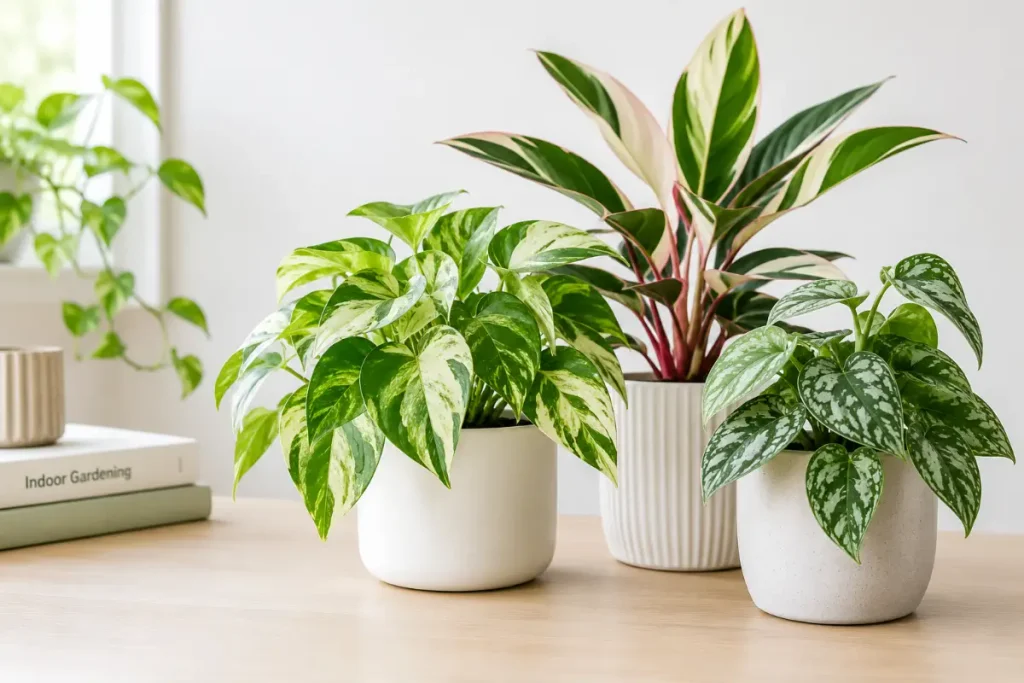
Sourcing Quality Variegated Plants
Variegated houseplants range from extremely common and affordable (Golden Pothos, Tradescantia zebrina, Aglaonema Silver Queen) to rare and expensive (Monstera albo, Philodendron ‘White Wizard’, variegated Hoya). A few guidelines for sourcing:
For common varieties: Garden centres and supermarkets carry the most popular variegated houseplants at reasonable prices. Quality varies — look for plants with even variegation across multiple leaves, no yellowing, and healthy-looking root systems visible through drainage holes.
For uncommon varieties: Specialist houseplant retailers and online marketplaces (Etsy, Facebook groups for plant swaps) carry a wider range. When buying online, check seller reviews carefully and understand that chimeric variegation can be unstable — even reputable sellers cannot guarantee the precise level of variegation on individual leaves that will emerge after purchase.
For rare chimeric types: Buy from established specialist retailers with clear photography of the specific plant being sold, rather than stock photos. The level of white in a Monstera albo varies considerably between plants — some are highly variegated, others are minimally so. A reputable seller photographs the exact plant available for purchase.
Quarantine new plants: All new plants — regardless of source — should be quarantined for 2–3 weeks before joining your main collection. This prevents pests arriving on a new plant from spreading to established plants. Check carefully for spider mites, mealybugs, and thrips during the quarantine period.
Conclusion
Indoor plants with variegated leaves represent some of the most visually compelling foliage available — from the dramatic white-splash patterning of rare Monstera and Philodendron forms to the accessible, affordable beauty of Pothos, Tradescantia, and Peperomia. The care principles that apply across the category are consistent: brighter light than you would give an all-green equivalent, attentive moisture management, and — for chimeric types — vigilance against reversion.
For species-specific cultivation advice on Monstera, Calathea, Hoya, and other variegated houseplants, the RHS houseplant pages at rhs.org.uk/plants/types/houseplants are a reliable and authoritative reference.
FAQs
Why are variegated plants more expensive?
Most highly variegated plants must be propagated vegetatively — you cannot produce true variegated plants from seed for chimeric types. This limits supply to the number of cuttings each existing plant can produce, which is slow. High demand for rare forms (Monstera albo, Philodendron ‘White Wizard’) relative to limited vegetative supply keeps prices elevated. As more plants are propagated and supply increases, prices for once-rare varieties typically fall.
Do variegated plants need more light than green plants?
Yes — because white or cream leaf sections contain no chlorophyll and cannot photosynthesise, variegated plants need more total light to gather the same energy as all-green equivalents. Position them in the brightest indirect light available. Insufficient light causes both slow growth and often a gradual reduction in variegation as the plant produces more green tissue.
Why is my variegated plant turning green?
Two possible causes: reversion (in chimeric types) or insufficient light. In chimeric plants like Monstera albo, all-green shoots grow more vigorously than variegated ones and will eventually dominate if not pruned. Prune reverted sections back to the last variegated node. In other cases — particularly Pothos, Tradescantia, and Aglaonema — greening is a response to low light. Move the plant to a brighter position.
Are variegated Monstera difficult to care for?
More demanding than standard Monstera — they need brighter light, are more sensitive to overwatering, and require occasional reversion pruning — but they are not exceptionally difficult. The main challenges are providing adequate light and resisting the temptation to overwater (slow-growing plants use water slowly).
Can I propagate my variegated Pothos?
Yes — take stem cuttings just below a node (including at least one leaf and one node), remove the lowest leaf, and root in water or moist propagating compost. For stable variegation like Pothos, any cutting from any part of the plant will produce a variegated plant.
What is the easiest variegated houseplant?
Standard ‘Golden Pothos’ or ‘Brasil’ Philodendron are the most forgiving — tolerating lower light, erratic watering, and imperfect conditions while maintaining reasonable variegation. Tradescantia zebrina is equally easy and fast-growing. Aglaonema ‘Silver Queen’ is the most shade-tolerant.
Why does my Calathea have brown leaf margins despite careful watering?
Calathea is acutely sensitive to fluoride and chlorine in tap water, which accumulates in leaf tissue and causes browning at the margins and tips. Switch to distilled water, rainwater, or water left overnight in an open container. Brown margins from fluoride damage do not heal, but new growth from correctly watered plants will be undamaged.
Can variegated plants revert to being fully green?
Yes — in chimeric variegated plants (Monstera albo, Philodendron ‘White Wizard’), all-green shoots can appear and, if left, outcompete variegated growth. Prune these sections promptly. In stable genetic variegation (Tradescantia, Calathea), reversion to pure green does not occur in the same way — though low-light conditions can cause reduced colour intensity.
Are variegated plants safe for pets?
It varies by species. Standard Pothos (Epipremnum aureum) and Philodendron are toxic to cats and dogs — keep them out of reach. Tradescantia is mildly irritating. Calathea is non-toxic and pet-safe. Always research specific species before purchasing if you have pets.
What is the difference between Pothos ‘Marble Queen’ and ‘N’Joy’?
Both are heavily cream-and-white variegated Pothos, but the pattern differs. ‘Marble Queen’ has a marbled, blended transition between cream and green — a soft, swirling pattern. ‘N’Joy’ has crisp, distinct blocks of white and green with clean edges — a more graphic, geometric look. Both are similarly easy to care for; choice comes down to aesthetic preference.
Pingback: Indoor Purple Passion Plant: Complete Care Guide (2026) - Plant Quill