
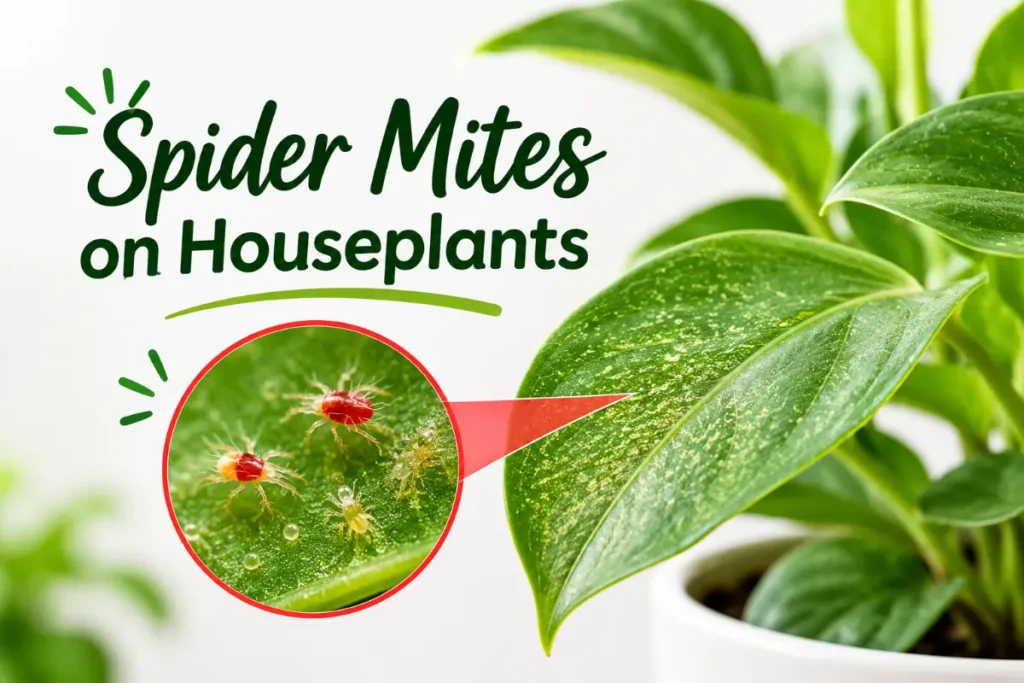
Spider mites are among the most frustrating houseplant pests — tiny enough to be nearly invisible until the infestation is severe, fast-reproducing, and capable of spreading from plant to plant in days. By the time most growers notice the characteristic fine webbing on their plants, populations are already in the hundreds or thousands.
Effective spider mites on houseplants treatment requires understanding how mites reproduce, why standard pesticides often fail, and which methods interrupt the life cycle rather than just killing exposed adults. This guide walks through nine proven treatments — from immediate knockdown techniques to long-term prevention — with the specific steps needed for each.
Identifying Spider Mites: What You Are Actually Dealing With
Before treating, confirm you have spider mites. Misidentification is common because the mites themselves are barely visible to the naked eye (0.5–1 mm), and early infestations look like other problems.
Visual signs of spider mite infestation:
- Stippling: Tiny yellow or bronze dots on leaf surfaces, most visible when you hold the leaf up to light. Each dot is a feeding puncture where a mite has extracted cell contents.
- Fine webbing: The most diagnostic sign — silk threads covering leaves, stems, and stem joints. Light webbing appears first at leaf undersides; heavy infestations encrust entire stems.
- Leaf discoloration: Yellow, bronze, or silver sheen on affected leaves as cell damage accumulates.
- Leaf drop: In severe infestations, leaves yellow rapidly and drop.
How to confirm: Hold a white sheet of paper under a suspected branch and tap it sharply. Tiny moving specks on the paper are mites. Use a 10× magnifying loupe to see the oval body, eight legs (mites are arachnids, not insects), and two dark spots on most common species.
Common species on US houseplants:
- Tetranychus urticae (two-spotted spider mite) — the most common; pale green or yellow with two dark spots on the abdomen
- Panonychus ulmi (European red mite) — reddish; less common on houseplants than on outdoor fruit trees
- Oligonychus species — reddish-brown; favors palms and dracaenas
Why Spider Mites Are Hard to Eliminate
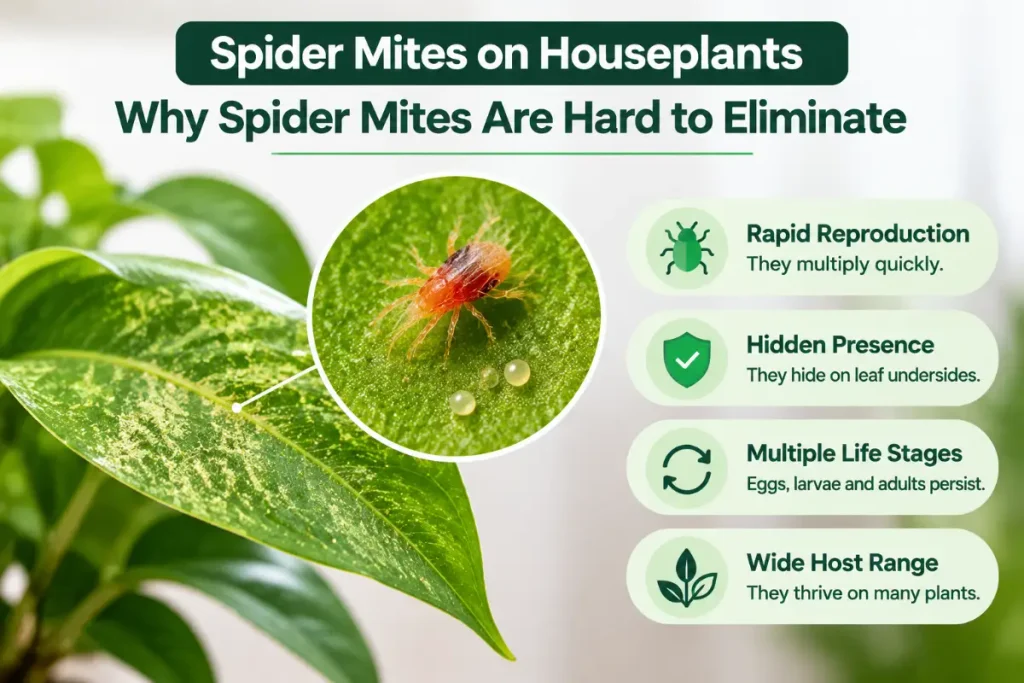
Spider mites reproduce with extraordinary speed. A single female can lay 100–200 eggs over her 2–4 week lifespan. Eggs hatch within 3 days at 80°F (longer in cooler conditions). A population can go from a handful of mites to tens of thousands in 2–3 weeks under warm, dry indoor conditions.
This rapid reproduction creates two specific challenges for treatment:
- Most treatments only kill exposed mites. Eggs are not affected by most contact insecticides, including insecticidal soap and neem oil. This is why a single treatment never eliminates an infestation — newly hatched mites from eggs survive and rebuild the population within days.
- Spider mites develop resistance quickly. Mite populations that survive repeated applications of the same pesticide develop resistance within a few generations. This is why rotating between treatment methods is essential for effective spider mites on houseplants treatment.
Both challenges are solved by consistent, repeated applications — typically every 5–7 days for 3–4 treatments — using alternating methods.
Treatment Method 1: Water Spray (First Response)
What it does: Physically dislodges mites and webbing; immediate knockdown; does not kill eggs.
How to do it: Take the infested plant to a shower or sink. Using lukewarm water and a moderate spray pressure, spray all leaf surfaces (focusing on undersides where mites concentrate), stems, and stem joints. Remove visible webbing manually with a damp cloth before spraying — the silk protects mites underneath it. After washing, allow the plant to drain fully and do not return it to a humid corner where the extra moisture encourages mold.
Frequency: Daily for the first 3–5 days of an active infestation; reduces population while other treatments take effect.
Best for: Initial knockdown before applying a treatment agent; ongoing suppression between chemical treatments.
Treatment Method 2: Neem Oil Spray
What it does: Azadirachtin in raw neem oil disrupts mite reproduction and molting; some contact kill through the oil fraction; antifeedant effect.
Recipe: 1 teaspoon cold-pressed neem oil + ¼ teaspoon liquid dish soap + 1 quart lukewarm water. Pre-mix oil and soap before adding water; shake vigorously; use within 1 hour.
Application: Spray all leaf surfaces, undersides, stems, and stem joints until thoroughly wet. Apply in the evening to prevent photosensitization burn. Neem oil is the cornerstone of spider mites on houseplants treatment because it works on multiple life stages and continues affecting mites for several days after application.
Frequency: Every 5–7 days for 3–4 applications. Rotate with insecticidal soap (see Method 3) to prevent resistance.
Effectiveness: High against active mites; moderate against eggs. The 5–7 day repeat interval is specifically timed to treat mites hatching from eggs that survived the previous application.
Treatment Method 3: Insecticidal Soap
What it does: Disrupts the waxy outer layer (cuticle) of soft-bodied mites, causing dehydration and death. Contact kill only — no residual effect after drying.
Recipe: 1 tablespoon pure liquid castile soap (or insecticidal soap concentrate such as Safer Brand) per 1 quart water. Do not use dish soaps with added moisturizers, degreasers, or antibacterials — these can damage plant tissue.
Application: Thorough coverage of all plant surfaces, including leaf undersides. The spray must contact mites directly to work — it has no residual effect once dry. Apply in the evening or on a cloudy day.
Frequency: Every 5–7 days; alternate with neem oil to prevent resistance buildup.
Phytotoxicity risk: Insecticidal soap can burn sensitive plants (calathea, fittonia, ferns) if applied in high concentration or in direct sun. Test on one leaf before full application. Do not apply to plants that are drought-stressed — wait until after watering.
Treatment Method 4: Rubbing Alcohol (Isopropyl Alcohol)
What it does: 70% isopropyl alcohol kills mites on contact through direct desiccation. Fast-acting, inexpensive, and effective.
Two application methods:
Spot treatment: Dip a cotton ball in 70% isopropyl alcohol and wipe individual leaves and stems — particularly effective for removing visible webbing and mite colonies from specific growth points.
Spray treatment: Dilute 70% isopropyl alcohol 1:1 with water (resulting in a 35% solution). Spray all plant surfaces. Test on one leaf 24 hours before full application — some plants are sensitive to alcohol sprays.
Frequency: Every 3–5 days for spot treatment; every 7 days for spray treatment.
Best for: Targeted treatment of specific badly-infected leaves or stems; initial knockdown of visible colonies.
Treatment Method 5: Miticide (For Severe Infestations)
What it does: Synthetic miticides such as bifenazate (Floramite), abamectin (Avid), or spiromesifen (Forbid) provide fast, comprehensive kill including eggs in some formulations.
When to use: When organic treatments have been applied consistently for 3+ weeks without adequate control, or when infestation is so severe that plant health is declining rapidly.
Products available in the US: Floramite SC (bifenazate) and Avid (abamectin) are available through specialty garden retailers and online. These are professional-grade miticides that require careful handling and strict label compliance.
Important: Rotate miticide active ingredients with each application — spider mites develop resistance to synthetic miticides extremely rapidly. Never apply the same miticide product more than twice in a season to the same plant population.
Treatment Method 6: Increase Humidity
What it does: Spider mites thrive in hot, dry conditions (above 70°F and below 40% relative humidity). Consistently high humidity (above 60%) suppresses reproduction and speeds natural die-off.
How to implement: Group infested plants together and add a pebble tray with water beneath them. Run a small humidifier nearby. Mist the air around plants (not directly onto heavily infected foliage, which spreads mites). Move plants away from heating vents and radiators during treatment.
Realistic expectation: Increased humidity alone will not eliminate an established infestation. It is a critical supporting condition that makes other treatments more effective and slows reinfestation after clearing.
Treatment Method 7: Remove Severely Infested Leaves
What it does: Physically removes the highest-density mite populations from the plant, reducing pressure on remaining treatments and preventing mites from retreating deeper into the plant during treatment.
How to do it: Inspect the plant carefully. Leaves with heavy webbing, significant stippling damage, or bronzing are both heavily infested and beyond recovery — removing them reduces the population by removing the habitat. Seal removed plant material in a plastic bag before disposal to prevent mites from dispersing.
Important: Never compost infested plant material — spider mites survive in compost.
Treatment Method 8: Predatory Mites (Biological Control)
What it does: Predatory mite species such as Phytoseiulus persimilis, Neoseiulus californicus, and Mesoseiulus longipes are natural predators of spider mites. They are commercially available in the US and provide ongoing biological control after release.
Where to source: Beneficial insect suppliers including Arbico Organics, Green Methods, and similar specialty vendors ship live predatory mites to US addresses. Packages typically contain several hundred to several thousand predatory mites on a carrier material (vermiculite or leaves).
How to use: Release predatory mites on infested plants following supplier instructions. They establish in the plant microclimate and consume spider mites at all life stages including eggs. Best used after reducing mite populations with other methods — releasing predators into a very heavy infestation may not achieve adequate control as predators are overwhelmed.
Best for: Plants with recurrent spider mite problems; growers with large collections where chemical treatments are impractical.
Treatment Method 9: Systemic Insecticide Drench (Last Resort)
What it does: Systemic insecticides such as imidacloprid (Bonide Systemic Houseplant Insect Control) are taken up through the root system and distributed throughout plant tissue. Mites feeding on treated tissue ingest the insecticide.
Important limitation: Imidacloprid is primarily effective against sucking insects (aphids, whiteflies, scale). Its effectiveness against spider mites specifically is limited and inconsistent — spider mites are arachnids rather than insects and respond differently to systemic insecticides. Acephate (Orthene) is a systemic with better mite activity but higher toxicity and stronger odor.
When to consider: Only when all other methods have failed and the plant is of significant value. Follow label instructions exactly; keep children and pets away from treated plants.
Treatment Schedule: The 4-Week Elimination Protocol
Combining methods on a consistent schedule is more effective than any single treatment. Here is a protocol that interrupts the mite life cycle at every stage:
Week 1:
- Day 1: Water blast (shower rinse) + remove heavily infested leaves → apply neem oil spray in the evening
- Day 3: Water blast
- Day 5: Insecticidal soap spray in the evening
- Increase humidity throughout the week
Week 2:
- Day 7: Water blast → apply neem oil spray in the evening
- Day 10: Insecticidal soap spray
- Day 12: Inspect with magnifying loupe — count mites per leaf
Week 3:
- Day 14: Water blast → apply neem oil spray
- Day 17: Insecticidal soap spray
- Day 19: Inspect — population should be very low or zero
Week 4:
- Day 21: Final neem oil preventive application
- Day 28: Inspect — confirm elimination
If significant populations remain after 4 weeks of this protocol, move to a commercial miticide for one application cycle, then return to organic rotation.
Preventing Spider Mite Re-Infestation
Spider mites most commonly enter homes on new plants, cut flowers, or through open windows in summer. Once eliminated, keeping them out requires a few consistent practices.
Quarantine new plants: Inspect all new plants for stippling and webbing before introducing them to your collection. Keep new arrivals separate for 2–4 weeks — this is the most effective single prevention measure.
Maintain humidity: Keeping indoor humidity at 50–60% year-round makes your home a consistently less hospitable environment for spider mites. This matters most in winter, when central heating creates the hot, dry conditions mites love.
Inspect regularly: Check the undersides of leaves on susceptible plants (palms, dracaenas, ivy, citrus) during routine watering. Early identification means treatment before populations reach damaging levels.
Avoid plant stress: Water-stressed, over-fertilized, or root-bound plants are more susceptible to mite infestation. A healthy plant under good growing conditions resists mite damage better than a stressed one.
Monthly preventive neem drench and spray: A preventive neem oil application once a month on susceptible plants maintains a background level of azadirachtin in the plant tissue that deters mites and other pests.
Most Susceptible Houseplants — and What to Watch
Some houseplants are significantly more vulnerable to spider mite infestation than others. Knowing which plants to monitor most closely helps you catch infestations early, when they are easiest to treat.
High-risk plants:
- Palms (Chamaedorea, Howea, Phoenix) — spider mites are almost inevitable on indoor palms in dry conditions; check frond undersides monthly
- Dracaenas — a common host in US homes; stippling on lower leaves is often the first sign
- Ivy (Hedera helix) — one of the most spider mite-prone houseplants; the dense leaf growth creates ideal sheltered conditions
- Citrus trees — dwarf citrus kept indoors in winter are very susceptible; check leaf undersides every 2 weeks
- Roses (indoor kept) — high susceptibility; mites spread rapidly between leaves
- Succulents and cacti — less commonly targeted but not immune; infestations on succulents tend to establish in stem joints and between leaves where they are hard to spot
- Schefflera (umbrella plant) — a frequent target in home and office settings
Lower-risk plants:
- Pothos — rarely affected; the thick waxy cuticle resists mite feeding
- Snake plant — the tough, leathery leaves are less susceptible to mite damage
- ZZ plant — the glossy surface and low transpiration rate make it a poor mite habitat
- Peace lily — moderate susceptibility; occasional but not chronic infestations
Knowing your high-risk plants tells you where to look first. During routine watering, make a habit of flipping a few leaves on your palms, dracaenas, and ivy to check undersides. This 30-second check each week catches infestations when populations are still small and a few applications of neem oil are sufficient to resolve them.
Mistakes That Make Spider Mite Infestations Worse
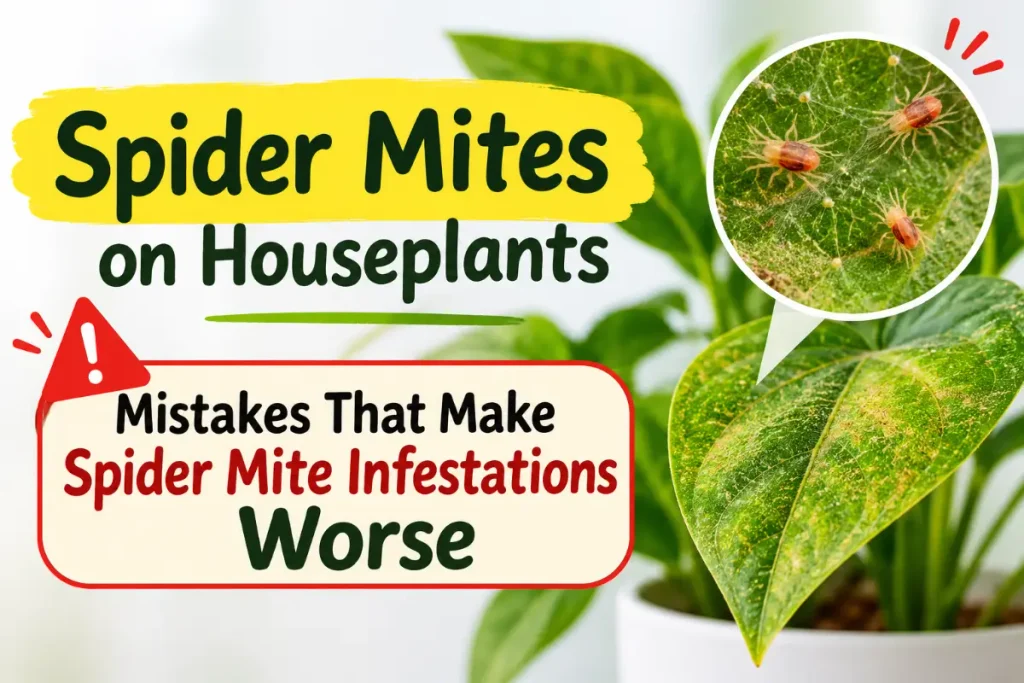
Several common mistakes actively worsen spider mite problems or prevent treatments from working.
Treating only once and stopping. The single most common mistake. One application kills visible mites but eggs hatch 3–5 days later and the population rebuilds. Commit to the full 3–4 week treatment schedule before concluding that a method is not working.
Using the same product every time. Spider mites develop pesticide resistance within a few generations. If you use neem oil every application, resistant mites survive and pass their resistance to offspring. Rotate between neem oil, insecticidal soap, and alcohol treatments on successive applications.
Applying treatments in direct sun. Both neem oil and insecticidal soap cause leaf burn when applied to foliage that then receives direct sun. Always apply in the evening or on overcast days.
Keeping affected plants near healthy ones. Spider mites spread by crawling from plant to plant and by air currents. Isolate infested plants immediately — move them at least 3 feet from neighboring plants, ideally to a separate room. Return them to their normal position only after two consecutive inspection checks (14 days apart) show zero mites.
Skipping the undersides of leaves. This is where mites live. Spraying only the top surface of leaves treats the least populated areas. All effective spider mite treatments require thorough coverage of leaf undersides — hold the spray bottle 8–10 inches below the leaf and spray upward.
Misting infested plants. Light misting does not dislodge mites or wet them sufficiently to kill them, but it can spread individual mites to adjacent foliage. Use the shower spray method (thorough, strong spray) for knockdown rather than the fine mist from a hand mister.
Conclusion
Effective spider mites on houseplants treatment depends on three things: identifying the infestation early, using multiple methods on a consistent 5–7 day rotation, and maintaining the conditions (humidity, plant health) that make your home less hospitable to mites. No single application eliminates an infestation — the 3–4 week protocol combining water blasts, neem oil, insecticidal soap, and elevated humidity gives mites no opportunity to recover between treatments while eggs hatch. For recurring problems, predatory mites offer a biological solution that keeps populations in check without repeated chemical applications.
For more on integrated pest management for indoor plants and evidence-based approaches to spider mite control, the Texas A&M AgriLife Extension guide to spider mite management covers biology, treatment options, and resistance management in detail.
FAQs
What kills spider mites instantly?
Isopropyl alcohol (70%) kills spider mites on direct contact almost instantly — dab or spray it directly on mites and they die within seconds. Insecticidal soap also kills on contact within minutes. Neither kills eggs, so repeat applications every 5–7 days are still necessary to catch newly hatched mites.
Can spider mites live in soil?
Most spider mite species live on foliage and do not inhabit potting mix. However, eggs and mites can fall to the potting mix surface and be redistributed when you water or handle the plant. Applying neem oil to the top inch of potting mix as part of treatment removes mites that have dropped from foliage.
How did spider mites get on my indoor plants?
The most common sources: new plants or cut flowers brought home with mites already present (always inspect new additions), open windows or doors in summer (mites are carried on air currents), and contaminated tools or hands after handling outdoor plants.
Do spider mites die in winter?
Outdoors, spider mite populations decline significantly in cold weather. Indoors, the warm, dry conditions of a heated home create year-round optimal conditions for mites — there is no seasonal die-off inside. This is why indoor spider mite infestations often worsen in winter when home heating systems reduce humidity.
How long does it take to get rid of spider mites on houseplants?
With consistent treatment every 5–7 days using rotating methods (neem oil, insecticidal soap, water blasts), most infestations are under control within 3–4 weeks. The timeline depends on the starting population density and how consistently treatments are applied.
Pingback: Mealybugs on Succulents Indoors: 8 Steps to Eliminate Them for Good - Plant Quill