
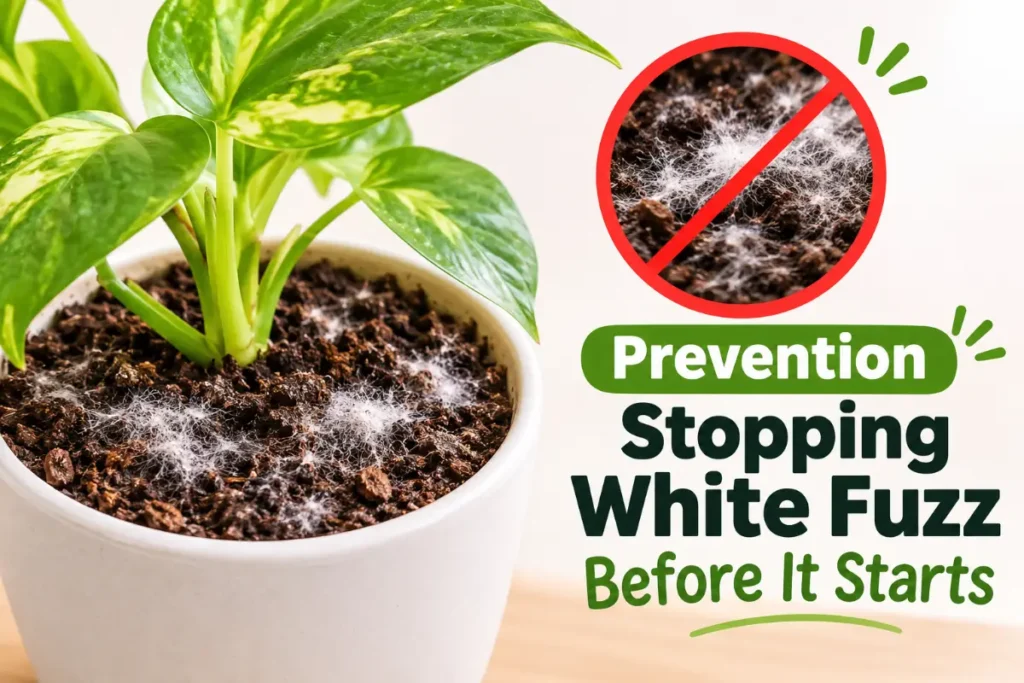
You reach to water a plant and notice the leaves feel strangely tacky — or you spot a shiny, sticky coating on leaf surfaces and the shelf beneath the pot. Sticky residue on houseplant leaves is one of the most reliable diagnostic signs in indoor plant care because it almost always points to a specific, identifiable cause.
In the vast majority of cases, the stickiness is honeydew — a sugary secretion produced by sap-feeding insects. This guide walks through all six causes, how to identify which one you are dealing with, how to clean the residue, and how to eliminate the underlying problem.
What Is the Sticky Stuff on Houseplant Leaves?
Before listing causes, it helps to understand what the stickiness actually is in most cases.
Honeydew is a sugar-rich liquid produced by sap-feeding insects — aphids, scale insects, mealybugs, and whiteflies — as a byproduct of feeding. These insects feed by inserting a stylet into plant vascular tissue (phloem) and drinking sap, which is high in sugar. They process far more sap than they can metabolize, and the excess is excreted as honeydew — a clear to slightly amber, slightly viscous liquid that drips from the insects onto leaves and surfaces below.
Honeydew is not harmful to plants in small amounts, but it creates two secondary problems:
- Sooty mold: Black, powdery fungal growth colonizes honeydew deposits and can reduce photosynthesis in heavy infestations
- Ant activity: Ants actively farm honeydew-producing insects — protecting them from predators in exchange for honeydew access — which can accelerate infestations
The sticky residue you notice on a houseplant leaf is almost always honeydew — which means there is an active sap-feeding insect population somewhere on the plant, even if you have not spotted it yet.
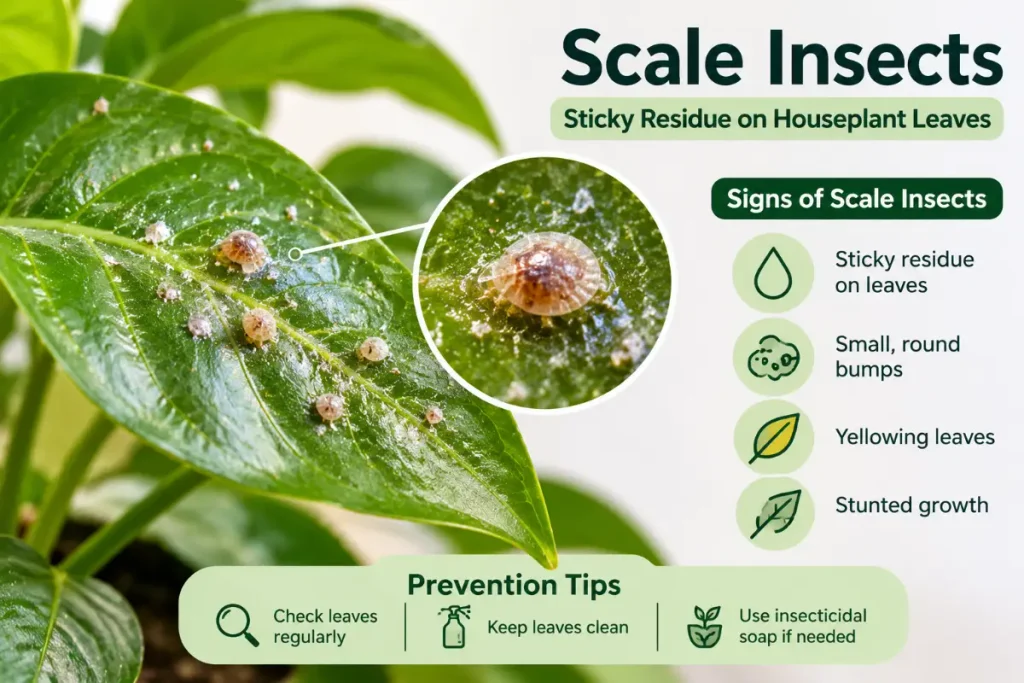
Cause 1: Scale Insects
How to identify: Scale insects are the most common cause of sticky residue on houseplant leaves in US homes. Look for small brown, tan, or white bumps on stems and along leaf veins — they look like natural stem features or bark but are actually the protective covering of the insect. Soft scale (the most common on houseplants) produces the most honeydew — a heavy, shiny film on leaves below and around the insect colonies.
Where to look: Along stems at branch joints, on the undersides of leaves along the midrib and veins, and at the base of leaf stems. Ficus, citrus, schefflera, palms, and orchids are particularly susceptible.
Confirmation: Run a fingertip along a stem — scale bumps do not wipe off (unlike dirt or mineral deposits) and have a slight resistance. If you see ants walking up the stem, follow them — they will lead you to the scale colony.
Treatment:
- Manual removal with a cotton swab or soft brush dipped in 70% isopropyl alcohol — rub directly over all visible scale; the alcohol kills the insect and removes the cover
- Follow with neem oil spray (1 teaspoon neem oil + ¼ teaspoon dish soap + 1 quart water) on all plant surfaces every 7 days for 3–4 weeks
- For large plants, horticultural oil spray (Bonide All Seasons Oil, available at Home Depot and Lowe’s) applied thoroughly to all surfaces covers more area than manual treatment
- For persistent infestations, a systemic insecticide drench (imidacloprid — Bonide Systemic Houseplant Insect Control) allows the plant to absorb the insecticide; scale feeding on treated tissue ingests it
Cause 2: Aphids
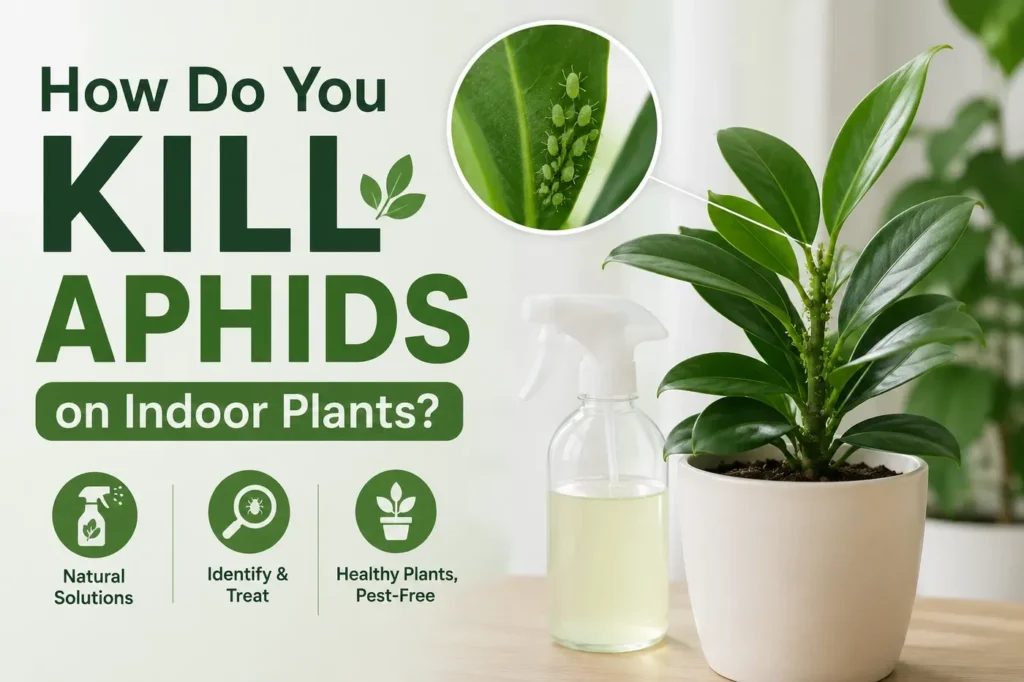
How to identify: Aphids are soft-bodied insects 1–3 mm long — typically green, yellow, black, or pink depending on species. Unlike scale, aphids are visible without a loupe and cluster densely on new growth, flower buds, and stem tips. They are found in groups, not scattered individually like scale. Aphids produce honeydew in substantial quantities — a severe aphid infestation can coat leaves with a thick sticky film within days.
Where to look: New growth, the undersides of young leaves, flower buds, and stem tips. Aphids prefer the most tender, highest-sugar tissue on the plant. Check new leaves first — curl them back and look at the underside.
Associated signs: Distorted, curled, or puckered new growth (caused by aphid feeding as the leaf develops), premature bud drop, and significant honeydew accumulation on lower leaves.
Treatment:
- Blast aphids off with water — a moderate pressure spray in the shower or outdoors removes the majority of an aphid population immediately
- Apply insecticidal soap (1 tablespoon castile soap per quart water) every 5 days — kills aphids on contact and is very effective given their soft-bodied, exposed nature
- Neem oil spray every 7 days for follow-up — disrupts reproduction and kills survivors
- For severe infestations, a systemic insecticide drench (imidacloprid) prevents aphids from feeding on treated tissue
Prevention: Aphids are fast reproducers — a single wingless female can produce 80 live offspring per week via parthenogenesis in warm conditions. Inspect new growth weekly on susceptible plants (roses, begonias, peace lilies, citrus) and treat immediately at first sighting before populations grow.
Cause 3: Mealybugs
How to identify: Mealybugs produce honeydew similar to scale and aphids, but their distinctive white, cottony, waxy coating makes them easier to spot than scale. Look for white fluffy masses in leaf axils, on stems, and at the base of leaves. The honeydew from mealybugs is typically found on leaves directly below the infestation and can be substantial in heavy infestations.
Where to look: Leaf axils (where leaf meets stem), stem joints, the base of rosette plants, and on roots below the soil line (root mealybugs). Succulents, citrus, begonias, ferns, and pothos are common hosts.
Confirmation: The white cottony masses are diagnostic. If the white material you see is at leaf axils and stem joints rather than spread across the potting mix surface, mealybugs are the most likely cause of both the white fuzz and the associated sticky residue.
Treatment:
- 70% isopropyl alcohol on a cotton swab, dabbed directly onto each colony — immediate contact kill
- Follow with neem oil spray on all plant surfaces every 7 days for 3–4 weeks
- For root mealybugs, unpot, rinse roots, treat with diluted isopropyl dip, and repot in fresh potting mix with a neem soil drench applied weekly for 3–4 weeks
Cause 4: Whiteflies
How to identify: Whiteflies are small white-winged insects that scatter dramatically from the plant when disturbed — shaking or touching the plant causes a cloud of tiny white flies to emerge from leaf undersides. The nymphs (immobile, scale-like) and adults both produce honeydew. Whitefly infestations create a sticky film on leaves below the infestation similar to scale and aphids, but the distinctive behavior (the cloud of white flies when disturbed) is unmistakable.
Where to look: Leaf undersides. Whitefly adults rest and feed on leaf undersides; nymphs are flatter and appear glued to the undersurface. Common on begonias, fuchsia, tomatoes, poinsettias, and hibiscus kept indoors.
Treatment:
- Yellow sticky traps — whiteflies are attracted to yellow; traps capture adults and reduce population
- Insecticidal soap spray on leaf undersides — targets nymphs on contact
- Neem oil spray every 7 days — disrupts nymph development and adult reproduction
- Spinosad spray (Monterey Garden Insect Spray) — effective against adults and nymphs; rotate with neem oil to prevent resistance
Cause 5: Natural Plant Secretions (Not Pest-Related)
How to identify: A minority of plants produce sticky secretions from glands on their leaves and stems — this is not pest-related and not honeydew. It is a natural plant product.
Plants that do this:
- Carnivorous plants (Drosera, Pinguicula) — produce sticky mucilage on leaf surfaces designed to trap insects; this is entirely normal and healthy
- Tomatoes and other Solanaceae — produce sticky trichome secretions on stems and leaves; harmless
- Some succulents and cacti — produce waxy or slightly tacky surfaces as part of their normal cuticle structure
How to tell pest honeydew from natural secretions: Natural plant secretions are uniform across the leaf surface, consistent from leaf to leaf, and do not come with associated insects, sooty mold, or ants. Honeydew is unevenly distributed (concentrated where insects have fed), appears on leaves below as well as at the infestation site, and is usually accompanied by insects visible on close inspection.
What to do: If the plant is otherwise healthy and you can confirm it is a secretion-producing species, nothing — this is normal plant behavior.
Cause 6: Residue from Leaf-Shine Products
How to identify: Leaf-shine products — oils and waxes applied to make plant leaves glossy — leave a tactile residue that some growers mistake for pest-related stickiness. If you have recently applied a commercial leaf shine (or used coconut oil, olive oil, or mayonnaise on leaves — a home practice sometimes recommended online), the residue is from the product.
Is it harmful? Leaf-shine products and home oil applications block stomata and can cause heat damage to leaves in direct sun. They also attract dust. This is cosmetically motivated, unnecessary, and potentially harmful — leaves do not need to be shiny.
What to do: Clean the residue from leaves (see cleaning instructions below) and discontinue use of leaf-shine products. If your leaves look dusty, wipe them with a damp cloth — that is all they need.
Sooty Mold: The Secondary Problem That Follows Sticky Residue
One of the most visible consequences of a sap-feeding insect infestation is sooty mold — the black, powdery coating that grows on honeydew deposits. Understanding sooty mold helps you treat it correctly rather than confusing it with a fungal disease of the plant itself.
What sooty mold is: Sooty mold is the collective name for several fungal species (primarily Cladosporium, Alternaria, and Aspergillus species) that colonize honeydew deposits. The fungi do not penetrate or infect leaf tissue — they grow on the surface of the honeydew as an external food source. This is why sooty mold follows the pattern of the honeydew beneath it, appearing where honeydew has dripped rather than spreading across the leaf uniformly.
Is sooty mold harmful? The mold itself does not damage leaf cells, but a thick coating of sooty mold reduces the amount of light reaching the leaf surface and can meaningfully reduce photosynthesis in severe cases. Plants with heavy sooty mold are essentially partially shaded from above by their own leaf coating.
Sooty mold disappears when honeydew stops. Because sooty mold requires honeydew as a food source, eliminating the sap-feeding insect population eliminates the honeydew supply and the mold naturally weathers away over several weeks. You do not need a fungicide — treat the insect, not the mold.
Speed up sooty mold removal: Wiping leaves with a damp soapy cloth (a few drops of dish soap in warm water) removes sooty mold deposits much faster than waiting for natural weathering. Work leaf by leaf from the base toward the tip, rinsing the cloth between leaves. This is worth doing before applying any pest treatment spray — clean leaves allow the treatment to contact leaf surfaces directly rather than sitting on top of a sooty mold layer.
Preventing Sticky Residue on Houseplant Leaves
Preventing the insect populations responsible for honeydew in the first place is more efficient than reactive treatment. These habits significantly reduce the likelihood of encountering sticky residue on houseplant leaves and the infestations behind it.
Quarantine every new plant. Sap-feeding insects — particularly scale, mealybugs, and aphids — are almost always introduced on new plants purchased from nurseries, garden centers, or even other plant enthusiasts. Keep every new plant in a separate space for 2–4 weeks and inspect stems, leaf undersides, and new growth carefully before introducing the plant to your collection.
Inspect during routine watering. The most reliable early-detection habit is a 30-second inspection while watering each plant: check stems for bumps, flip a few leaves to check undersides, and look at new growth. Early detection means a small infestation treatable in one or two applications rather than a severe infestation requiring weeks of treatment.
Monthly preventive neem oil spray. A monthly application of neem oil spray on susceptible plants (ficus, citrus, orchids, palms, begonias) maintains a low background level of azadirachtin on plant surfaces that deters sap-feeding insects from settling. This takes 10 minutes per plant and prevents infestations rather than treating established ones.
Manage ants. If your home has indoor ant activity, managing it reduces the chance of ants farming scale or aphids on your houseplants. Ant populations actively protect and relocate sap-feeding insects to new plants — controlling ants controls one vector of infestation spread. Sticky ant barrier tape wrapped around pot stands and shelving legs prevents ants from reaching plants; boric acid bait stations placed away from plants address the colony at the source without putting pesticide on plant surfaces.
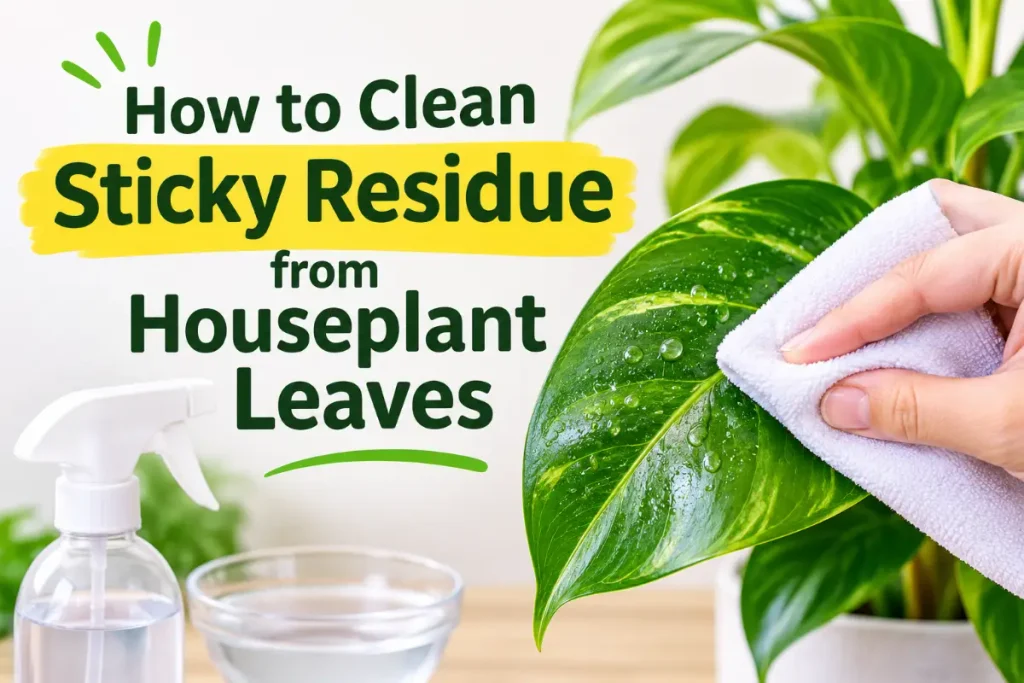
How to Clean Sticky Residue from Houseplant Leaves
Regardless of the cause, cleaning the honeydew and sooty mold from affected leaves is beneficial — it improves photosynthesis, removes the medium sooty mold grows on, and allows you to inspect the leaf surfaces clearly for further pest activity.
For lightly sticky leaves: Wipe each leaf individually with a damp cloth moistened with lukewarm water. Work from the base of the leaf toward the tip on the top surface; support the leaf from underneath with your other hand to avoid tearing. Rinse the cloth between leaves to avoid spreading residue.
For heavily sticky or sooty mold-coated leaves: Add a few drops of dish soap to warm water and wipe with a soft cloth — soap cuts through honeydew and sooty mold deposits more effectively than water alone. Follow with a clean damp cloth to rinse the soap residue.
For delicate or textured leaves (ferns, calathea): Use a soft makeup brush or cotton ball dampened with water to gently clean between leaf ridges and around the edges where residue accumulates.
For stems and pots: Clean pots, saucers, and shelving under infested plants with soapy water followed by a wipe with diluted isopropyl alcohol — this removes honeydew deposits and kills any crawlers or aphids that have wandered from the plant.
Identifying the Pest: A Quick Visual Guide
| Sticky residue accompanied by… | Most likely cause |
|---|---|
| Brown or white bumps on stems, no visible insects | Scale insects |
| Clusters of small green/yellow/black insects on new growth | Aphids |
| White cottony masses in leaf axils or stem joints | Mealybugs |
| Cloud of tiny white flies when plant is disturbed | Whiteflies |
| Ants walking on the plant | Any sap-feeder (follow ants to find colonies) |
| Black powdery coating on leaves | Sooty mold (secondary to any sap-feeder) |
| No insects found after thorough inspection | Natural plant secretion or leaf-shine product |
Conclusion
Sticky residue on houseplant leaves is almost always honeydew from a sap-feeding insect — scale, aphids, mealybugs, or whiteflies. The appearance of the stickiness and what you find on close inspection of the plant tells you which pest is responsible, and each has a targeted treatment. Clean the residue from affected leaves to improve plant health and inspect clearly, then treat the underlying pest systematically with the appropriate combination of isopropyl alcohol, neem oil, insecticidal soap, or systemic insecticide — repeated weekly for 3–4 weeks to break the reproductive cycle. Early identification is the key: a small aphid colony or a few scale bumps is a 20-minute treatment; an ignored infestation for two more months is weeks of work.
For research on common houseplant pest identification and integrated management approaches, the Iowa State University Extension guide to common houseplant insects and related pests covers identification, biology, and management options for the full range of sap-feeding insects found on US indoor plants.
FAQs
Why are my plant leaves sticky?
Sticky leaves are almost always caused by honeydew — a sugary secretion from sap-feeding insects. The most common culprits are scale insects, aphids, mealybugs, and whiteflies. Inspect the plant closely: check stem surfaces for bumps (scale), new growth for clustered insects (aphids), leaf axils for cottony masses (mealybugs), and leaf undersides for white insects that fly when disturbed (whiteflies).
Is sticky residue on plant leaves dangerous?
Honeydew itself is not directly harmful to the plant in small amounts. The secondary effects — sooty mold growth that blocks photosynthesis, and the presence of an active sap-feeding population steadily weakening the plant — are the real concerns. Treat the insect population and the stickiness resolves.
How do I remove sticky residue from plant leaves?
Wipe each leaf with a damp cloth moistened with warm water and a small amount of dish soap. Work from the leaf base toward the tip, supporting the leaf from underneath. Rinse with a clean damp cloth after. For textured leaves, use a soft brush. The cleaning removes honeydew and sooty mold but does not treat the underlying insect problem — treat the pest after cleaning.
What causes black stuff on plant leaves after sticky residue?
The black coating that often accompanies sticky residue is sooty mold — a black fungus that colonizes honeydew deposits. It is not a primary plant pathogen but blocks light from reaching leaf surfaces. Eliminating the sap-feeding insects stops the honeydew supply and the sooty mold naturally weathers away; it can be wiped off with a damp soapy cloth to speed the process.
Can ants cause sticky plant leaves?
Ants do not cause the stickiness — they are attracted to it. If you see ants on a houseplant, they are almost certainly farming a sap-feeding insect population (scale, aphids, or mealybugs) for honeydew. Follow the ants on the plant and they will lead you directly to the insect colony responsible for the sticky residue.
Pingback: Cinnamon for Fungus Gnats in Plants: Does It Work and How to Use It - Plant Quill