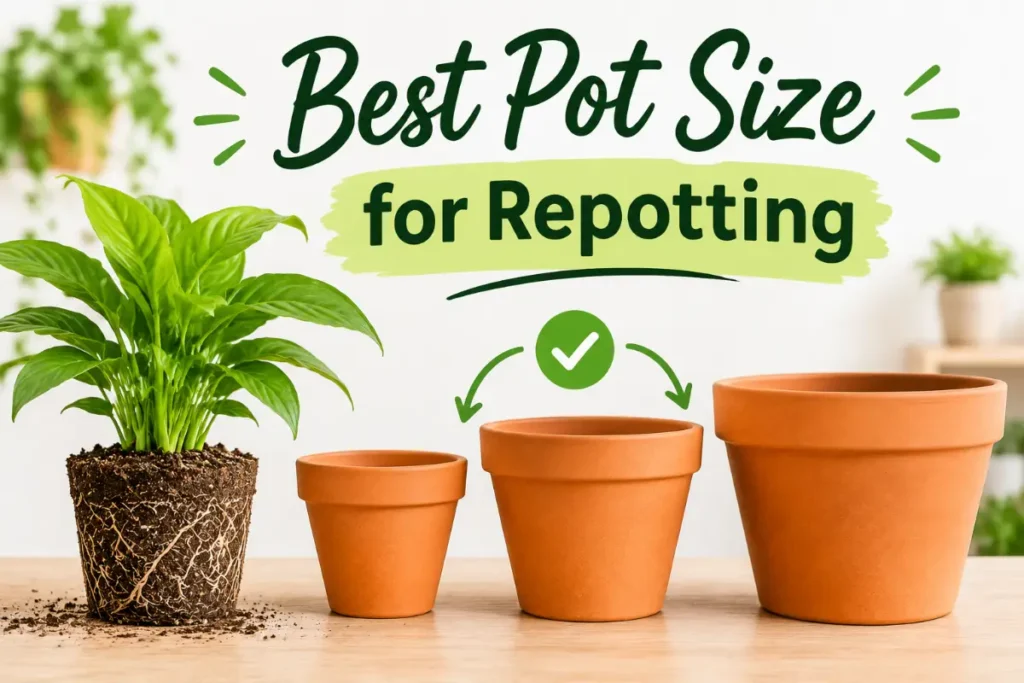
Choosing the right pot when you repot is one of the most consequential decisions in houseplant care — and one of the most commonly done wrong. The instinct is to give a plant as much room as possible, but oversizing a pot creates the same persistent problem across every plant type: too much potting mix surrounding the root ball, too much retained moisture, and eventually root rot. Finding the best pot size for repotting means balancing enough room for root growth against the risk of a waterlogged mix that the plant cannot dry out efficiently between waterings.
The classic guideline — go up one or two inches in pot diameter — exists for a good reason. A container that is modestly larger than the root ball gives roots room to expand while keeping the volume of unoccupied potting mix low enough that the medium dries at a reasonable rate. The same rule applies whether you are repotting a small pothos from a 4-inch to a 6-inch pot or moving a large monstera from a 10-inch to a 12-inch container.
This guide covers how to measure correctly, the specific scenarios where you should size up more aggressively or stay in the same pot, how pot material affects how fast the mix dries, and which plants need special consideration. If you are still deciding whether a repot is actually needed, the guide on reading the signs that a plant needs repotting covers every indicator that tells you the root system has outgrown its container.
The 1–2 Inch Rule: What It Means and Why It Works
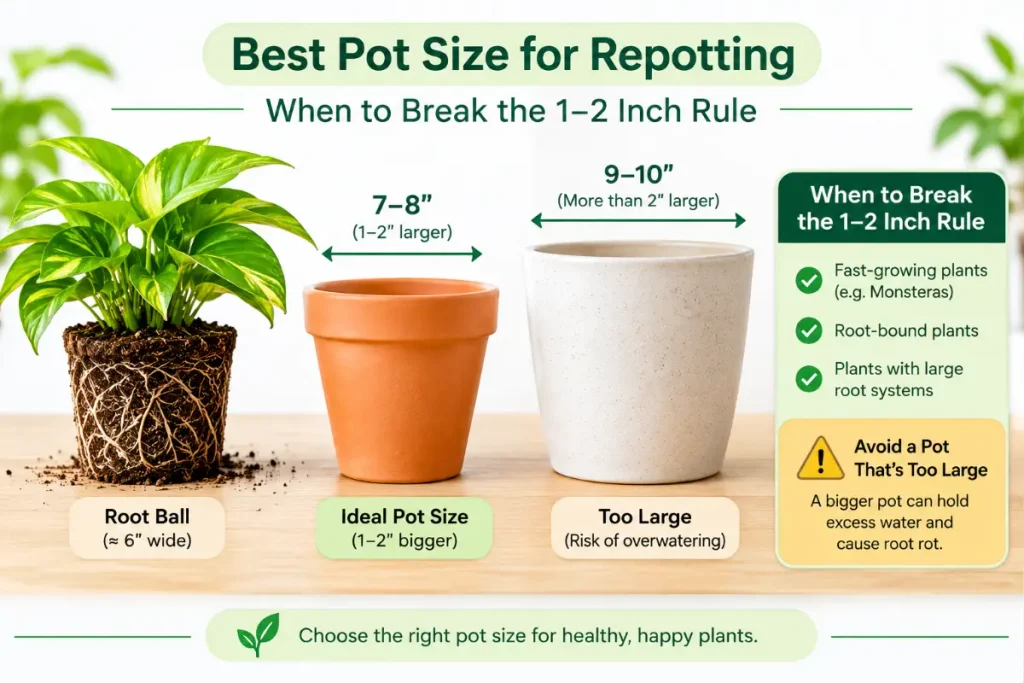
The standard recommendation for repotting is to choose a new pot that is 1–2 inches larger in diameter than the current pot. For most houseplants in most situations, this is exactly right.
Why not bigger?
When you place a small root ball into a large container, most of the potting mix is not in contact with roots. That portion of the mix stays wet for extended periods after watering — there are no roots actively drawing moisture from it, and it cannot dry through plant transpiration. Wet, unoccupied potting mix creates anaerobic conditions at the center of the pot, and those conditions are where root rot pathogens thrive.
A plant in a pot 4–6 inches larger than its root ball is constantly at risk of overwatering problems — not because you are watering too often, but because the mix cannot dry at a rate appropriate for the root mass.
Why 1 inch vs. 2 inches:
- Go up 1 inch for slow-growing plants, plants prone to root rot (succulents, cacti, snake plants, ZZ plants), and plants going into a heavy potting mix that retains moisture well
- Go up 2 inches for fast-growing tropicals (pothos, philodendron, monstera), plants in a lightweight, perlite-rich mix that drains quickly, and plants that are severely root-bound and need more space
What “pot size” means: Pot sizes are measured in diameter across the top opening. A “6-inch pot” is 6 inches wide at the top. When you go from a 4-inch to a 6-inch pot, you are adding 2 inches of diameter — but the volume increase is proportionally much larger, because volume scales with the square of the radius. A 6-inch pot holds approximately 2.5 times more potting mix than a 4-inch pot of the same depth. This is why even a 2-inch diameter increase creates a significant volume change and why you should not go larger than 2 inches without a specific reason.
How to Measure Pot Size
Step 1: Remove the plant from its current pot. Measure the diameter of the current pot across the top from inner rim to inner rim — not the outer rim, which includes the pot wall thickness.
Step 2: Measure the diameter of the root ball itself. If the root ball is significantly smaller than the current pot (because the plant has been shedding roots due to root rot, for example), size the new pot to the root ball, not the old pot.
Step 3: Add 1–2 inches to the root ball diameter. That is your new pot size.
Example:
- Current pot: 6 inches
- Root ball is healthy and fills the pot: add 1–2 inches
- New pot: 7–8 inches
Example with root rot:
- Current pot: 8 inches
- Root ball after trimming diseased roots: 4 inches in diameter
- New pot: 5–6 inches (sized to the trimmed root ball, not the old pot)
This second example is important — many growers automatically go up one size from the previous pot without checking whether the root ball is still the same size. If you have trimmed roots, size down to match the new root mass.
Pot Shape: Depth and Width Considerations
Diameter is not the only dimension that matters. The depth and overall shape of the pot influence how quickly the mix dries and how well it supports different root structures.
Deep, narrow pots: Good for plants with deep taproots or long, downward-growing roots — like snake plants, some dracaenas, and palms. Poor for shallow-rooted plants like most ferns and peperomias, which may sit at the surface of a pot that is too deep, leaving most of the mix below the root zone chronically wet.
Wide, shallow pots (azalea pots): Designed for plants that grow wide root systems rather than deep — many tropical foliage plants, ferns, peace lilies, and spider plants do well in a shallower profile. These dry more evenly because the mix is shallower throughout. Sometimes labeled “bulb pots” or “azalea pots” in US garden centers.
Standard nursery pots: The familiar tapered cylindrical shape, equal parts deep and wide. Works for the majority of houseplants and is the default to reach for when you are unsure.
A practical test: When unpotting, observe where the roots are concentrated. If the root mass occupies only the top two-thirds of the pot and the bottom third is relatively root-free, consider a shallower pot at the same diameter. If the entire pot depth is occupied with roots, standard depth is appropriate.
When to Break the 1–2 Inch Rule
There are specific situations where sizing up more than 2 inches is appropriate — and a few where staying in the same size pot is the right call.
When to go up more than 2 inches
Fast-growing plants during the growing season: A monstera deliciosa or a split-leaf philodendron that has become severely root-bound in spring can benefit from a jump of 3–4 inches in diameter, because it will colonize the new potting mix quickly and reduce the period of elevated moisture risk. Use a fast-draining mix with 25–30% added perlite to compensate for the larger volume.
Plants in very lightweight, fast-draining mixes: A plant in a mix that is 50% perlite or in a chunky aroid mix dries much faster than a plant in standard potting mix. For plants in these mixes, a larger pot does not carry the same overwatering risk as it would in a denser, moisture-retaining mix.
Repotting into terracotta: Unglazed terracotta evaporates moisture through its porous walls, which means the mix dries faster than it does in plastic or glazed ceramic. A terracotta pot can be sized 1 inch larger than you would choose for the equivalent plastic pot.
When to stay the same size (or go smaller)
Root rot recovery: A plant being repotted because of root rot should go into a container sized to its trimmed root ball — often the same size or smaller than its previous pot. The goal is to minimize unoccupied mix volume until the root system recovers and expands.
Pot-bound bloomers: Some plants bloom most reliably when slightly root-bound — peace lilies, anthuriums, spider plants, and some orchids. If a peace lily is flowering well, do not repot it. If it needs repotting (roots at the drainage holes, watering frequency increasing), go up only 1 inch so it returns to a lightly root-bound state quickly.
Winter repotting: If you must repot in winter, stay at the same pot size or go up only 1 inch. The plant’s root growth is minimal in low-light conditions, so excess potting mix will stay wet for extended periods. A smaller pot is more forgiving.
Very slow growers in already-heavy mixes: A cactus or haworthia in a dense cactus mix in a plastic pot — staying in the same size pot and simply refreshing the potting mix may be more appropriate than sizing up.
Pot Material and Its Effect on Drying Rate
The best pot size for repotting also depends on the pot material, because different materials dry the potting mix at very different rates.
Unglazed terracotta: The most forgiving material for overwatering risk. Porous clay walls allow water vapor to escape from the sides of the pot, drying the mix significantly faster than plastic. Terracotta is ideal for succulents, cacti, snake plants, and any plant prone to root rot. The tradeoff: plants in terracotta need more frequent watering (up to twice as often as the same plant in plastic), and terracotta is heavy and breakable.
Plastic nursery pots: Hold moisture much longer than terracotta because there is no evaporation through the walls. The cheapest and lightest option, and the most common at US garden centers. Appropriate for moisture-loving plants (ferns, peace lilies, pothos) and for plants being grown in very porous mixes. For succulents and cacti in plastic, sizing conservatively (1 inch up) is especially important.
Glazed ceramic: Behaves similarly to plastic in terms of moisture retention — the glaze seals the porous clay. Available in a wide range of sizes and aesthetics; a good middle ground for most houseplants. Many glazed ceramics come without drainage holes, which is a dealbreaker — always verify drainage before purchase.
Fabric grow bags: Highly porous fabric walls provide excellent air pruning of roots and very fast drying. Fabric bags can accommodate more generous sizing than terracotta because the drying rate is even faster. Used extensively in cannabis cultivation and increasingly popular for fast-growing tropical houseplants. The limitation: fabric bags are not aesthetically appealing for most home settings and require a tray.
Metal, wood, and fiberglass: Varies by wall thickness and porosity. Many decorative metal and wood pots function as cachepots (they have no drainage holes); always verify before planting directly into them. Fiberglass is lightweight and non-porous, behaving similarly to glazed ceramic.
Matching Pot Size to Common Houseplant Categories
A practical reference for the most common houseplant types sold in US garden centers (The Sill, Bloomscape, Home Depot, Lowe’s):
Tropical foliage (pothos, philodendron, monstera, alocasia): Repot when root-bound. Go up 2 inches in a standard nursery pot or glazed ceramic with drainage. Use a potting mix with 20–30% perlite. These plants grow quickly and tolerate repotting well.
Succulents and cacti: Go up 1 inch maximum. Use terracotta for best results. Use a dedicated cactus/succulent mix or a 50/50 potting mix and coarse perlite blend. Never use a pot without drainage for succulents.
Snake plants (Sansevieria/Dracaena): Go up 1 inch. These are slow growers that tolerate being root-bound and are prone to root rot in oversized pots. Terracotta is ideal. The root system tends to be wide and shallow — a standard or slightly shallow pot works better than a deep one.
Ferns (Boston fern, maidenhair, staghorn): Go up 1–2 inches in a wide, shallow pot. Ferns are moisture-loving and benefit from a mix that retains some moisture — a standard potting mix without added perlite. Plastic or glazed ceramic works well for moisture retention.
Orchids (phalaenopsis): Repot into a clear plastic orchid pot (allows root photosynthesis) or a terracotta orchid pot (with extra drainage slots). Orchid pots are typically the same size or 1 inch larger than the previous, with the focus on fresh bark medium rather than more space. Clear plastic nursery pots specifically made for orchids are sold at most US orchid suppliers and Walmart garden departments.
Drainage Holes: Non-Negotiable
Every pot used for repotting must have at least one drainage hole. This is the single non-negotiable criterion that overrides every other pot-selection consideration — size, material, aesthetics. Without drainage, water accumulates at the bottom of the pot regardless of how carefully you water. The anaerobic, waterlogged zone that forms at the bottom of an undrained pot is where root rot begins and where fungus gnat larvae thrive.
If you have found the perfect decorative pot without drainage holes, use it as a cachepot: place your plant in a correctly sized nursery pot with drainage, set that inside the decorative pot, and water by removing the nursery pot, watering over a sink until it drains freely, and then setting it back inside. This gives you the aesthetic of the decorative container without the root damage of undrained potting mix.
Drilling drainage holes in ceramic and glazed pots is also an option. Use a diamond-tipped masonry bit at low speed with water as a coolant, drilling slowly through the base. This works reliably on most ceramic pots and is worth doing for a container you love.
The best pot size for repotting is a meaningless concept if the container does not drain — size your drainage correctly as a first step, before comparing any other attributes.
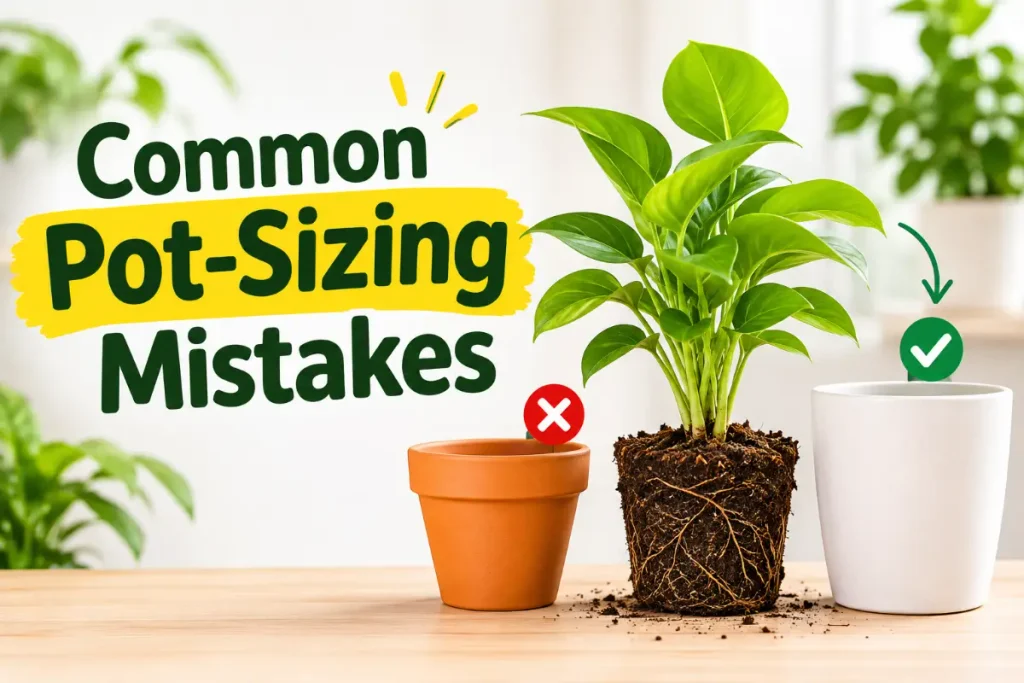
Common Pot-Sizing Mistakes
Going up 4–6 inches “to give it room to grow.” The plant cannot photosynthesize its way to a healthy root system fast enough to keep up with the moisture retention of that much extra potting mix. The result is chronic wet conditions, compaction, and root rot.
Sizing from the old pot without checking the root ball. If you have trimmed diseased roots, the root ball is now smaller than the old pot. Size to the current root ball, not the previous container.
Choosing a pot without drainage holes. No matter how beautiful the pot, if it has no drainage, every watering event creates a reservoir of standing water at the bottom. Use it as a cachepot instead — place the nursery pot inside the decorative pot and remove for watering.
Ignoring pot material. A plant repotted into a pot 2 inches larger in glazed ceramic in a dense mix may be overwatered; the same plant in unglazed terracotta in a perlite-rich mix at the same size difference will dry appropriately. Material and mix composition determine how the size decision plays out in practice.
Not checking the depth. A pot can be the right diameter but too deep for a shallow-rooted plant. The portion of the potting mix below the root zone stays wet for extended periods, particularly in deep, narrow pots.
Conclusion
The best pot size for repotting is usually modest — 1–2 inches larger in diameter than the current root ball, in a material that suits the plant’s moisture requirements. This keeps the volume of unoccupied potting mix low, reduces overwatering risk, and gives the plant room to grow without creating conditions that stress the roots. Matching the pot material to the plant’s needs (terracotta for drought-tolerant plants, plastic for moisture-loving ones) and always verifying drainage before planting are the other two decisions that determine whether a repot succeeds.
For research-based guidance on container selection and potting media for indoor plants, the Virginia Tech Extension guide to houseplant care covers container types, drainage requirements, and potting mix selection with practical guidance for US home growers.
FAQs
How much bigger should a repotting pot be?
Go up 1–2 inches in diameter from the current pot (or the current root ball size, if you have trimmed roots). One inch is right for slow-growing plants, succulents, and plants prone to root rot; two inches works for fast-growing tropicals and plants in very well-draining mixes. Avoid going up more than 2 inches in most situations — the excess potting mix retains moisture the roots cannot use, creating overwatering conditions.
Can you repot into a pot that is too big?
Yes, and it is one of the most common causes of root rot in houseplants. A pot that is significantly larger than the root ball holds excess potting mix that stays wet for extended periods, creating anaerobic conditions that kill roots. If you have already repotted into a pot that seems too large, let the mix dry thoroughly between waterings, hold off on fertilizing until the plant shows new growth, and consider repotting into a smaller container if the plant shows signs of distress.
Does pot material affect how often I need to water?
Significantly. Unglazed terracotta evaporates moisture through its porous walls, drying the mix roughly twice as fast as plastic or glazed ceramic. A plant in terracotta may need watering twice as often as the same plant in plastic. For succulents and cacti, terracotta is ideal because it reduces overwatering risk. For moisture-loving plants (ferns, peace lilies), plastic or glazed ceramic retains moisture at a rate that suits their higher water demand.
Should I use the same pot after repotting?
You can reuse pots as long as you sterilize them first. Wash the pot with hot water and dish soap, then soak it for 10 minutes in a 10% bleach solution (1 part bleach to 9 parts water) to kill any pathogens, pest eggs, or fungal spores from the previous plant. Rinse thoroughly and allow to dry before reuse. For pots that housed a plant with a severe root rot infection or a persistent pest problem like root mealybugs, sterilizing is especially important.
What is the best pot for succulents?
Unglazed terracotta in a size 1 inch larger than the current root ball is the best combination for most succulents. Terracotta’s porous walls wick moisture away from the mix efficiently, reducing the risk of root rot that succulents are particularly prone to in moisture-retaining containers. Use a cactus and succulent potting mix (or a 50/50 blend of standard potting mix and coarse perlite) for drainage that matches what terracotta provides at the wall.