
Worm castings for indoor plants consistently outperform most other fertilizers, natural or synthetic, in long-term plant health outcomes, and the reason comes down to what they actually are. Worm castings are not simply composted organic matter. They are the digested output of earthworms that have processed organic material through their digestive systems, and that process transforms nutrients into a form more immediately available to plant roots than almost any other natural soil amendment. A tablespoon of quality worm castings contains more biologically active nutrition per gram than virtually any commercial fertilizer at an equivalent application rate, without any risk of burning roots, damaging soil structure, or building up harmful salt residues in potting mix over time.
This guide covers the 8 most significant benefits of using worm castings for indoor plants, exactly how to apply them in every form that delivers results, which plants respond most noticeably, and where to source quality castings if you are not producing your own through home vermicomposting.
Quick Answer
Worm castings benefit indoor plants by providing immediately available balanced nutrition, improving soil structure and drainage, increasing beneficial microbial populations, suppressing harmful soil pathogens, delivering natural plant growth hormones, improving the plant’s resistance to pests and disease, enhancing seed germination and root development, and releasing nutrients slowly enough to eliminate burn risk entirely. Apply as a soil top-dress every six to eight weeks, mixed into potting soil at 20% when repotting, or steeped in water to make worm casting tea applied every two weeks through spring and summer.
What Makes Worm Castings Different From Other Fertilizers
The earthworm digestive process is what separates worm castings from other compost products and from synthetic fertilizers in ways that matter significantly for indoor plant health.
When an earthworm ingests organic matter, the material passes through a long digestive tract lined with bacteria and enzymes. During this journey, complex organic compounds including proteins, starches, and cellulose are broken down and transformed. By the time the material exits as castings, the nutrients are in a form called humate complexes, which are chemically stable, water-soluble, and directly accessible to plant root systems without requiring further microbial breakdown in the soil. This is different from raw compost, where nutrients are still bound in complex organic molecules that soil microorganisms must process before roots can access them.
The microbial component is equally significant. A teaspoon of quality worm castings contains between 100 million and 1 billion beneficial bacteria, fungi, and other microorganisms. These organisms colonize potting mix when castings are added, improving nutrient cycling, suppressing harmful pathogens, and improving the overall biological health of the growing medium in ways that no synthetic fertilizer can replicate.
8 Benefits of Worm Castings for Indoor Plants
Benefit 1: Immediately Available Balanced Nutrition
The NPK content of worm castings varies slightly depending on the organic matter the worms processed, but a typical analysis shows nitrogen between 1 and 3%, phosphorus between 1 and 2%, and potassium between 1 and 2%. These numbers appear modest compared to concentrated synthetic fertilizers with ratios like 20-20-20, but the form in which these nutrients exist makes the comparison misleading.
In synthetic fertilizers, nutrients are in simple ionic forms that dissolve completely and immediately in water. This produces fast visible results but also the risk of nutrient overdose when applied too heavily, and the rapid leaching that means frequent reapplication is necessary to maintain nutrition.
In worm castings, nutrients exist in the humate complexes mentioned above, which bind to soil particles and release to plant roots on demand as the plant needs them through a process called cation exchange. The plant effectively draws nutrition from the casting particles at the rate it can use rather than receiving a flood of dissolved ions that either gets absorbed all at once or leaches away. This on-demand release mechanism is why worm castings never burn roots even at high application rates and why their effects persist in potting mix for months rather than weeks.
Benefit 2: Dramatically Improved Soil Structure
Worm castings significantly improve the physical structure of potting mix in ways that benefit plant root health beyond their nutritional content. The humus compounds in castings form stable aggregates with soil particles, improving the balance between water retention and drainage. Potting mix amended with worm castings holds moisture long enough for roots to access it while draining excess water more freely than unamended mix, which reduces the waterlogging that drives root rot and fungus gnat infestations.
This structural improvement also increases the air-filled porosity of the growing medium, which is critical for healthy root function since plant roots need oxygen as well as water and nutrients. Compact, poorly draining old potting mix that has lost its structure becomes noticeably more friable and well-draining after incorporation of worm castings.
Benefit 3: Explosive Beneficial Microbial Populations
The bacterial and fungal populations in worm castings are their most underappreciated benefit for indoor plant health. When you add castings to potting mix, you are not just adding nutrients. You are inoculating the soil with a diverse community of microorganisms that establish in the potting mix and fundamentally improve how it functions as a growing medium.
Beneficial bacteria in castings fix atmospheric nitrogen, making it available to plant roots beyond what the castings themselves provide. Mycorrhizal fungi extend root reach dramatically, allowing plants to access water and nutrients from a much larger soil volume than their physical root system covers. Trichoderma species in castings are among the most effective biological agents known for suppressing the fungal root pathogens responsible for damping off and root rot in indoor plants.
Benefit 4: Suppression of Harmful Soil Pathogens
The beneficial microbial community in worm castings actively competes with and suppresses harmful soil pathogens through a combination of mechanisms including competition for nutrients and space, production of antifungal compounds, and parasitism of harmful organisms.
Research on worm casting applications consistently shows reduced incidence of pythium, fusarium, and rhizoctonia root rots in plants grown in casting-amended soil compared to plants in unamended potting mix. For indoor plants where root rot from overwatering is one of the most common causes of plant death, this pathogen suppression benefit provides genuine protective value beyond what any topical fungicide treatment delivers since it addresses the soil environment rather than the symptom.
Benefit 5: Natural Plant Growth Hormones
Worm castings contain detectable concentrations of plant growth hormones including auxins, cytokinins, and gibberellins. These hormones are present in concentrations low enough to be non-toxic to plants but high enough to stimulate measurable growth responses including faster root development in cuttings and seedlings, increased branching in established plants, and improved cell division rates that contribute to larger leaf production.
The cytokinin content is particularly valuable for indoor plants since cytokinins delay leaf senescence (the natural aging and yellowing of older leaves), which means plants grown in casting-amended soil maintain healthy functional foliage longer before it naturally drops. This effect is visible in the extended productive life of individual leaves on plants regularly fed with worm casting tea compared to the same species grown without castings.
Benefit 6: Enhanced Pest and Disease Resistance
Plants grown in worm casting-amended soil consistently show improved resistance to pest attack and disease infection compared to those in unamended potting mix, and this effect appears to operate through multiple mechanisms simultaneously.
The stronger cell walls that develop in nutritionally complete, biologically rich soil are physically harder for sap-feeding insects like aphids and spider mites to pierce. The silica compounds present in castings contribute to this structural strengthening effect. The beneficial microorganism community in casting-amended soil also produces compounds that are directly repellent or toxic to several common plant pests, particularly soil-dwelling larvae. For context on how soil health connects to pest prevention across the full range of common indoor plant pest species, bugs in indoor plant soil covers this relationship in detail alongside treatment approaches for when prevention is not enough.
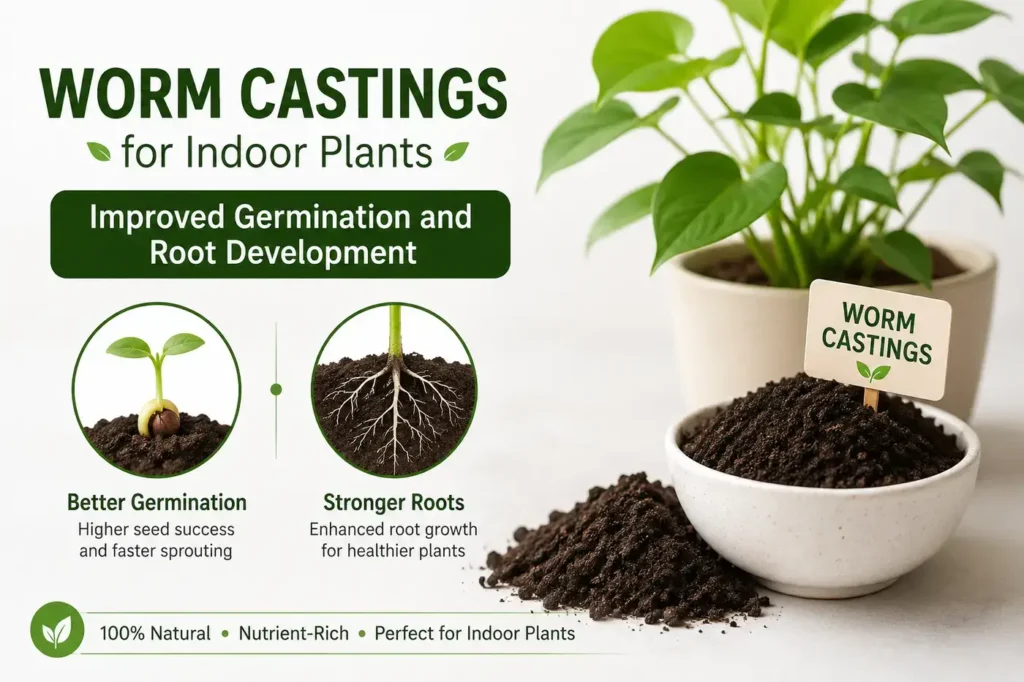
Benefit 7: Improved Germination and Root Development
Worm casting tea applied to seedlings and cuttings consistently produces faster germination rates and more aggressive early root development than untreated controls. The combination of immediately available nutrition, growth hormone content, and beneficial microbial inoculation creates conditions that support the most vulnerable stages of plant development more effectively than synthetic starter fertilizers.
For indoor gardeners who propagate plants from cuttings, soaking cutting bases in diluted worm casting tea before planting and watering with casting tea during the rooting period produces rooted cuttings in significantly shorter time frames than plain water propagation in the same medium.
Benefit 8: Zero Risk of Fertilizer Burn
This is perhaps the most practically important benefit of worm castings for indoor plant use specifically. It is essentially impossible to burn plant roots with worm castings at any reasonable application rate. The nutrient release mechanism, which delivers nutrition through cation exchange rather than through dissolved ionic flood, means that excess castings simply provide extra organic matter and microbial life to the soil without reaching the concentration levels that cause root burn.
This makes worm castings the single safest fertilizer option for sensitive plants, recently repotted plants with disturbed root systems, and plant owners who are not comfortable measuring precise fertilizer concentrations. The worst outcome from applying too many worm castings is that you provide more organic matter than the plant needs at that moment, which has no negative effect on plant health.
How to Apply Worm Castings to Indoor Plants
Method 1: Soil Top-Dress
Top-dressing is the most straightforward application method and works well for established plants in pots where you do not want to disturb the root system by repotting.
Spread a half-inch to one-inch layer of worm castings across the entire soil surface of the pot, working it gently into the top half-inch of soil with a finger or small fork to improve contact with the existing potting mix. Water normally after application to begin moving the soluble nutrients and microbial life down through the soil profile toward the root zone.
Apply every six to eight weeks through the growing season. The castings release their benefits gradually over this period as they are watered into the soil and as their microbial community establishes and expands through the potting mix.
Method 2: Soil Amendment When Repotting
Incorporating worm castings into fresh potting mix when repotting plants provides the most thorough and even distribution of their benefits throughout the root zone. Mix castings into your standard potting mix at a ratio of approximately 20% castings to 80% potting mix. For plants that prefer particularly rich soil conditions including most tropical foliage plants, ratios up to 30% castings are appropriate. For succulents and cacti, reduce to 10% or less since these plants perform better in lower-nutrient conditions.
This incorporation method delivers immediate root contact with the casting nutrients and microbial population as the plant establishes in new soil, which is particularly beneficial for the post-repotting root development period when plants are building new root systems.
Method 3: Worm Casting Tea
Worm casting tea is the liquid extraction of worm casting nutrients and microorganisms in water, producing a fertilizer that can be applied as a regular watering for plants that cannot be conveniently top-dressed or when you want more frequent application than solid castings allow.
How to make casting tea: Place one cup of worm castings in a mesh bag or cheesecloth and steep in one gallon of dechlorinated tap water or rainwater. For maximum benefit, aerate the water continuously with an aquarium air pump and airstone throughout a 24-hour steeping period. The aeration multiplies the beneficial bacterial population in the finished tea exponentially compared to non-aerated steeping. Use the finished tea immediately since the microbial population declines rapidly without continued aeration. The remaining castings in the bag can be top-dressed onto plant soil surfaces after straining.
How to apply it: Use the tea in place of a regular watering, applying it at the base of plants to soak the root zone. Apply every two weeks through spring and summer for actively growing plants. Monthly maintenance applications in fall work well for plants that continue slow growth through cooler months.
Method 4: Propagation Soak
For cuttings being rooted in water or in propagation medium, soaking the cut base in diluted worm casting tea before planting and using casting tea as the watering medium through the rooting period accelerates root development noticeably.
Make a half-strength casting tea (half cup of castings per gallon rather than the standard one cup) and use this as the water in which cuttings are rooted, or water propagation medium with it throughout the rooting period. The growth hormone content and microbial inoculation create conditions that support aggressive early root development.
Which Indoor Plants Respond Best to Worm Castings
Virtually every common houseplant benefits from worm castings to some degree, but certain plant types show the most dramatic and visible response.
Tropical foliage plants including monsteras, philodendrons, pothos, and peace lilies respond with noticeably larger new leaves and darker, richer green color within four to six weeks of the first casting application. These are fast-growing, nutrient-demanding plants that use the complete nutrition in castings rapidly and visibly.
Flowering houseplants including African violets, gardenias, and orchids show improved bloom production and longer bloom duration when grown in casting-amended soil, partly from the nutritional support and partly from the cytokinin content that maintains leaf health through the energetically demanding flowering period.
Herbs grown indoors including basil, mint, and rosemary show faster growth and more flavorful harvests from casting-amended soil. The improved soil biology in casting-amended mix also makes herb roots more resistant to the root rot that frequently affects herbs grown in standard potting mix without good drainage.
Seedlings and young plants show the most dramatic response of any growth stage since the combined nutritional, hormonal, and microbial benefits of castings align perfectly with what young plants need during their most vulnerable development period.
Where to Buy Quality Worm Castings
Not all commercially available worm castings are equal in quality. Key factors that distinguish effective products from ineffective ones include the freshness of the castings (fresher castings have higher living microbial populations), the organic matter the worms were fed (more diverse inputs produce more nutritionally complete castings), and the moisture content (overly dry castings have reduced microbial viability).
Wiggle Worm Soil Builder is one of the most widely available and consistently reviewed worm casting products at garden centers and on Amazon. Available in multiple sizes from small bags suitable for a few houseplants through 30-pound bags for larger collections.
Unco Industries Wiggle Worm and Worm Bliss are two other widely available options that receive consistently positive reviews for houseplant applications specifically.
Local vermicomposting operations sometimes sell castings directly and these are often fresher and higher in microbial viability than products that have been stored in bags for extended periods. Farmers markets and local garden clubs are good places to find local casting producers.
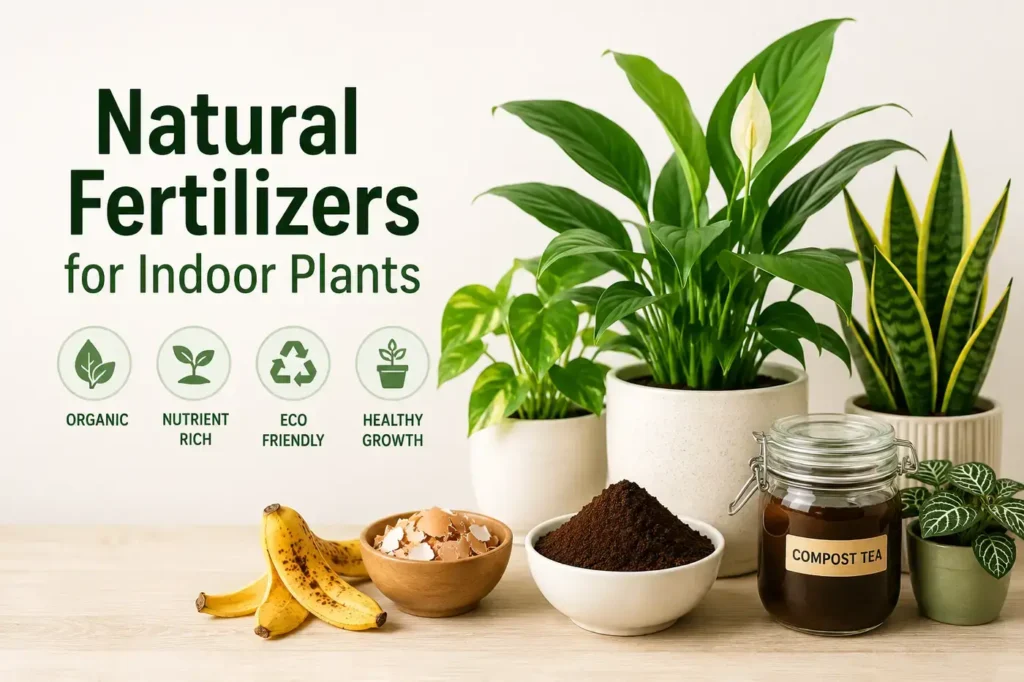
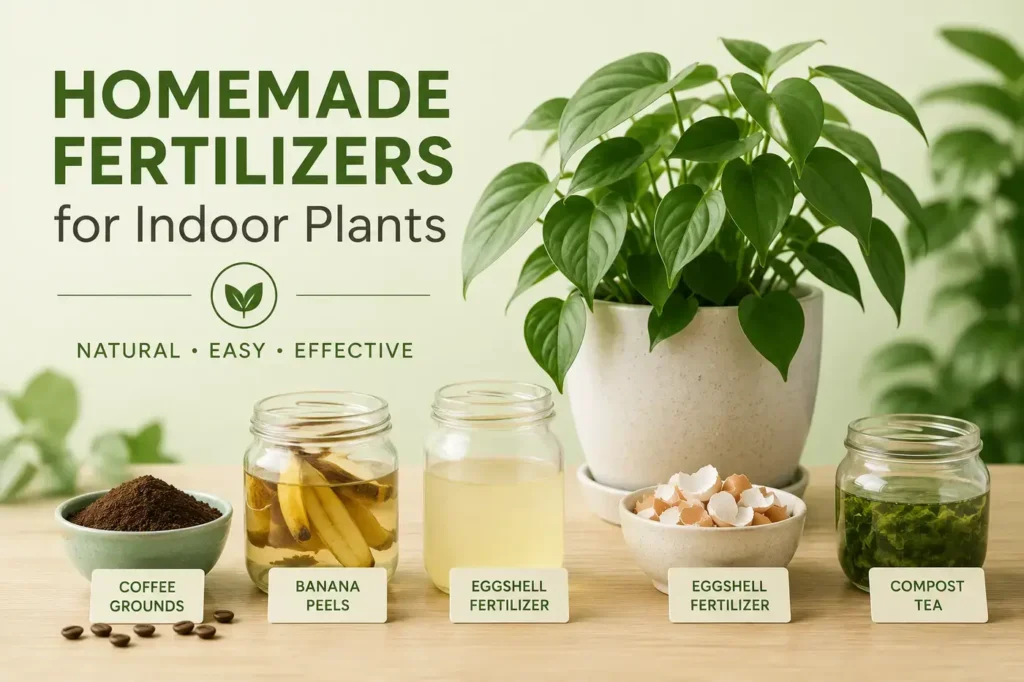
Home vermicomposting produces the freshest, highest-quality castings of any source and requires only a worm bin, red wigglers (Eisenia fetida), and kitchen vegetable scraps. A small bin maintained under a kitchen sink or in a utility room produces enough castings to fertilize a modest indoor plant collection continuously at essentially zero ongoing cost. For the complete guide to every natural fertilizer option for indoor plants including how worm castings compare to every alternative and how to build a rotation schedule that covers all nutritional needs, natural fertilizer for indoor plants covers every option in full detail. And for cost-free homemade fertilizer recipes that complement worm castings in a complete organic feeding program, homemade fertilizer for indoor plants covers every effective kitchen-based option alongside worm casting tea.
Conclusion
Worm castings for indoor plants deliver benefits that no synthetic fertilizer and few other organic options can match: immediately available balanced nutrition without burn risk, significant soil structure improvement, explosive beneficial microbial inoculation, pathogen suppression, natural growth hormone delivery, enhanced pest resistance, and accelerated root development. The fact that they cannot be overapplied makes them uniquely forgiving for indoor gardeners of every experience level.
Start by adding castings to your potting mix at 20% when next repotting any houseplant. Brew worm casting tea every two weeks through spring and summer for the plants you cannot repot immediately. Top-dress every six to eight weeks as a maintenance feeding between tea applications. Give the program four to six weeks to show visible results in plant growth and health.
The difference between a plant collection fed with worm castings consistently through the growing season and one receiving no supplemental nutrition becomes increasingly obvious as the season progresses. Healthier soil biology, stronger more pest-resistant plants, and more vigorous growth are the consistent outcomes from making worm castings a routine part of your indoor plant care approach.
Frequently Asked Questions
How often should I apply worm castings to indoor plants?
Top-dress with solid worm castings every six to eight weeks through the growing season (spring through summer). Apply worm casting tea every two weeks through the same period for more frequent liquid nutrition and microbial inoculation. Monthly applications of either form in fall work well for plants that continue slow growth through the cooler months. Reduce to a single annual incorporation into potting mix when repotting during winter dormancy for plants that are not actively growing.
Can you use too many worm castings on indoor plants?
No, not in any practical sense. Worm castings release nutrients through cation exchange rather than ionic flood, which means excess castings simply provide additional organic matter and microbial life without reaching concentrations that burn roots or cause toxicity. The only practical limitation is that adding castings at ratios above 30% of total potting mix volume can reduce drainage in some mixes, particularly for succulents and cacti that require excellent drainage. For these species, keep casting incorporation at 10% or less.
Are worm castings better than compost for indoor plants?
For indoor pot use specifically, yes. Worm castings have several advantages over standard compost for houseplant applications. Their nutrients are in more immediately plant-available forms. Their microbial populations are larger and more diverse. They have less variable composition than compost made from diverse garden materials. They are less likely to introduce weed seeds or pest eggs than compost materials that may not have reached the temperatures needed to eliminate these during the composting process. Compost is more appropriate for large-volume outdoor applications where its lower cost per volume makes it practical.
Do worm castings attract pests to indoor plants?
No. Unlike fresh organic materials including food scraps and coffee grounds, worm castings have already been fully processed through earthworm digestion and do not contain the fermenting organic matter that attracts fungus gnats, fruit flies, and other soil-dwelling pests. Their slightly earthy smell is neutral rather than attractive to pest insects. They are one of the few organic soil amendments that improve soil health without increasing pest attraction risk in indoor plant environments.
Can I make my own worm castings at home?
Yes, through vermicomposting. Red wiggler worms (Eisenia fetida) process kitchen vegetable scraps, cardboard, and paper in a small bin and produce finished castings within three to six months of starting a new bin. A standard 14-gallon storage bin with drainage holes drilled in the bottom, a pound of red wigglers (available online from Uncle Jim’s Worm Farm and similar suppliers), and regular kitchen vegetable scrap additions produce enough castings to fertilize a modest indoor plant collection continuously at no ongoing cost beyond the initial worm purchase.
How long do worm castings last in potting soil?
The solid organic matter component of worm castings persists in potting mix for four to six months before fully decomposing through normal soil microbial activity. The beneficial microbial populations they introduce can persist significantly longer if the soil conditions remain favorable (adequate moisture, organic matter, and oxygen). Nutrients release gradually over the same four to six month period, providing a sustained nutritional benefit that outlasts any single synthetic fertilizer application by several months. Top-dressing every six to eight weeks through the growing season maintains both the nutritional and microbial benefits at effective levels throughout the season.
Pingback: Peat Moss for Indoor Plants: 7 Things You Need to Know - Plant Quill
Pingback: Coconut Coir for Indoor Plants: 8 Uses That Improve Plant Health - Plant Quill
Pingback: 9 DIY Fertilizers for Indoor Plants That Cost Almost Nothing - Plant Quill
Pingback: 7 Best Slow Release Fertilizers for Indoor Plants - Plant Quill
Pingback: Do You Need Nutrients After Repotting Indoor Plants? - Plant Quill
Pingback: Osmocote Plus Outdoor and Indoor Smart Release Plant Food (2026) - Plant Quill
Pingback: Mold in Indoor Plant Soil: 7 Causes and How to Get Rid of It Fast - Plant Quill
Pingback: Elephant Ear Plant Care Indoors: 8 Steps to Massive Leaves - Plant Quill
Pingback: Polka Dot Plant Care Indoor: 7 Steps to Keep It Colorful and Bushy - Plant Quill
Pingback: Ficus Plant Care Indoor: 8 Steps to Stop the Leaf Drop for Good - Plant Quill
Pingback: Arrowhead Plant Care Indoors: 7 Steps to Keep It Lush and Healthy - Plant Quill
Pingback: Polka Dot Plant Indoor Care: 7 Expert Tips to Keep It Vibrant - Plant Quill
Pingback: Hawaiian Ti Plant Indoor Care: 8 Steps to Keep It Bold and Colorful - Plant Quill
Pingback: Wandering Jew Plant Care Indoors: 7 Steps to Lush Trailing Vines - Plant Quill
Pingback: Compost for Indoor Plants 7 Ways to Use It Without Making a Mess - Plant Quill
Pingback: Mulch for Indoor Plants: 7 Types That Actually Work in Pots - Plant Quill
Pingback: Asparagus Fern Plant Indoor: 7 Steps to Keep It Lush and Full (2026) - Plant Quill
Pingback: Creeping Charlie Indoor Plant: 7 Steps to a Lush, Trailing Display - Plant Quill
Pingback: Party Time Plant Indoors: 7 Steps to Keep Its Wild Colors Vivid - Plant Quill
Pingback: Tractor Seat Plant Indoor: 7 Steps to Keep Its Bold Leaves Thriving - Plant Quill