
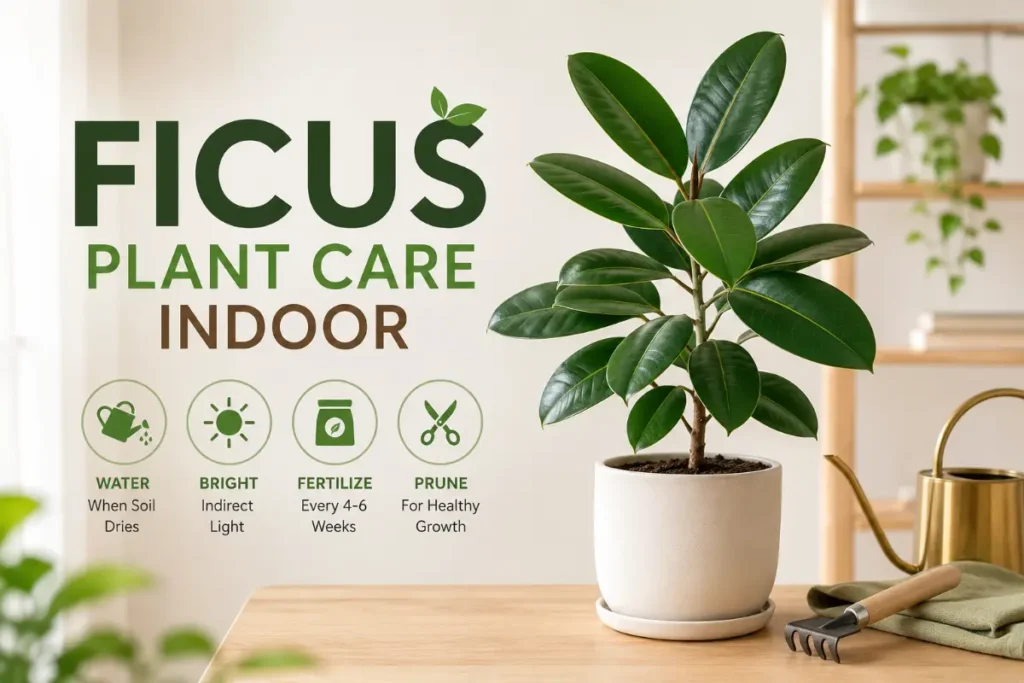
Ficus plant care indoor frustrates more plant owners than almost any other houseplant category because of one specific behavior: the dramatic leaf drop that happens when a ficus is moved, stressed, or placed in conditions below its preferences. You buy a beautiful, full ficus tree. You bring it home. Within two weeks it drops half its leaves and looks bare and skeletal. This is not random. It is predictable, understandable, and largely preventable once you understand what triggers it.
The ficus genus covers hundreds of species but the most common indoor varieties each have specific behaviors and preferences worth knowing before purchase. This guide covers the care steps that apply across the most popular indoor ficus types, with specific notes on the quirks of each that explain most of the frustrating experiences people have with this plant family.
Quick Answer
Ficus plant care indoor requires a stable permanent position with bright indirect light that does not change once the plant has acclimated, watering when the top one to two inches of soil feel dry, well-draining soil, temperatures between 60 and 85 degrees Fahrenheit with no cold drafts, moderate humidity above 40%, fertilizing every two weeks through spring and summer, and most importantly not moving the plant once it has settled. Position changes, drafts, and inconsistent watering are the three most common triggers for the leaf drop that makes ficus so frustrating indoors.
The Most Common Indoor Ficus Types and Their Differences
Understanding which ficus you have matters because they behave differently in ways that change specific care requirements.
Ficus benjamina (Weeping fig) is the most commonly purchased ficus tree and the one most notorious for leaf drop when moved or stressed. Its small, glossy, dark green leaves on weeping branches create the classic indoor tree appearance. It is highly sensitive to position changes and drafts and drops leaves reliably when either occurs.
Ficus lyrata (Fiddle leaf fig) has become one of the most popular statement houseplants due to its large, dramatic violin-shaped leaves. It is less prone to sudden leaf drop from position changes than benjamina but more sensitive to overwatering, cold air, and root disturbance.
Ficus elastica (Rubber plant) is the most forgiving indoor ficus, producing large glossy oval leaves in green, burgundy, or variegated forms. It tolerates lower light, less consistent watering, and position changes better than the other two without dramatic leaf drop.
Ficus microcarpa (Chinese banyan) is often sold as a bonsai or indoor tree in Asian-inspired decorative settings. Care requirements similar to Ficus benjamina with comparable sensitivity to position changes.
The care steps below apply to all four species with specific notes where they differ meaningfully.
Step 1: Find the Right Position and Commit to It
This is the single most important step in ficus care and the one most plant owners skip or underestimate. Ficus, particularly Ficus benjamina and Ficus lyrata, acclimate to a specific position over weeks to months. Moving them from that position, even to a seemingly better location, triggers leaf drop as the plant readjusts.
Choosing the right position: Bright indirect light from a large south or east-facing window suits all common indoor ficus types. Ficus benjamina and lyrata prefer positions that never receive direct harsh afternoon sun which bleaches leaves. Ficus elastica tolerates slightly lower light than the others without significant decline.
Once positioned, do not move it: This sounds extreme but it reflects genuine ficus behavior. A Ficus benjamina that has been in the same corner for three months has adjusted its leaf angle, water uptake rate, and metabolic processes to that specific light environment. Moving it to a window with different light, even better light, triggers the stress response that causes leaf drop. If the plant is healthy and growing in its current position, leave it there.
The exception: If the plant is clearly declining from insufficient light with progressive leaf yellowing and drop not triggered by a recent move, improving light is necessary despite the temporary stress response it may cause. Accept a period of leaf drop during the transition period and the plant will re-acclimate to the better position within four to eight weeks.
Step 2: Water Correctly for Each Species
Watering requirements differ enough between common ficus types that knowing your specific plant matters for watering approach.
For Ficus benjamina and microcarpa: Water when the top one to two inches of soil feel dry. These species prefer consistent moisture without waterlogging. Every seven to ten days in a bright position during summer. Every ten to fourteen days in winter or lower light.
For Ficus lyrata (fiddle leaf fig): Water when the top one to two inches of soil feel dry. Fiddle leaf figs are extremely sensitive to overwatering and to inconsistent watering. They prefer thorough, infrequent watering with complete drying of the top two inches between sessions rather than frequent light watering.
For Ficus elastica (rubber plant): Water when the top two inches feel dry. This species is more drought-tolerant than the others and benefits from slightly drier conditions between waterings than other ficus types. Overwatering is the most common cause of rubber plant decline.
Water quality: Like many tropical houseplants, ficus benefits from filtered or distilled water in hard water areas where fluoride and mineral accumulation causes brown leaf tips over time.
The thorough watering approach: When you do water, water until it flows from the drainage holes. This ensures the entire root zone receives moisture rather than just the top layer. Allow full drainage before returning the plant to its saucer.
Step 3: Use Well-Draining Soil
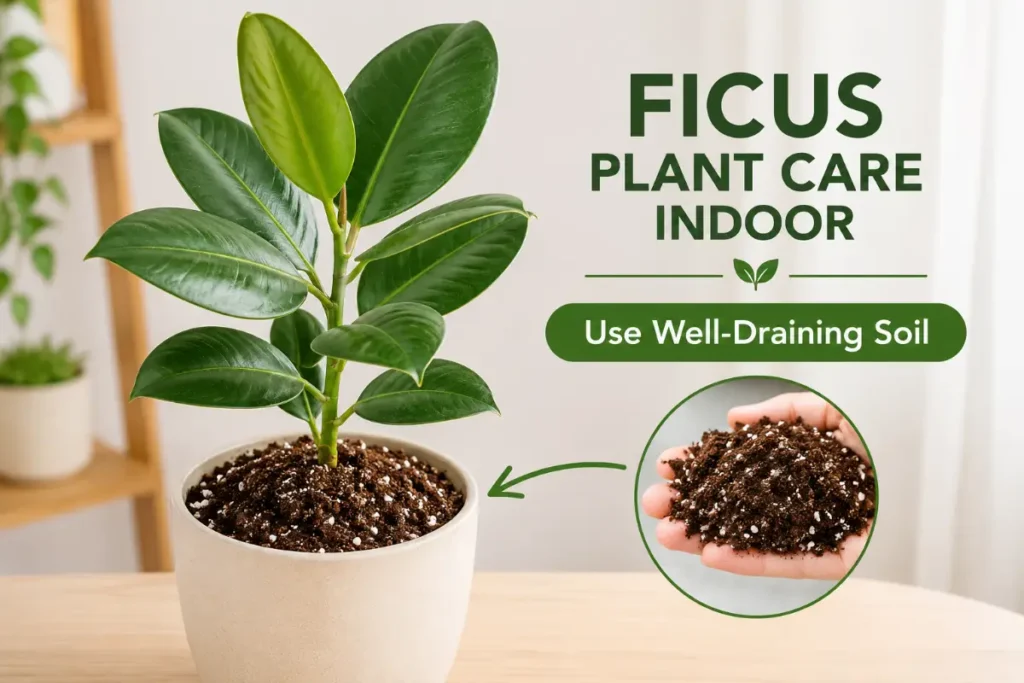
All indoor ficus types require well-draining soil that holds adequate moisture without staying wet between waterings. The default commercial potting mix holds too much moisture for ficus root systems that are prone to rot in consistently wet conditions.
The right mix: 60 to 70% quality potting mix with 20 to 30% perlite creates the drainage and aeration that ficus roots need. For fiddle leaf fig specifically, adding 10% orchid bark to this formula improves aeration further, which suits its particularly root-rot-sensitive nature.
Pot selection: Always choose pots with drainage holes. Terracotta pots work particularly well for ficus since the porous walls allow the soil to dry between waterings more quickly than plastic or glazed ceramic.
For the complete guide to building well-draining soil mixes for tropical trees and large indoor plants, soil mixture for indoor plants covers every component with exact ratios and explanations.
Step 4: Maintain Stable Temperature and Avoid Drafts
Temperature stability is as important as the temperature range itself for ficus plants. Sudden temperature changes trigger the same leaf drop response as position changes.
Ideal range: 60 to 85 degrees Fahrenheit for all common indoor ficus types. This aligns with typical US home temperatures.
Cold drafts: This is a primary leaf drop trigger that many plant owners overlook. A Ficus benjamina positioned near an exterior door that opens in winter receives cold air blasts multiple times daily that trigger the stress response even though average room temperature is adequate. Air conditioning vents blowing cold air directly on ficus foliage in summer cause the same response. Check that the chosen position is not in the path of cold air from any source.
Radiators and heating vents: Warm dry air from heating sources directly on ficus desiccates foliage and creates the low humidity conditions that stress the plant, though warm air triggers less dramatic leaf drop than cold drafts typically do.
Step 5: Provide Moderate Humidity
Ficus plants prefer moderate humidity above 40% and show stress in the very dry air of heated winter homes but are less dramatically sensitive to humidity than Norfolk Island pine or areca palms.
Signs of inadequate humidity: Brown leaf tips and edges. Crispy texture on leaf margins. Some lower leaf yellowing and drop beyond normal aging.
Effective solutions: A pebble tray with water beneath the pot. Grouping with other tropical plants. A humidifier running nearby during the driest winter months. These approaches raise local humidity without any risk of the leaf spotting that misting causes on some ficus varieties.
Fiddle leaf fig specific note: Fiddle leaf figs are more sensitive to leaf spotting from water contact than other ficus types. Avoid misting and any method that leaves water droplets on the large leaf surfaces where they sit and cause brown spots as they dry.
Step 6: Fertilize Through the Growing Season
Ficus are moderate feeders that benefit from consistent nutrition during their active growing period to support the leaf production and stem growth that keeps the plant looking full and healthy.
Through spring and summer: Feed every two weeks with a balanced liquid fertilizer at half the label rate. A formulation that includes micronutrients prevents the trace mineral depletion that causes yellowing in older leaves over time.
For fiddle leaf fig specifically: A fertilizer with a slightly higher nitrogen content (first number) drives the large leaf production that makes this plant so impressive. Products marketed specifically for fiddle leaf figs typically have this nitrogen emphasis.
Organic options: Worm casting tea every two weeks provides gentle burn-safe nutrition alongside soil biology benefits particularly valuable for plants that are sensitive to fertilizer salt accumulation in their root zone. For the complete organic fertilizer guide, worm castings for indoor plants covers every method and timing guidance for large tropical plants.
Fall and winter: Reduce to monthly or stop entirely when growth slows.
Step 7: Prune for Shape and Health
Ficus respond well to pruning and maintain more attractive forms with occasional shaping than when left to grow entirely unpruned indoors.
For Ficus benjamina: Light pruning of crossing stems and stems that break the desired tree shape can be done anytime through the growing season. Avoid heavy pruning that removes more than one-third of total foliage at once which triggers significant leaf drop as a stress response.
For Ficus lyrata (fiddle leaf fig): Pruning encourages branching in what naturally grows as a single-stem tree. Notching (making a small cut just above a leaf node without removing the stem) encourages branching at that point without removing foliage. Full cuts for shaping should be minimal and done in spring when the plant can recover most actively.
For Ficus elastica: Rubber plants can be pruned more aggressively than other ficus types without dramatic leaf drop. Cutting the main stem encourages branching below the cut, creating a bushier form. Wear gloves when pruning since the white sap (latex) causes skin irritation in some people.
Cleaning cuts: Always use clean, sharp pruning tools. Wipe blades with diluted rubbing alcohol between cuts when working on a plant that has shown any disease symptoms to prevent pathogen spread through fresh cuts.
Step 8: Manage Pests Proactively
Ficus plants attract a few specific pest species that take advantage of their broad leaf surfaces and the indoor environment where natural predators are absent.
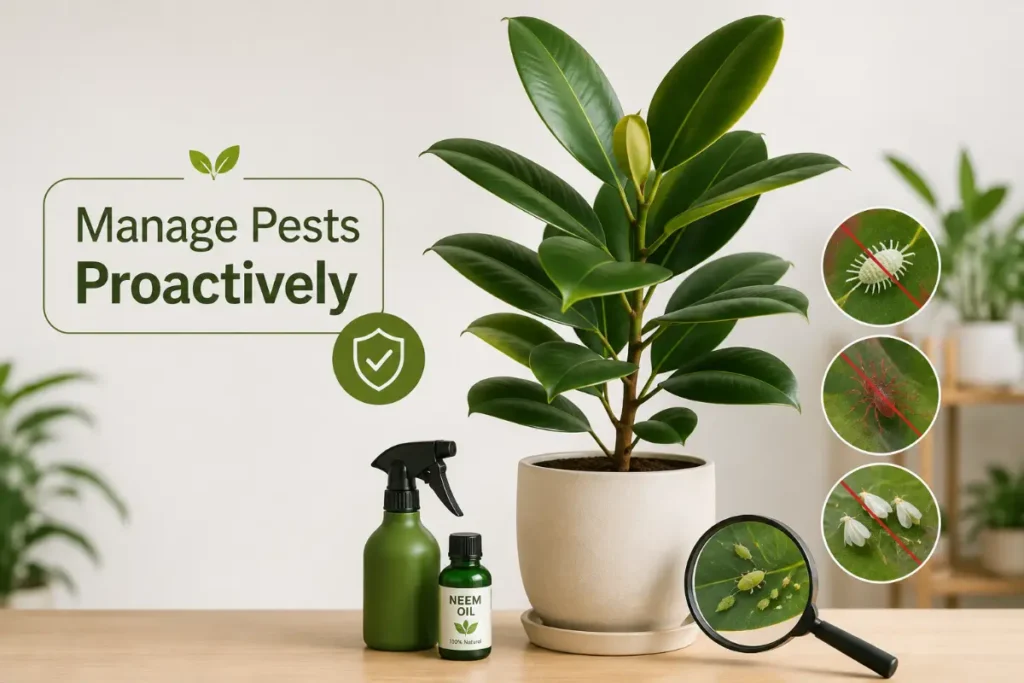
Scale insects are the most common ficus pest and are particularly problematic on Ficus benjamina where the small trunk and branch structure provides ideal sheltered habitat. Scale appears as small brown or tan bumps on stems and the undersides of leaves. Remove manually with rubbing alcohol on a cotton swab and follow with neem oil spray every seven days for three weeks.
Spider mites appear in dry winter conditions and show as fine stippling on leaf surfaces with possible webbing between leaves. Neem oil spray every seven days for three weeks handles active infestations. Maintaining humidity above 40% prevents establishment.
Mealybugs appear as white cottony clusters in leaf axils and at stem junctions. Treat with rubbing alcohol direct application followed by neem oil spray. For the complete treatment escalation for soft-bodied indoor plant pests, how to get rid of aphids on indoor plants covers the approach that applies to mealybugs, scale crawlers, and every other soft-bodied pest on indoor tropical plants.
Why Ficus Drops Leaves: Complete Diagnostic
Understanding the specific cause of leaf drop on your ficus determines the correct response rather than guessing.
Sudden drop of many leaves after a position change or move: Normal acclimation response. Do not move the plant again. Maintain consistent watering and wait four to eight weeks for the plant to re-acclimate.
Gradual yellowing and drop of lower leaves over months: Natural aging of oldest leaves combined with potentially insufficient light reaching the lower canopy. Some lower leaf drop is normal. If it is progressing rapidly upward through the plant, improve light.
Brown, crispy leaf edges with dropping: Low humidity or cold draft exposure. Increase humidity and check for drafts from vents or exterior doors.
Yellow leaves with green veins: Iron or magnesium deficiency from pH imbalance or nutritional depletion. A balanced fertilizer with micronutrients or a targeted trace mineral supplement addresses this.
Sudden drop without position change: Check for root rot from overwatering, cold draft exposure you may not have noticed, or pest infestation. Examine roots if overwatering is suspected. Check for pests on undersides of remaining leaves.
Ficus and Air Quality Benefits
Ficus plants, particularly the larger varieties like Ficus benjamina and Ficus lyrata, contribute meaningfully to indoor air quality through their substantial leaf surface area. NASA’s Clean Air Study included Ficus benjamina among the plants that remove formaldehyde, benzene, and trichloroethylene from indoor air, making large, healthy ficus specimens genuinely functional air purifiers alongside their aesthetic role as statement indoor trees.
The leaf surface area of a mature Ficus lyrata specimen with its large paddle-shaped leaves creates significant air purification capacity relative to its footprint. A single large fiddle leaf fig in good health processes more air volume through its leaves than multiple smaller plants with the same total leaf count.
The transpiration benefit is equally significant. Large ficus plants release substantial water vapor through their leaves, raising local humidity in the room they occupy. This humidity increase is particularly noticeable in dry winter conditions where a large, actively growing ficus measurably raises the ambient humidity of the room it occupies, which benefits both the plant itself and the humans breathing that air.
For context on the full range of air purification benefits documented for common indoor plants, peace lily indoor plant benefits covers the NASA research and practical air quality improvement evidence that applies across all large-leaved tropical houseplants including ficus.
Propagating Ficus Indoors
Propagating ficus from stem cuttings is practical for Ficus elastica and Ficus benjamina but more challenging for Ficus lyrata which roots slowly and inconsistently from standard stem cuttings.
For Ficus elastica: Take stem cuttings of four to six inches with two to three leaves attached. Allow the cut end to dry for thirty minutes to let the latex sap seal before placing in water or moist propagation medium. Roots develop within three to six weeks in warm conditions above 70 degrees. The white latex sap is a skin irritant so wear gloves during propagation work.
For Ficus benjamina: Take stem tip cuttings of three to four inches in spring or summer. Remove lower leaves leaving only two to three at the tip. Dip in rooting hormone powder and place in moist perlite or a perlite-soil mix. Cover with a clear plastic bag to maintain humidity and place in bright indirect light. Roots develop in four to six weeks.
For Ficus lyrata: Air layering is more reliable than standard stem cuttings. Select a healthy stem section and wound a small area of bark. Pack moist sphagnum moss around the wound and wrap tightly with clear plastic film, sealing both ends. Roots develop into the moss over six to twelve weeks. Once roots are visible through the plastic, cut the stem below the root ball and pot the new plant in appropriate potting mix.
Propagation timing matters for all ficus species. Spring and early summer propagation in warm conditions produces roots significantly faster than fall or winter attempts when lower temperatures and reduced light slow every biological process including root initiation.
Ficus and Air Quality Benefits
Like peace lilies and areca palms, ficus plants contribute to indoor air quality through their leaf surfaces. Ficus benjamina in particular was identified in NASA’s Clean Air Study as effective at removing formaldehyde, benzene, and trichloroethylene from indoor air alongside the significant oxygen production from its substantial leaf mass.
The air purification benefit scales with leaf surface area, which is why a full, bushy Ficus benjamina with thousands of small leaves or a mature Ficus lyrata with large leaf surfaces provides more measurable air quality benefit than a sparse or small specimen. This is another reason maintaining leaf fullness through stable positioning, consistent care, and pest management matters practically beyond just aesthetics.
For the complete breakdown of how different houseplants contribute to indoor air quality including the NASA research behind specific plant recommendations, peace lily indoor plant benefits covers the research and practical implications for every documented air purification benefit of keeping tropical houseplants indoors.
Seasonal Ficus Care Adjustments
Adapting ficus care to the changing seasons produces more consistent results than applying the same care routine year-round regardless of light levels, temperature, and growth rate changes.
Spring: As day length increases and light intensity improves, ficus enters its most active growth phase. Resume biweekly fertilizing as soon as new growth becomes visible. Check for pests that may have established during lower-light winter conditions. This is the best time for any necessary pruning or shaping since the plant can respond most actively to cut stimulation.
Summer: Peak growing season with maximum light and warmth. Maintain biweekly fertilizing. Watch for spider mites as temperatures rise and indoor humidity drops with air conditioning use. Water more frequently as higher temperatures and light intensity increase water uptake. If moving the plant outdoors during summer for any ficus type, transition gradually over two weeks and choose a partially shaded position that prevents leaf scorch.
Fall: Reduce fertilizing to monthly as day length shortens and growth slows. Begin monitoring for the lower leaf yellowing that naturally accompanies reduced light in fall. Move plants away from windowpanes that will radiate cold in winter. Check that heating vents are not positioned to blow directly on the plant as heating systems activate.
Winter: Stop fertilizing or reduce to once every six to eight weeks for plants still showing slow growth. Water less frequently as growth slows and light decreases. Maintain humidity with a pebble tray or humidifier since winter heating dramatically reduces indoor humidity. Monitor for scale and mealybugs which sometimes peak in winter when stressed plants are more vulnerable.
Conclusion
Ficus plant care indoor succeeds when you find the right position, commit to it completely, and maintain consistent watering and temperature stability from that point forward. The leaf drop that makes ficus so frustrating is almost entirely preventable once its triggers are understood: position changes, cold drafts, inconsistent watering, and very low humidity are responsible for the vast majority of dramatic ficus leaf loss events.
Choose the ficus species that suits your conditions. Ficus elastica for lower light or less consistent care routines. Ficus lyrata for dramatic statement making in the brightest available position and Ficus benjamina for the classic indoor tree form in a stable, draft-free, bright location where it will not be moved. Place it correctly once, water when the soil tells you it needs it, and protect it from drafts and extreme temperature changes. Those practices produce the full, lush ficus that makes this plant family so desirable as indoor trees.
Frequently Asked Questions
Why is my ficus dropping so many leaves indoors?
Ficus leaf drop is almost always triggered by one of three causes: a recent position change or move, exposure to cold drafts from exterior doors or air conditioning vents, or inconsistent watering. Ficus, particularly Ficus benjamina, drops leaves reliably when moved even to a better position as it readjusts to the new light environment. Do not move the plant again once it has settled, maintain consistent watering, eliminate any draft sources, and wait four to eight weeks for re-acclimation.
How much light does ficus need indoors?
All common indoor ficus types need bright indirect light from a large south or east-facing window. Ficus benjamina and lyrata prefer bright indirect light without direct harsh afternoon sun. Ficus elastica tolerates slightly lower light than the others. Very low light causes progressive leaf yellowing and drop in all ficus types over months regardless of other care quality.
How often should I water indoor ficus?
Water when the top one to two inches of soil feel dry, which typically means every seven to ten days in a bright position during summer and every ten to fourteen days in winter or lower light. Overwatering is the most common cause of root rot in fiddle leaf fig specifically. Underwatering causes leaf drop across all ficus types. Check soil moisture before every watering rather than following a fixed calendar schedule.
Can ficus survive in low light?
Ficus elastica (rubber plant) tolerates moderate lower light better than other common ficus types and can maintain acceptable health in north-facing or interior positions. Ficus benjamina and Ficus lyrata decline progressively in low light with increasing leaf drop and pale foliage over months. For lower light positions, choose rubber plant or consider a different plant family entirely.
Why does my fiddle leaf fig have brown spots?
Brown spots on fiddle leaf fig leaves have three common causes. Brown spots with yellow halos indicate bacterial infection from overwatering or water sitting on leaves. Dark brown edges indicate underwatering or low humidity. Tan or bleached spots indicate direct sun exposure. Identifying the pattern and location of spots on the leaf surface guides the correct response.
Is ficus toxic to pets?
Yes. All common indoor ficus species are toxic to cats and dogs. The sap contains compounds that cause vomiting, drooling, and skin irritation on contact. Ficus elastica sap is particularly irritating to skin and mucous membranes. Keep all ficus plants out of reach of pets that chew on houseplants or choose non-toxic alternatives for households with animals that regularly interact with indoor plants.