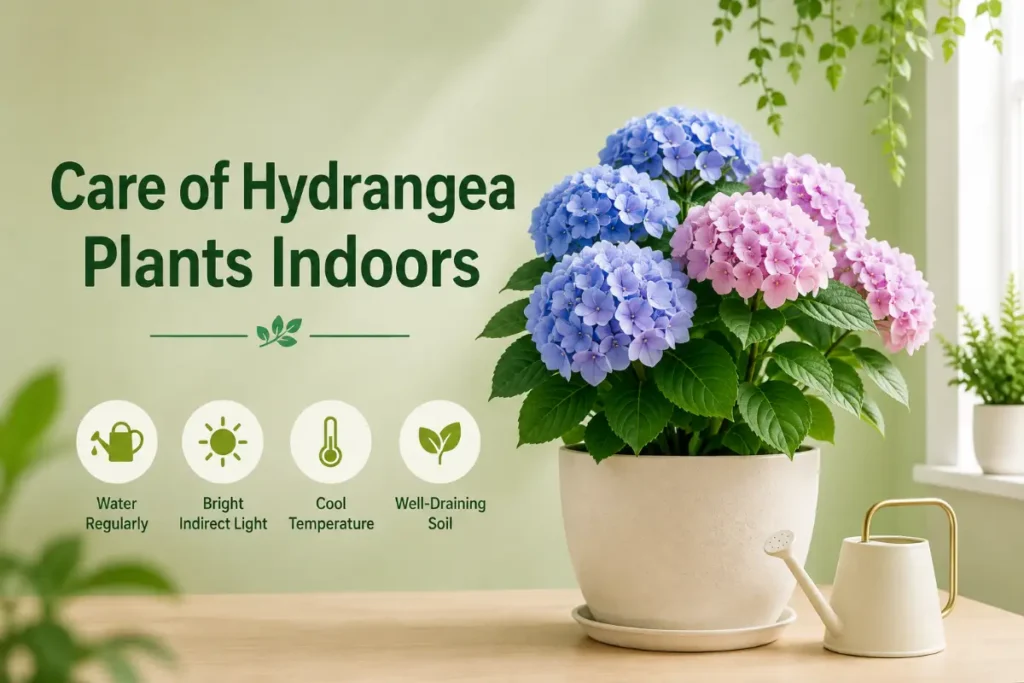
Care of hydrangea plants indoors is one of the most searched flowering plant topics for a simple reason: hydrangeas are irresistible at the garden center in full glorious bloom, and most of them are dead within three weeks of purchase. That rapid decline is not the plant failing. It is a care mismatch between what the plant needs and what the average warm, dry, dimly lit indoor environment provides.
Hydrangeas are temperate shrubs that bloom abundantly in cool, moist, well-lit conditions. The warm, dry, centrally heated or air-conditioned interiors of most American homes are the opposite of what they want. But those conditions can be managed well enough to extend a hydrangea’s indoor bloom period significantly and in some cases to successfully transition it to outdoor garden life where it thrives for decades.
Quick Answer
Care of hydrangea plants indoors requires the coolest bright position available, ideally below 65 degrees Fahrenheit to extend bloom duration, consistently moist soil that never fully dries out, high humidity above 60%, bright indirect light without direct hot sun, deadheading spent flowers to redirect energy, no fertilizing during the bloom period, and a clear plan for either outdoor transition or dormancy management after blooming ends. The most common mistake is placing them in warm rooms where blooms collapse within days.
Understanding Indoor Hydrangea
The hydrangeas sold as indoor gift plants are typically Hydrangea macrophylla, the large-flowered mophead or lacecap varieties bred for compact growth and abundant bloom. They are natural outdoor shrubs of temperate gardens, not houseplants in the traditional sense.
Commercial growers force them into bloom indoors through controlled temperature and light manipulation, selling them when they are at peak visual impact. The buyer inherits a plant that has been pushed to bloom ahead of its natural schedule, is expending significant energy on flower production, and needs conditions very different from what most indoor spaces provide.
The more honestly you understand this, the better your results will be. The goal for most indoor hydrangeas is not permanent indoor cultivation. It is extending the current bloom as long as possible and then transitioning the plant to an outdoor garden where it will thrive naturally.
Step 1: Temperature Is Everything for Bloom Duration
This is the single most important care factor and the one most commonly mishandled. Cool temperatures dramatically extend hydrangea bloom duration. Warm temperatures collapse it within days.
Ideal temperature: 50 to 65 degrees Fahrenheit during the bloom period. At this range individual flower clusters last weeks rather than days and the plant continues producing modest new growth alongside its flowers.
What warm temperatures do: Above 70 degrees consistently, hydrangea flowers wilt, brown at the edges, and collapse far faster than in cool conditions. In a warm living room above 72 degrees, a beautiful hydrangea in full bloom at purchase can look exhausted and spent within five to seven days.
Practical placement: The coolest bright room in your home. A north-facing room that stays cooler than the rest of the house. A bright enclosed porch that does not receive direct heating. A cool sunroom. Even positioning the plant near a window that stays slightly cooler than the interior helps.
Night temperature: Hydrangeas specifically benefit from cool nights. A room that drops to 50 to 55 degrees at night extends bloom noticeably even if daytime temperatures are slightly above ideal.
Step 2: Keep Soil Consistently Moist
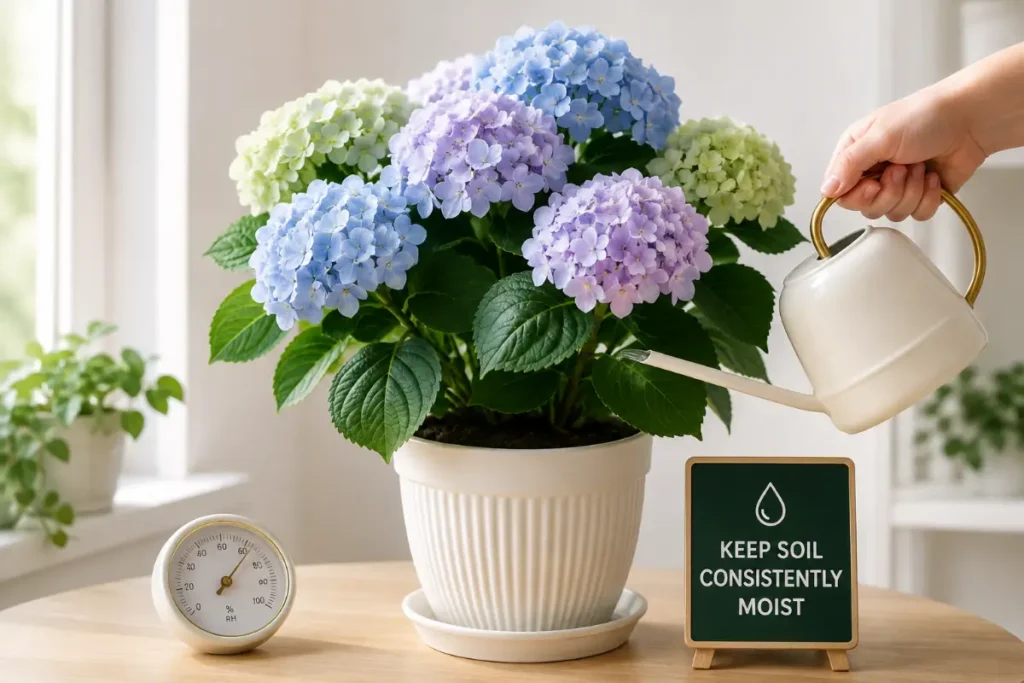
Hydrangeas are among the most water-demanding common flowering plants. In their natural habitat they grow in consistently moist, humus-rich soil and wilt dramatically when soil dries even partially during the bloom period.
The correct approach: Check soil moisture daily during the bloom period. Water when the top half inch of soil feels dry. This may mean watering every two to three days in warm indoor conditions or daily during peak summer heat.
Wilting as a signal: Hydrangea wilting during bloom is one of the most dramatic distress signals of any flowering plant. A hydrangea that has dried out enough to wilt looks alarmingly dead within hours. The good news is that thorough watering usually revives a wilted hydrangea within two to three hours if the roots are still healthy. Water immediately, soak the pot thoroughly, and place in a slightly cooler position to reduce moisture demand.
Drainage: Despite needing consistent moisture, hydrangeas require good drainage. Soil that stays waterlogged rather than consistently moist causes root rot. Always use pots with drainage holes and empty saucers within thirty minutes of watering.
Water quality: Use room temperature water. Cold water causes temperature shock to hydrangea roots and can trigger leaf and flower drop. Filtered or rainwater produces better results than chlorinated tap water in sensitive plants.
Step 3: Maximize Humidity
Hydrangeas are woodland shrubs that evolved in consistently humid environments. The low humidity of heated or air-conditioned indoor spaces is one of the primary drivers of the flower browning and leaf wilting that occurs even when watering is adequate.
Target humidity: Above 60% for best flower condition. Between 50 and 60% is tolerable but produces noticeably more brown flower edges than higher humidity.
Effective solutions: A humidifier running nearby is the most effective approach given the significant moisture demand of large hydrangea flower heads. A large pebble tray with water beneath the pot provides modest benefit. Grouping with other plants raises collective humidity through combined transpiration.
What not to do: Misting the flowers directly causes botrytis grey mold in the cool humid conditions that hydrangeas otherwise prefer. Mist foliage only and avoid the flower heads entirely.
Step 4: Provide Bright Indirect Light
Hydrangeas need good light to sustain blooming and maintain foliage health but are damaged by direct hot afternoon sun which wilts flowers and scorches foliage.
What works: Bright indirect light from an east or north-facing window. Filtered light through a sheer curtain from a south or west-facing window. Morning sun from an east-facing exposure is well-tolerated.
What causes problems: Direct afternoon sun wilts flowers within hours and causes the brown scorched patches on petals that make the plant look spent even when it is otherwise healthy. Very low light stops new bud development even when the plant has existing open flowers.
The cool-bright balance: The coolest bright position available is the ideal. In most homes this means north or east-facing windows that stay away from direct heating sources. The tradeoff between slightly less light and significantly cooler temperature is worth making since temperature affects bloom duration more dramatically than light level within the reasonable indoor range.
Step 5: Deadhead Spent Flowers Promptly
Removing spent hydrangea flower heads as they fade redirects the plant’s energy from seed production toward the remaining buds and toward the foliage and root system that determine the plant’s future health.
How to deadhead: Cut spent flower heads at the base of their stem just above the uppermost pair of leaves below the flower. Use clean sharp scissors or pruning shears. Do not pull flowers off since tearing the stem damages tissue below the cut.
When to deadhead: As soon as the majority of petals in a flower head have browned or dropped. Individual florets within a hydrangea flower head age at different rates so some browning within an otherwise intact head is normal. Deadhead the full head when the overall appearance is more brown than colored.
What not to do: Do not deadhead aggressively into old wood or remove stems with green healthy leaves below the flower since these continue contributing to the plant’s energy production through photosynthesis.
Step 6: Do Not Fertilize During Bloom
This is counterintuitive but important. Fertilizing a hydrangea during its active bloom period stimulates new vegetative growth at the expense of bloom quality and duration. The plant redirects energy from sustaining existing flowers to producing new leaves and stems in response to fertilizer inputs.
During blooming: No fertilizer. Water consistently. Maintain humidity and cool temperature. That is sufficient for the bloom period.
After blooming: If you are keeping the plant for outdoor transition or attempting indoor dormancy management, begin light fertilizing with a balanced fertilizer at half rate every two to four weeks after all flowers have been removed and new growth is emerging.
For outdoor-transitioned plants: Once established outdoors, fertilize in early spring with a slow release balanced fertilizer formulated for flowering shrubs. Outdoor hydrangeas feed from garden soil biology in ways that pot-bound indoor plants cannot.
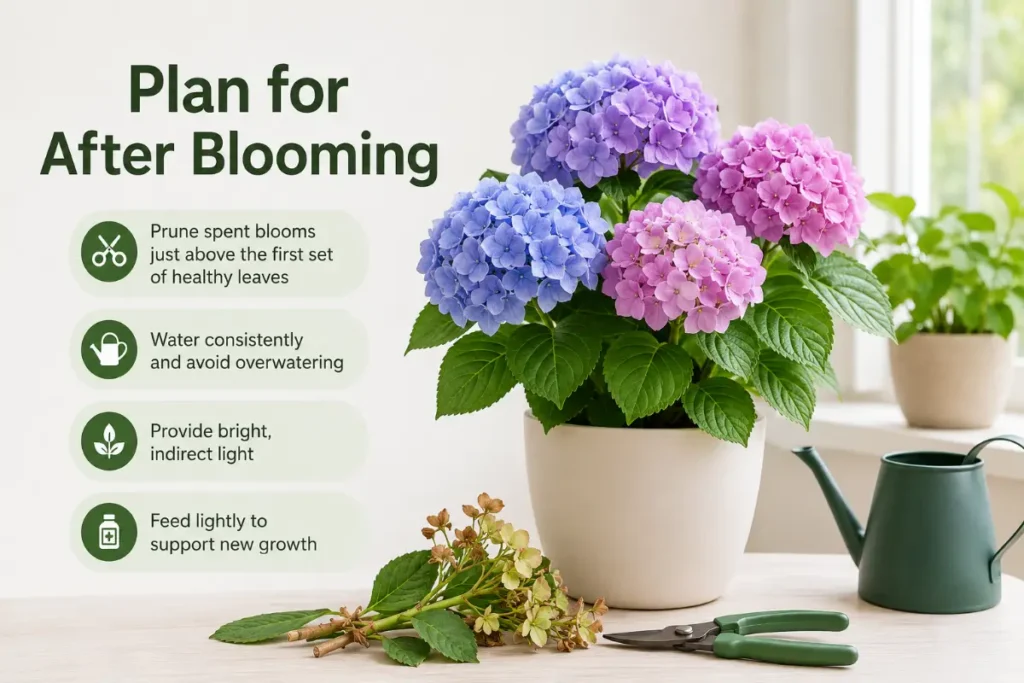
Step 7: Plan for After Blooming
What you plan to do with the plant after blooming ends determines every care decision from purchase onward. There are two realistic paths.
Path 1: Outdoor garden transition (strongly recommended)
After all flowers have finished, gradually transition the plant to outdoor conditions. Move to a shaded outdoor position initially, increasing light exposure over two weeks. Plant in a prepared garden bed with rich, consistently moist, well-draining soil after the last frost date. Hydrangeas planted outdoors after indoor blooming establish themselves through summer and fall and bloom reliably every summer for years to decades with minimal care.
This is the most rewarding outcome for most people. The investment of a gift plant purchase becomes a permanent garden shrub that improves with age.
Path 2: Indoor dormancy management
Keeping a hydrangea indoors through dormancy and attempting to rebloom it the following season requires cool dormancy storage between 35 and 45 degrees Fahrenheit through winter, specific pruning in late winter, and then providing the right conditions to break dormancy and set new flower buds. This is achievable but requires more specific management than outdoor transition and is less reliably successful in typical home environments.
For the complete guide to hydrangea dormancy management and post-bloom care that applies to both indoor and outdoor hydrangeas, caring for a hydrangea plant indoors covers the dormancy cycle in full detail alongside outdoor transition guidance at caring for a hydrangea plant indoors.
Step 8: Watch for Pests
Hydrangeas grown indoors are susceptible to a few specific pest species that take advantage of the controlled indoor environment.
Spider mites are the most common and are particularly aggressive in the warm dry conditions that indoor hydrangeas suffer from. Fine stippling on leaf surfaces and webbing between stems and flower heads indicate mite activity. Neem oil spray every seven days for three weeks handles active infestations. Increasing humidity to above 60% prevents establishment since mites struggle in consistently humid conditions.
Aphids cluster on new soft growth and on the stems below flower heads where sap concentration is highest. Inspect weekly during the bloom period. Treat with a firm spray of water to dislodge colonies followed by neem oil spray if populations persist. For the complete treatment approach for aphids and other soft-bodied flowering plant pests, how to get rid of aphids on indoor plants covers every method from manual removal through biological controls.
Powdery mildew appears as white powdery coating on leaves in poor air circulation conditions. Improve airflow and apply diluted neem oil spray. Prevention through good air circulation around the plant is more effective than treatment after establishment.
Why Hydrangea Flowers Change Color
One distinctive characteristic of Hydrangea macrophylla is that flower color responds to soil pH. Acidic soil (pH below 6.0) produces blue flowers by making aluminum available to the plant. Alkaline soil (pH above 7.0) produces pink flowers. Neutral soil produces purple or mixed tones.
For indoor potted hydrangeas this color-pH relationship is less practically relevant since the bloom cycle is typically too short to make pH adjustments visible. For outdoor-transitioned plants, adding aluminum sulfate to acidify soil produces bluer flowers over subsequent growing seasons and adding lime to raise pH produces pinker flowers.
White-flowering hydrangea varieties are genetically fixed in their color and do not change with soil pH regardless of amendments. Only the blue-pink range responds to acidity.
Buying an Indoor Hydrangea: What to Look For
Most indoor hydrangeas are purchased impulsively at the height of their beauty in garden centers, grocery stores, and florists. Choosing the right plant at the point of purchase significantly affects how long you enjoy it indoors.
What to look for: A plant with a mix of fully open flower heads and buds still developing gives you the longest display since buds continue opening after purchase. A plant where all flowers are fully open is closer to the end of its bloom cycle regardless of how beautiful it looks in the store.
Foliage health: Dark green leaves without yellowing, browning, or spots indicate a well-rooted, well-managed plant. Yellowing lower leaves suggest the plant has been stressed by overwatering or poor light at the store.
Soil moisture: Hydrangea soil should feel consistently moist at purchase. Bone dry soil means the plant has already experienced water stress. Soggy waterlogged soil suggests poor drainage that may have begun root rot before you bring it home.
Store conditions: Avoid plants displayed near heating vents, automatic sliding doors that let in cold blasts, or in very warm store entrances. These conditions stress the plant before purchase and shorten the bloom duration you experience at home.
Hydrangea Color and Soil pH: What You Can Control
Understanding the relationship between soil pH and hydrangea flower color gives you a tool for influencing the appearance of outdoor-transitioned plants in future seasons.
Hydrangea macrophylla flowers blue in acidic soil because low pH makes aluminum ions available to the plant which are incorporated into the flower pigment. In alkaline soil where aluminum is chemically unavailable regardless of its physical presence, the same plant produces pink flowers. Neutral soil produces purple or mixed tones.
For indoor potted plants during their brief bloom period this chemistry has limited practical application since the bloom cycle is too short for pH adjustments to become visible in the current flower color. The color you see at purchase is essentially the color you will enjoy through the indoor bloom.
For outdoor-transitioned plants in subsequent seasons, you can influence color by acidifying soil with aluminum sulfate for bluer flowers or adding garden lime to raise pH for pinker flowers. Make adjustments in fall for the following season’s flowers since the color chemistry develops as buds form over winter and spring.
For the complete guide to managing soil pH for acid-loving plants including hydrangeas, and how coffee grounds and peat moss contribute to long-term soil acidity maintenance, what indoor plants like coffee grounds covers the pH management approach that applies to hydrangeas and every other ericaceous plant in indoor and outdoor settings. And for a deeper understanding of how peat moss specifically maintains the acidic conditions blue hydrangeas need in garden soil, peat moss for indoor plants covers the pH-lowering properties and application guidance that applies equally to garden beds prepared for hydrangea planting.
Seasonal Care Timeline for Indoor Hydrangea
Managing an indoor hydrangea through its full seasonal cycle with a clear timeline removes the guesswork from knowing what to do at each stage.
At purchase during bloom: Cool bright position. Consistent daily moisture. High humidity. No fertilizer. Deadhead spent flowers promptly. Enjoy the display.
As flowers finish (typically four to six weeks after purchase): Remove all spent flower heads. Assess outdoor transition timing based on local last frost date and nighttime temperatures. Begin very light fertilizing if keeping indoors through dormancy.
Spring outdoor transition: After last frost date when nights stay above 45 degrees, move to a shaded outdoor position initially. Acclimate over two weeks with increasing light exposure. Plant in prepared garden bed with rich moist well-draining soil amended with compost.
First outdoor summer: The plant establishes its root system through summer. Some varieties bloom lightly in their first outdoor summer. Others use their first season entirely for root establishment and bloom more strongly in subsequent years.
Ongoing outdoor care: Mulch around the base in winter to protect roots in zones 5 and below. Prune dead wood in early spring before new growth begins. Apply balanced slow release fertilizer in early spring. Enjoy increasingly spectacular bloom displays as the plant matures over years and decades.
Conclusion
Care of hydrangea plants indoors succeeds most completely when you accept the plant’s true nature as a temperate outdoor shrub and manage its indoor stay as a temporary bloom display rather than a permanent indoor resident. Cool temperatures extending the bloom period. Consistent moisture preventing the dramatic wilting these water-demanding plants exhibit when stressed. High humidity protecting flower quality. Bright indirect light without hot direct sun. And a clear plan for outdoor garden transition after blooming ends.
The hydrangea that collapses in a warm living room within a week of purchase is not a failed plant. It is a temperate garden shrub in the wrong environment. Give it cool bright conditions and consistent moisture and that same plant delivers four to six weeks of one of the most spectacular flowering displays available from any plant sold at retail. Then put it in your garden and enjoy it for decades.
Frequently Asked Questions
Why is my indoor hydrangea wilting?
Hydrangea wilting indoors is almost always caused by insufficient watering, warm temperatures, or both combined. Hydrangeas are among the most water-demanding flowering plants and wilt dramatically when soil dries even partially during the bloom period. Water thoroughly immediately and move to a cooler position. If the plant does not recover within three hours of thorough watering, check for root rot from chronically waterlogged soil as an alternative cause.
How long do indoor hydrangeas last?
With cool temperatures between 50 and 65 degrees Fahrenheit and consistently moist soil, indoor hydrangeas bloom for four to six weeks. In warm rooms above 70 degrees the bloom period shortens to one to two weeks. Temperature is the single biggest factor in how long an indoor hydrangea maintains its flowers. The cooler the bright position you can provide, the longer the display.
Can I keep my hydrangea indoors permanently?
Hydrangeas are outdoor temperate shrubs that do not adapt well to permanent indoor growing. They require the cool winter dormancy that outdoor conditions provide naturally to set flower buds for the following season. Attempting to keep them as permanent indoor plants without providing this dormancy produces a plant that survives but blooms poorly or not at all in subsequent years. Outdoor garden transition after the indoor bloom period is the most rewarding long-term approach.
How do I get my indoor hydrangea to rebloom?
Reblooming requires either successful outdoor garden establishment where the plant follows its natural seasonal cycle, or controlled indoor dormancy management with cool storage below 45 degrees through winter followed by careful spring reactivation. The outdoor path is significantly more reliable and requires less active management. Plant in a prepared outdoor bed after the last frost and the hydrangea will rebloom reliably every summer.
Should I cut back my hydrangea after it blooms indoors?
Remove spent flower heads promptly as they fade. Beyond deadheading, do not prune aggressively until you have decided on the outdoor or indoor dormancy path. For outdoor transition, light shaping after planting outdoors is appropriate. For indoor dormancy management, specific pruning in late winter before new growth begins is the correct timing.
Why are my hydrangea flowers turning brown at the edges?
Brown flower edges on indoor hydrangeas most commonly indicate low humidity or warm temperatures desiccating the large flower petals. Increase humidity with a pebble tray or humidifier and move to a cooler position. Direct sun exposure causes rapid browning from heat rather than desiccation. Move out of direct sun to bright indirect light. Overwatering causing root rot can also present as browning flowers when the root system can no longer support adequate water delivery to the large flower heads.