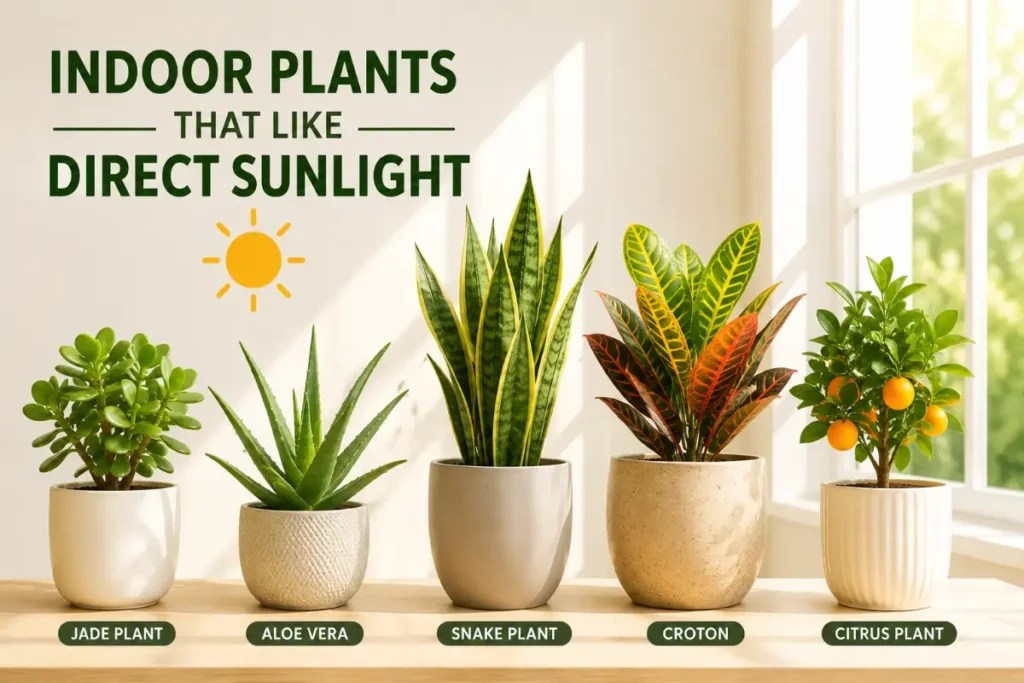
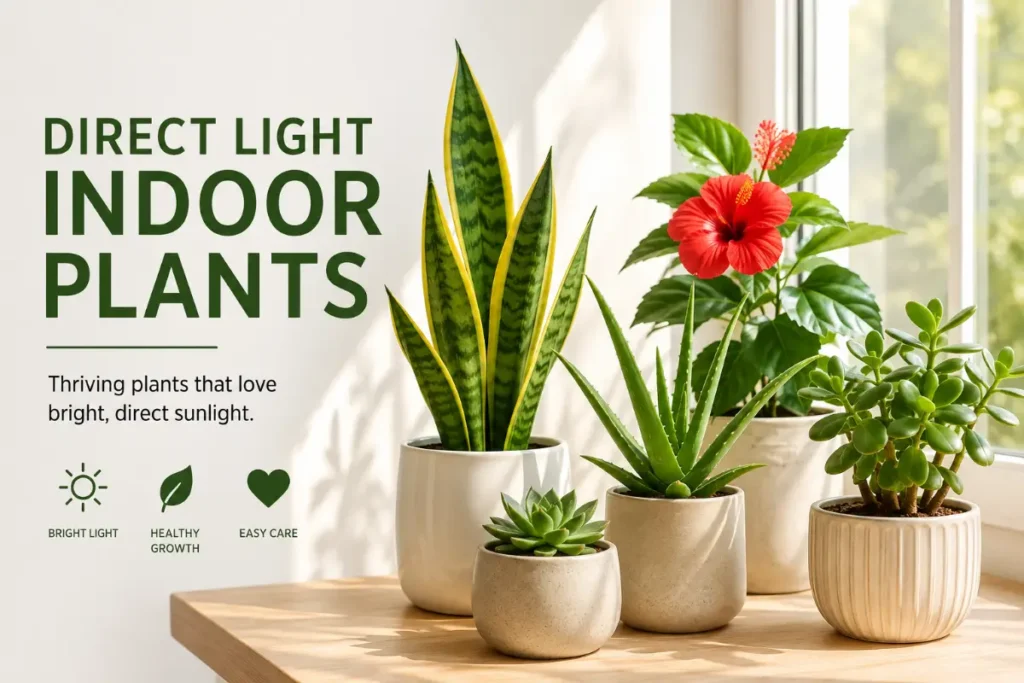
Direct light indoor plants are among the most commonly misplaced houseplants in US homes. Not because people deliberately put sun-loving plants in dark corners, but because the signs that a plant needs more direct light are often misread as signs of other problems. Brown tips get blamed on overwatering. Pale leaves get treated with fertilizer. Leggy, stretched growth gets attributed to the wrong pot size. Meanwhile the actual problem, a plant that evolved in high-intensity sunlight sitting in insufficient direct light, goes unaddressed and the plant continues declining.
This guide takes a diagnostic approach. It covers the eight most common and most distinctive signs that a plant needs more direct light, explains what each signal means biologically, and gives you practical guidance on how to correct each situation. If you have a sun-loving plant that is not performing well, this is where to start.
Quick Answer
Direct light indoor plants show insufficient sun through eight characteristic signs: etiolation (stretching toward light), pale or faded leaf color, loss of variegation or sun-stress coloring, reduced or absent flowering in blooming species, smaller new leaves than existing ones, weak stems that cannot support their own weight, increased pest susceptibility, and very slow or completely stopped growth during the growing season. Each of these signals points to a specific biological response to insufficient light and can be corrected by improving direct light access.
Understanding Why Direct Light Plants Need Direct Sun
Before covering the eight warning signs, understanding why direct-sun plants specifically need direct rather than indirect light prevents the common assumption that “bright indirect light” is close enough for all sun-loving plants.
Direct sunlight provides three things that bright indirect light does not deliver at equivalent intensity.
Total photon quantity: Direct sunlight delivers more photosynthetically active photons per square meter per second than any indirect light position. Even the brightest indirect light position delivers approximately 20 to 30% of the photon quantity that direct south-facing window sun provides. For plants adapted to high-intensity sun environments, this difference is not trivial.
UV-A wavelengths: Standard glass filters significant UV but some UV-A passes through, particularly through single-pane glass. This UV-A drives the production of protective anthocyanin pigments that create the vivid colorations in succulents and croton, increases essential oil concentration in herbs, and contributes to compact stem structure. Bright indirect light has essentially no meaningful UV-A component.
Blue-spectrum intensity: The blue wavelengths that drive photomorphogenesis, the process controlling stem elongation, leaf expansion, and plant form, are present at higher intensity in direct sunlight than in indirect light. Insufficient blue light intensity is the primary driver of the etiolation described in Sign 1 below.
Sign 1: Etiolation — Stretching Toward the Light
Etiolation is the most visually obvious sign that a direct-light plant is not getting enough sun. It describes the pattern of stem growth where internodes, the sections of stem between leaf attachment points, become progressively longer as the plant stretches toward any available light source.
What it looks like: A plant that previously had leaves closely spaced along its stems now has leaves several inches apart on the same stems. The plant may lean noticeably toward the nearest window. New growth is lighter colored than the existing foliage. The overall plant looks stretched out and sparse compared to its original compact form.
Why it happens: When a plant’s photoreceptors detect insufficient blue-light intensity, they trigger a hormonal response (primarily auxin redistribution) that elongates cells on the shaded side of stems, causing them to bend toward the light source and extend in length to reach better light conditions. This is a genuine adaptive strategy that works in the plant’s natural habitat where moving a few inches toward a light gap can dramatically improve light access. Indoors in a pot it just produces an increasingly unattractive, weakened plant.
The fix: Move to a direct sun position in a south or west-facing window. Etiolated growth does not revert to compact growth but new growth produced in better light emerges with appropriate compact form. Prune back leggy etiolated stems to encourage new compact growth from lower nodes where the plant’s stored energy produces fresh growth in better light conditions.
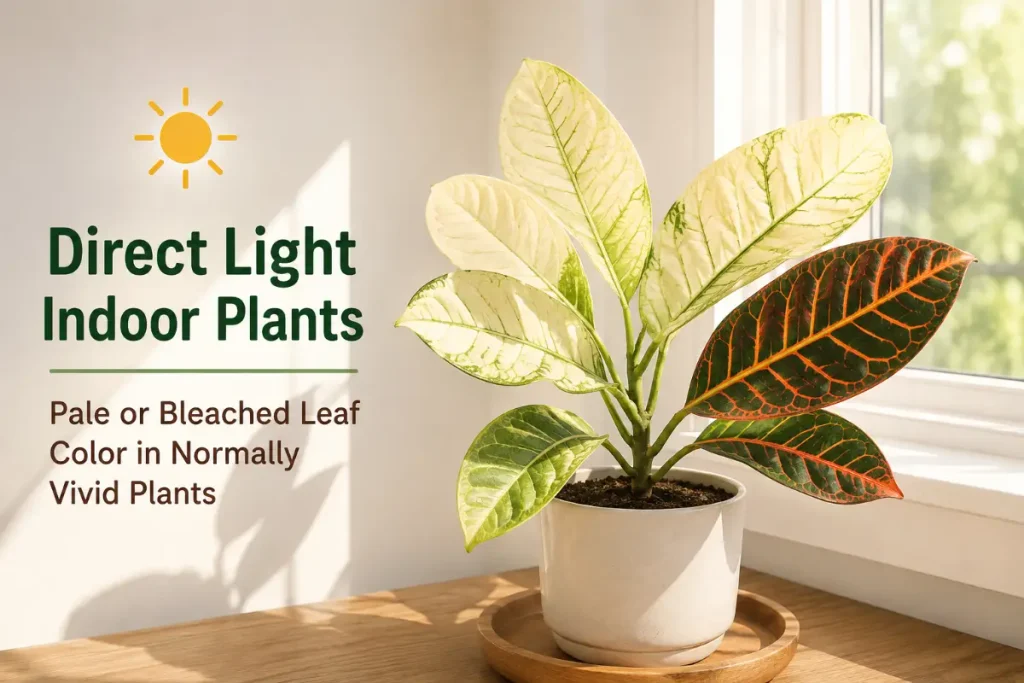
Sign 2: Pale or Bleached Leaf Color in Normally Vivid Plants
For plants where vivid coloration is part of their characteristic appearance, pale, washed-out color is one of the clearest signs of insufficient direct light. This is distinct from the directional bleaching caused by too much intense sun, which produces pale patches on the sun-facing side of leaves while the rest of the plant remains normal.
What it looks like in specific plants: Croton leaves that were vivid red, orange, and yellow fade toward muted yellow-green and olive. Succulents with characteristic sun-stress pink or purple margins fade to plain green. Rosemary and lavender produce pale grey-green growth instead of the rich silver-green of well-lit plants. Geranium flowers appear washed out rather than saturated in color.
Why it happens: The pigments responsible for vivid color in these plants, anthocyanins for reds and purples, carotenoids for yellows and oranges, are produced in response to light stress signals including high light intensity and UV exposure. In insufficient light these metabolically expensive non-photosynthetic pigments are reduced or eliminated as the plant maximizes chlorophyll production for light capture in any available wavelength.
The fix: Move to a direct south or west-facing window. New growth produced in better light emerges with full color intensity within two to four weeks. Already-faded leaves may show some color improvement as the plant adjusts but do not fully recover. Pruning to promote fresh new growth in better light conditions produces the fastest visual improvement.
Sign 3: Loss of Variegation
Variegated plants that lose their white, yellow, or colored markings and revert toward solid green are specifically signaling that light is insufficient for the plant to maintain the metabolic cost of producing non-green tissue alongside its chlorophyll-containing green tissue.
Why variegation fades: Variegated leaf tissue (white, yellow, or pale areas) contains less chlorophyll than green tissue. In sufficient light this reduced chlorophyll is compensated by the contribution of the surrounding green tissue. In insufficient light the plant reduces or eliminates the non-photosynthetic variegated areas to maximize total chlorophyll coverage for light capture. This is an adaptive response that works in the short term but produces aesthetically unappealing plants.
Plants most affected: Golden pothos fading to solid green. Marble queen pothos losing its cream marbling. Variegated snake plant losing its yellow margins. Croton retaining only green rather than its multicolored pattern. Variegated rosemary producing increasingly plain growth.
The fix: Move to brighter direct light. In some plants variegation returns to new growth in better light conditions. In others once variegation is lost from existing leaves it does not return to those leaves, but new growth emerges with full variegation. Direct south-facing sun produces the best variegation retention for most variegated direct-light plants.
Sign 4: Reduced or Absent Flowering in Blooming Species
Flowering plants that need direct sun stop producing flowers or produce very few flowers with minimal color saturation in insufficient light. This is among the clearest diagnostic signs for sun-dependent bloomers like hibiscus and geraniums.
The light-bloom connection: Flowering requires more energy than vegetative growth. A plant in insufficient light prioritizes survival (maintaining existing tissue through whatever photosynthesis it can manage) over reproduction (producing energy-intensive flowers and seeds). The result is a plant that looks vegetatively acceptable but produces no flowers or only occasional small flowers with reduced color.
What hibiscus does: Hibiscus in insufficient direct light produces abundant, healthy-looking foliage with essentially no flowers. The plant can look deceptively healthy while failing to do the one thing it is grown for. Moving to direct south-facing sun transforms it from a foliage plant to a continuous bloomer within weeks.
What geraniums do: Geraniums in insufficient light produce stretched, sparse growth with occasional single flowers on long weak stems rather than the tight clusters of flowers on compact stems that full sun positions produce.
The fix: Move to maximum available direct south-facing sun immediately. Bloom production in appropriate direct sun typically begins within two to four weeks as existing buds that were suppressed in low light begin developing and new bud sites activate in response to improved light conditions.
Sign 5: New Leaves Smaller Than Existing Ones
When a plant in a direct-light position begins producing new leaves significantly smaller than the mature leaves already on the plant, it signals that the energy available for new tissue production has declined. In a previously healthy plant this most commonly indicates declining light conditions such as a seasonal reduction in sun hours, a tree outside the window leafing out in spring, or a position change that reduced direct sun access.
Why new leaves are smaller: Leaf size is determined during the initial expansion phase immediately after the leaf emerges from its bud. The plant allocates the energy available at that moment to expanding the leaf. In high light with abundant photosynthate, leaves expand to full size. In insufficient light the available energy for expansion is reduced and the leaf reaches a smaller final size before cell division and expansion stop.
The progressive nature: This sign worsens over time. As older large leaves naturally age and drop, they are replaced by progressively smaller new leaves. The plant becomes increasingly sparse looking as its total leaf area declines in each generation of new growth.
The fix: Restore direct light access. New growth produced after improving light conditions emerges at normal size within weeks. Already-produced small leaves do not expand further but stop creating the false impression of decline once new normal-sized growth appears alongside them.
Sign 6: Weak Stems That Cannot Support the Plant’s Own Weight
Stems on direct-light plants in insufficient light become increasingly weak and unable to support the plant’s weight without staking, drooping, or flopping. This is particularly noticeable in plants that maintain strong, upright, or structured form in good light.
The biology of stem weakness: Blue-light signals from adequate direct sun exposure trigger the production of shorter, stronger stem cells with thicker walls. In insufficient blue light, cells elongate and thin walls rather than producing the structural strength of sun-grown stems. Combined with the etiolation response that lengthens stems, the result is a tall, thin, weak plant that droops under its own weight.
Plants most affected: Rosemary and lavender with stems too weak to hold their characteristic upright form. Aloe vera with leaves that flop outward rather than standing upright from the rosette. Succulents with unstable, leaning rosettes. Hibiscus with long, thin stems that droop rather than holding flower heads upright.
The fix: Move to direct south-facing sun and prune back weak stems severely. New growth produced in good light is significantly stronger than the existing weak growth. Temporary staking supports the plant during the transition period while new strong growth develops from better-lit positions.
Sign 7: Increased Pest Susceptibility
Direct-light plants in insufficient light become noticeably more susceptible to the pest problems they would normally resist. Spider mites, aphids, and fungal diseases establish more readily on light-stressed plants than on healthy, vigorously growing specimens in appropriate direct sun.
Why light stress increases pest susceptibility: Plants produce their own defensive compounds including resins, essential oils, and phenolic compounds that deter pests and resist fungal infection. Production of these compounds requires the energy from adequate photosynthesis. In insufficient light, a plant invests what limited photosynthate it can produce in basic survival functions and reduces production of defensive compounds.
The compound effect: A light-stressed plant with reduced defenses in the still, stagnant air of an interior position that receives insufficient direct sun faces both compromised defenses and the environmental conditions that favor pest establishment. The combination of low light and still air is the most pest-prone indoor plant environment.
The fix: Improve light conditions first, then treat the pest problem. Treating pests on a plant that remains in insufficient light produces only temporary improvement since the plant continues producing the weakened growth that makes it susceptible. Moving to direct sun restores the plant’s natural defenses while the pest treatment addresses the immediate infestation. For the complete approach to treating the specific pests that most commonly affect light-stressed direct-sun plants, how to get rid of aphids on indoor plants covers aphid treatment and indoor plants that repel bugs covers the pest deterrent properties that healthy, well-lit Mediterranean herb plants specifically provide.
Sign 8: Stopped Growth During the Active Growing Season
The most unambiguous sign that a direct-light plant is not getting what it needs is zero new growth through spring and summer when all growth conditions except light are adequate. Active growth during the warm months requires energy from photosynthesis. In insufficient light there is not enough photosynthate produced to support new growth even when water, temperature, and nutrients are all appropriate.
Distinguishing from normal dormancy: Many plants naturally slow or stop growth in winter in response to shorter days and lower temperatures. This is expected and appropriate seasonal behavior. Growth that stops or remains minimal through spring and summer when temperatures are warm and days are long is not normal dormancy. It is a light deficiency response.
What to check first: Confirm the growing season is underway (consistent temperatures above 65 degrees, increasing day length after the spring equinox). Confirm watering is appropriate and soil is not waterlogged. Confirm fertilizing is occurring every two to four weeks. If all of these are in order and the plant is still producing no new growth, light is almost certainly the limiting factor.
The fix: Move to the most direct-sun position available in a south or west-facing window. New growth typically begins within two to four weeks of improved light conditions as the plant has enough photosynthate to invest in new tissue production. For guidance on supplementing natural direct sun with grow lights for plants that cannot be moved to a better window position, UV light for plants indoor covers grow light selection and placement for supplementing natural light effectively.
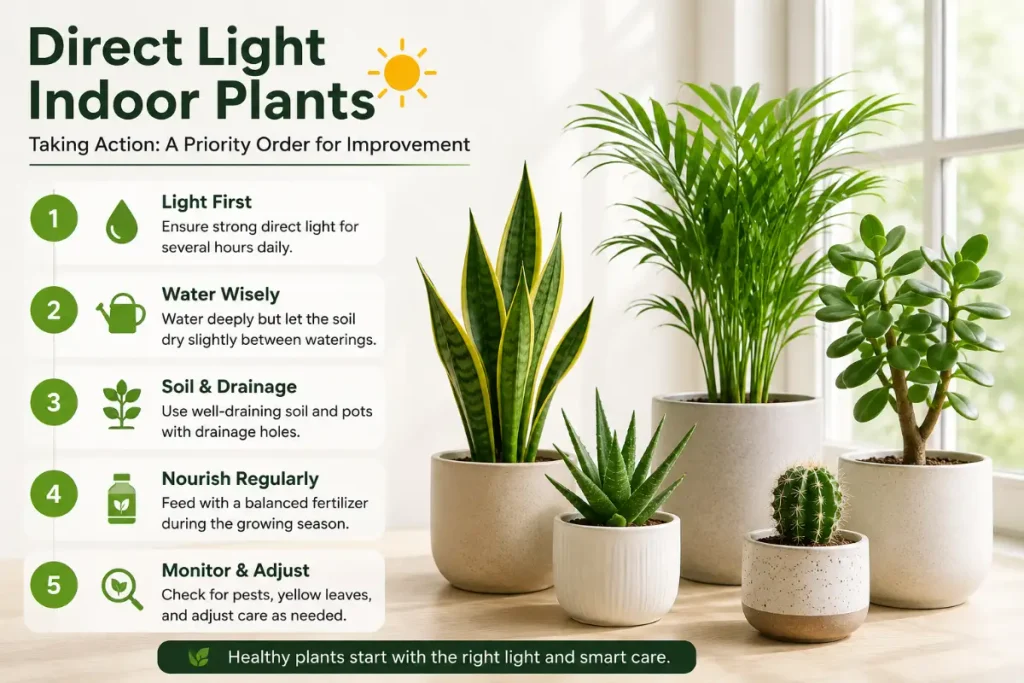
Taking Action: A Priority Order for Improvement
When a plant shows multiple signs from this list, addressing them in the right order produces faster improvement than tackling everything simultaneously.
First priority: Light. Move to the best available direct sun position immediately. Everything else improves faster once light is adequate.
Second priority: Pest treatment. If pests are present, begin treatment once the plant is in better light. Treating pests before improving light extends the treatment period unnecessarily since the plant remains susceptible.
Third priority: Pruning. After two to three weeks in better light, prune back the weakest, most etiolated growth to encourage compact new growth from better positions on the plant. Pruning before adequate light is established removes the existing leaf area the plant needs to begin recovering through photosynthesis.
Fourth priority: Fertilizing. Resume or increase fertilizing after the plant shows new growth in better light conditions. Fertilizing before adequate light and initial recovery wastes nutrients the plant cannot use and accumulates salts in the pot.
Conclusion
Direct light indoor plants in insufficient sun tell you clearly and consistently that something needs to change. Etiolation, pale color, lost variegation, absent flowering, progressively smaller leaves, weak stems, increased pests, and stopped growth are all different expressions of the same underlying problem: a plant adapted to high-intensity direct sun that is not receiving it.
Reading these signs correctly saves time spent treating the wrong problem. Move to the best direct sun position first. Let the plant respond to improved light for two to four weeks. Then address the secondary issues of pests, weak growth, and appearance through targeted pruning and fertilizing as the plant begins recovering with the energy from adequate photosynthesis.
Frequently Asked Questions
How do I know if my plant needs direct sunlight or indirect sunlight?
Sun-adapted plants including cacti, succulents, jade plant, Mediterranean herbs, hibiscus, geraniums, aloe vera, and croton need direct sunlight for their best performance and show the eight warning signs in this guide when they do not receive it. Shade-adapted plants including pothos, peace lily, ferns, calathea, and heartleaf philodendron perform best in indirect light and show bleaching and scorching when placed in direct sun. Check the plant’s origin: desert or Mediterranean origin suggests direct sun preference, tropical forest origin suggests indirect light preference.
Can bright indirect light substitute for direct sunlight?
For plants that evolved in desert, Mediterranean, or high-altitude grassland conditions, bright indirect light is not a substitute for direct sun. These plants produce significantly less growth, less vivid color, fewer flowers, and weaker stems in bright indirect light compared to appropriate direct sun. For plants that evolved in tropical forest conditions, bright indirect light is actually preferable to the direct sun that would damage their thin, broad, shade-adapted leaves.
How long does it take to see improvement after moving a plant to direct sun?
Most direct-light plants show initial signs of improvement within two to four weeks of moving to appropriate direct sun. New growth emerging in better light is the most reliable indicator of recovery. Color improvement in new growth happens simultaneously. Flower buds on blooming species typically develop within two to four weeks in appropriate light. Already-produced pale, etiolated, or small growth does not improve in place but stops being produced as new healthy growth replaces it over months.
Why is my sun-loving plant not improving despite direct sun?
If a direct-light plant shows no improvement after two to four weeks in direct sun, check for root rot from previous overwatering during its time in insufficient light. Root rot produces symptoms similar to light deficiency and is more common in plants that have been in low light where reduced photosynthesis leads to reduced water uptake and chronically wet soil. Remove from pot and inspect roots. If overwatering is ruled out, confirm the direct sun position provides at least three to four hours of actual direct rays touching the plant rather than just a bright room.
Do direct light plants need more water than indirect light plants?
Yes. Direct sun plants photosynthesize more actively and transpire more water through their leaves than the same plants in indirect light. Watering frequency increases noticeably when a plant moves from indirect to direct sun, particularly during summer when high temperatures increase transpiration further. Always check actual soil moisture before watering rather than following fixed schedules since direct sun conditions change watering frequency significantly compared to indirect light positions.
Is it better to move a struggling plant to direct sun gradually or immediately?
Gradually is almost always better. Even for genuinely sun-adapted plants, moving directly from low light to intense direct south-facing afternoon sun can cause sun-stress bleaching on leaves that developed in low-light conditions. A two to three week gradual transition starting with morning direct sun for a few hours daily before full direct sun exposure prevents this transitional damage and allows the plant to develop the protective adaptations for direct sun alongside the improved light access it needs.