

Osmocote Plus Outdoor and Indoor Smart Release Plant Food is one of the most recognized fertilizer products on the market, and for good reason. It has been feeding plants in gardens and homes across the country for decades and consistently delivers what it promises: steady, reliable nutrition that lasts months from a single application. But buying the right fertilizer and using it correctly for indoor plants are two different things, and the outdoor-focused label rate on most Osmocote packaging is one of the most common reasons indoor gardeners either burn their plants or feel underwhelmed by the results.
This guide gives you an honest, complete picture of how Osmocote Plus works, what makes it genuinely good for indoor plants, where it falls short, how to apply it safely, and how it compares to the competition so you can decide if it is the right choice for your plant collection.
Quick Answer
Osmocote Plus Outdoor and Indoor Smart Release Plant Food is a polymer-coated granular fertilizer with a 15-9-12 NPK ratio plus 11 essential micronutrients. It feeds plants for up to six months from one application. For indoor plants, apply at half the label rate by pressing granules into the top inch of soil. It is one of the most convenient and reliable slow release options available but does not improve soil biology the way organic fertilizers do. Best for foliage plants and mixed collections where simplified feeding matters most.
What Osmocote Plus Actually Is
Osmocote Plus is a controlled-release fertilizer where each granule consists of nutrient salts coated in a semi-permeable polymer resin. When the granule contacts moisture during watering, water moves through the resin coating and dissolves a small amount of the nutrients inside. That dissolved nutrient solution then moves back out through the coating into the surrounding soil where plant roots absorb it.
The release rate is primarily moisture-driven rather than temperature-driven, which is an important distinction for indoor use. Temperature-controlled release products work well outdoors where seasonal temperature changes naturally correspond to plant growth periods. Indoors where temperatures stay relatively constant year-round, moisture-based release is more predictable and better suited to the watering schedules of potted houseplants.
The Plus formulation specifically includes 11 micronutrients beyond the primary NPK: magnesium, sulfur, boron, copper, iron, manganese, molybdenum, and zinc. These trace minerals are frequently the nutrients that become depleted from potting mix first since commercial mixes are designed to a baseline standard that long-term plant growth depletes over months.
The NPK Ratio: 15-9-12 Explained
The 15-9-12 NPK ratio of Osmocote Plus is slightly nitrogen-forward, which suits the broadest range of common foliage houseplants well. Breaking it down:
15 nitrogen drives healthy leaf production and the rich green color that makes foliage plants attractive. For plants like pothos, philodendrons, monsteras, and snake plants grown primarily for their leaves, nitrogen is the nutrient that produces the most visible results.
9 phosphorus supports root development and flowering. The lower phosphorus ratio compared to nitrogen makes this formulation better suited to foliage plants than to flowering houseplants that perform better with a more phosphorus-forward formula during their blooming period.
12 potassium supports overall plant health, water regulation, and disease resistance. The relatively high potassium content is one of the distinguishing features of the Plus formulation compared to original Osmocote which has a simpler 14-14-14 ratio.
For predominantly foliage collections, the 15-9-12 ratio of Osmocote Plus is well matched. For flowering houseplants including African violets, orchids, and gardenias, a higher phosphorus formula or switching to a phosphorus-forward liquid fertilizer during the bloom period alongside Osmocote Plus produces better flowering results.
How to Apply Osmocote Plus to Indoor Plants Correctly
This is where most indoor gardeners go wrong. The label on Osmocote Plus shows application rates calculated for outdoor garden beds with large soil volumes, high drainage, and the higher nutritional demand of plants growing in full-sun outdoor conditions. Applying those rates to a small indoor pot creates salt accumulation that causes brown leaf tips and root burn rather than the healthy growth you were expecting.
The indoor application rule: always use half the label rate.
For a standard 6-inch pot the label might suggest one tablespoon. Use half a tablespoon. For a large 12-inch pot where the label suggests two tablespoons, use one tablespoon. This halved rate delivers appropriate nutrition for the limited soil volume of a pot without the accumulation problems that outdoor rates create indoors.
Application method:
Scatter granules evenly across the soil surface at the half rate. Press them gently into the top inch of soil rather than leaving them sitting on the surface where they are more likely to release unevenly or roll out of the pot when watering. Water normally after application to begin the release cycle.
How often to reapply:
Osmocote Plus releases for up to six months under outdoor conditions with frequent watering. Indoors where watering is less frequent, expect four to five months of effective release per application. Reapply in spring when the previous application is running out, and again in midsummer if needed. Do not apply through fall and winter when most houseplants slow their growth and cannot use the nutrition efficiently.
After repotting: Wait four to six weeks before applying Osmocote Plus to a freshly repotted plant. Fresh potting mix already contains starter nutrients and the disturbed root system during the establishment period is more vulnerable to fertilizer concentration. For the complete guide on post-repotting nutrition timing, do you need nutrients after repotting a indoor plants covers exactly when to start and what rate to use.
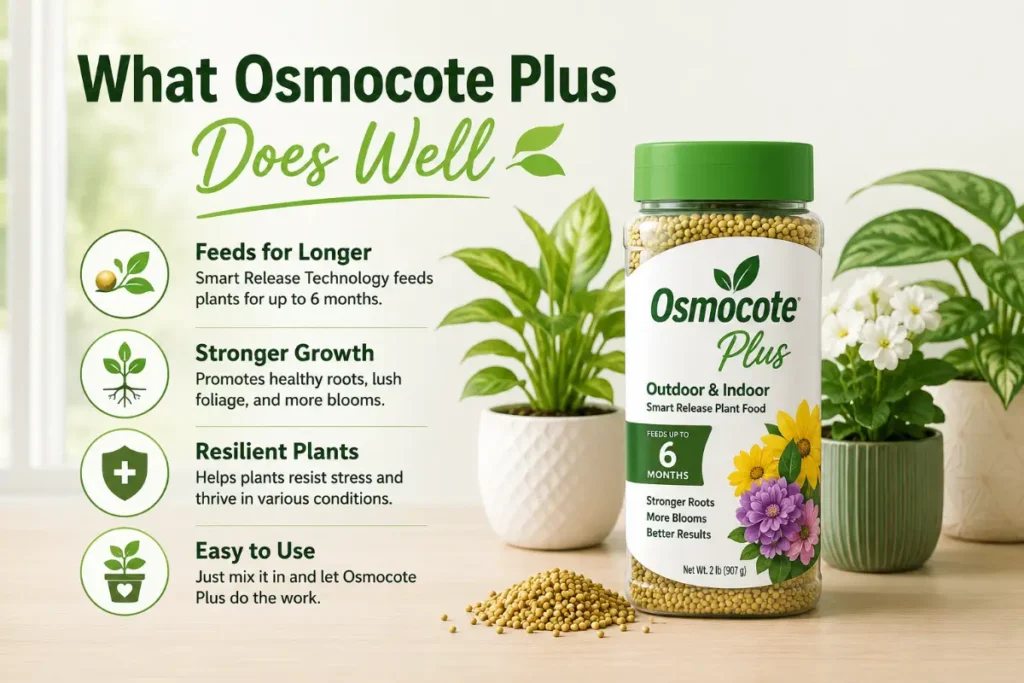
What Osmocote Plus Does Well
Convenience. One application every four to five months eliminates the biweekly measuring and mixing of liquid fertilizers. For plant owners with large collections or busy schedules, this is the single biggest practical advantage and it is a genuine one.
Micronutrient coverage. The 11 micronutrients in the Plus formulation address the trace mineral depletion that is one of the most common but least visible causes of indoor plant decline over time. Standard liquid fertilizers often cover only the primary NPK without addressing the micronutrients that plants need in smaller quantities but cannot grow well without.
Predictable, consistent release. The polymer coating produces reliable release rates that do not spike and crash the way some organic fertilizers can. Plants fed with Osmocote Plus receive a consistent small nutrient dose with every watering rather than a large dose followed by depletion.
Wide availability. Home Depot, Lowe’s, Walmart, Amazon, and most garden centers carry Osmocote Plus. Finding it is never a problem regardless of where you live.
Long shelf life. Unused granules stored in the original sealed container last for years without losing effectiveness, unlike liquid fertilizers that can degrade and organic products that can change in quality over time.
Where Osmocote Plus Falls Short
No soil biology benefit. Osmocote Plus feeds the plant but does nothing for the living ecosystem of beneficial bacteria and fungi that healthy potting mix contains. Over twelve to eighteen months of exclusive Osmocote Plus use without organic amendments, potting mix becomes nutritionally supplemented but biologically depleted. Plants fed only with synthetic slow release fertilizers long-term often need repotting more urgently than those maintained with organic options alongside.
Not ideal for sensitive or specialty plants. Orchids, succulents, and carnivorous plants have specific nutritional requirements that the 15-9-12 ratio and six-month release rate do not serve well. Orchids need very dilute nutrition and benefit from fertilizer programs specifically designed for their sensitivity. Succulents and cacti need lower nitrogen than this formulation provides. Carnivorous plants should not be fertilized at all.
Outdoor label rates mislead indoor users. This is not a flaw in the product itself but it is consistently the source of the negative experiences people report with Osmocote indoors. The label does not make the indoor half-rate application clear enough and many new users apply the full outdoor rate and then blame the product when their plants show burn symptoms.
Salt accumulation over time. Synthetic fertilizers including Osmocote Plus contribute mineral salts to potting mix with every application. Flushing the soil thoroughly with plain water every three to four months prevents the white crust that appears on soil surfaces and pot rims when salts accumulate to visible levels. This is standard maintenance for any synthetic fertilizer rather than a specific Osmocote problem but worth knowing before you start.
Osmocote Plus vs Original Osmocote: What Is the Difference
The original Osmocote (14-14-14) and Osmocote Plus (15-9-12 plus micronutrients) are the two main formulations most commonly available at US retailers.
Original Osmocote delivers equal parts NPK in a simple balanced formula without micronutrients. It suits plants that need balanced feeding without specific nutritional requirements beyond the primary three macronutrients.
Osmocote Plus provides a nitrogen-forward ratio with added micronutrients that address the trace mineral depletion that original Osmocote does not cover. For most indoor plant collections, the Plus formulation is the better practical choice because the micronutrient inclusion eliminates one category of deficiency that original Osmocote leaves unaddressed.
The price difference between the two is minimal. The micronutrient benefit of the Plus formulation is real. Most indoor gardeners are better served by the Plus version unless they have a specific reason to prefer the equal ratio of original Osmocote.

How Osmocote Plus Compares to Organic Slow Release Options
The comparison that matters most for deciding between Osmocote Plus and organic slow release alternatives comes down to what you want from your fertilizer beyond just delivering nutrients.
Osmocote Plus delivers predictable, complete nutrition including micronutrients from a convenient single product. It does not improve soil health beyond the nutritional content of the granules themselves.
Organic slow release options including worm castings and Jobe’s Organics granules deliver nutrition alongside beneficial microorganisms and growth hormones that improve soil biology and plant resilience over time. Their NPK values are lower and their release is somewhat less predictable than Osmocote.
The practical answer for most indoor plant owners is that combining both works better than choosing one exclusively. Using Osmocote Plus in spring for the four to five month initial release period, then supplementing with worm castings top dresses through summer, gives you the precise, micronutrient-complete nutrition of Osmocote alongside the soil biology benefit of organic amendments. For the complete comparison of worm castings against synthetic slow release options, worm castings for indoor plants covers every difference in detail. And for how Osmocote Plus fits into a complete slow release fertilizer program alongside other options, slow release fertilizer for indoor plants covers every product comparison.
Signs Osmocote Plus Is Working for Your Indoor Plants
Two to four weeks after application, watch for these signs that the fertilizer is releasing and your plants are using it effectively.
New leaves that are noticeably larger and darker green than what the plant was producing before. This is the clearest nitrogen uptake signal and usually the first visible change.
Faster production of new growth overall. A plant that was putting out one new leaf per month in early spring should accelerate to two or three per month through peak growing season with Osmocote Plus in the soil.
In flowering plants, more abundant flower production and slightly earlier onset of the blooming period than in previous seasons without fertilizer.
If none of these signs appear four weeks after application, check light levels before questioning the fertilizer. No fertilizer compensates for insufficient light. A plant not receiving enough light to photosynthesize efficiently cannot use the nutrients Osmocote provides regardless of how well the product is performing.
Where to Buy Osmocote Plus and What Size to Get
Osmocote Plus is one of the most widely distributed fertilizer products at US retailers and finding it is rarely a problem.
Home Depot and Lowe’s carry Osmocote Plus in the fertilizer aisle year-round in multiple sizes. The 8-ounce shaker bottle is the most commonly stocked size and suits small to medium indoor plant collections well. The 2-pound resealable bag is more economical for larger collections.
Amazon carries every available size including the larger 8-pound bags that represent significantly better value per application for anyone with ten or more houseplants. The product ships well since the dry granules are not affected by shipping conditions.
Walmart typically stocks the smaller shaker bottle sizes, which are convenient for first-time buyers who want to try the product before committing to a larger quantity.
What size makes sense for indoor use:
The 8-ounce shaker bottle applies Osmocote Plus to approximately 10 to 15 medium-sized indoor plant pots at the indoor half rate, making it the right starting size for most home plant collections. The 2-pound bag applies to 30 to 40 pots and makes sense for larger collections or anyone who has used Osmocote Plus before and wants to stock up. At the correct storage conditions of cool and dry, sealed bags last for several years without degradation.

Common Questions About Using Osmocote Plus Indoors
One question that comes up regularly is whether the granules should be visible on the soil surface or fully buried. The answer is that pressing them into the top inch of soil rather than leaving them sitting on top is better for two reasons. Granules on the surface are more likely to roll to the pot edge when you water and concentrate there rather than distributing evenly through the root zone. Surface granules also receive the full moisture contact of watering immediately, which can cause a brief spike in release rate rather than the steady gradual release the product is designed to provide.
Another common question is what to do with granules still in the soil when it is time to repot. You do not need to remove them. Simply repot as normal and the granules in the root ball continue releasing in the new pot. Add fresh granules at the half rate to the new potting mix after the four to six week post-repot waiting period. For full guidance on the timing and approach to fertilizing newly repotted plants, do you need nutrients after repotting a indoor plants covers every consideration with specific timing guidance.
The third frequent question is whether Osmocote Plus works for seed starting. It is not appropriate for seed starting or for very young seedlings since the nutrient concentrations, even at the gradual release rate, can be too high for the most sensitive early development stages. Wait until seedlings have developed their first two to three sets of true leaves before introducing any slow release fertilizer product. For the natural fertilizer options that suit the earliest plant development stages more safely, natural fertilizer for indoor plants covers the gentle options appropriate for seedlings and young plants that synthetic products are not suited for.
Conclusion
Osmocote Plus Outdoor and Indoor Smart Release Plant Food earns its reputation as one of the most convenient and reliable indoor plant fertilizers available. The polymer-coated slow release mechanism delivers consistent nutrition for four to five months per application. The 15-9-12 NPK ratio with 11 additional micronutrients covers the nutritional needs of most common foliage houseplants more completely than simpler balanced products. Wide availability at major US retailers means you are never hunting for it.
The critical application rule is half the label rate for indoor pots. Applied at outdoor rates in small pot volumes, Osmocote Plus causes the burn symptoms that give it a bad reputation in some indoor gardening communities. Applied at half rate pressed into the top inch of soil at the start of the growing season, it does exactly what it promises: keeps your plants well-fed for months without any further attention.
Use it alongside organic amendments like worm castings to cover both the nutritional and soil biology needs of your plants. Stop applying in October and restart in spring when growth resumes. Those simple practices make Osmocote Plus one of the easiest paths to consistently healthy indoor plants through the growing season.
Frequently Asked Questions
How much Osmocote Plus should I use for indoor plants?
Use half the label rate for all indoor potted plants. The label rates are calculated for outdoor garden beds with larger soil volumes and better drainage. For a standard 6-inch pot, one tablespoon is the typical label rate which means half a tablespoon is appropriate indoors. For a large 12-inch pot, use one tablespoon instead of the two the label might suggest. This halved rate delivers appropriate nutrition without the salt accumulation that outdoor rates create in the limited volume of a pot.
How long does Osmocote Plus last in indoor plant soil?
Osmocote Plus lasts four to five months in typical indoor conditions where watering is less frequent than outdoor rainfall. The label states up to six months but this reflects outdoor growing conditions with more frequent moisture contact. In indoor pots watered every one to two weeks, the slightly less frequent moisture exposure extends the release slightly but the practical effective period is four to five months for most houseplant watering schedules.
Can Osmocote Plus burn indoor plants?
At the correct half-rate application for indoor pots, Osmocote Plus is very unlikely to burn plants since the gradual release mechanism prevents the concentration spikes that cause burn with liquid fertilizers. At the full outdoor label rate in small pots, salt accumulation over time can cause brown leaf tips and root stress. Always use half rate for indoor applications to avoid this.
Is Osmocote Plus safe for all indoor plants?
Osmocote Plus suits most common foliage houseplants and flowering houseplants well at the indoor half rate. It is not appropriate for carnivorous plants which should not be fertilized at all, orchids which need much more dilute nutrition than this product provides, and succulents and cacti which need lower nitrogen than the 15-9-12 ratio delivers. For these specialized plant types, use fertilizers specifically formulated for their requirements.
Should I use Osmocote Plus in winter for indoor plants?
No. Stop applying Osmocote Plus in October when most houseplants begin their slow-growth dormant period. Granules already in the soil from a previous application can remain since their release slows with reduced watering frequency in winter. Do not add new applications until spring when growth resumes and plants begin actively drawing on available nutrition again.
Can I use Osmocote Plus at the same time as liquid fertilizer?
Using liquid fertilizer alongside slow release granules doubles the nutrition input, which risks over-fertilizing in the limited soil volume of indoor pots. If you want to combine approaches, reduce liquid fertilizer to once monthly through the growing season rather than the standard biweekly schedule when Osmocote Plus granules are present. Alternatively, use Osmocote Plus as the sole fertilizer through spring and switch to liquid fertilizer through summer when you reapply, rather than running both simultaneously throughout the season.

Pingback: 11 Espoma Organic Indoor Plant Food: Honest Review for Houseplant Owners - Plant Quill