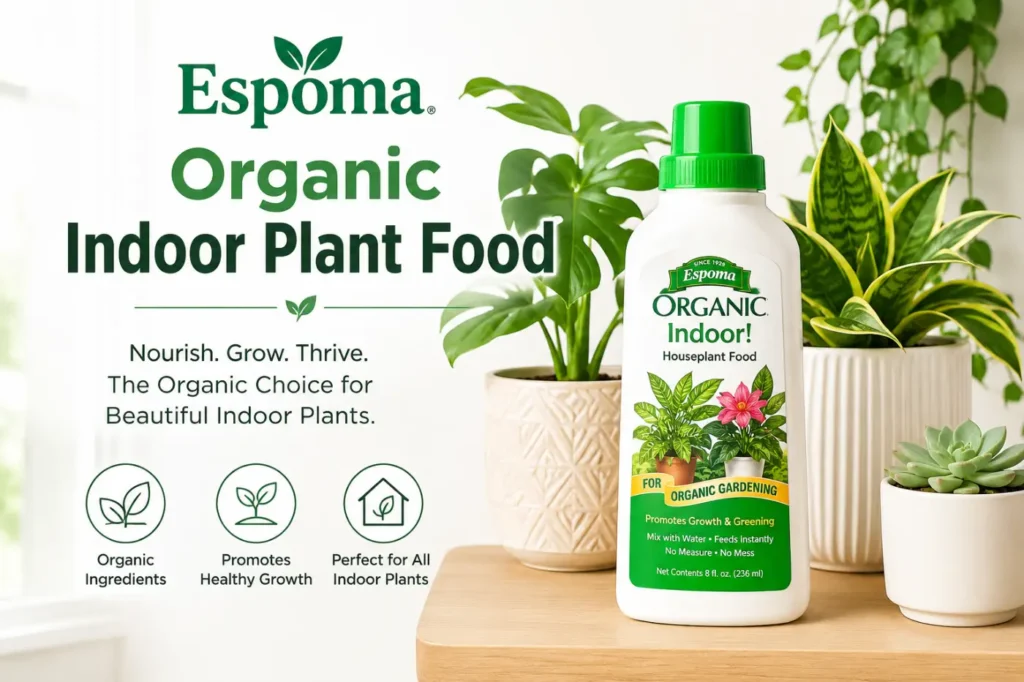
Espoma Organic Indoor Plant Food sits in an interesting position in the houseplant fertilizer market. It is organic, widely available, competitively priced, and comes from a brand that has been trusted by gardeners since 1929. But organic liquid fertilizers get mixed reviews from indoor plant owners because people often expect the same speed of results they get from synthetic options, then feel disappointed when visible improvement takes a few extra weeks to appear.
The honest evaluation of Espoma Organic Indoor Plant Food is this: it works very well for what it is designed to do, but what it is designed to do is different from what a synthetic fertilizer does. Understanding that difference before buying it is what separates satisfied customers from disappointed ones.
Quick Answer
Espoma Organic Indoor Plant Food is a 2-2-2 NPK liquid fertilizer made from hydrolyzed poultry manure and kelp. It feeds all houseplants safely with no burn risk at any reasonable application rate. It improves soil biology alongside plant nutrition. It works more slowly than synthetic options, showing visible results in four to six weeks of consistent biweekly applications. It is the best choice for sensitive plants, recently repotted plants, and plant owners committed to organic growing. It is not the best choice for plants needing rapid nutritional correction or for plant owners expecting instant results.
What Is Espoma Organic Indoor Plant Food
Espoma Indoor Plant Food is a concentrated liquid fertilizer made from hydrolyzed poultry manure and seaweed extract (kelp). The 2-2-2 NPK ratio is intentionally gentle, significantly lower concentration than synthetic indoor plant fertilizers that typically range from 6-6-6 to 20-20-20.
The low concentration is a feature rather than a limitation. It means the fertilizer is safe to use on virtually every common houseplant type without leaf burn risk, safe for sensitive species like orchids and ferns that stronger products can damage, safe for recently repotted plants whose roots are still establishing, and safe for edible herbs where the organic certification matters for culinary use.
The kelp component adds trace minerals and natural plant hormones including auxins and cytokinins that synthetic fertilizers do not contain. These hormones stimulate root development and healthy cell division at concentrations too low to cause any negative effect but high enough to contribute measurably to plant vigor over a full growing season.
How Espoma Organic Indoor Plant Food Works
The nutrient delivery mechanism in Espoma differs fundamentally from synthetic fertilizers, and this difference explains both its gentleness and its slower visible results.
Synthetic fertilizers deliver nutrients in simple ionic forms that dissolve immediately and become available to plant roots within days. Fast results, higher burn risk at excessive rates, no soil biology benefit.
Espoma’s hydrolyzed poultry manure delivers nutrients in more complex organic forms that require soil microorganism activity to convert to plant-available ion forms. This conversion takes time, which is why visible results take four to six weeks rather than one to two. But the microbial activity involved in that conversion is itself beneficial to the soil ecosystem. The microorganisms that process Espoma’s organic nitrogen multiply and establish in the potting mix, improving the overall biological health of the soil in ways that continue providing benefit long after individual nutrient doses are depleted.
This soil biology benefit is the real differentiator between Espoma and synthetic options. Plants growing in biologically healthy soil absorb nutrients more efficiently, show better disease resistance, and maintain healthier root systems long-term than those growing in biologically depleted potting mix fed exclusively with synthetic inputs.
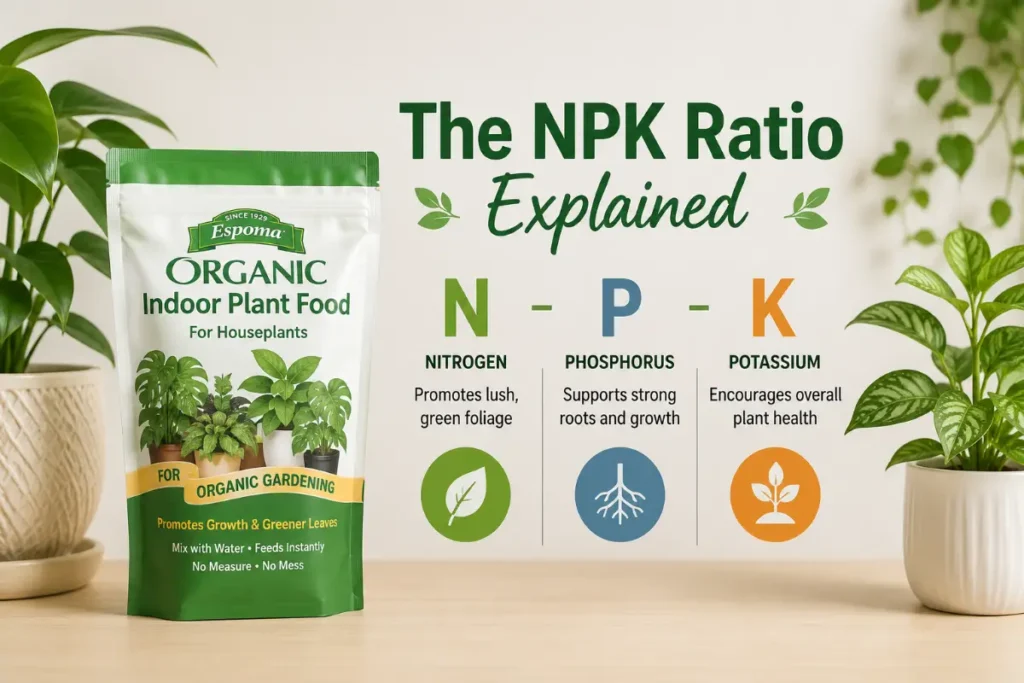
The NPK Ratio Explained: Is 2-2-2 Strong Enough
The 2-2-2 NPK ratio of Espoma Indoor Plant Food is the most common point of concern for first-time buyers comparing it to synthetic options. A 20-20-20 synthetic fertilizer seems ten times stronger and therefore ten times better at the same cost. The comparison is misleading for a straightforward reason.
Synthetic fertilizer at 20-20-20 must be diluted to a tiny fraction of its concentrated form before application to avoid burning plants. The actual concentration delivered to plant roots is far lower than the label numbers suggest. Espoma at 2-2-2 requires less dilution from its concentrated form to reach the final application concentration that plants receive. The difference in effective delivery to roots is much smaller than the label numbers imply.
For most indoor plants through the growing season, the 2-2-2 formula at the recommended biweekly application rate provides adequate nutrition to support healthy, active growth. Plants showing severe deficiency symptoms after extended periods without any fertilization may benefit from a higher concentration product for the initial recovery period before transitioning to Espoma for ongoing maintenance.
How to Apply Espoma Organic Indoor Plant Food
Dilution rate: The standard recommendation is one to two teaspoons per quart of water. Use two teaspoons per quart for actively growing plants through peak summer. Use one teaspoon per quart in early spring when plants are just resuming growth and in early fall when growth is beginning to slow.
How to mix it: Add the concentrated liquid to water rather than water to concentrate. Shake or stir gently to combine. The product has a distinct organic smell when concentrated that dissipates significantly once diluted.
How to apply it: Water the plant with the diluted solution in place of a regular watering rather than in addition to one. Apply at soil level rather than as a foliar spray. Soak the soil thoroughly so the fertilizer solution reaches the full root zone.
Frequency: Every two weeks through spring and summer. Monthly in early fall for plants still showing active growth. Stop entirely through late fall and winter when most houseplants slow their growth significantly.
For edible herbs: Espoma Indoor Plant Food is OMRI listed for organic use and is safe for culinary herbs at any point. Rinse herbs with water before harvesting after any fertilizer application regardless of how organic the product is. This is standard food safety practice rather than a product-specific concern.
Which Plants Respond Best to Espoma Organic Indoor Plant Food
Sensitive plants. Orchids, ferns, calatheas, and African violets that show burn or stress symptoms with stronger synthetic fertilizers handle Espoma without any issues. The 2-2-2 ratio at biweekly application rates stays within the safe absorption range for the most sensitive root systems.
Recently repotted plants. The gentle concentration makes Espoma one of the safest options to begin using in the four to six week window after repotting when roots are still recovering. For the detailed guide on post-repotting nutrition timing, do you need nutrients after repotting a indoor plants covers exactly when to start and which products are safest for recovering root systems.
Tropical foliage plants. Pothos, philodendrons, peace lilies, and monsteras all respond well to Espoma over a full growing season. The visible results take longer to appear than with synthetic options but the sustained soil biology improvement means plants fed with Espoma consistently over multiple growing seasons tend to maintain better baseline health than those fed exclusively with synthetic inputs.
Indoor herb gardens. The organic certification, pleasant smell once diluted, and safety for edible plants make Espoma the obvious choice for anyone growing culinary herbs alongside ornamental houseplants in the same space.
Plants in older potting mix. The soil biology component of Espoma is particularly valuable for plants that have been in the same potting mix for more than a year. The microbial inoculation from the hydrolyzed organic materials reactivates the biological activity in old, depleted potting mix in ways that purely nutritional synthetic fertilizers cannot.
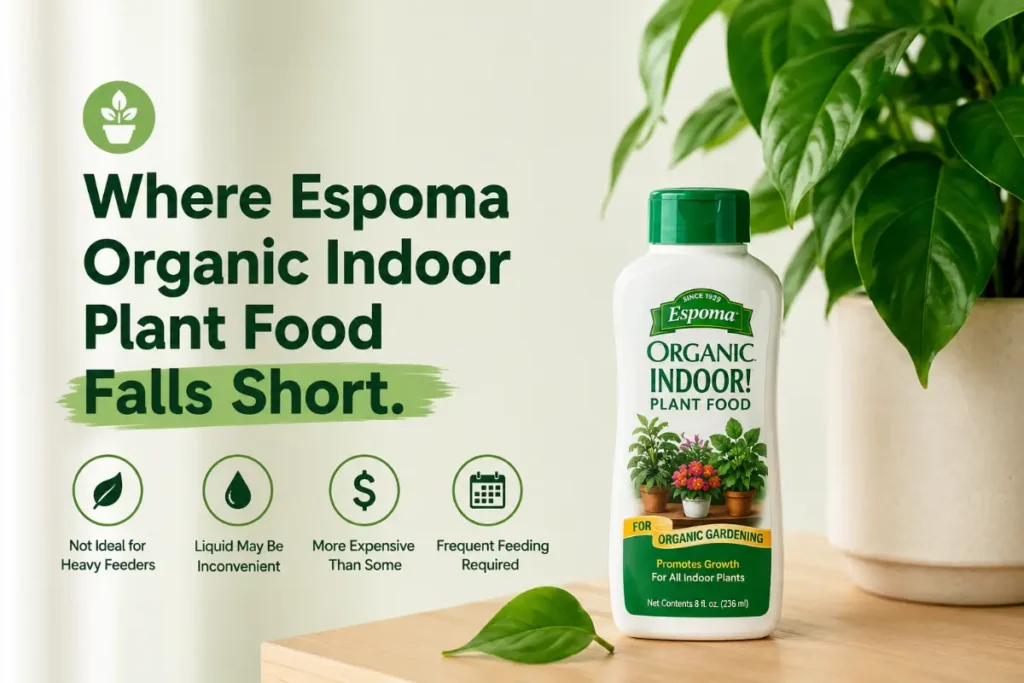
Where Espoma Organic Indoor Plant Food Falls Short
Speed of results. If a plant is severely deficient and you need rapid nutritional correction, Espoma’s four to six week timeline to visible improvement is too slow. A diluted synthetic liquid fertilizer at half rate gets nutrition to stressed roots faster for acute deficiency situations.
Not the best for heavy feeding plants. Plants with very high nutritional demands during peak growth, including large indoor fruit trees and aggressively growing tropical specimens in full sun, may need a higher concentration product than 2-2-2 to keep pace with their nutritional demand during the most active growth periods.
The smell during concentrated use. The organic poultry manure base has a noticeable agricultural smell when the concentrate is being measured and poured. Once diluted and applied to soil it dissipates significantly, but the brief smell during preparation puts some users off. Working near an open window when measuring and applying handles this easily.
Espoma Organic vs Synthetic Liquid Fertilizers for Indoor Plants
The comparison comes down to what you value most in a fertilizer for your indoor plant collection.
Synthetic liquid fertilizers deliver faster visible results, precise nutrient ratios, and complete control over exactly what nutrition your plants receive. They do not improve soil biology and require careful rate management to avoid burn.
Espoma Organic delivers slower visible results, gentle nutrition safe for virtually every plant type, and genuine soil biology improvement that builds plant resilience over the growing season. Burn risk is essentially zero at any reasonable application rate.
For most indoor plant collections, the practical difference in plant health outcomes between consistent synthetic and consistent organic feeding over a full growing season is smaller than most people expect. The bigger difference is in what happens to the soil over one to two years of exclusive use of each approach. Organically fed soil maintains biological activity. Synthetically fed soil gradually loses it.
For the complete comparison of organic versus synthetic liquid fertilizer options for indoor plants with specific product recommendations at every price point, best liquid fertilizer for indoor plants covers every option in full detail.
Espoma Organic vs Osmocote Plus
This is the comparison most indoor plant owners face when choosing between a liquid organic fertilizer and a granular slow release synthetic option.
Osmocote Plus is more convenient since it requires application only every four to five months compared to Espoma’s biweekly schedule. It also includes more complete micronutrient coverage than Espoma’s simpler formulation.
Espoma provides soil biology benefit that Osmocote Plus does not, organic certification for edible plants, and zero burn risk even on the most sensitive plant species.
The practical approach many experienced indoor gardeners use: Osmocote Plus in spring for the initial growing season application, then transition to Espoma liquid applications through summer when the biweekly schedule is manageable and the soil biology benefit matters most for the season ahead. For the complete Osmocote Plus review and how it compares in detailed application guidance, osmocote plus outdoor and indoor smart release plant food covers every aspect of that product alongside the comparison with organic alternatives.
Where to Buy Espoma Organic Indoor Plant Food
Espoma Indoor Plant Food is widely available at major US retailers.
Home Depot and Lowe’s stock it in the fertilizer section year-round in 8-ounce and quart-sized bottles. The quart bottle represents significantly better value per application than the smaller size for anyone using it regularly on multiple plants.
Amazon carries both sizes and the quart size specifically is often available through Subscribe and Save which reduces the per-bottle cost further for consistent users.
Local garden centers frequently carry the full Espoma product line and staff at independent garden centers often have firsthand experience with Espoma products they can speak to.
The quart bottle at the two-teaspoon per quart dilution rate provides approximately 96 biweekly applications, enough to feed one plant for nearly four growing seasons. For a plant collection of ten plants, a quart bottle covers approximately ten months of biweekly feeding at the standard dilution rate, making it economical relative to many synthetic alternatives at equivalent application frequency.
What Espoma Users Say After a Full Growing Season
The most consistent pattern in long-term Espoma user experience is that the product rewards patience in ways that are not immediately obvious when switching from synthetic fertilizers.
Plant owners who try Espoma for two to four weeks, see slower visible results than their previous synthetic fertilizer, and switch back are the ones who leave neutral or negative reviews. Plant owners who commit to a full growing season of consistent biweekly applications are the ones who report that their plants are noticeably healthier, more resilient to pest problems, and producing larger leaves than in previous seasons.
This pattern reflects the soil biology benefit discussed earlier. The microbial community that develops in potting mix consistently fed with organic inputs takes a full growing season to fully establish and start producing the soil ecology benefits that synthetic inputs cannot provide. A two-week trial period captures none of this benefit and gives an incomplete picture of what the product does over time.
The practical implication is that Espoma is not the right choice for someone looking to fix a problem quickly or for a plant in acute distress needing rapid nutritional support. It is the right choice for someone building a long-term indoor plant care routine where consistent, gentle, organic feeding produces cumulative improvements in plant health over months and growing seasons.
For the complete picture of how Espoma compares to every other natural and organic fertilizer option for indoor plants including homemade alternatives that cost nothing, natural fertilizer for indoor plants covers every option side by side. And for the DIY organic options that can supplement or replace Espoma at zero cost using kitchen materials, diy fertilizer for indoor plants covers every effective recipe with the same biweekly application approach that makes Espoma work when used consistently.
Tips for Getting the Best Results From Espoma Organic Indoor Plant Food
A few practical habits make a noticeable difference in how well Espoma performs through the growing season.
Always shake the bottle before measuring. The organic components in the concentrate settle between uses. An unmixed application from an unshaken bottle delivers uneven nutrient ratios that produce inconsistent results. Ten seconds of shaking before each use ensures every application delivers the full 2-2-2 benefit.
Use room temperature water for dilution. Cold water slows the microbial activity that makes organic nutrients available to plant roots. Room temperature water supports immediate microbial engagement with the organic nutrients as soon as the solution enters the soil. This matters more for organic fertilizers than for synthetic ones since the microbial processing step is central to how organic nutrients become plant-available.
Apply in the morning. Soil microorganisms are most active during the warmest part of the day. Applying in the morning gives the nutrient solution the maximum warm active period before evening temperature drops. This is a marginal rather than critical benefit but it costs nothing and supports the best possible organic nutrient processing timing.
Do not skip applications during weeks when new growth is not visible. It is tempting to skip a biweekly application if the plant looks unchanged from the previous week. Consistent application regardless of visible response in any single week is what builds the soil microbial community over the growing season. Inconsistent application with gaps interrupts the microbial establishment process and is one of the main reasons organic fertilizers underperform for some users.
Combine with worm casting top dresses. Espoma provides liquid nutrition and initial microbial inoculation. Worm castings applied as a top dress every six to eight weeks alongside the biweekly Espoma applications add a richer microbial population, plant growth hormones, and slow-release solid nutrition that the liquid alone does not provide. The two approaches complement each other to create the most biologically complete feeding program available for indoor plants without any synthetic inputs. For the worm casting application guidance that pairs best with a liquid organic feeding program, worm castings for indoor plants covers every method with specific timing alongside liquid fertilizer schedules.
Conclusion
Espoma Organic Indoor Plant Food is a genuinely good product that rewards patient, consistent use. The 2-2-2 NPK ratio is gentle enough for every common houseplant type including the most sensitive species. The hydrolyzed poultry manure and kelp base provides nutrition alongside soil biology benefit that synthetic alternatives cannot replicate. The organic certification makes it appropriate for edible herbs and for plant owners who prefer keeping synthetic chemistry out of their indoor environment.
Manage your expectations around timeline. Four to six weeks of consistent biweekly applications before visible improvement is normal and expected. The results that appear after that establishment period tend to be sustained and build over the growing season rather than fading between applications the way some synthetic products do.
Apply every two weeks through spring and summer at two teaspoons per quart. Work near an open window when measuring the concentrate. Stop in fall. Restart in spring. Used consistently on the right plants with reasonable expectations about timeline, Espoma Organic Indoor Plant Food delivers on what it promises.
Frequently Asked Questions
How often should I use Espoma Organic Indoor Plant Food?
Apply every two weeks through spring and summer at the standard dilution of one to two teaspoons per quart of water. Monthly applications in early fall work for plants still showing active growth. Stop entirely through late fall and winter when most houseplants slow their growth and cannot use the nutrients effectively.
Is Espoma Organic Indoor Plant Food safe for all houseplants?
Yes, for virtually all common houseplant types. The 2-2-2 NPK ratio and organic formulation are gentle enough for sensitive plants including orchids, ferns, and African violets that show stress with higher-concentration products. It is also OMRI listed for organic use on edible plants including indoor culinary herbs. The only plants that should not receive any fertilizer are carnivorous plants like pitcher plants and Venus flytraps that get their nutrition from insects.
Why is Espoma only 2-2-2 when other fertilizers are much higher?
The 2-2-2 ratio reflects the diluted application concentration that plants receive rather than a direct comparison with the label numbers on concentrated synthetic products. Synthetic fertilizers at 20-20-20 must be diluted to a tiny fraction of their concentrated form before application. The effective concentration reaching plant roots from Espoma at 2-2-2 is much closer to the effective concentration from synthetic options than the label numbers suggest. The lower ratio also reflects the organic formulation where nutrients are in more complex forms that require microbial processing rather than immediate ionic availability.
How long does it take to see results from Espoma Organic Indoor Plant Food?
Four to six weeks of consistent biweekly applications before visible improvement is typical. The organic nutrients require soil microbial processing before becoming available in plant-absorbable forms, which takes longer than the immediate availability of synthetic ionic nutrients. Once the soil microbial community establishes around the organic inputs, the improvement tends to be sustained and builds over the growing season rather than fading between applications.
Can I use Espoma on recently repotted plants?
Yes, and it is one of the safer fertilizer options for plants in the post-repotting establishment period because its gentle concentration reduces burn risk on recovering roots. Apply at the lower one teaspoon per quart dilution rate for the first four to six weeks after repotting, then increase to the standard two teaspoons per quart once clear new growth confirms the root system has established.
Is Espoma Organic Indoor Plant Food worth the price compared to cheaper synthetic options?
For plant owners who prioritize organic growing, soil biology improvement, and safety across all plant types including edibles and sensitive species, yes. The price difference between Espoma and basic synthetic liquid fertilizers is modest and the soil biology benefit over a full growing season provides value that synthetic options cannot offer at any price. For plant owners whose primary priority is fastest visible results at lowest cost, a synthetic fertilizer at half rate achieves comparable visible results faster and less expensively, though without the organic and soil biology benefits.