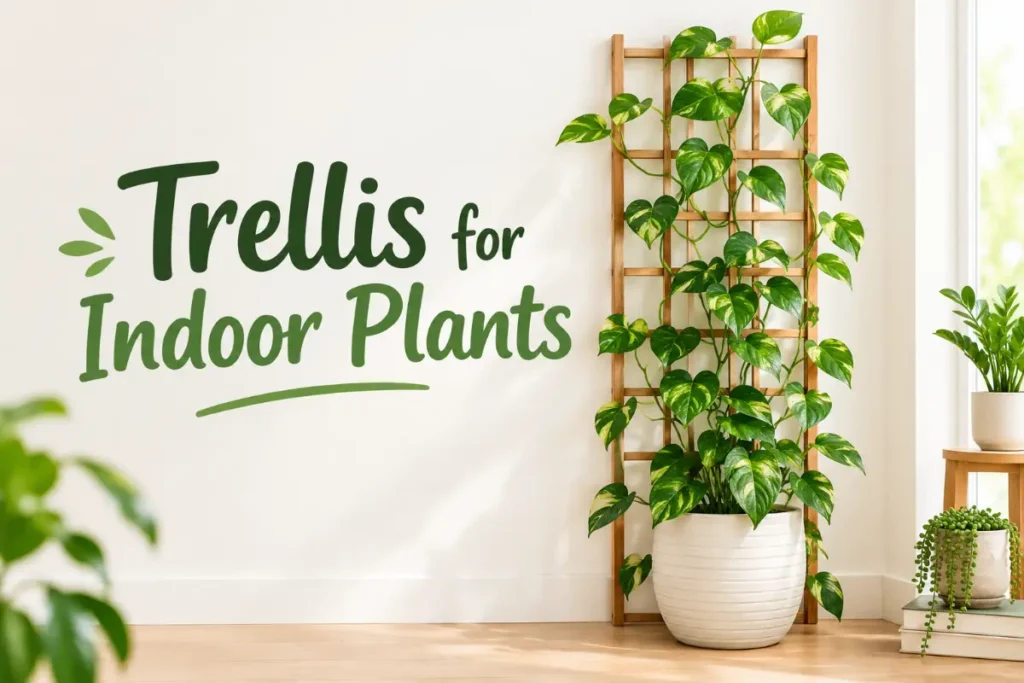
A trellis for indoor plants does more than hold a climbing stem upright — the right support structure actively improves plant health, encourages larger leaves, promotes aerial root attachment, and transforms a sprawling, unsupported vine into a striking architectural feature. Whether you are training a monstera up a moss pole, supporting a pothos along a shelf edge, or building a bamboo frame for an indoor passionflower, the support choice and installation method make a significant difference to long-term results.
This guide covers every main category of trellis for indoor plants — from moss poles to bamboo stakes, fan trellises to copper wire frames — with guidance on matching support type to plant, installation technique, and how to train climbing plants effectively once the support is in place.
Why Indoor Climbing Plants Need a Trellis
In their natural habitat, the climbing houseplants most commonly grown indoors — monsteras, pothos, philodendrons, hoyas, climbing aroids generally — grow upward by attaching aerial roots to tree bark, rock faces, or other vertical surfaces. The upward growth toward light is fundamental to how these plants develop.
Larger leaves with support: Monsteras produce their iconic split and fenestrated leaves (the holes and cuts that make the plant so recognisable) as a response to maturity and upward growth. A monstera left to trail horizontally or downward off a shelf produces small, unfenestrated juvenile leaves. The same plant supported vertically on a trellis or moss pole and allowed to grow upward produces progressively larger, more fenestrated adult leaves — the growth form most people buy the plant for in the first place.
Aerial root attachment: Many climbing aroids — monsteras, philodendrons, rhaphidophora — produce aerial roots at each node. These roots anchor to rough surfaces (tree bark, moss, coco coir) and absorb moisture and nutrients. A trellis for indoor plants that provides a textured surface (moss pole, coco coir pole) encourages these roots to attach and contributes meaningfully to the plant’s nutrition and water uptake.
Structural integrity: Unsupported climbing plants become increasingly ungainly as they grow — stems lean, the pot tips, leaves crowd together reducing air circulation and increasing pest risk. A properly installed trellis keeps growth directed and the plant manageable.
Types of Trellis for Indoor Plants

Moss Poles
A moss pole is the most botanically effective trellis for moisture-loving tropical climbers. A central pole (usually PVC pipe or bamboo) is wrapped with sphagnum moss and secured with mesh or string. The moss surface provides:
- A grip point for aerial roots, which penetrate and anchor into the moist moss
- Moisture delivery directly to aerial roots when the moss is misted or watered from the top
- A textured, naturalistic support that encourages the plant to produce the adult growth form
Best plants for moss poles: Monstera deliciosa, Monstera adansonii, Rhaphidophora tetrasperma, climbing Philodendron species (P. scandens, P. gloriosum, P. melanochrysum), Epipremnum (pothos) in larger pots.
Moss pole height: Choose a pole at least 30–40 cm taller than the current plant height — topping up or replacing a pole once a plant has grown around it is difficult. For fast-growing plants like pothos, a 150–180 cm pole is worth installing from the start.
DIY moss pole: A simple and effective option — wrap a 30 mm diameter PVC pipe with damp sphagnum moss and secure with horticultural wire mesh or natural jute string. The pipe’s hollow centre can be filled with the same moss to allow top watering (pour water in at the top; it slowly wets the moss down the length of the pole). Commercially available moss poles from UK retailers typically cost £8–20 depending on height.
Coco coir poles: An alternative to sphagnum moss — the same principle using coco coir fibre as the surface material. More sustainable than peat-sourced sphagnum moss, easier to re-wet, and slightly less effective at aerial root attachment than sphagnum but functionally similar.
Bamboo Stakes
The simplest and most widely available trellis for indoor plants — a single bamboo cane inserted into the growing medium, to which stems are loosely tied with soft plant ties or natural raffia. Available in lengths from 30 cm to 180 cm.
Best plants for bamboo stakes: Hoyas (trained in circles or hearts around a single stake), single-stem plants that need vertical correction rather than climbing support, young alocasias and elephant ears with heavy leaves that flop without support, flowering plants (peace lilies, anthuriums) with stems too heavy for self-support.
Hoya training on stakes: Hoyas are commonly trained around circular or heart-shaped wire frames attached to a central bamboo stake — the vines are wound around the frame and tied loosely, producing a dense decorative shape. Because hoyas flower from the same spurs repeatedly, avoid removing tied stems — new growth from existing attachment points produces the next season’s flowers.
Multi-stake structures: Three or four bamboo stakes arranged in a fan or teepee pattern inside a large pot create a more substantial climbing frame for vigorous growers — passionfruit, indoor cucumber, or larger pothos vines that have outgrown a single cane.
Fan Trellises
A fan-shaped trellis — typically bamboo or metal — positioned in a pot or against a wall behind a pot provides a flat climbing surface for plants that extend horizontally across a wall space rather than climbing upright on a pole.
Best plants for fan trellises: Climbing roses trained to a window wall, indoor jasmine trained across a conservatory wall, passionfruit vine in a heated conservatory, hoyas in a flat wall-display arrangement.
Wall-mounted fan trellises: Secured to the wall behind or beside the pot, these allow plants to cover a significant wall area — an effective way to create a living wall effect without specialist infrastructure. Ensure any wall fixing method can support the eventual weight of the plant and trellis combined — a well-established jasmine on a wall trellis can reach 2–3 kg over several years.
Wire and Copper Frames
Sculpted wire or copper frames positioned in a pot give climbing plants a defined three-dimensional shape to follow — popular for topiary-style indoor displays and for training smaller climbers into geometric or decorative forms.
Best plants for wire frames: Ficus pumila (creeping fig) trained over a shaped frame; pothos or philodendron trailing over a minimalist copper hoop; small-leafed ivy trained to a wreath or letter shape; miniature passionflower trained to a circular frame.
Copper wire frames: Increasingly popular as an interior design element as well as a plant support. Copper wire (2–3 mm diameter) is workable by hand into any shape — circles, ovals, abstract forms — and is naturally anti-fungal, which is a minor benefit in the humid conditions indoor climbing plants prefer.
DIY wire frame: A simple hoop frame for a pothos or tradescantia requires only a length of thick garden wire bent into a circle or arch and pushed into the growing medium. Stems are wound around the wire and secured with soft ties as they grow.
Coir Totems and Fibre Poles
A coir totem is a solid cylinder of compressed coconut coir fibre — denser and more self-supporting than a moss-wrapped pole, with a rough texture that grips aerial roots well. Available in heights from 30 cm to 120 cm from most UK garden retailers.
Advantages over moss poles: Coir totems are pre-formed (no wrapping required), resistant to mould at high humidity, and do not compact or shrink as much as sphagnum moss over time. They are heavier than moss poles of equivalent height, which can be an advantage (stability in large pots) or a disadvantage (harder to reposition).
Extending coir totems: Most commercial coir totems have a central hole that accepts an extension pole — two totems can be stacked and joined with a wooden dowel or bamboo cane to create a continuous 2-metre climbing surface. This is worth planning for at installation — inserting a cane or dowel through the first totem before planting makes later extension straightforward.
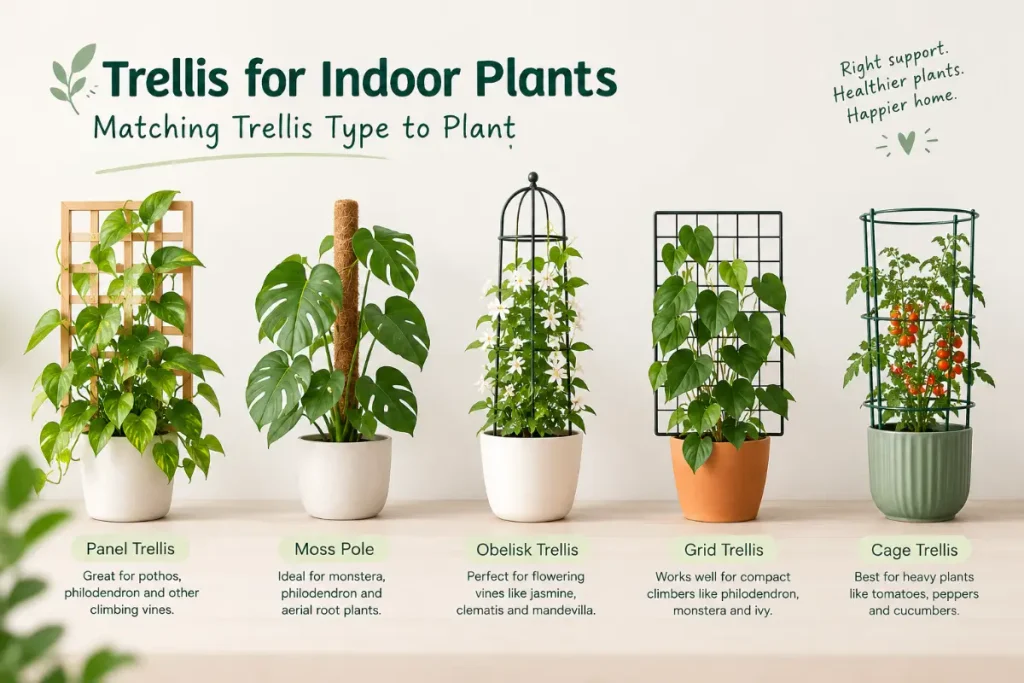
Matching Trellis Type to Plant
| Plant | Best trellis type |
|---|---|
| Monstera deliciosa | Moss pole or coir totem (tall — 150 cm+) |
| Pothos (Epipremnum) | Moss pole for large specimens; bamboo multi-stake for smaller |
| Philodendron scandens | Moss pole |
| Rhaphidophora tetrasperma | Moss pole (grows quickly — plan for 150 cm+) |
| Hoya species | Circular/heart wire frame on bamboo stake |
| Monstera adansonii | Moss pole or coir totem |
| Climbing jasmine | Fan trellis, wall-mounted |
| Indoor passionflower | Fan trellis or multi-stake teepee |
| Peace lily | Single bamboo stake |
| Alocasia | Single or two bamboo stakes |
| Ficus pumila | Wire or copper frame, wall trellis |
How to Install a Trellis for Indoor Plants
Installing a moss pole or coir totem:
- Insert the pole into the growing medium at the time of potting or repotting — repositioning a pole in an established plant damages roots
- Push the pole to the base of the pot or close to it — the pot base provides the primary anchoring point
- Position the pole slightly off-centre, toward the side where current stems lean
- Firm the growing medium around the base of the pole once positioned
- Tie existing stems loosely to the pole with soft plant ties, raffia, or velcro plant ties — do not cinch tightly enough to restrict stem expansion
Training stems to the support: Aerial roots, where present, should be guided into contact with the moss or coir surface. A small piece of damp sphagnum moss pressed around an aerial root and held against the pole with a strip of soft fabric encourages the root to attach within 2–4 weeks. Once attached, the root anchors the stem independently and plant ties become unnecessary for that section.
For plants without aerial roots (jasmine, hoyas, indoor passionflower), loose ties with soft plant ties at 20–30 cm intervals are the primary attachment method. Use a figure-eight tie rather than a loop — the figure-eight cushions the stem against the support and prevents the tie from cutting into tissue as the stem grows.
DIY Trellis Ideas for Indoor Plants
A trellis for indoor plants does not require specialist products — several effective options use materials available from hardware stores or recycled at home:
Bamboo grid: Cut bamboo canes to equal lengths and lash together at the intersections with jute twine — a simple grid panel that can stand in a large pot or be mounted against a wall.
Driftwood branch: A single attractive piece of driftwood or a branching twig from the garden (dried and treated with dilute hydrogen peroxide to kill pathogens) planted in a large pot provides a natural climbing support — particularly effective for hoyas and rhaphidophoras.
Copper pipe frame: Short lengths of 10 mm copper pipe cut to length and connected with elbow joints create a rigid, industrial-look frame. Copper pipe is inexpensive from plumbers’ merchants and requires no tools beyond a pipe cutter to produce precise lengths.
Rope trellis: Lengths of natural jute rope strung between ceiling hooks and pot-mounted anchors create a vertical growing guide for lightweight climbers — pothos trained up a jute rope column is a popular design effect in plant-focused interiors.
Maintaining a Trellis for Indoor Plants
Moss pole maintenance: Mist the moss surface every 2–3 days or water through the hollow centre (if using a hollow-core design) to keep the moss lightly moist. Dry moss fails to encourage aerial root attachment and loses its moisture-contributing function. The post on moisture meters for indoor plants is useful for tracking moisture in both the growing medium and, qualitatively, the moss pole surface.
Replacing a full pole: When a plant has grown to the top of its pole and new growth is extending beyond the tip, options are: extend (add a second pole above using a join-and-stake method), replace (difficult once roots are embedded — the least disruptive approach is to add a new, taller pole beside the original without removing it), or begin horizontal training of growth extending beyond the top.
Cleaning bamboo and wire supports: Annual cleaning in dilute bleach solution (1 part bleach to 10 parts water) removes algae, mineral deposits, and surface pathogens from bamboo and wire structures. Allow to dry fully before returning to the pot.
Seasonal Trellis Management
The relationship between a climbing plant and its trellis for indoor plants changes through the year — active growth in spring and summer requires regular training and tying; the slower growth of autumn and winter is an opportunity for maintenance and planning.
Spring: New growth emerges rapidly from the growing tip and from dormant nodes along established stems. Tie new growth to the trellis every 7–10 days to keep direction consistent. Check that all existing ties are loose — stems expand in diameter through the growing season, and ties applied the previous autumn may have tightened significantly. Replace any that show signs of cutting into stem tissue.
Summer: The fastest growth period for most tropical climbers. Mist moss pole surfaces more frequently — daily if possible — as ambient humidity typically drops and plant transpiration increases. For plants growing toward the top of their support, assess whether extension is needed before growth reaches the tip; repositioning a trellis is far easier before the plant grows around it.
Autumn: Growth slows from September onward for most tropical houseplants. Use this period to remove any dead or damaged leaves that have accumulated around the trellis structure, clean the support structure if accessible, and evaluate whether the trellis size and type remains appropriate for the plant’s current size.
Winter: Minimal active training required. Reduce misting of moss poles in line with reduced plant water demand. Avoid repositioning or adjusting the trellis in winter — cold stress combined with root disturbance can cause significant setback in tropical plants.
Trellis and Indoor Plant Display
Beyond their practical function, trellises contribute significantly to the visual impact of an indoor plant display — and the choice of material and style is worth considering alongside the support’s horticultural function.
Copper and brass frames complement warm interior styles — terracotta pots, warm timber shelving, and neutral walls. A copper hoop in a terracotta pot trailing a pothos or hoya reads as a deliberate design element rather than a practical support.
Natural materials (bamboo, driftwood, jute rope) work with organic, botanical interior styles. A group of bamboo-staked hoyas on a shelf, or a driftwood branch in a ceramic pot with climbing philodendron, creates a cohesive naturalistic display.
Minimal black metal stakes suit contemporary and industrial interiors. Simple black-powder-coated metal stakes or grid panels recede visually and direct attention to the plant rather than the support.
Moss poles work well in larger rooms and botanical-style interiors where scale is appropriate — a 150 cm moss pole with a maturing monstera alongside large-leafed tropical companions reads as a serious plant collection statement.
The post on grow lights for indoor tomato plants covers display positioning for productive plants that shares principles with climbing houseplant display — positioning for light access applies equally to ornamental climbers trained on a trellis.
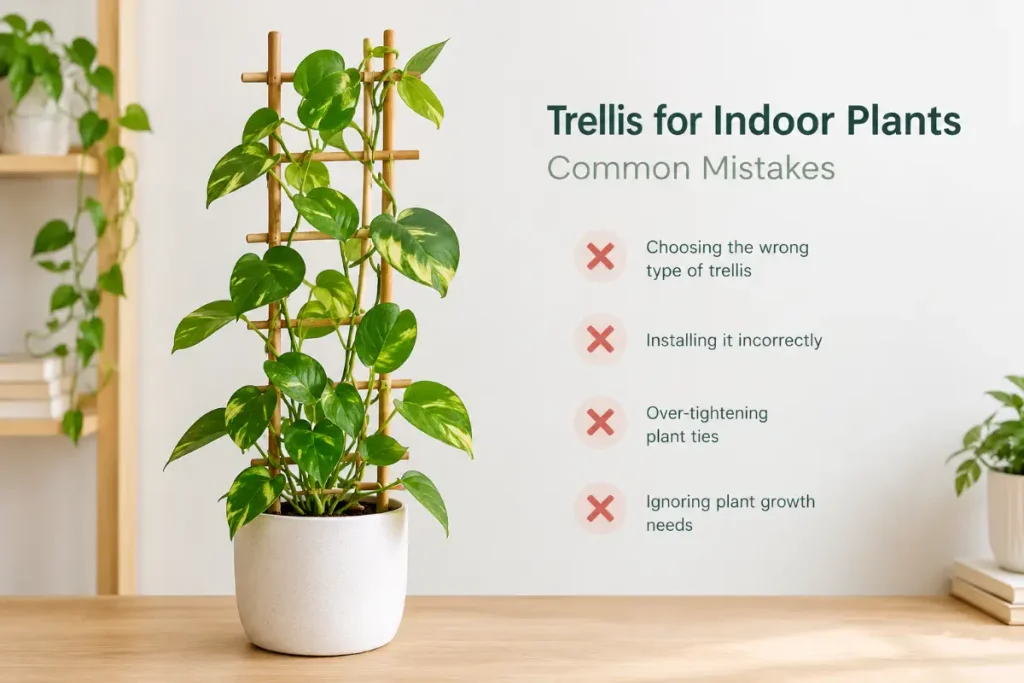
Common Mistakes with Trellis for Indoor Plants
Installing the trellis too late: The most common error — adding a moss pole or stake after the plant has reached significant size. Inserting any support into an established root zone damages roots; for a large monstera with a dense root ball, it is nearly impossible to install a pole without significant damage. Install at potting time, always.
Tying stems too tightly: Plant ties applied correctly should be loose enough to slide along the stem. Tight ties constrict the flow of water and nutrients through the stem, cause permanent damage to stem tissue, and are often only noticed when the damage becomes visible as a constricted scar. Use velcro plant ties (reusable, easy to adjust) rather than permanent wire or cable ties.
Wrong trellis height: A trellis significantly shorter than the plant’s eventual size will be outgrown within a season or two — and retrofitting taller support to an established, attached plant is difficult. Err on the side of too tall; excess height above the current plant simply represents unused capacity.
Ignoring aerial roots: For plants that produce aerial roots (monstera, climbing philodendrons, rhaphidophora), the aerial roots are the plant’s natural attachment mechanism — and often its supplemental moisture and nutrient source when attached to a moss or coir surface. Cutting aerial roots off to keep things tidy removes a significant plant function. Guide them onto the moss pole surface instead.
Using a non-textured surface: A smooth bamboo cane or metal rod provides no grip surface for aerial roots. For monstera and similar aerial-rooting climbers, a smooth pole produces a plant that leans on the support rather than climbing it — ties are required forever and the adult growth form is inhibited. A textured surface (moss, coir, rough wood) is functionally important, not just decorative.
Conclusion
A well-chosen trellis for indoor plants is one of the most transformative additions you can make to a climbing or trailing plant — encouraging larger leaves, better growth form, and the aerial root attachment that marks the transition to true adult growth. Whether a moss pole for a maturing monstera, a copper hoop for a trailing hoya, or a wall-mounted fan trellis for indoor jasmine in a conservatory, the right support actively improves plant health while enhancing the visual impact of your indoor growing space.
For further guidance on training climbing plants and understanding their support needs, the RHS guide to climbing plants provides excellent background on growth habits that translate directly to indoor growing.
FAQs
What is the best trellis for a monstera indoors?
A tall moss pole (150 cm+) or coir totem is the best trellis for monstera indoors. Both provide a rough, moisture-retentive surface that encourages aerial root attachment — the key to promoting larger, fenestrated adult leaves. Install at potting time rather than adding to an established plant to avoid root disturbance.
Do indoor climbing plants always need a trellis?
Not always — many trailing plants (pothos, tradescantia, string of pearls) grow well without support, trailing from a shelf or hanging basket. Climbing plants that naturally grow upward in the wild (monstera, climbing philodendrons, rhaphidophora) produce their best growth with vertical support. Plants grown without support remain in juvenile growth form and produce smaller leaves.
How do I stop my trellis from falling over in the pot?
Push the trellis to the base of the pot for maximum anchorage. In large pots, add 2–3 cm of coarse gravel or horticultural grit around the base of the pole before adding growing medium — this stabilises the base without affecting drainage. For tall poles in lightweight pots, consider weighting the outside of the pot with decorative stones.
Can I make my own moss pole?
Yes — wrap damp sphagnum moss around a 25–30 mm PVC pipe or bamboo cane, using horticultural mesh or jute string to hold it in place. Damp the moss thoroughly before wrapping for best adhesion. DIY moss poles are usually more cost-effective than commercial versions for heights above 100 cm.
What plants can I grow on a trellis indoors?
Monstera deliciosa and adansonii, pothos, climbing philodendrons, rhaphidophora tetrasperma, hoyas, climbing jasmine, passionflower, ficus pumila, indoor ivy, vanilla orchid vine, and many other epiphytic or scrambling plants all respond well to a trellis for indoor plants.
How do I train a hoya on a trellis?
Wind hoya stems loosely around a wire hoop or circular frame and secure with soft plant ties. Do not remove stems from the frame once attached — hoyas flower from the same spurs repeatedly (peduncles), and removing a stem removes potential flowering sites. Add new growth to extend coverage and leave established stems in place.
How tall should a trellis be for indoor plants?
Match the trellis height to the plant’s expected mature size, with 30–40 cm of extra height for growth room. For monstera, a minimum of 120 cm is advisable; 150–180 cm is better for long-term use. For smaller climbers like pothos in a 15 cm pot, a 60–90 cm pole is typically sufficient.
Do moss poles need to be kept wet?
Lightly moist rather than wet — aim for moss that feels damp when touched, not dripping. Mist with a spray bottle every 2–3 days, or water through a hollow-centre pole from the top. Dry moss is ineffective at encouraging aerial root attachment; constantly soaked moss can develop mould and the associated smell.