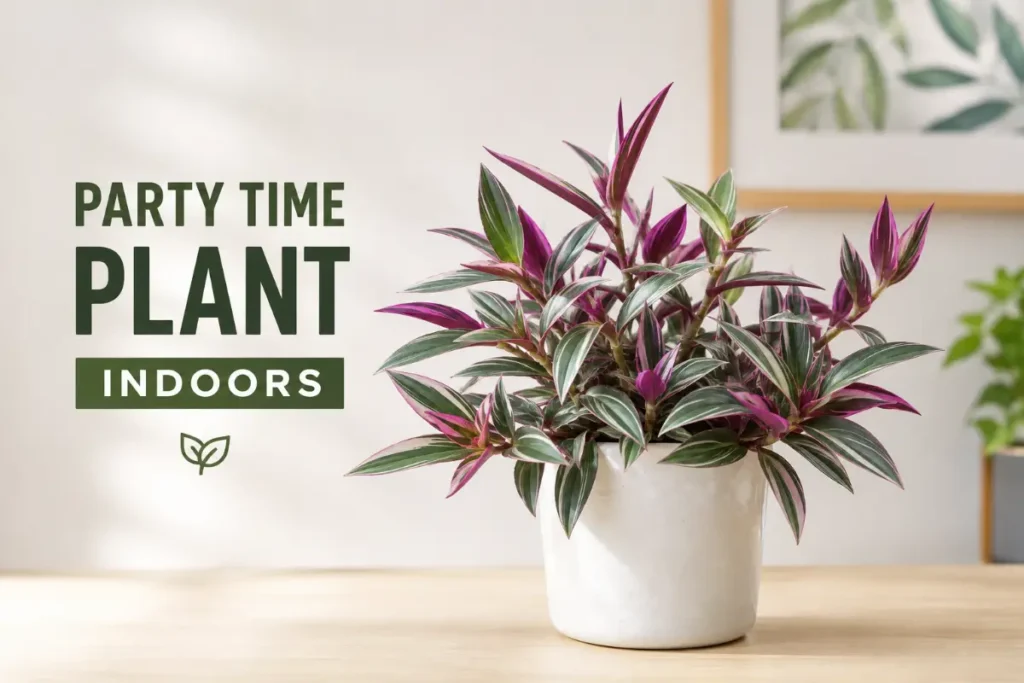
The party time plant indoors is a bold, colorful choice that earns its name through foliage that splashes red, pink, orange, and yellow across its small rounded leaves in combinations that genuinely look celebratory. Party time plant (Alternanthera ficoidea ‘Party Time’) is grown entirely for this multicolored foliage rather than for flowers, making it one of the most color-diverse non-flowering plants available for indoor growing.
The care approach is similar to other colorful foliage plants in this cluster: light drives color intensity, pruning prevents legginess, and the plant’s compact form is maintained through active management rather than passive growing. What sets party time plant apart is the specific sensitivity of its brilliant color to light quality and the speed with which it reverts toward less vivid coloration in insufficient light.
Quick Answer
Party time plant indoors requires very bright indirect light or filtered direct sun to maintain its vivid multicolored foliage, consistent moisture keeping the top inch moist, temperatures between 65 and 85 degrees Fahrenheit, moderate to high humidity above 50%, biweekly fertilizing through spring and summer, and regular aggressive tip pruning every two to four weeks to maintain the compact, bushy form that shows off the colorful foliage most effectively.
Understanding Party Time Plant
Alternanthera ficoidea ‘Party Time’ is a cultivar of the Joseph’s coat plant family, tropical plants native to Brazil and Central and South America grown for their intensely multicolored foliage in combinations of red, pink, orange, yellow, and green. The specific Party Time cultivar produces particularly vivid color combinations that have made it popular as both an outdoor bedding plant and an indoor foliage plant.
Like all Alternanthera cultivars, the Party Time variety is a short-lived perennial that grows most vigorously as an annual in typical cultivation. It produces better growth in warm, bright conditions than in cool or dim ones, which distinguishes it from the cool-preferring flowering plants earlier in this cluster and places it firmly in the warm-tropical category despite not being a traditional tropical rainforest plant.
The foliage color is produced by a combination of chlorophyll (green), carotenoids (yellow and orange), and anthocyanins (red and pink) in varying concentrations across individual leaves. Light intensity and quality are the primary drivers of how much of each pigment the plant produces, with brighter light supporting the full complement of all pigments simultaneously for the most vivid multicolored effect.
Step 1: Provide Maximum Bright Indirect Light
Light is the most critical factor in maintaining the vivid multicolored foliage that defines party time plant. This is one of the more light-demanding foliage plants commonly grown indoors, requiring bright light levels that approach what flowering plants need for bloom production.
What works: Bright indirect light from a south or west-facing window with some filtering to prevent the harshest direct afternoon rays from scorching the delicate colored leaves. A few feet back from a bright south-facing window. Morning sun from an east-facing window. Under grow lights running fourteen to sixteen hours daily.
What low light produces: The red and pink anthocyanin pigments are the first to disappear in insufficient light as the plant reduces these metabolically expensive non-photosynthetic pigments. A plant that was brilliantly multicolored in the garden center becomes increasingly green-dominant within weeks of placement in a dim indoor position. In very low light, the plant reverts almost entirely toward plain green.
The outdoor summer advantage: Moving party time plant outdoors for summer in bright partial shade produces the most vivid color of any growing condition and significantly better overall plant health than indoor growing alone. The higher natural light intensity outdoors even in shade exceeds what most indoor windows provide.
Grow lights: For indoor growing in spaces without adequate south or west-facing window light, a grow light running fourteen to sixteen hours daily is the reliable solution for maintaining party time plant’s color throughout the year.
Step 2: Water Consistently for Moist Soil
Party time plant prefers consistently moist soil and wilts noticeably when underwatered, though it recovers quickly after watering.
The correct approach: Water when the top inch of soil feels dry. In a bright position during summer this typically means every five to seven days. In lower light or winter every seven to ten days.
Signs of underwatering: Drooping stems and leaves. The colorful foliage loses its upright presentation and looks limp. Recovery after watering is typically complete within one to two hours.
Signs of overwatering: Yellow lower leaves. Soft, mushy stem sections near soil. Musty soil smell. Root rot develops in chronically wet conditions. Always use pots with drainage holes.
Water quality: Party time plant benefits from filtered or distilled water in hard water areas where fluoride and mineral accumulation causes tip browning that detracts from the colorful foliage display.
Step 3: Maintain Warm Temperature
Unlike the cool-preferring plants earlier in this cluster, party time plant is genuinely warm-loving and performs best in the upper portion of the typical home temperature range.
Ideal range: 65 to 85 degrees Fahrenheit. Active growth and most vivid color expression occur throughout this range with peak performance at the warmer end.
Cold sensitivity: Below 60 degrees growth slows noticeably. Below 50 degrees the plant shows stress with leaf drop and stem damage. Party time plant is one of the most cold-sensitive plants in this cluster and is the first to show damage from cold drafts, cold windows in winter, and air conditioning vents blowing cold air directly on the foliage.
Warm preference advantage: Party time plant is one of the few plants in this cluster that genuinely thrives in the warm living room temperatures that cool-preferring plants like cyclamen and creeping jenny find hostile. This makes it a practical choice for the warm interior positions where cool-preferring plants would suffer.
Step 4: Provide Moderate to High Humidity
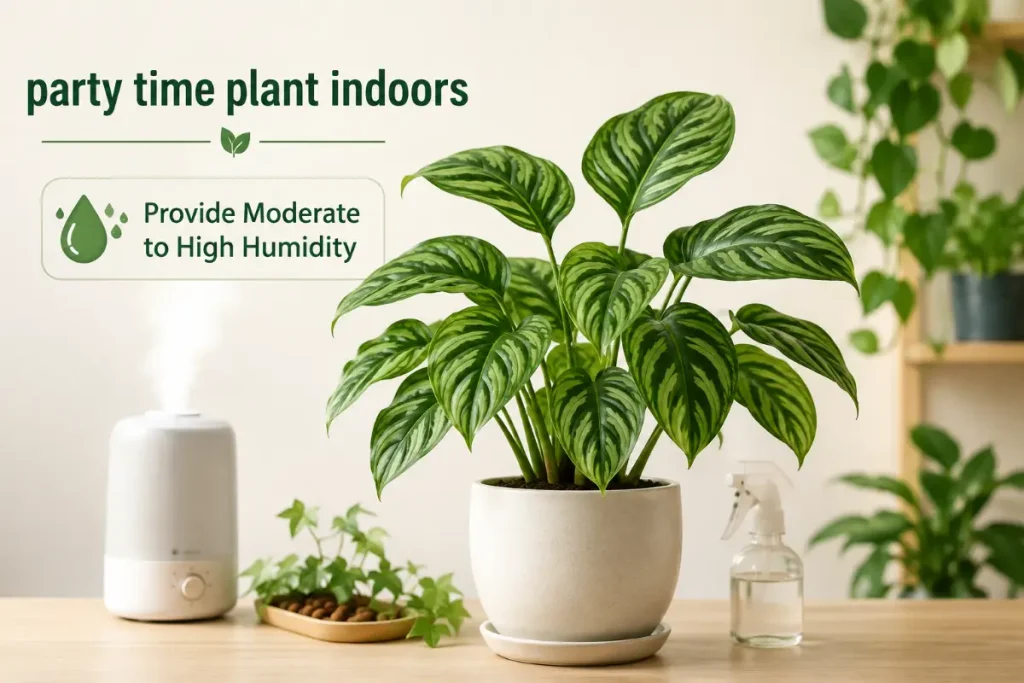
As a tropical plant from the warm, humid conditions of South American coastal regions, party time plant prefers humidity above 50% and shows stress in the very dry air of heated winter homes.
Signs of low humidity: Brown, crispy leaf edges that advance inward from the leaf margins. The colorful foliage looks dull and slightly papery rather than vibrant and plump. In severe low humidity, some leaf drop may occur.
Effective solutions: A pebble tray with water beneath the pot provides steady local humidity through evaporation. A humidifier running nearby during winter heating season maintains consistent humidity above 50%. Grouping with other tropical plants raises collective humidity.
Misting: Party time plant tolerates misting well since its small leaves do not retain surface moisture long enough to create significant disease risk. Misting every two to three days supplements pebble tray humidity in very dry environments.
Step 5: Fertilize to Support Color and Growth
Party time plant benefits from consistent nutrition through the growing season to support both the active growth and the pigment production that creates its characteristic multicolored foliage.
Through spring and summer: Feed every two weeks with a balanced liquid fertilizer at half the label rate. The balanced formula supports all aspects of plant health including the pigment production that drives color intensity.
What to avoid: Very high-nitrogen fertilizers at full rate drive lush green vegetative growth at the expense of the red and pink anthocyanin pigments that define party time plant’s color. A balanced or slightly phosphorus-forward formula maintains better color alongside vigorous growth.
Organic options: Worm casting tea applied every two weeks provides gentle balanced nutrition with soil biology benefits. For the complete organic fertilizer guide, worm castings for indoor plants covers timing and application for fast-growing colorful foliage plants.
Fall and winter: Reduce to monthly feeding or stop entirely when growth slows.
Step 6: Prune Aggressively and Consistently
Pruning is even more critical for party time plant than for most other compact foliage plants because it grows rapidly in good conditions and becomes leggy within weeks without regular tip pruning.
How to prune: Pinch or cut all stem tips back to just above a leaf node every two to three weeks during the growing season. This is slightly more frequent than the two to four week interval for slower-growing plants and reflects party time plant’s faster growth rate in good conditions.
The bushy effect: Each pruned tip produces two new shoots from the node below within seven to ten days. Consistent pruning creates the dense, rounded, compact form that displays the multicolored foliage most effectively. An unpruned party time plant becomes tall and sparse with color concentrated at the stem tips rather than distributed throughout a full bushy plant.
Aggressive rejuvenation: When a plant has become significantly leggy, cut all stems back to within two to three inches of the soil. Party time plant regenerates vigorously from this level of pruning within two to three weeks with a fresh flush of densely colored new growth.
Propagation from prunings: Every pruned cutting propagates easily. Place stem cuttings four to six inches long in water or moist potting mix. Roots develop within one to two weeks. The resulting plants are compact and vibrantly colored from the start.
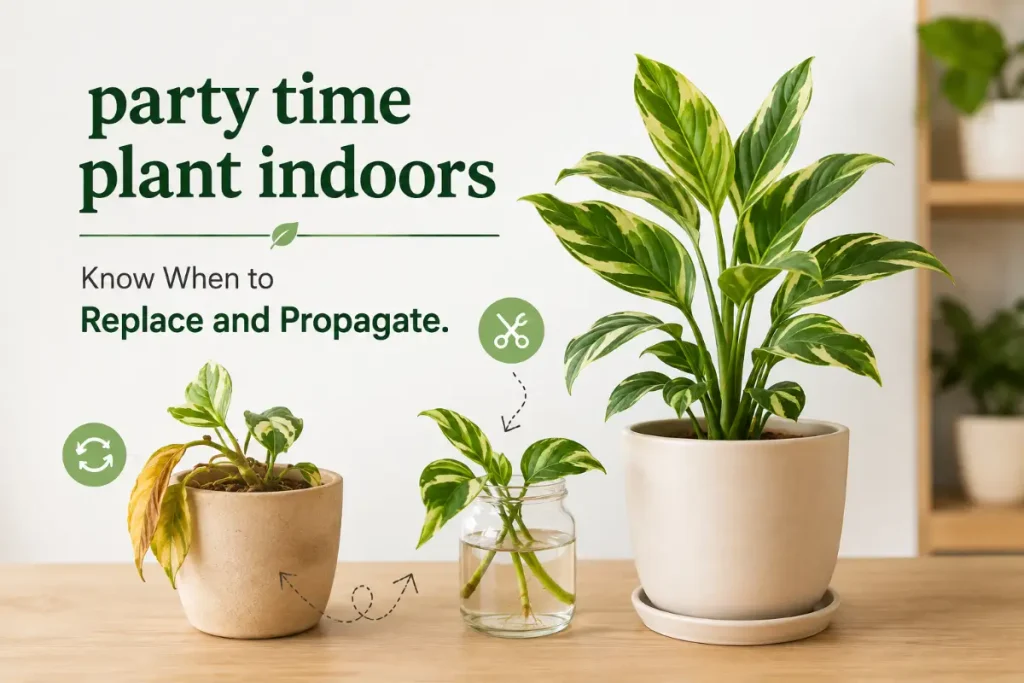
Step 7: Know When to Replace and Propagate
Party time plant is a short-lived perennial that performs most vigorously in its first one to two years. Starting fresh from cuttings annually maintains the plant at its most colorful and compact rather than attempting to maintain aging specimens indefinitely.
Signs the plant needs refreshing: Multiple aggressive pruning sessions have not restored compact colorful growth. The stems have become significantly woody. Color intensity does not return to full vividness despite improved light. The plant has been growing for more than eighteen months.
Propagation timing: Take cuttings annually in spring from the most vibrantly colored, most actively growing sections. This ensures the next generation starts from the best available genetic expression of the color pattern.
The outdoor bedding plant alternative: Party time plant is sold as an outdoor annual bedding plant in most US climates. Purchasing fresh plants each spring from garden centers and growing them through the indoor season before replacing the following spring is a practical alternative to indoor overwintering for growers who find annual propagation inconvenient.
For context on other intensely colored foliage plants that complement party time plant in mixed tropical displays and share its warm-position preferences, hawaiian ti plant indoor care covers the care approach for another bold foliage plant with anthocyanin-based color that responds to light quality in similar ways and pairs visually with party time plant in warm-position mixed displays.
Party Time Plant Varieties and Alternanthera Relatives
Beyond the specific Party Time cultivar, the broader Alternanthera genus includes several varieties worth knowing for indoor growing.
Alternanthera ficoidea ‘Party Time’ is the most vivid multicolored variety with its characteristic splash of red, pink, orange, and yellow. This is the variety that gives the group its most festive appearance.
Alternanthera ficoidea ‘Red Threads’ has very fine, thread-like leaves in deep red with some yellow-orange marking. A more unusual texture than the rounded Party Time leaves.
Alternanthera ficoidea ‘Little Ruby’ produces small, rounded leaves in deep burgundy-red without the multicolor variation of Party Time. More compact growth habit and more consistent coloring that maintains better in slightly lower light than the multicolored varieties.
Alternanthera dentata ‘Purple Knight’ is the largest-leaved Alternanthera commonly available and produces deep purple-burgundy foliage on larger, more upright stems. Better suited to large pots and container gardens than the compact Party Time.
All share the same fundamental care requirements: maximum bright indirect light, consistent moisture, warm temperatures, regular pruning, and annual replacement or propagation for best results.
Common Party Time Plant Problems and Solutions
Color fading to mostly green: Insufficient light. Move to maximum available bright indirect light immediately. New growth in better light emerges with full color intensity within two to three weeks.
Leggy sparse stems: Not pruning frequently enough. Begin pruning every two to three weeks and improve light simultaneously. Add rooted cuttings back to the pot for immediate density.
Brown leaf edges: Low humidity combined with warm temperatures. Increase humidity with pebble tray or humidifier. Check for cold air sources if browning is directional.
Sudden leaf drop: Cold temperature shock from drafts or cold windows. This is one of the most cold-sensitive plants in the cluster. Identify and eliminate cold air sources immediately.
Yellow lower leaves: Overwatering or natural aging. Assess soil moisture and adjust if overwatering is suspected. Single lower leaf yellowing is normal aging.
Party Time Plant in Mixed Colorful Displays
Party time plant’s vivid multicolored foliage creates particularly effective contrast in mixed tropical displays where its small, densely packed colored leaves sit alongside larger, more uniformly colored plant companions.
With solid-colored foliage plants: Party time plant’s multicolored randomness contrasts dramatically with the clean, uniform deep green of peace lily or rubber plant, or the uniform burgundy of Purple Knight alternanthera. The eye moves naturally between the complex color of party time plant and the simpler backdrop of solid-colored companions.
With other colored-leaved plants: Combining party time plant with wandering jew (purple and silver), Hawaiian ti plant (deep red), and polka dot plant (pink and green) creates a richly colored mixed display where no single color dominates. The different scales of leaf and pattern across these companions creates the kind of visual complexity that makes plant displays genuinely interesting to look at rather than just decorative.
Pot arrangement: Party time plant works best as a low, bushy foreground or midground plant in mixed arrangements rather than as a tall backdrop. Its compact, mounding form suits positions at the front of grouped arrangements where the detailed color pattern of its small leaves can be appreciated at the viewing distance typical of indoor plant displays.
Scale considerations: The small leaf size of party time plant (individual leaves typically one to two centimeters in diameter) pairs best visually with other small to medium-leaved plants rather than with very large-leaved specimens where the size differential overwhelms the detailed pattern of party time plant’s foliage.
Seasonal Care for Indoor Party Time Plant
Spring: The most actively growing period as temperatures warm and day length increases. Resume biweekly fertilizing when new growth is clearly active. Begin the aggressive pruning schedule. Take cuttings in late spring from the most vibrantly colored growth for propagation. Consider transitioning outdoors for summer as temperatures allow.
Summer: Peak performance period for party time plant, which thrives in warm conditions unlike many other plants in this cluster. Full biweekly fertilizing and fortnightly or more frequent pruning to manage the vigorous summer growth rate. Outdoor placement in bright partial shade dramatically improves color and vigor compared to indoor growing. Monitor for spider mites in dry conditions.
Fall: Reduce fertilizing to monthly as growth slows. Bring indoors before temperatures drop below 55 degrees since this is one of the most cold-sensitive plants in the cluster. The transition to indoor conditions typically involves some color reduction as light levels drop from outdoor to indoor intensity.
Winter: Stop or significantly reduce fertilizing. Water less frequently as growth slows. Maintain maximum available light since color fading is most pronounced in the low light of winter. Consider grow light supplementation for maintaining acceptable color through the darkest months. This is the period when party time plant shows the greatest gap between indoor and outdoor performance potential.
For the complete guide to worm casting applications that support warm-position tropical foliage plants through seasonal changes, worm castings for indoor plants covers every method with specific guidance on reducing application frequency through fall and winter to match the reduced growth rates of warm-position foliage plants like party time plant. And for natural fertilizer options that complement worm castings through the growing season, natural fertilizer for indoor plants covers every effective approach for colorful foliage plants where balanced nutrition supports both growth and pigment production simultaneously.
Conclusion
Party time plant indoors earns its celebratory name through foliage color combinations that few other houseplants can match. Maintaining that vivid color requires maximum bright indirect light since color is the first thing to fade in dim conditions. Consistent moisture prevents the wilting that stresses the plant. Warm temperatures align with what most homes naturally provide. Regular pruning every two to three weeks maintains the compact bushy form that displays the color most effectively. And annual propagation from cuttings keeps the display at its most vibrant.
For anyone seeking an indoor foliage plant that provides true multicolored interest without waiting for flowers, party time plant delivers in good light exactly the visual impact its name promises.
Frequently Asked Questions
Why is my party time plant losing its color indoors?
Color fading in party time plant almost always indicates insufficient light. The red and pink anthocyanin pigments are the first to disappear as the plant reduces non-photosynthetic pigments in dim conditions. Move to maximum bright indirect light from a south or west-facing window or under grow lights. New growth in better light emerges with full vivid color within two to three weeks.
How often should I water party time plant indoors?
Water when the top inch of soil feels dry, typically every five to seven days in a bright position during summer and every seven to ten days in lower light or winter. Party time plant wilts noticeably from underwatering and recovers quickly after watering. Avoid both chronic drought and chronic overwatering that causes root rot.
How do I keep party time plant bushy and compact?
Pinch or cut stem tips back to a leaf node every two to three weeks throughout the growing season. Each pruned tip produces two new branches creating a progressively denser plant. For very leggy plants, cut all stems back to within two to three inches of the soil. The plant regenerates within two to three weeks with fresh dense colorful growth.
Can party time plant grow in low light indoors?
It survives in low light but loses its distinctive multicolored foliage rapidly, reverting toward plain green as red and pink pigments are reduced. For maintaining the vivid color that makes party time plant worth growing, bright indirect light close to a south or west-facing window or under grow lights is necessary. It is not an appropriate plant for dim interior positions.
Is party time plant toxic to pets?
Alternanthera species are generally not considered significantly toxic to cats and dogs. However, any plant material ingested in quantity can cause gastrointestinal upset in sensitive animals. Consult the ASPCA database for the most current toxicity information on specific Alternanthera cultivars.
How long does party time plant live indoors?
Party time plant performs most vigorously in its first one to two years. Starting fresh from cuttings annually maintains the display at maximum color intensity and compact growth rather than attempting to maintain aging specimens. Purchasing fresh plants from garden centers each spring and propagating from the best material through the season produces the most consistently attractive displays.