
Finding the right bug sprays for indoor plants is harder than it should be. Walk into any Home Depot or Lowe’s garden section and you will find dozens of products making bold claims on their labels, but very few that are actually safe to use inside your home, around your family, and on the specific pests you are dealing with. Use the wrong spray and you damage your plant. Use one not formulated for indoor use and you fill your living space with chemicals that linger on surfaces for days.
This guide cuts through all of that. These are the 7 best bug sprays for indoor plants available right now, chosen based on what they actually kill, how safe they are for indoor use, and whether they are realistically available at garden centers across the country. Each one is matched to the pest it handles best so you know exactly which product to reach for based on what you are dealing with.
Quick Answer
The best bug sprays for indoor plants are neem oil spray for broad-spectrum organic control, insecticidal soap spray for soft-bodied insects like aphids and mites, Safer Brand Insect Killing Soap for sensitive plants, Bonide Neem Oil for ready-to-use convenience, Captain Jack’s Deadbug Brew for caterpillars and beetles, Natria Insect Disease and Mite Control for multi-pest situations, and a homemade dish soap spray for immediate low-cost treatment. Always choose products labeled safe for indoor use and test on a single leaf before full application.
What to Look for in a Bug Spray for Indoor Plants
Not every pest spray sold at garden centers is safe or appropriate for use inside your home. Before buying anything, check these four things on the label:
Indoor use labeling. The product must explicitly state it is safe for indoor use. Many outdoor pesticides contain pyrethroids or other compounds that are safe in open air but accumulate to harmful concentrations inside an enclosed living space.
Target pest match. Every spray has a specific range of pests it is effective against. A spray formulated for caterpillars will do nothing for spider mites. Match the product to the pest you have confirmed is present.
Plant safety. Some sprays damage certain plant types even at correct dilutions. Ferns, succulents, orchids, and newly rooted cuttings are the most commonly sensitive. Check the label or test on a single leaf first.
Residual vs contact. Contact sprays kill only what they hit while wet and leave no residue. Systemic or residual sprays continue working after drying. For indoor use, contact sprays are generally preferable since they do not leave lingering chemicals on surfaces you touch.
7 Best Bug Sprays for Indoor Plants
1. Homemade Dish Soap Spray — Best Immediate Zero-Cost Option
Before spending money on any commercial product, a homemade dish soap spray handles the majority of soft-bodied pest problems on indoor plants quickly and safely. It is the first thing to reach for when you spot aphids, spider mites, or whiteflies and want to act immediately.
How it works: The fatty acids in dish soap break down the waxy protective coating on soft-bodied insects, causing rapid dehydration and death on contact. Once dry it leaves no residual toxicity, making it one of the safest options for use in a living space.
What it kills: Aphids, spider mites, whiteflies, mealybugs (young crawlers), thrips, fungus gnat adults
How to make it: Mix 1 teaspoon of Dawn Original dish soap with 1 quart of room temperature water in a spray bottle. Shake gently and apply immediately, covering all leaf surfaces including undersides thoroughly.
Best for: First-time treatment of mild to moderate infestations when you want to act the same day without a trip to the store.
Limitations: No residual effect, requires consistent reapplication every 3 to 4 days, can cause leaf burn on sensitive species at higher concentrations.
For a full breakdown of how soap spray works and which commercial soap products perform best for sensitive plants, insecticidal soap for indoor plants covers every option with specific product comparisons.
2. Neem Oil Spray — Best Broad-Spectrum Organic Treatment
Neem oil is the single most versatile organic bug spray available for indoor plants. Unlike soap spray which kills only on contact, neem oil’s active compound azadirachtin disrupts insect hormones and prevents surviving insects from feeding, molting, and reproducing. This hormonal disruption continues working for several days after application, giving it residual effectiveness that contact sprays lack.
What it kills: Aphids, spider mites, whiteflies, mealybugs, thrips, fungus gnats, scale crawlers, leafhoppers
How to make it: Mix 2 tablespoons of pure cold-pressed neem oil with 1 teaspoon of dish soap and 1 quart of warm water. The soap emulsifies the oil into the water. Shake thoroughly before each use as the mixture separates quickly.
Application: Spray every surface of the plant in the evening to avoid potential leaf burn from oil concentrating under intense light. Apply every 5 to 7 days for two to three weeks.
Where to buy: Garden Safe Pure Neem Oil and Bonide Neem Oil Concentrate are two of the most widely available options at Home Depot, Lowe’s, and on Amazon.
Best for: Established infestations that have not fully responded to soap spray alone, or as a monthly preventive treatment across an entire plant collection.
Limitations: Strong smell that some people find unpleasant indoors. Needs to be mixed fresh before each application. Not effective against hard-shelled insects.
3. Safer Brand Insect Killing Soap — Best Commercial Soap Spray
Safer Brand Insect Killing Soap is the most widely recommended commercial insecticidal soap product for indoor plant use. It uses potassium salts of fatty acids specifically pH-balanced for plant safety, which makes it significantly less likely to cause leaf burn on sensitive species than a homemade dish soap version.
What it kills: Aphids, spider mites, whiteflies, mealybugs, thrips, soft scale crawlers
How to use it: Available in both ready-to-use spray bottles and concentrate forms. The ready-to-use version is convenient for smaller collections. The concentrate is more economical when treating multiple plants regularly. Apply every 4 to 7 days for two weeks, covering all leaf surfaces thoroughly including undersides.
Where to buy: Home Depot, Lowe’s, Walmart, Target, and Amazon. One of the most consistently available pest control products at garden centers nationwide.
Best for: Anyone whose plants have shown sensitivity to homemade dish soap spray, or anyone who wants a consistent, purpose-formulated product rather than a homemade mix. Also the best choice for edible herbs since it is OMRI listed for organic use on food crops.
Limitations: Same contact-only limitation as homemade soap spray. No residual effectiveness once dry.
4. Bonide Neem Oil Ready-to-Use — Best Convenience Option
For anyone who wants the broad-spectrum effectiveness of neem oil without the mixing and measuring, Bonide Neem Oil Ready-to-Use comes pre-mixed in a spray bottle and is one of the most convenient options available at US garden centers.
What it kills: Same broad range as homemade neem oil spray covering aphids, mites, whiteflies, mealybugs, fungus gnats, and more across all life stages including eggs.
How to use it: Shake well and spray directly onto all plant surfaces. No mixing required. Apply every 7 days for two to three weeks for active infestations, or once a month as a preventive treatment.
Where to buy: Home Depot, Lowe’s, Ace Hardware, and Amazon. Widely available in both 32-ounce spray bottles and larger concentrate formats.
Best for: People who want reliable neem oil performance without the mess of emulsifying raw neem oil themselves. Particularly good for apartment gardeners with smaller collections where buying a large concentrate is impractical.
Limitations: Pre-mixed formulas are more expensive per application than making your own from concentrate. Smell is the same as raw neem oil.
5. Captain Jack’s Deadbug Brew — Best for Hard-to-Kill Pests
Captain Jack’s Deadbug Brew contains spinosad, a naturally derived compound produced by a soil bacterium that works differently from every other organic spray on this list. Where soap and neem oil target soft-bodied surface feeders, spinosad is effective against caterpillars, beetles, leafminers, and thrips that other organic sprays struggle to control.
What it kills: Caterpillars, beetles, leafminers, thrips, spider mites, fruit flies, fungus gnats
How to use it: Available in ready-to-use and concentrate forms. Apply to all plant surfaces and repeat every 7 to 10 days. Spinosad breaks down in sunlight within a few days, leaving no long-term residue.
Where to buy: Home Depot, Lowe’s, and Amazon. Widely available in garden centers that carry organic pest control products.
Best for: Situations where soap and neem oil have been used consistently for two or more weeks without fully resolving the infestation, particularly for thrips which are notoriously resistant to soap spray. Also the best option when caterpillars or beetles are the identified pest rather than soft-bodied insects.
Limitations: Harmful to bees if applied while plants are flowering. Use in the evening when pollinators are not active, though for strictly indoor use this is rarely a concern.
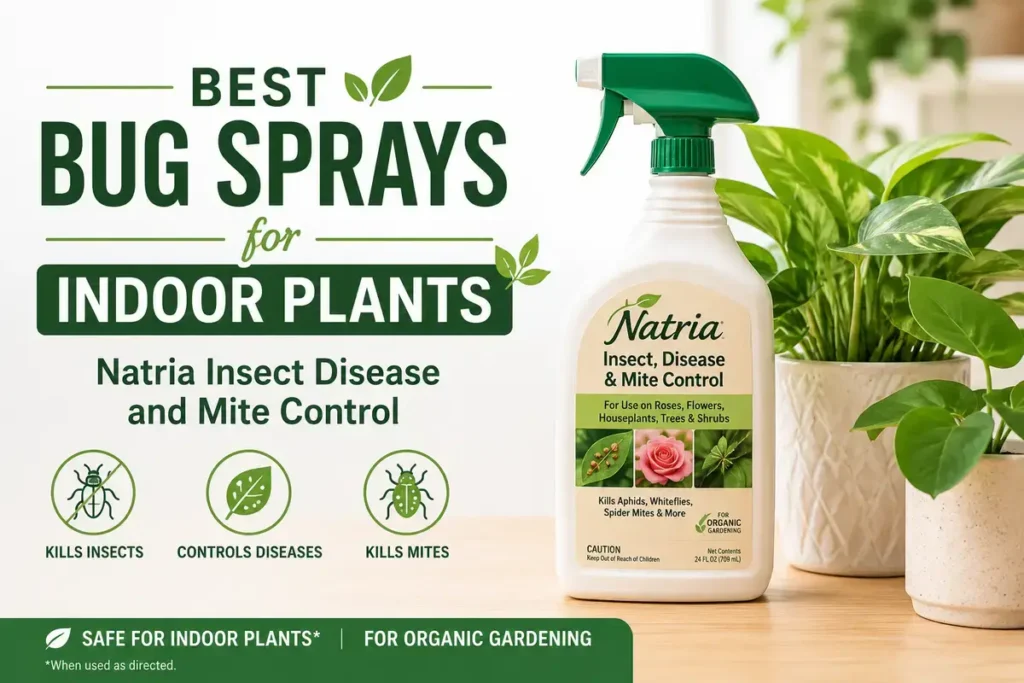
6. Natria Insect Disease and Mite Control — Best Multi-Problem Spray
Natria combines insecticidal soap with clarified hydrophobic neem oil extract in a single ready-to-use formula, which means it handles both insect pests and fungal diseases like powdery mildew simultaneously. For plants dealing with both a pest problem and disease symptoms at the same time, this is the most efficient single-product solution available.
What it kills: Aphids, spider mites, whiteflies, mealybugs, scale, plus fungal diseases including powdery mildew and black spot
How to use it: Ready-to-use spray bottle. Shake well and apply to all plant surfaces. Repeat every 7 to 14 days as needed.
Where to buy: Home Depot, Walmart, and Amazon. Available in 24-ounce ready-to-use bottles.
Best for: Plants showing both pest damage and disease symptoms simultaneously, particularly roses and hibiscus which are prone to both aphid infestations and powdery mildew indoors.
Limitations: More expensive per application than single-purpose products. If you are only dealing with pests and no disease symptoms, a dedicated insecticidal soap or neem oil product is more cost-effective.
7. Diatomaceous Earth Spray — Best for Crawling Soil Pests
While most bug sprays target above-ground insects, food-grade diatomaceous earth mixed into a spray solution addresses crawling insects and soil-surface pests that liquid sprays miss. It works through physical rather than chemical means, with microscopic sharp edges piercing the protective coating of insects and causing dehydration.
What it kills: Crawling insects on soil surfaces, fungus gnat adults, ants, soil mites, any soft-bodied crawling insect crossing treated surfaces
How to use it: Mix 4 tablespoons of food-grade diatomaceous earth with 1 quart of water and apply as a spray to soil surfaces and the base of stems. Once the water evaporates, the diatomaceous earth remains as a dry barrier. Reapply after watering since moisture temporarily reduces its effectiveness.
Alternatively, dust dry diatomaceous earth directly onto the soil surface without mixing with water for longer-lasting barrier protection.
Where to buy: Harris Diatomaceous Earth is one of the most widely available brands at Home Depot, Lowe’s, and on Amazon. Available in sizes suited for small indoor use through large garden applications.
Best for: Complementing above-ground spray treatments by addressing the soil-surface and crawling pest stage of infestations. Particularly effective as part of a fungus gnat treatment plan targeting adults at soil level while hydrogen peroxide drenches address larvae below. For a complete guide to identifying and treating every type of pest living in your potting mix, bugs in indoor plant soil covers every species from fungus gnat larvae to root aphids in full detail.
Limitations: Loses effectiveness when wet. Does not work on flying insects. Must be food-grade for safe indoor use.
How to Apply Any Bug Spray for Maximum Effectiveness
The product matters less than the application technique in most indoor pest situations. These rules apply to every spray on this list.
Cover leaf undersides completely. This is where aphids, spider mites, and whiteflies live and feed. A spray that only hits the top surface of leaves misses the majority of the pest population entirely. Slow down and work the nozzle under each leaf.
Apply in the morning or evening. Never spray plants in direct bright sunlight. Spray solutions concentrate under intense light and cause leaf burn on many species, particularly oil-based sprays like neem.
Test before full application. Spray one leaf, wait 24 hours, check for discoloration or spotting before treating the whole plant. This step takes 30 seconds and saves you from damaging an entire plant.
Treat every plant in the area. Pests spread between plants faster than most people realize. Treating one plant while leaving infested neighbors untouched means reinfection within days.
Repeat on schedule. A single application rarely eliminates an infestation completely because eggs survive most contact sprays. Every product on this list requires repeat applications on a consistent schedule to break the full reproductive cycle.
Matching the Right Spray to Your Pest
| Pest | First Choice | If That Fails |
|---|---|---|
| Aphids | Dish soap spray or Safer Brand | Neem oil spray |
| Spider mites | Neem oil spray | Natria multi-spray |
| Whiteflies | Safer Brand soap | Captain Jack’s Deadbug |
| Fungus gnats | Diatomaceous earth | Hydrogen peroxide drench |
| Mealybugs | Rubbing alcohol spot treatment | Bonide Neem Oil RTU |
| Thrips | Captain Jack’s Deadbug | Neem oil spray |
| Soil crawlers | Diatomaceous earth | Neem oil soil drench |
Safety Tips for Using Bug Sprays Indoors
Using any spray product inside your home requires a few additional precautions that outdoor application does not.
Ventilate the room. Open a window or run a fan when applying any spray indoors, even organic products. Good airflow disperses any fine mist particles that would otherwise concentrate in a closed room.
Keep pets and children away during application. Even organic sprays like neem oil and insecticidal soap should dry completely before children or pets return to the area. Most products are dry and safe within 30 to 60 minutes under normal indoor conditions.
Wash hands thoroughly after application. This applies to every product on this list including the homemade dish soap version.
Store products safely. Keep all pest control products in their original labeled containers, away from food, and out of reach of children.
When Bug Spray Alone Is Not Enough
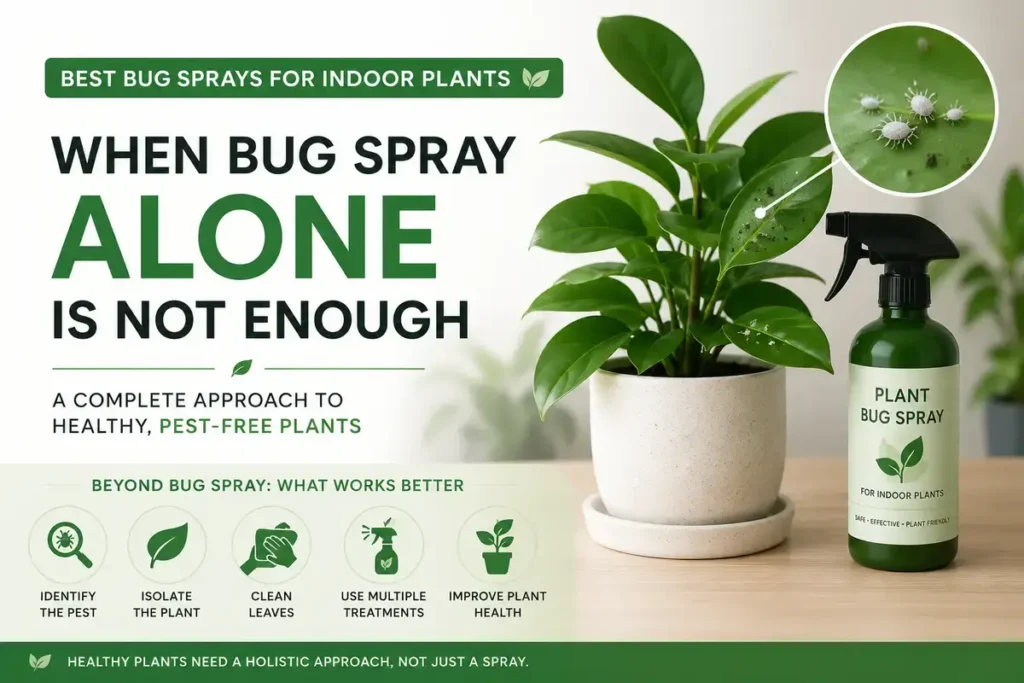
Sprays address the active pest population but do not address what attracted pests to your plants in the first place. If you are dealing with recurring infestations despite consistent spray treatment, the underlying cause is almost always one of these:
A stressed plant producing the high amino acid sap that pests target. Overwatered soil creating the moist environment fungus gnats and shore flies require. No physical barrier stopping pests from entering through open windows or spreading between plants in your collection.
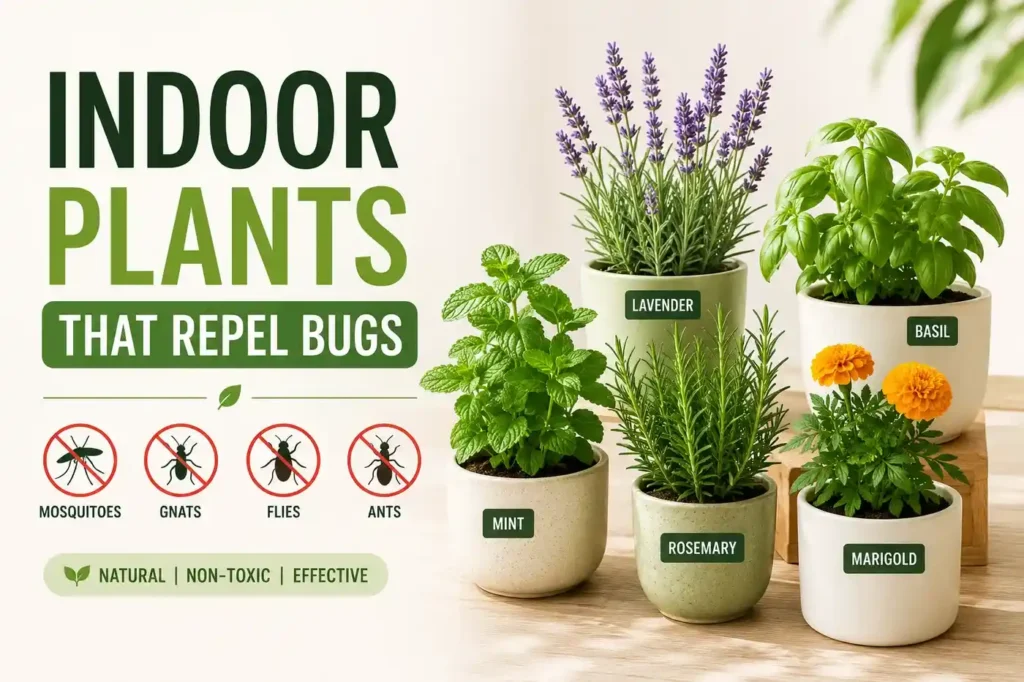
Combining spray treatment with companion planting is one of the most effective long-term prevention strategies available. Certain plants produce volatile compounds that repel the insects most likely to attack your houseplants before they ever establish a colony. The complete guide on indoor plants that repel bugs covers which companion plants work best and exactly where to position them alongside your existing collection for maximum deterrent effect.
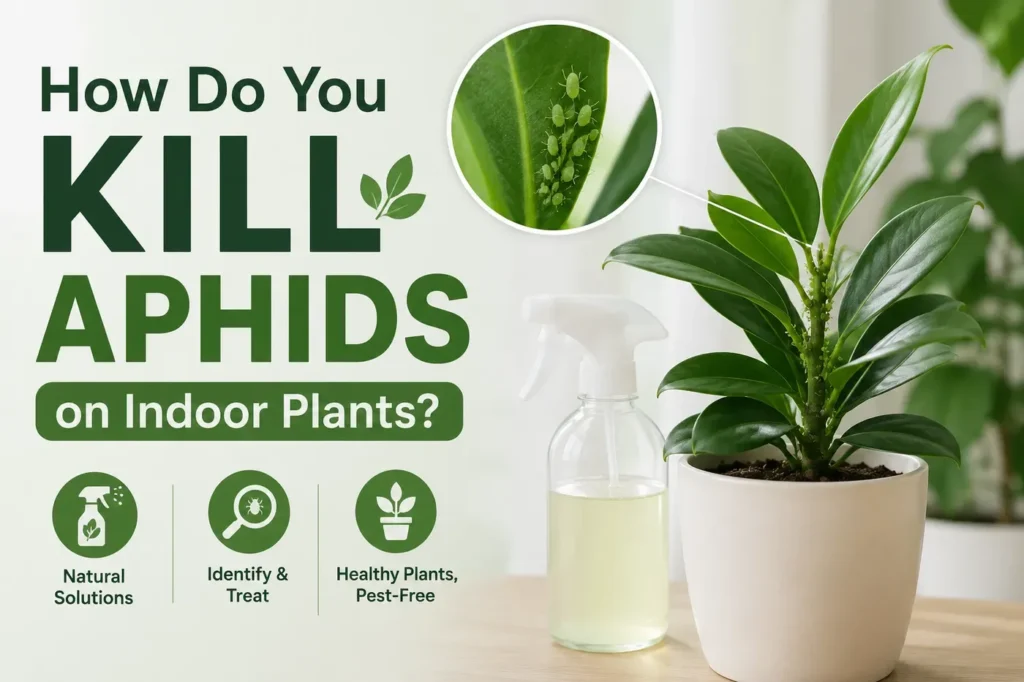
For identifying exactly which pest you are dealing with before choosing a spray, how to get rid of aphids on indoor plants and how do you kill aphids on indoor plants cover the full identification and treatment process for the most common indoor plant pest in detail.
Conclusion
The best bug spray for indoor plants is not the most expensive one or the one with the most impressive label claims. It is the one matched correctly to your specific pest, applied thoroughly to every plant surface on a consistent schedule, and repeated long enough to break the full reproductive cycle of whatever you are dealing with.
Start with the homemade dish soap spray for immediate action on most soft-bodied pests. Move to neem oil if soap alone is not producing clear results after the first week. Reach for Captain Jack’s Deadbug Brew for thrips and hard-to-kill beetles that organic sprays struggle with. Add diatomaceous earth at soil level when crawling pests or fungus gnats are part of the problem.
Two applications of the right spray applied correctly will outperform ten applications of the wrong one. Identify the pest, match the spray, cover every surface, and stay consistent for two full weeks minimum. That combination clears the overwhelming majority of indoor plant pest problems without complicated chemical regimens or expensive products.
Frequently Asked Questions
Is it safe to use bug spray on indoor plants around pets?
Most organic sprays including neem oil, insecticidal soap, and diatomaceous earth are safe around pets once fully dry. Keep pets out of the room during application and for 30 to 60 minutes afterward while the spray dries. Avoid pyrethrin-based sprays around cats specifically since cats cannot metabolize pyrethrins effectively and even low concentrations can cause serious reactions. Always check the product label for specific pet safety information before use.
How often should I spray my indoor plants for bugs?
Contact sprays like soap and neem oil need to be applied every 3 to 7 days for a minimum of two full weeks to break the pest reproductive cycle completely. Monthly preventive applications of neem oil across your entire plant collection significantly reduce the frequency of active infestations developing in the first place.
Can I use outdoor bug spray on indoor plants?
No. Many outdoor pesticides contain synthetic pyrethroids and other compounds that are safe in open outdoor air but accumulate to harmful indoor concentrations in an enclosed living space. Always use products explicitly labeled for indoor use. The products covered in this guide are all safe and appropriate for indoor application.
Why is my bug spray not working on my indoor plants?
The most common reasons a spray fails to resolve an infestation are incomplete coverage of leaf undersides where pests actually live, stopping treatment too early before eggs hatch and are killed by follow-up applications, using a spray not matched to the specific pest present, or leaving neighboring infested plants untreated so reinfection happens continuously. Check all four of these before switching products.
Can I make my own neem oil bug spray at home?
Yes, and it is straightforward. Mix 2 tablespoons of pure cold-pressed neem oil with 1 teaspoon of plain dish soap and 1 quart of warm water. The soap emulsifies the oil into the water so it sprays evenly. Shake before each use as the mixture separates on standing. This homemade version performs comparably to commercial ready-to-use neem products at a fraction of the cost per application.
What is the safest bug spray for indoor plants near food?
Safer Brand Insect Killing Soap, Garden Safe Neem Oil, and Captain Jack’s Deadbug Brew are all OMRI listed for organic use on edible plants and are among the safest options for use near herbs and indoor vegetables. Rinse edible plants with plain water at least 24 hours before harvesting after any spray application regardless of the product used.
Do I need to wipe off bug spray after applying it to indoor plants?
For soap-based sprays, rinsing with plain water 2 to 3 hours after application reduces the risk of leaf spotting on sensitive plants and removes dead insect debris from the surface. For neem oil sprays, rinsing is optional but recommended on thin-leaved plants. Diatomaceous earth should not be rinsed off since moisture deactivates it. Check individual product labels for specific rinse recommendations.
Pingback: How Do You Get Rid of Aphids on Indoor Plants: 8 Steps That Work - Plant Quill
Pingback: 14 Plants That Keep Bugs Away Indoors Naturally and Effectively - Plant Quill
Pingback: 9 Beneficial Bugs for Indoor Plants That Fight Pests Naturally - Plant Quill