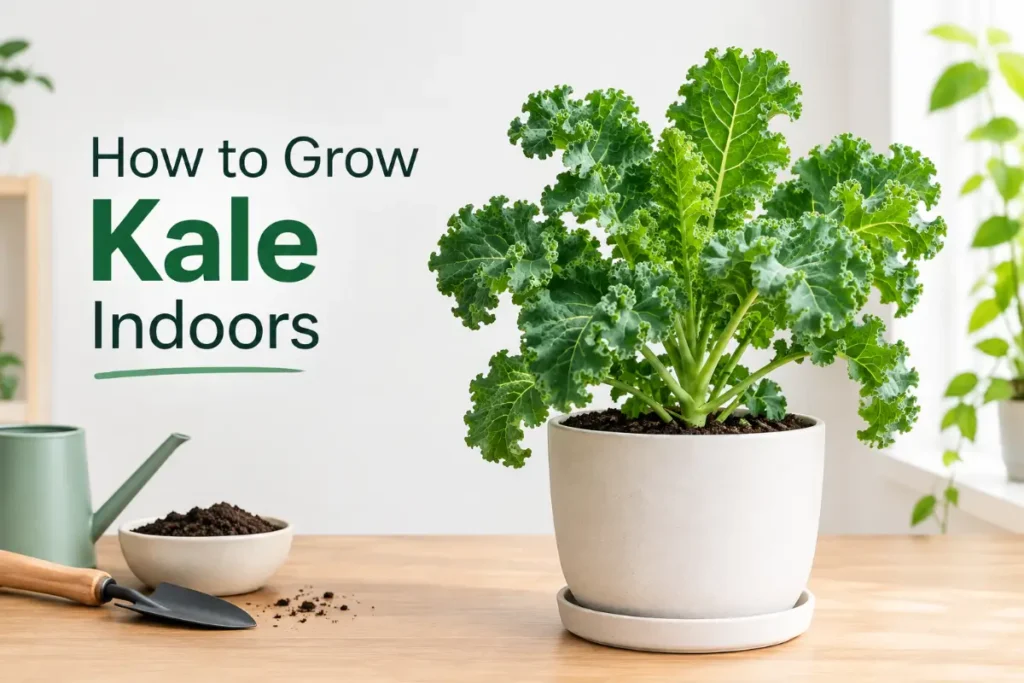
How to grow kale indoors is one of the most nutritionally rewarding indoor food growing projects available. Kale is consistently ranked among the most nutrient-dense foods available and fresh kale harvested from a kitchen plant and eaten within minutes retains the full complement of vitamins, minerals, and antioxidants that make it nutritionally valuable in ways that grocery store kale — cut days ago and stored under refrigeration — cannot match.
Kale is also one of the most cold-tolerant food crops in this cluster, making it particularly practical for indoor growing in positions that are too cool for the warm-season crops that dominate this guide. It is a genuinely different crop from spinach and lettuce in both flavor intensity and physical robustness, producing large, substantial leaves on plants that grow significantly larger than most other indoor leafy greens.
Quick Answer
To grow kale indoors: choose compact varieties like Dwarf Siberian, Red Russian, or Lacinato (Dinosaur kale), sow seeds in containers at least eight inches deep with standard potting mix, provide bright indirect to direct east or south-facing window light or grow lights running 12 to 14 hours daily, maintain cool to moderate temperatures between 55 and 75 degrees Fahrenheit, water when the top inch dries, fertilize every two to three weeks with a nitrogen-forward formula, and harvest outer leaves leaving the central growing point intact for continuous production.
Understanding Kale as an Indoor Crop
Kale (Brassica oleracea var. sabellica) is a cool-season biennial from the Mediterranean region that is grown as an annual in most vegetable gardens. It is more cold-tolerant than any other crop in this cluster — outdoor kale sweetens after frost and survives temperatures well below freezing. This cold tolerance makes it one of the most versatile indoor food crops for rooms that stay cool and for year-round growing in homes where summer indoor temperatures are controlled.
Kale is significantly more vigorous and larger-growing than spinach or lettuce. Full-sized kale varieties in outdoor gardens reach two to four feet in height with leaves that span twelve inches or more. For indoor container growing, compact and dwarf varieties that stay under eighteen inches and produce smaller, more manageable leaves are the practical choice.
Nutritional profile: Kale is one of the most nutritionally complete vegetables available, providing extremely high concentrations of vitamins K, A, and C, significant calcium and iron, and high levels of antioxidant compounds including quercetin and kaempferol. It also contains glucosinolates (sulfur compounds with documented anti-cancer research interest) and lutein and zeaxanthin for eye health. Per calorie, kale is among the most nutritionally dense foods available.
Step 1: Choose the Right Kale Variety
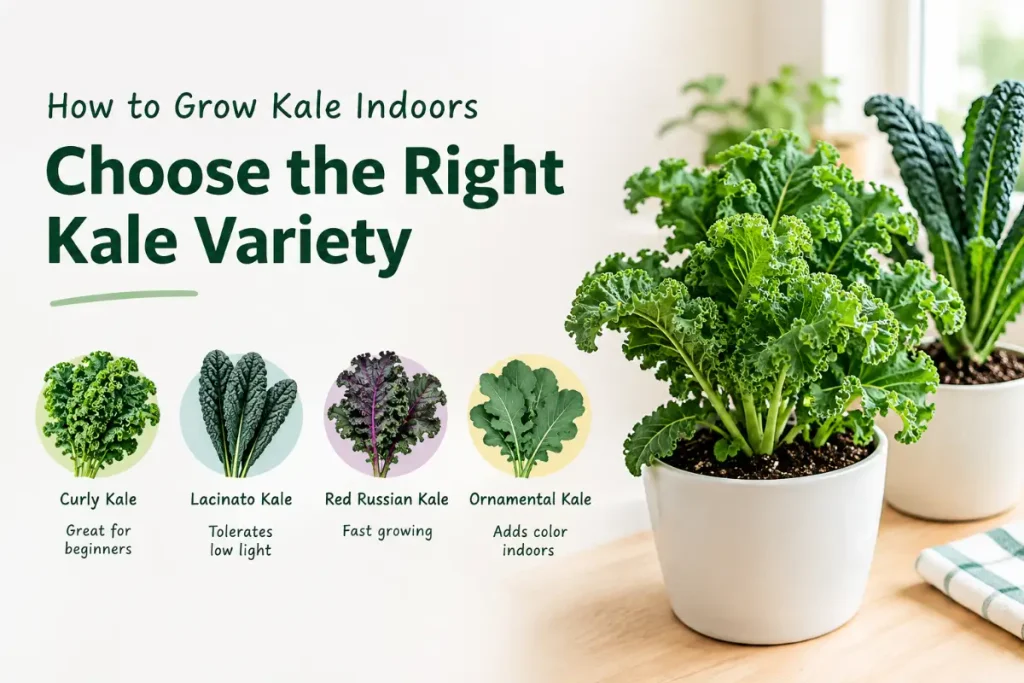
Variety selection matters significantly for indoor kale since the difference between compact and full-sized varieties determines whether the plant stays manageable in containers or becomes too large for practical indoor growing.
Best compact varieties for indoors:
Dwarf Siberian: One of the most compact kale varieties available, staying under twelve to fifteen inches with broad, grey-green, ruffled leaves. Fast-maturing and productive. Excellent for container growing.
Red Russian: Open, slightly frilly red-green leaves on a relatively compact plant. One of the most tender kale varieties when harvested young. Less fibrous than curly kale types. Attractive red leaf coloring makes it visually appealing on a kitchen shelf.
Lacinato (Dinosaur kale or Tuscan kale): Dark blue-green, narrow, deeply textured leaves on upright stems. More heat-tolerant than other varieties, which is a practical advantage in warmer indoor environments. Excellent flavor that is milder and less bitter than curly kale.
Dwarf Blue Curled: A compact curly kale variety staying under fifteen inches. Dense, heavily curled blue-green leaves. One of the most cold-tolerant compact varieties, suitable for very cool indoor positions.
What to avoid: Full-sized curly kale varieties like Winterbor and Redbor that grow to three feet or more and become impractical for container management. These varieties produce excellent outdoor garden kale but are not appropriate for the container growing constraints of indoor production.
Step 2: Set Up Containers for Kale’s Deeper Root System
Kale develops a more substantial root system than spinach or lettuce and requires deeper containers than the shallow trays appropriate for those crops.
Container depth: Eight to ten inches minimum. Kale roots grow deeper than most other leafy greens and need adequate depth for the water and nutrient uptake that supports its vigorous leaf production. Containers shallower than eight inches produce significantly smaller, less productive plants.
Container width: Twelve inches wide for a single plant. Sixteen to eighteen inches for two plants. Kale grows larger than spinach and lettuce and needs more space per plant to reach its productive potential.
Fabric grow bags: Five-gallon fabric grow bags provide excellent root environment for indoor kale. The air pruning that fabric bags provide prevents the root circling that occurs in plastic containers and produces noticeably healthier plants over the multi-month productive life of indoor kale.
Drainage: Multiple drainage holes essential. While kale prefers consistently moist soil, anaerobic waterlogged conditions cause root rot. Good drainage throughout the container base.
Step 3: Start from Seed or Transplant
From seed: Kale germinates readily across a wide temperature range of 45 to 85 degrees Fahrenheit, making it one of the most reliable seed starters in the cool-season crop category. Sow seeds one-half inch deep in moist potting mix. Germination occurs within five to ten days. Thin to one plant per six inches of container space when seedlings reach two inches tall.
From transplant: Garden center kale transplants in spring provide a four-to-six-week head start over seed sowing. Choose the most compact variety available. Transplant into an eight-to-ten-inch deep container with fresh potting mix. Kale transplants establish quickly and begin producing harvestable leaves within two to three weeks of transplanting.
Planting depth: Set transplants at the same depth they were growing in their nursery containers. Do not bury the stem as you would with tomatoes.
Time to first harvest: Three to four weeks from transplant. Five to seven weeks from seed sowing to first harvest.
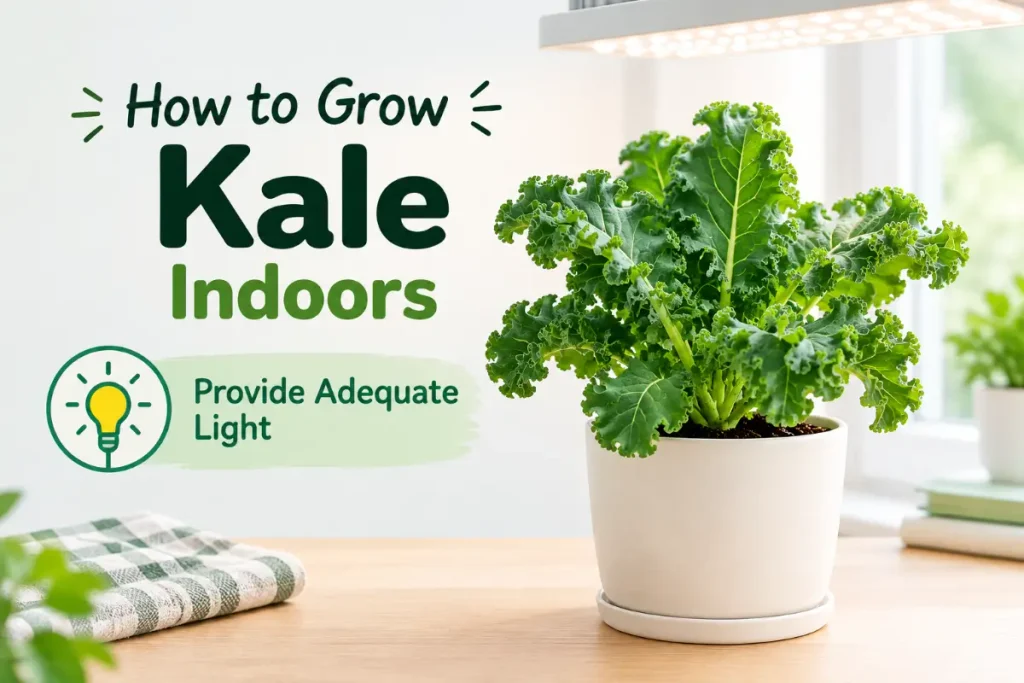
Step 4: Provide Adequate Light
Kale has more flexible light requirements than fruiting crops but more demanding requirements than spinach for vigorous productive growth.
Natural light: Bright indirect light from an east-facing window or some direct morning sun produces good indoor kale growth. South-facing window positions with direct sun produce the most vigorous kale. North-facing windows with medium indirect light produce acceptable but slower growth with smaller leaves than brighter positions.
Grow lights: A standard full-spectrum LED grow light running 12 to 14 hours daily produces vigorous, productive indoor kale in any room regardless of natural light direction. Unlike tomatoes and peppers that require high-output grow lights, kale’s leafy-green growth responds well to modest grow light intensity.
The heat-bolt interaction: Direct intense south-facing afternoon sun in warm rooms can combine with temperature to stress kale in summer. If your indoor environment is consistently above 75 degrees in summer, east-facing window light with cooler temperatures produces better kale than intense south-facing sun in a warm room.
Step 5: Maintain Cool Temperatures
Ideal range: 55 to 75 degrees Fahrenheit. Kale grows most vigorously and produces the sweetest, least bitter leaves in the cooler portion of this range. Outdoor kale is famously sweeter after frost, and indoor kale similarly develops better flavor in cool conditions.
Above 80 degrees: Growth continues but leaf quality declines. Leaves become more bitter and tougher as temperatures rise above the comfortable range. In very warm indoor conditions above 85 degrees, growth slows significantly and the plant may begin bolting.
The cold tolerance advantage: Unlike every warm-season crop in this cluster, kale handles temperatures down to 45 to 50 degrees indoors without stress. This makes it suitable for cool spaces where heating is minimal — a cool garage with a bright window, an unheated sunroom in mild climates, a basement growing area. These cool positions that would damage tomatoes and peppers are often ideal for kale.
Step 6: Water and Fertilize Consistently
Watering: Water when the top inch of soil feels dry. In typical indoor conditions this means every four to six days. Kale is somewhat more drought-tolerant than spinach but prefers consistent moisture for the most productive leaf growth. Drought stress causes tougher, more bitter leaves similar to the heat-stress effect on leaf quality.
The larger leaf surface area: Mature kale plants have significantly more leaf surface area than spinach or lettuce, which means higher total water demand per plant. Check moisture more frequently as plants reach full size than during the seedling and young plant stages.
Fertilizing: Every two to three weeks through the active growing period with a balanced to slightly nitrogen-forward liquid fertilizer at half rate. Kale’s continuous leaf production is a nitrogen-demanding process and benefits from more frequent fertilizing than the once-per-month approach appropriate for slower-growing herbs. However, like other leafy crops, excessive nitrogen fertilizing reduces flavor concentration and produces larger but nutritionally diluted leaves.
Organic options: Liquid fish emulsion at half rate every two to three weeks suits kale’s moderate nitrogen requirement with gentle organic nutrition. Worm casting tea as a supplement every three to four weeks provides soil biology support alongside the liquid fertilizer program.
Step 7: Harvest Outer Leaves for Continuous Production
The cut-and-come-again harvesting principle applies to kale as it does to spinach and lettuce, but kale’s larger individual leaves and slower regrowth rate mean a slightly different harvesting cadence.
The correct technique: Cut or snap outer leaves from the base, leaving the central growing point and the smaller inner leaves intact. Always leave at least four to six leaves on the plant at any time to maintain adequate photosynthetic capacity for regrowth.
Harvest frequency: Every seven to ten days as new outer leaves reach usable size. Kale regenerates more slowly than spinach after harvesting — the outer leaves you harvest take seven to ten days to be replaced by the next set of inner leaves growing to harvestable size.
How long each plant produces: Indoor kale in good conditions produces harvestable outer leaves continuously for three to six months before the plant exhausts its productive capacity, bolts, or becomes too woody in its lower stems for attractive harvest. This significantly longer productive life compared to spinach and lettuce (which last four to eight weeks per sowing) reduces the succession sowing frequency needed for continuous indoor kale production.
Succession sowing for kale: Given the longer productive life, one to two plants started every six to eight weeks maintains continuous indoor kale availability with fewer active growing cycles than faster-cycling cool-season crops. Starting a new container when an existing plant reaches peak size ensures continuous production without the weekly succession sowing that cilantro requires.
Using harvested kale: Fresh indoor kale is excellent raw in salads when leaves are young and tender (three to four inches), lightly massaged with olive oil and salt to soften the texture, in smoothies, sautéed as a side vegetable, added to soups and stews, or made into the kale chips that are one of the most straightforward and satisfying culinary uses of a home kale harvest. For the complete guide to the indoor food garden context in which kale fits alongside other leafy greens and herbs, indoor herb garden covers the broader indoor growing setup that provides the framework within which indoor kale production operates most effectively alongside complementary herbs and cool-season crops.
Common Indoor Kale Problems and Solutions
Bitter leaves even when young: Temperature consistently above 75 degrees. Move to the coolest available indoor position. Choose Lacinato variety which is milder than curly types. Harvest younger (two to three inches) for milder flavor.
Yellowing lower leaves: Natural aging as the plant puts growth energy into upper leaf production. Remove cleanly. If yellowing spreads throughout the plant rather than just the oldest lower leaves, assess for nitrogen deficiency (begin or increase fertilizing) or overwatering causing root damage.
Aphids clustered on new growth: Kale attracts aphids more readily than most other indoor food crops. Inspect weekly. Remove small colonies by hand or with a firm water spray. Follow with neem oil spray every seven days for three weeks if colonies persist. For the complete aphid treatment guide, how to get rid of aphids on indoor plants covers every effective approach.
Leggy plants stretching toward the window: Insufficient light. Move to a brighter position or add grow light hours. Kale’s physical size means insufficient light produces dramatically visible stretching within two to three weeks.
Slow growth despite adequate light and water: Temperature too warm or nitrogen deficiency. Check temperatures and begin or increase fertilizing with nitrogen-forward formula.
Kale Nutrition: Why Fresh Indoor Kale Outperforms Store-Bought
The nutritional case for growing kale indoors is stronger than for almost any other crop in this cluster because of how dramatically kale’s nutritional content deteriorates after harvest.
Vitamin C loss: Kale loses approximately 50% of its vitamin C content within the first twenty-four hours after cutting, even under refrigeration. By the time grocery store kale reaches your kitchen — typically three to seven days after harvest — a significant fraction of its original vitamin C is gone. Indoor kale harvested and eaten within minutes retains its full vitamin C content.
Glucosinolate preservation: The glucosinolates in kale, which are the sulfur compounds associated with its anti-cancer research interest and its characteristic flavor, are more stable than vitamin C but still degrade in stored kale over days of refrigeration. Fresh indoor kale provides a more complete glucosinolate profile than stored grocery kale.
The washing loss problem: Commercial kale is washed multiple times in large industrial facilities before packaging. Each washing removes some water-soluble nutrients. Indoor kale that is rinsed once immediately before use retains more of its water-soluble vitamin and mineral content.
Practical implication: A smaller quantity of fresh indoor kale provides equivalent or greater nutritional benefit than a larger quantity of week-old grocery store kale. The freshness advantage compounds over regular use, making indoor kale one of the most nutritionally justified indoor food growing investments across this entire cluster.
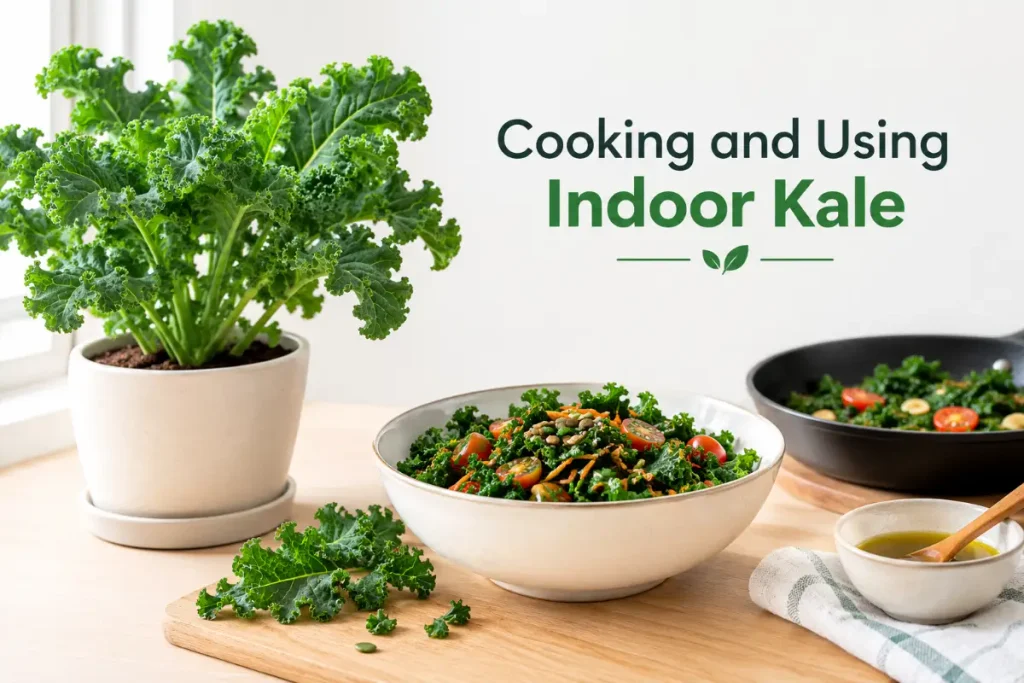
Cooking and Using Indoor Kale
Fresh indoor kale has more versatility than grocery store kale that may be slightly wilted or tough from storage. Understanding how to use different harvesting stages expands the culinary applications significantly.
Baby kale (two to three inches): The most tender, mildest form. Excellent raw in salads where it needs no massage. Good in sandwiches and wraps. Best for eating fresh where the mild flavor and tender texture are most appreciated.
Young kale (three to five inches): Slightly more substantial texture. Can be used raw with light massage or very brief wilting. Excellent in smoothies where the mild flavor at this stage blends without dominating. Perfect for light sautéing in olive oil with garlic.
Mature kale (five or more inches): Full kale flavor and texture. Benefits from massage with oil and salt for raw use or from cooking. Makes the best kale chips, braised kale, and additions to soups and stews where the more robust texture holds up to heat without completely dissolving.
Kale chips from indoor harvest: Tear harvested kale leaves into chip-sized pieces, toss with olive oil and salt, and bake at 300 degrees Fahrenheit for fifteen to twenty minutes. The result is one of the most immediately rewarding culinary uses of a home kale harvest — crispy, intensely flavored chips that use the crop directly and immediately in a way that motivates continued growing.
For the companion guide to spinach growing that shares kale’s cool-season preference and cut-and-come-again harvesting approach while providing a nutritionally complementary leafy green with different flavor and texture, how to grow spinach indoors covers the spinach care approach that pairs naturally with indoor kale in a complete cool-season indoor salad garden where both crops are grown simultaneously for maximum nutritional variety from a single growing setup.
Conclusion
How to grow kale indoors delivers one of the most nutritionally dense harvests of any indoor food crop from a plant that is significantly more cold-tolerant and longer-lived per sowing than spinach or lettuce. Compact varieties like Dwarf Siberian, Red Russian, and Lacinato in eight-to-ten-inch deep containers with adequate indirect to direct light, consistent moisture, and biweekly nitrogen fertilizing produce continuous outer leaf harvests for three to six months per planting.
The longer productive life and larger individual leaf size of indoor kale makes it the most volume-productive leafy green for indoor growing on a per-container basis, providing significant weekly harvests from a smaller number of active plantings than the faster-cycling spinach and lettuce that require more frequent succession sowing for comparable continuous yield.
Frequently Asked Questions
What is the best kale variety to grow indoors?
Dwarf Siberian and Red Russian are the most compact and most practical for indoor container growing, staying under fifteen inches and producing tender leaves in smaller containers than full-sized varieties require. Lacinato (Dinosaur kale) is the mildest flavored and most heat-tolerant, making it the best choice for warmer indoor environments or for growers who find standard kale too bitter. All three outperform full-sized curly kale varieties for indoor container management.
How long does it take to grow kale indoors?
Five to seven weeks from seed sowing to first harvest. Two to three weeks from transplant to first harvest. After the first harvest, outer leaves are available every seven to ten days continuously for three to six months from a single planting, making kale one of the longest-lived per-sowing indoor food crops covered in this cluster.
Does indoor kale need direct sunlight?
Bright indirect light from an east-facing window produces adequate indoor kale. Some direct morning sun improves production further. South-facing direct sun produces the most vigorous growth but in very warm rooms can contribute to heat stress and bitterness. North-facing medium indirect light produces slower but acceptable kale growth. Grow lights running 12 to 14 hours daily work well for kale in any room.
Why does my indoor kale taste bitter?
Bitterness in indoor kale is most commonly caused by warm temperatures consistently above 75 degrees, harvesting leaves that are too mature (larger than four to five inches for most indoor varieties), or inadequate watering causing drought stress. Move to a cooler position, harvest younger leaves more frequently, and maintain consistent moisture. Choosing Lacinato variety provides a naturally milder flavor baseline regardless of growing conditions.
How do I prevent aphids on indoor kale?
Inspect the undersides of kale leaves weekly since aphids establish on kale more readily than most other indoor food crops. Remove small colonies immediately by hand or with a firm spray of water. Apply neem oil spray every seven days as a preventive measure if your indoor environment is prone to aphid problems. Good air circulation around the plant reduces the still-air conditions that allow aphid populations to establish and expand rapidly.
Can I grow kale indoors in winter?
Yes, and winter is one of the most productive seasons for indoor kale in cool homes since kale specifically prefers the 55 to 70 degree temperatures that winter indoor environments often provide. The reduced light intensity of winter months is the primary management challenge — increasing grow light hours to 14 daily compensates for reduced natural light and maintains vigorous growth through the darkest winter months.