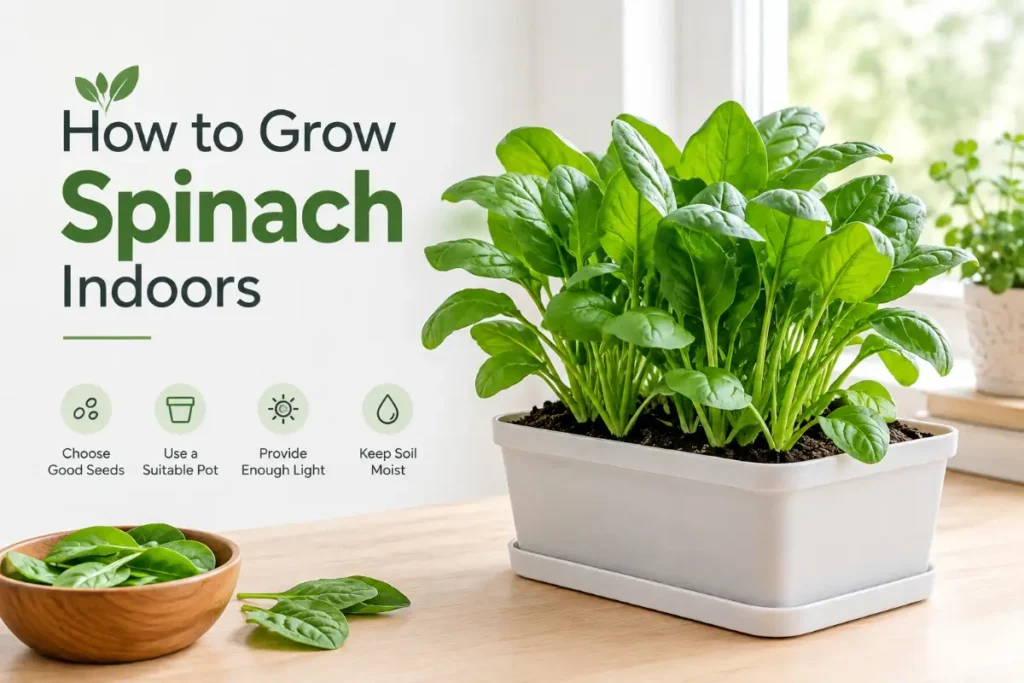
How to grow spinach indoors is a straightforward project that produces results within three to four weeks of sowing and delivers one of the most nutritionally dense harvests available from any indoor food crop. Spinach is a cool-season crop that suits indoor growing particularly well because the temperature-controlled environment of most homes prevents the rapid bolting that defeats outdoor spinach in summer heat.
Like indoor lettuce, spinach is managed through cut-and-come-again harvesting and succession sowing rather than the single large harvest approach of outdoor spinach production. Understanding this continuous-production mindset from the start produces a more satisfying and more practically useful indoor spinach garden than treating each sowing as a one-time harvest event.
Quick Answer
To grow spinach indoors: sow seeds directly into a shallow container with standard potting mix, one-half inch deep and two inches apart, water gently, and place in bright indirect light from an east or north-facing window. Keep temperatures between 50 and 70 degrees Fahrenheit since spinach is a cool-season crop that bolts in heat. Begin cut-and-come-again harvests when outer leaves reach three to four inches. Succession sow every three to four weeks for continuous harvest. Avoid temperatures consistently above 75 degrees which trigger bolting.
Understanding Spinach as an Indoor Crop
Spinach (Spinacia oleracea) is a cool-season annual native to central Asia where it evolved in the mild, moist conditions of mountain valleys and temperate plains. Its preference for cool temperatures and moderate moisture distinguishes it from the warm-season crops like tomatoes and basil that dominate most indoor food growing coverage.
The cool-season preference is the most practically useful characteristic of indoor spinach growing. While outdoor spinach struggles in summer heat and bolts within weeks of warming temperatures, indoor spinach in an air-conditioned or naturally cool home maintains productivity through summer months when outdoor spinach has long since been abandoned. The indoor environment’s temperature control solves spinach’s greatest outdoor challenge.
Nutritional density: Spinach is among the most nutrient-dense leafy vegetables available, providing iron, magnesium, vitamins K, A, C, and folate alongside antioxidant compounds including lutein and zeaxanthin. Fresh spinach harvested and eaten within minutes of cutting retains significantly more of these compounds than spinach that has spent days in transit and refrigeration. This nutritional freshness advantage is one of the most compelling practical reasons to grow spinach indoors.
Savoy versus flat-leaf varieties: Savoy spinach varieties have crinkled, dark green leaves with more complex texture. Flat-leaf varieties have smoother leaves that are easier to wash and process. Both grow equally well indoors. Baby spinach varieties harvested at small leaf size are the most practical for indoor container growing since their compact leaf size suits the harvesting method that produces continuous yield.
Step 1: Choose the Right Container
Spinach roots are shallower than most vegetable crops, making it one of the most container-friendly indoor food crops in this cluster.
Depth: Four to six inches of soil depth is sufficient for productive spinach growing. This means standard seed trays, window boxes, shallow bowls with drainage holes, and purpose-built herb planters all provide adequate growing volume.
Width: More important than depth for spinach production. A wider container allows more plants and more total harvest. A standard twelve-inch window box holds a productive spinach planting. A twenty-four-inch window box under adequate light provides enough spinach for regular salad harvests for one to two people.
Drainage: Non-negotiable. Spinach roots rot quickly in waterlogged soil. Drill drainage holes in any container that does not already have them.
Multiple containers for succession: Plan for two to three containers at different planting stages from the beginning. The succession sowing approach that maximizes continuous indoor spinach harvest requires having multiple plantings in progress simultaneously.
Step 2: Sow Seeds Correctly
Spinach seeds are larger than lettuce seeds and require slightly different sowing technique.
Seed preparation: Soaking spinach seeds in room-temperature water for two to four hours before sowing softens the seed coat and accelerates germination by one to two days. Not strictly necessary but helpful particularly in cooler indoor conditions.
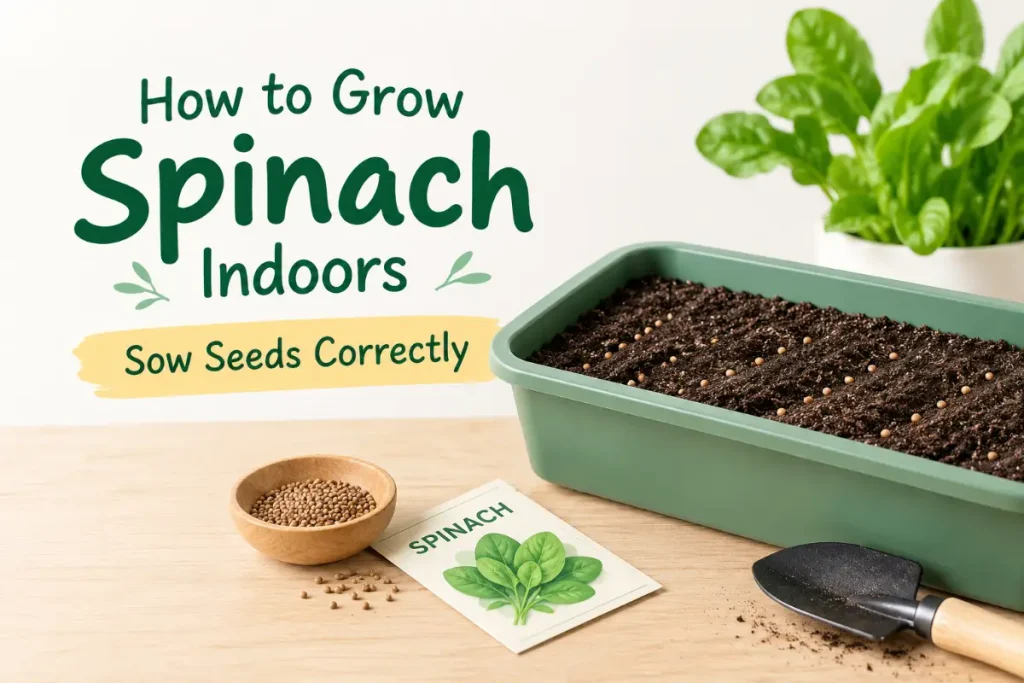
Sowing depth: One-half inch deep. Unlike the surface sowing appropriate for lettuce, spinach seeds benefit from being covered with half an inch of growing medium. Press seeds into slightly moist soil at the appropriate depth and cover lightly.
Spacing: Two inches between seeds for cut-and-come-again production where you are harvesting individual leaves. Three to four inches if you plan to harvest whole small plants. The closer spacing produces more leaf material per container area for cut-and-come-again harvesting.
Germination conditions: Spinach germinates best at soil temperatures between 45 and 65 degrees Fahrenheit — cooler than most other food crops. At room temperature (68 to 72 degrees) germination still occurs but may be slightly slower. In very warm conditions above 75 degrees, germination rate drops significantly. This is one reason spinach starting from seed in summer indoors is more challenging than in spring or fall.
Germination time: Five to ten days in appropriate cool to moderate conditions. Two to three weeks in warmer conditions. Do not discard a sowing that has not germinated within ten days in warm indoor environments — germination may still occur through two to three weeks.
Step 3: Provide the Right Light
Spinach has lower light requirements than fruiting crops and many other culinary herbs, making it one of the most accessible indoor food crops for homes with limited natural light.
Natural light: Bright indirect light from an east or north-facing window produces adequate spinach growth. Spinach tolerates the lower light levels that would be insufficient for tomatoes, peppers, and Mediterranean herbs. A north-facing kitchen window that cannot support basil or rosemary can produce functional spinach harvests.
The bolt risk from intense light and heat: Unlike most other food crops where more light always means better performance, very intense direct afternoon south-facing sun combined with warm temperatures can accelerate bolting in spinach. East-facing morning sun followed by indirect afternoon light is often a better spinach position than intense south-facing afternoon sun in warm rooms.
Grow lights: A modest grow light running 12 to 14 hours daily produces the fastest, most vigorous spinach growth and allows spinach growing in any room regardless of natural light. Spinach does not require the high-output grow lights needed for tomatoes — a standard LED plant light provides sufficient intensity.
Day length and bolting: Spinach is sensitive to long days and bolts in response to extended day length above 14 hours, which is why outdoor spinach bolts in summer even in cool climates. Grow lights set to 12 to 14 hours daily avoid the very long light periods that trigger bolting while providing adequate growing light.
Step 4: Maintain Cool Temperatures
Temperature management is the most distinctive aspect of indoor spinach care compared to the warm-season crops that dominate this cluster.
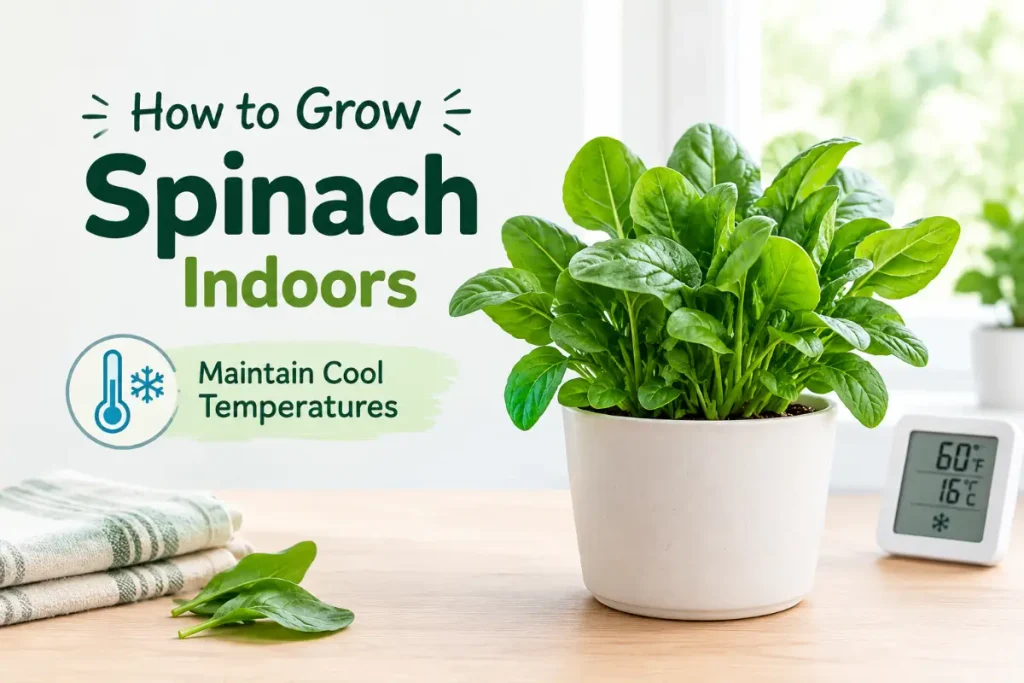
Ideal range: 50 to 70 degrees Fahrenheit. Spinach grows most vigorously in the cooler end of this range and maintains productive non-bolting growth through the full range. Above 75 degrees growth accelerates but so does the bolting tendency that ends productive harvest.
The cool-room advantage: Spinach is the ideal crop for rooms that run cooler than typical living areas. A spare bedroom maintained at 65 degrees, a cool home office, or a north-facing kitchen that stays naturally cool are excellent spinach growing environments where many other crops would grow too slowly.
Managing warm summer indoor temperatures: In homes without air conditioning where summer temperatures regularly exceed 75 degrees, positioning spinach in the coolest available indoor location extends productive life. A window air conditioner running in the room where spinach is grown, or positioning near a cool basement stairwell, reduces temperature-driven bolting.
The air conditioning advantage: Homes with central air conditioning maintaining 68 to 72 degrees through summer can grow productive spinach year-round indoors — one of the clearest practical advantages of indoor over outdoor spinach growing in hot summer climates.
Step 5: Water Consistently
Spinach prefers consistently moist soil and shows stress from drought faster than many other leafy greens.
The correct approach: Water when the top half inch of soil feels dry. In typical cool indoor conditions this means every three to five days. In warmer or drier conditions every two to three days. Spinach in shallow containers dries faster than deep-potted crops and benefits from more frequent checking.
Consistency over volume: Consistent moderate moisture produces the most tender, mildest spinach leaves. Spinach allowed to repeatedly drought stress and recover produces leaves that are tougher and more bitter than consistently moist specimens.
Watering technique: Water gently at soil level rather than on the leaves. Wet spinach leaves in indoor still-air conditions create conditions for the downy mildew that occasionally affects indoor spinach in poor ventilation situations.
Step 6: Fertilize Lightly
Spinach is a light to moderate feeder that does not need the intensive fertilizing of fruiting crops.
What it needs: Nitrogen primarily, to support the rapid leaf production that makes cut-and-come-again harvesting most productive. A balanced fertilizer with adequate nitrogen every three to four weeks through the active growing period provides sufficient nutrition.
Organic options: Worm casting tea applied every three to four weeks provides gentle nitrogen alongside soil biology benefits. Liquid fish emulsion at half rate every three to four weeks suits spinach’s moderate nitrogen requirement with the organic approach that indoor food crop growers increasingly prefer.
What to avoid: Very high-nitrogen fertilizers at full rate drive rapid but nutritionally diluted leaf growth. Light fertilizing that produces slightly slower growth maintains better nutrient concentration in the harvested leaves, which is consistent with the nutritional density that makes indoor spinach worth growing.
Step 7: Harvest Cut-and-Come-Again and Succession Sow
The cut-and-come-again technique: When outer leaves reach three to four inches, cut them at the base leaving one inch of stem and the inner growing point intact. The plant regenerates new outer leaves from the central growing point within five to seven days in appropriate growing conditions. One sowing produces harvests every five to seven days for four to eight weeks before the plant either bolts or exhausts its productive capacity.
Harvesting outer leaves only: Never cut the central growing point or the small leaves clustered at the plant’s center. These are the source of all future growth. Harvesting only outer leaves while leaving the center intact is the practice that converts a single sowing from a one-time harvest to weeks of continuous production.
Signs the plant is bolting: The central growing point elongates upward on a stem rather than producing new flat leaves. Leaves become increasingly pointed and arrow-shaped rather than rounded. Flavor becomes noticeably more bitter even in young leaves. When these signals appear, harvest everything remaining from the container and start the next succession sowing.
Succession sowing schedule: Start a new container every three to four weeks. As one container enters the bolting phase and is harvested out, the next is at peak production and the one after that is in early growth. This rolling three-container schedule maintains continuous weekly spinach harvest without gaps.
For the complete guide to the similarly managed cut-and-come-again lettuce growing that complements indoor spinach in a complete indoor salad garden, how to grow lettuce indoors covers the succession sowing approach and cut-and-come-again technique that applies identically to spinach with the variety and temperature adjustments described in this guide.
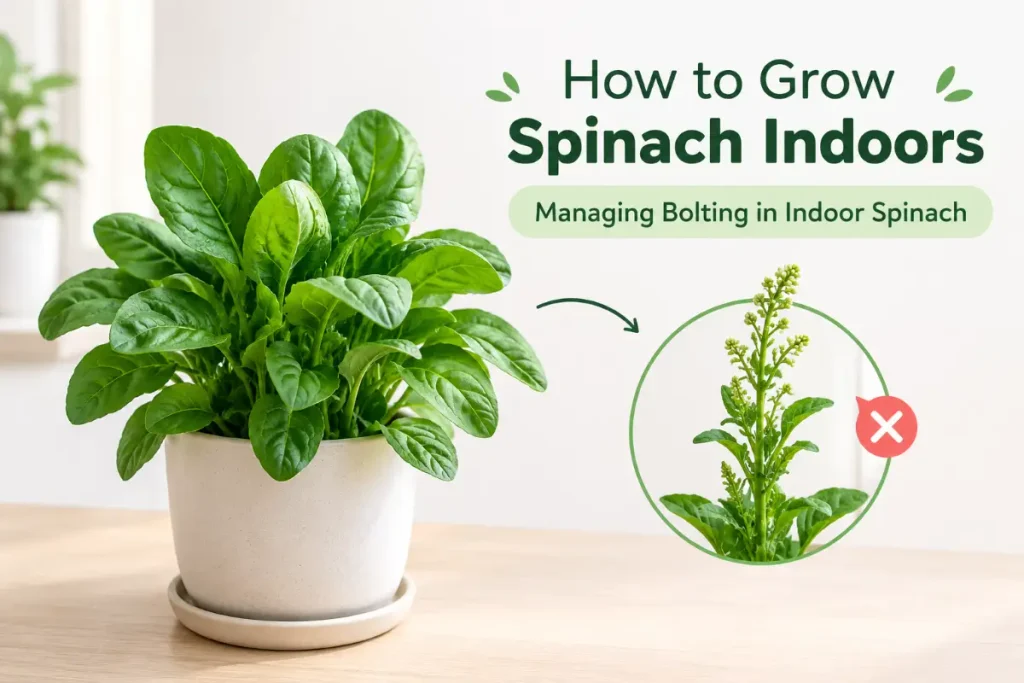
Managing Bolting in Indoor Spinach
What triggers bolting: Temperatures consistently above 75 degrees, day length above 14 hours, and plant age all independently trigger the bolting response. Indoors, temperature is the most controllable factor. Grow light hours set to 12 to 14 daily prevent the day-length trigger. Plant age is managed by the succession sowing rotation.
Early bolting signs: As described above, central elongation and increasingly pointed leaf shape. The bitter flavor that accompanies bolting is immediately noticeable when you taste a fresh leaf — even a small sample reveals whether the plant has entered the reproductive phase that reduces culinary quality.
Using bolted plants: The flowers of bolted spinach are edible and mildly flavored. Young seed heads before full maturity can be eaten in salads. The entire bolted plant including flowers can be cooked when the leaves alone become too bitter for raw use. Nothing from a bolting spinach plant needs to be wasted.
Preventing premature bolting through variety selection: Slow-bolt spinach varieties are available that resist bolting longer than standard varieties under the same temperature and day-length conditions. Tyee, Space, and Catalina are slow-bolt varieties that extend the productive life of each indoor sowing by one to two weeks compared to fast-bolting varieties.
Nutrient Management for Maximum Nutritional Value
One of the most compelling reasons to grow spinach indoors is the nutritional superiority of freshly harvested leaves over stored grocery store spinach. Understanding how growing practices affect the nutritional density of indoor spinach helps you make care decisions that maximize the health benefit of your harvest.
Harvest timing and nutrition: Spinach harvested in the morning has higher concentrations of certain antioxidants including lutein than spinach harvested in the afternoon, as these compounds fluctuate through the day with photosynthetic activity. For maximum nutritional benefit, harvest in the morning immediately before use.
The storage loss problem: Spinach loses approximately 50% of its folate content within eight days of harvest even under refrigeration. The fresh spinach in grocery stores has typically been in transit and storage for three to eight days by the time it reaches your kitchen. Indoor spinach harvested and eaten within minutes contains essentially its full original nutritional content.
Light and nutrition: Spinach grown in better light produces leaves with higher chlorophyll content (reflected in deeper green coloration) which correlates with higher concentrations of the fat-soluble vitamins and antioxidants that make spinach nutritionally valuable. While spinach tolerates lower light than many food crops, providing the best available light within its comfortable range (bright indirect rather than dim indirect) produces more nutritious leaves alongside faster growth.
Fertilizer effects on nutrition: As noted in the fertilizing step, moderate rather than heavy nitrogen fertilizing produces leaves with better nutritional density. Rapidly grown heavily fertilized spinach has higher water content and lower concentration of the phytonutrients that make spinach valuable. This is consistent with the broader pattern in food crop research that slower, leaner growth typically produces more nutritionally concentrated food than rapid growth-optimized production.
Building an Indoor Salad Garden Around Spinach
Spinach anchors one of the most practically useful indoor food growing combinations available: the complete indoor salad garden that produces fresh mixed salad greens year-round from a few containers on a single kitchen shelf.
The core trio: Spinach, lettuce, and arugula form the most practical indoor salad garden combination. All three are cool-season crops with similar temperature preferences and light requirements. All three are grown through cut-and-come-again harvesting and succession sowing. Their different leaf flavors, textures, and colors create more complex, interesting salads than any single green provides alone.
Spinach in the combination: Provides iron-rich substance, slightly chewy texture, and a mild earthy flavor that balances the more delicate lettuce and peppery arugula in mixed harvests. Also the only one of the three that cooks well alongside raw salad use, providing culinary versatility that lettuce and arugula cannot match.
Succession schedule for the full trio: With three crops on three-to-four-week succession cycles, a total of nine containers (three crops times three succession stages) fits on a standard grow light shelf or bright window area and provides continuous harvest of all three greens simultaneously. This is the maximum practical indoor salad garden that produces genuine week-by-week fresh salad without reliance on grocery store greens. For the companion guide to arugula growing that completes this indoor salad garden trio alongside spinach and lettuce, indoor herb garden covers the broader indoor growing context in which spinach, lettuce, and arugula sit as the leafy green complement to the aromatic herb collection that together make up a complete kitchen indoor growing operation.
Conclusion
How to grow spinach indoors delivers one of the most nutritionally valuable and most practically accessible harvests in this cluster from one of the lowest-investment setups. Shallow containers, standard potting mix, moderate indirect light, cool temperatures, consistent moisture, light fertilizing, and the cut-and-come-again harvesting technique together produce fresh spinach harvests every five to seven days from a planting that requires minimal space and care time.
The succession sowing rotation of three containers at different stages is the system-level practice that converts a single-batch growing project into a genuinely continuous kitchen resource. Start the second container three weeks after the first. Start the third three weeks after the second. Replace each container when it bolts with a fresh sowing. That rolling cycle produces fresh indoor spinach year-round from three containers that together fit comfortably on a single kitchen shelf.
Frequently Asked Questions
How long does it take to grow spinach indoors?
First harvest is possible three to four weeks after sowing in appropriate conditions. Cut-and-come-again harvests continue every five to seven days for four to eight weeks from a single sowing. The full productive life of one sowing from germination to bolting is approximately seven to twelve weeks depending on temperature management and variety selection.
Does spinach need a lot of light indoors?
Spinach is one of the most shade-tolerant common food crops. It grows acceptably in bright indirect light from a north-facing window that would be insufficient for tomatoes, peppers, and Mediterranean herbs. East-facing morning sun followed by indirect afternoon light is ideal. Very intense direct afternoon south-facing sun combined with warm temperatures can accelerate bolting. A modest grow light running 12 to 14 hours daily produces the best year-round results regardless of natural light availability.
Why is my indoor spinach bolting so quickly?
Bolting is most commonly caused by temperatures consistently above 75 degrees. Position in the coolest available indoor location. Also check grow light duration — more than 14 hours daily triggers the long-day bolting response. Choosing slow-bolt varieties like Tyee, Space, or Catalina extends productive life by one to two weeks compared to standard varieties in the same conditions.
Can I grow spinach indoors year-round?
Yes, in temperature-controlled homes. The indoor environment’s ability to maintain cool temperatures through summer is spinach’s greatest indoor growing advantage over outdoor production where summer heat defeats it. In air-conditioned homes maintaining 65 to 72 degrees, spinach grows productively through all four seasons with consistent succession sowing. In warmer homes without air conditioning, summer indoor growing is more challenging but achievable in the coolest available position.
How often should I water indoor spinach?
Water when the top half inch of soil feels dry, typically every three to five days in cool indoor conditions and every two to three days in warmer or brighter conditions. Spinach in shallow containers dries faster than deep-potted crops and benefits from more frequent checking than the two-to-three-inch checks appropriate for deeper-rooted plants. Consistent moisture produces the most tender, least bitter leaves.
What is the difference between growing spinach and lettuce indoors?
Both use the cut-and-come-again harvest technique and benefit from succession sowing every three to four weeks. Spinach requires slightly cooler temperatures (50 to 70 degrees ideal versus lettuce’s 60 to 70 degrees) and produces leaves with higher nutrient density, more robust flavor, and better suitability for cooking applications alongside raw salad use. Lettuce is somewhat more light-flexible and faster to first harvest. Both are equally practical for indoor growing and complement each other in a continuous indoor salad garden where their slightly different care requirements can be managed on compatible watering and harvesting schedules.