How to water indoor plants while on vacation is one of the most common practical indoor plant questions because most plant owners eventually face a trip that is longer than their plants can go without water. The anxiety of leaving a carefully tended collection to chance is real, and the disappointment of returning to dead plants after a much-needed trip is genuinely demoralizing.
The good news is that a range of proven methods covers trips of every length, from a long weekend to a three-week international trip. The right method depends on how long you will be away, how many plants you have, which plant types you are managing, and how much setup effort and cost you are willing to invest. This guide covers eight specific methods with honest assessments of what each one works for.
Quick Answer
For one to two week trips: group moisture-loving plants together, move to cooler indirect light, water thoroughly before leaving, and use self-watering wicks or spikes for the most moisture-dependent plants. Add a drip irrigation timer system or arrange a plant sitter for two to four week trips. For drought-tolerant plants: no special action needed for most trips under two weeks. Match the method to the trip length and the plant’s specific water needs.
Step 1: Assess Your Plants Before Planning
Before choosing a vacation watering method, honestly assess what your collection actually needs. This prevents over-engineering solutions for plants that do not need them and under-planning for plants that are genuinely at risk.
Categorize by drought tolerance:
Will survive two to three weeks without any intervention: Cacti, succulents, aloe vera, jade plant, ZZ plant, snake plant. These plants store water and handle extended dry periods routinely. For trips under two weeks, simply water thoroughly before leaving and do nothing else. For three-week trips, a single watering before leaving is usually sufficient for these species.
Need intervention for trips over one week: Pothos, heartleaf philodendron, spider plant, Chinese evergreen, rubber plant, monstera. These plants prefer consistent moisture but tolerate one to two weeks of reduced water if properly prepared. Use one of the passive methods below for trips of seven to fourteen days.
Need reliable watering for any trip over five to six days: Peace lily, ferns, calathea, basil, most herbs, seedlings, and actively fruiting food crops. These moisture-sensitive plants need the most reliable watering methods for any trip over a long weekend. Plan accordingly.
Method 1: Thorough Pre-Trip Watering and Grouping
Best for: Trips of five to seven days for moisture-loving plants, up to two weeks for moderate-moisture plants.
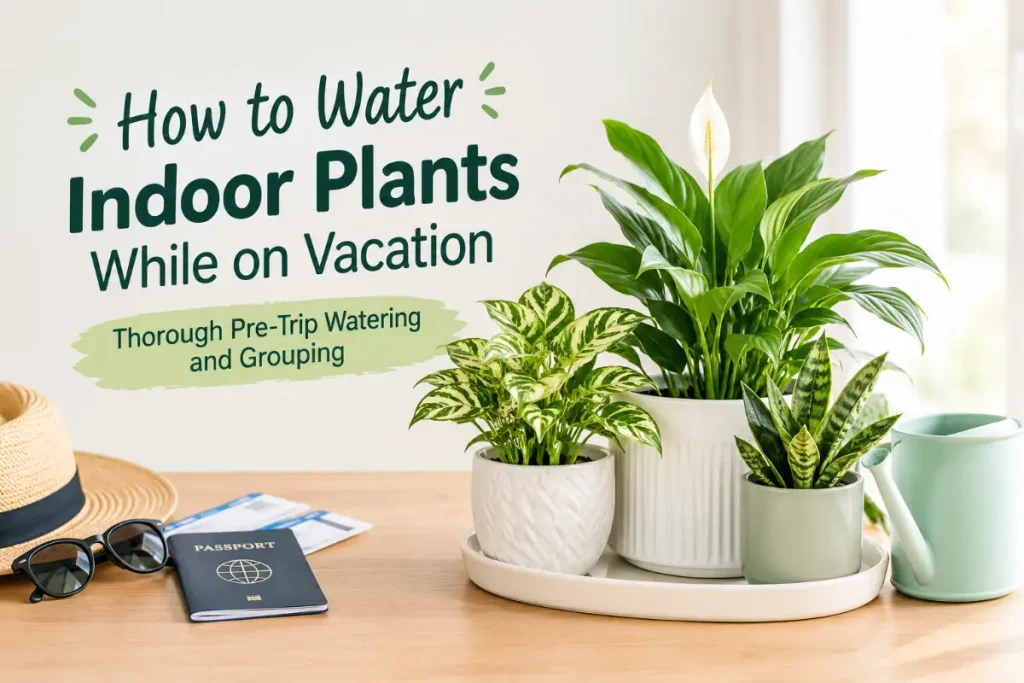
How it works: Water all plants thoroughly twenty-four hours before departure. Group plants together on a tray so their combined transpiration raises local humidity, reducing individual water loss. Move plants to a cooler position (65 degrees rather than 75) and away from direct sun to reduce transpiration and slow soil drying.
The grouping effect: When multiple plants are clustered together, the water vapor they release through their leaves accumulates in the shared air space rather than dispersing into the room. This elevated local humidity reduces the rate at which each plant loses moisture through transpiration, extending the time between needed waterings by twenty to thirty percent.
The temperature and light reduction: Moving plants from a bright sunny position to a cooler, slightly dimmer position before leaving significantly reduces their water demand. Plants in direct sun at 75 degrees transpire far more than the same plants in bright indirect light at 65 degrees. The slight reduction in light quality during a one to two week trip does not cause permanent harm to most plants.
Method 2: Self-Watering Wicks
Best for: Trips of one to two weeks for moisture-loving plants in individual pots.
How it works: A wick (cotton rope, yarn, or commercial plant wick) connects a reservoir of water to the plant’s pot, drawing water through capillary action as the soil dries. As the soil surface dries and capillary tension increases, water is pulled from the reservoir through the wick into the soil at approximately the rate the plant uses it.
DIY setup: Cut a length of cotton rope or thick yarn long enough to reach from a water reservoir (a bucket, jug, or bowl) to the bottom of the plant’s pot with extra length to thread through the drainage hole. Soak the wick thoroughly before using. Thread one end through the drainage hole to sit in the soil near the root zone. Place the other end in the water reservoir positioned above or beside the plant. The wick must be continuously wet from reservoir to soil without gaps for capillary action to work.
Commercial wicks: Pre-made plant watering wicks are available from garden centers and online retailers at low cost. These come in various lengths and materials and are designed for this specific application with consistent diameter and absorbency characteristics that DIY alternatives may not match.
Limitations: Works best for plants in relatively small pots (up to eight inches) since the wick’s flow rate is limited. Not reliable for very large pots with substantial soil volume. The reservoir must hold enough water for the full trip duration — calculate approximately half a liter per plant per week as a starting estimate.
Method 3: Self-Watering Spikes and Globes
Best for: Trips of one to two weeks for individual plants with consistent moisture needs.
How it works: Terracotta spikes filled with water are inserted into the soil beside the plant. Water seeps slowly through the porous terracotta walls into the surrounding soil as the soil dries, providing a slow, self-regulating release.
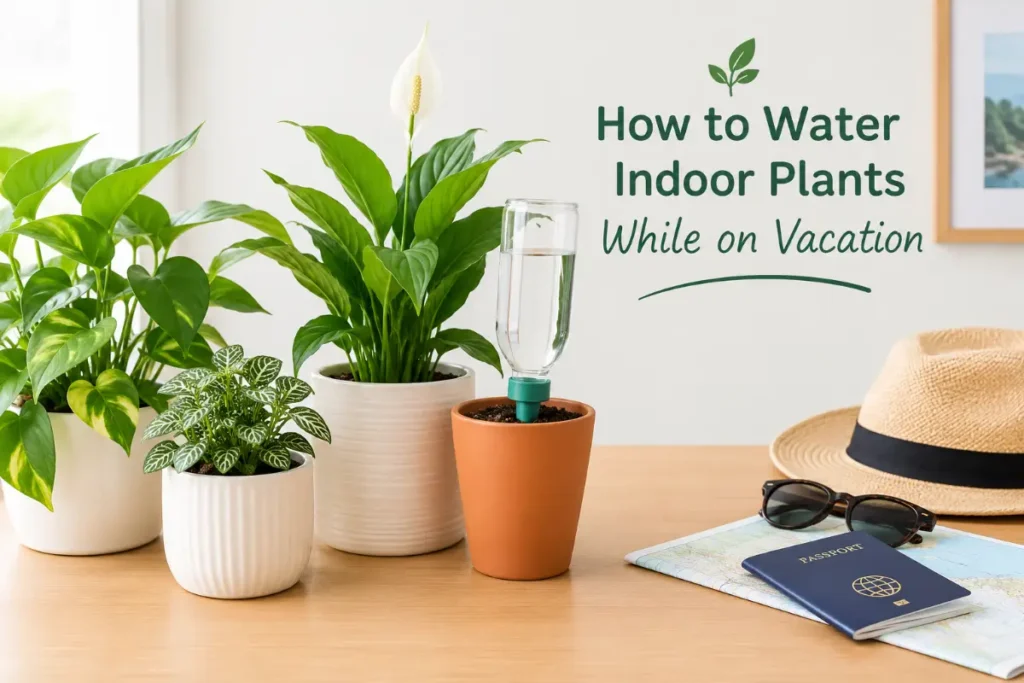
Glass globes: The decorative glass globe version works on the same principle — a globe filled with water and inserted upside-down into the soil releases water as the soil dries and air enters through the soil-globe interface. More decorative than terracotta spikes but equivalent in function.
Sizing: The size of the spike or globe determines the reservoir volume and therefore the duration of water supply. Small spikes hold approximately two hundred milliliters and last three to five days for moisture-loving plants. Larger spikes hold up to six hundred milliliters and last seven to ten days.
Limitations: Flow rate depends on soil moisture level. If soil is very dry before insertion, initial flow is fast and the reservoir depletes quickly. If soil is moist before insertion, flow is very slow. Insert when soil is at normal moisture level for best results. Not suitable for drought-tolerant plants since continuous moisture delivery can overwater cacti and succulents.
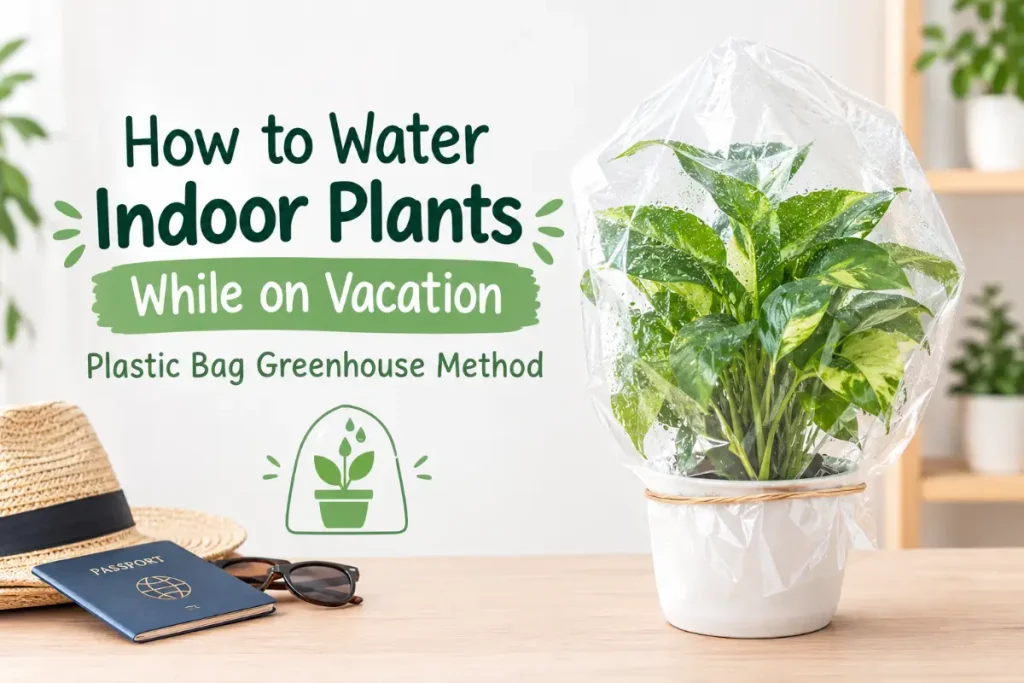
Method 4: Plastic Bag Greenhouse Method
Best for: Trips of one to two weeks for moisture-loving tropical plants, particularly ferns and other high-humidity plants.
How it works: After thoroughly watering, place the entire pot inside a large clear plastic bag and seal it. The plant continues transpiring, releasing water vapor that condenses on the inside of the bag and drips back into the soil. This creates a closed moisture cycle that sustains the plant for one to two weeks without any external water input.
Setup: Water thoroughly. Allow excess drainage to stop. Place the pot in a large clear plastic bag. Inflate the bag slightly by blowing in air before sealing so the bag walls do not contact the plant leaves. Seal with a twist tie or rubber band. Place in bright indirect light — not direct sun which would overheat the enclosed environment.
Why it works: The sealed environment prevents evaporative moisture loss to the surrounding air while maintaining the water recycling cycle that keeps the enclosed space consistently humid. Plants inside a properly sealed bag for two weeks typically have moist soil and healthy foliage upon return.
Limitations: Not appropriate for plants susceptible to fungal disease in humid conditions. Not appropriate for Mediterranean herbs or succulents that need dry conditions. Requires a bag large enough to fully enclose the pot without the bag pressing against the plant.
Method 5: Bathtub Method
Best for: Trips of five to ten days for collections with mostly moisture-loving tropical plants.
How it works: Line the bathtub with towels. Soak the towels thoroughly with water. Place potted plants on the wet towels. The plants absorb moisture from the wet towels through their drainage holes, supplementing whatever moisture is in the soil.
Setup: Fill the bathtub with one to two inches of water. Lay folded towels in the tub to absorb the water. Place pots on the wet towels. Close the bathroom door to slow moisture evaporation from the towels. For plants with no drainage holes, this method does not work.
Enhancement: Close the bathroom door and place a damp towel along the bottom of the closed door to create a more humid enclosed environment that reduces the rate at which the soaked towels dry out.
Limitations: Requires a bathroom that can be dedicated to plants for the trip duration. Not appropriate for drought-tolerant plants. Works best for plants in small to medium pots since the capillary uptake through drainage holes has limited flow rate for larger soil volumes.
Method 6: Self-Watering Pots
Best for: Ongoing vacation readiness for any length trip, particularly for moisture-loving plants.
How it works: Self-watering pots have a built-in water reservoir in the base of the pot that is separate from the growing medium. A wick or capillary mat connects the reservoir to the soil above. The plant draws water up from the reservoir as needed, self-regulating its water uptake. The reservoir is filled from above through a fill tube.
Reservoir capacity: Standard self-watering pots have reservoirs of one-half to two liters depending on size. A two-liter reservoir lasts approximately two to three weeks for a moisture-loving plant in a six-to-eight-inch pot.
The long-term advantage: Self-watering pots are not just a vacation solution. They consistently provide the right amount of water for moisture-loving plants year-round, reducing overwatering and underwatering risk during normal use as well as eliminating most vacation watering concerns for their plants. The initial investment in self-watering pots for the most moisture-demanding plants in a collection pays dividends in reduced plant care stress throughout the year.
Limitations: More expensive than standard pots. Require transition period as plants adjust to bottom watering. Not appropriate for drought-tolerant plants that need extended dry periods between waterings.
Method 7: Drip Irrigation Timer System
Best for: Trips of two to four weeks or longer, for larger collections, for frequent travelers who leave regularly.
How it works: A battery-powered irrigation timer connects to a water source (sink, bucket, or outdoor tap) and delivers water through small-diameter drip tubes to individual plants on a programmed schedule. The timer runs automatically without any human intervention, delivering set amounts of water at set intervals.
Setup complexity: Moderate. Requires running drip lines to each plant, setting the timer for appropriate intervals and duration for each plant type, and testing the system for several days before departure to verify correct delivery. More setup effort than passive methods but provides the most reliable watering for complex collections during extended trips.
Cost: Basic timer and drip systems start at approximately thirty to fifty dollars for a ten to twenty plant system. More sophisticated systems with multiple zones and programmable per-zone timing cost one hundred to three hundred dollars.
Testing before leaving: Always run the drip timer system for three to five days before departure to verify water delivery amounts and timing. Adjust flow rate and timing based on whether plants are too wet or too dry after the test period. A system that has not been tested before departure may overwater or underwater significantly.
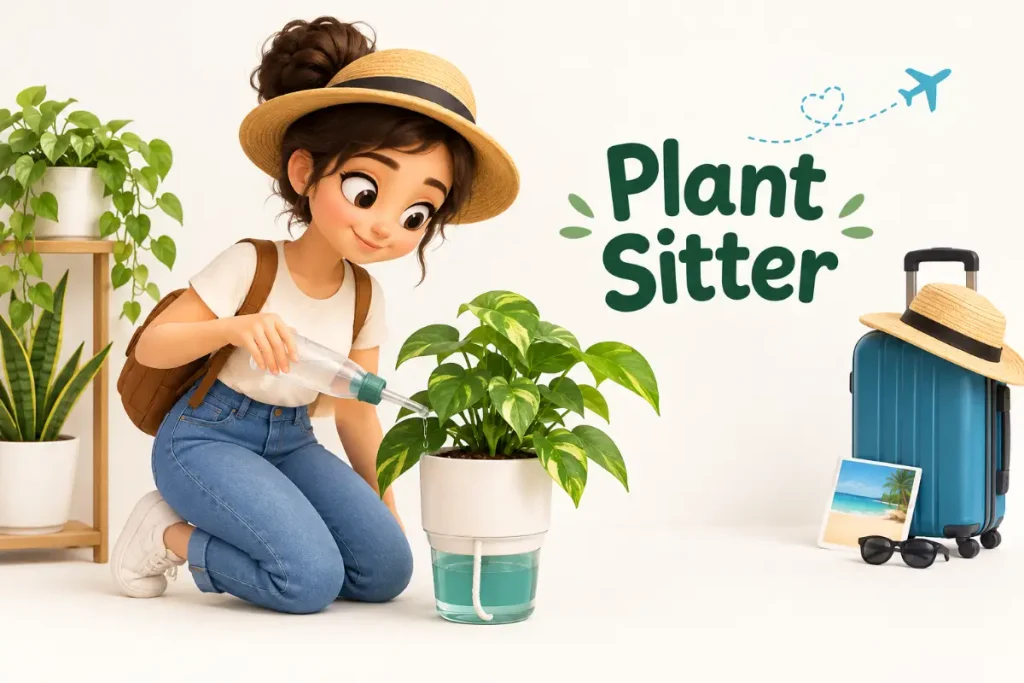
Method 8: Plant Sitter
Best for: Trips of any length where other methods are impractical, for large complex collections, for collections with many moisture-sensitive plants.
How it works: A trusted person (friend, neighbor, family member, or professional plant sitter) visits the home on a schedule to water plants according to specific instructions.
Making it work: The success of a plant sitter arrangement depends entirely on the quality of the instructions provided. Written instructions for each plant group, including: which plants need water and how often, exactly where to check soil moisture, how much water each plant needs, which plants to leave alone, and what warning signs to report or address. A clear labeling system on each pot (brief note with the checking and watering frequency) prevents the plant sitter from guessing.
Professional plant sitters: Available in most US cities through house-sitting platforms, local Facebook groups, and specialty plant care services. Typically charge per visit for plant-only care. More expensive than asking a friend but more reliable for complex collections.
The briefing session: Invite the plant sitter for a thirty-minute walk-through of the collection before departure. Physically demonstrating the soil check, showing the watering cans and tools, identifying which plants are most sensitive, and walking through the written instructions together produces significantly better outcomes than written instructions alone.
Combining Methods for Comprehensive Coverage
For trips over two weeks or for collections with diverse plant types requiring different approaches, combining methods produces the most comprehensive coverage.
The drought-tolerant group: Nothing special needed. Water before leaving.
The moderate-moisture group: Grouping, plastic bag greenhouse, or self-watering wicks.
The high-moisture group: Self-watering pots, drip timer system, or plant sitter visits.
The fragile or specialist group (orchids, carnivorous plants, recently repotted plants): Plant sitter with detailed specific instructions, or bring to a trusted plant-knowledgeable friend’s home during the trip.
For the complete guide to which plant types fall into which drought tolerance category and how that affects vacation watering planning, how often to water indoor plants covers the soil check method and plant category watering frequencies that provide the baseline for understanding which plants need vacation watering interventions and which can safely be left.
Preparing Plants for Vacation: The Full Pre-Departure Checklist
Beyond choosing the right watering method, a complete pre-departure preparation improves plant survival rates for any trip length by addressing multiple factors that affect plant health during your absence.
One week before departure: Check all plants for pests and treat any active infestations. A pest problem left unattended for two weeks while you travel can become a severe infestation that damages or kills plants. Remove any obviously unhealthy or dying leaves that could become sources of fungal problems in enclosed or still-air vacation conditions.
Two to three days before departure: Move any plants that benefit from position changes (drought-tolerant plants away from direct sun, moisture-loving plants into groupings) to their vacation positions early enough to assess whether the positioning works before you leave.
One day before departure: Water all plants that need watering according to their normal soil check method — not extra water that might flood roots before you leave, but the normal thorough watering that the soil check indicates they need. Setting up wicks, spikes, or any passive devices at this stage rather than on departure day allows you to verify the system is working before leaving.
Departure day: Close blinds or curtains on south and west-facing windows to reduce light intensity and temperature for moisture-loving plants without eliminating all light. Turn off any heating or cooling that is directed specifically at plant positions. Leave a note for anyone entering the home explaining the watering system if applicable. Take a quick photo of each plant before leaving — the visual record provides a baseline for assessing what happened while you were away upon return.
Upon return: Before catching up on anything else, walk through the collection and assess which plants need immediate watering. Resume normal care routines within twenty-four hours of return. Note which plants struggled most during the absence to refine your vacation preparation approach for the next trip.
Conclusion
How to water indoor plants while on vacation has a reliable solution for every trip length and every plant type. For most trips under ten days, thorough pre-trip watering combined with grouping, light reduction, and passive methods like wicks or spikes covers the needs of the majority of indoor collections. For longer trips or moisture-sensitive plants, drip timer systems and plant sitters provide the reliable scheduled watering that passive methods cannot sustain.
Match the method to the trip length and the plant’s actual water needs rather than applying the most elaborate solution to every plant. The snake plant and aloe vera do not need anything. The peace lily and fern need reliable moisture. Matching the solution to the need saves both money and effort while ensuring every plant returns from your vacation in good health.
Frequently Asked Questions
How long can most indoor plants go without water?
Drought-tolerant plants including cacti, succulents, snake plant, and ZZ plant go three to four weeks without water without significant harm. Moderate-moisture plants including pothos, monstera, and philodendron go one to two weeks. Moisture-loving plants including peace lily, ferns, and calathea go five to seven days at most. Match your vacation planning to these timeframes for each plant type in your collection.
What is the easiest vacation watering method for indoor plants?
For most collections on trips of one to two weeks, thoroughly watering before leaving and grouping plants together in a cooler position requires zero equipment and zero ongoing effort. For individual high-moisture plants, pre-filled watering spikes inserted before departure provide passive self-regulation without any ongoing attention required.
Can I use ice cubes to water plants while on vacation?
Yes, with caveats. Placing ice cubes on the soil surface of pots before leaving creates a slow-melt delivery that provides moisture over several hours rather than immediate flooding. This works for one to three days of delayed delivery and is particularly popular for orchids in bark medium where the slow melt mimics gentle rain. It does not replace reliable watering for trips longer than a few days.
Should I move my plants to the bathroom before a vacation?
The bathtub method works well for trips of five to ten days for collections of moisture-loving plants. Close the bathroom door to slow evaporation. Ensure plants have drainage holes for capillary uptake from wet towels. This is a simple, no-equipment method for moderate trip lengths that works better than leaving plants in position without any intervention for moisture-sensitive species.
How do self-watering plant spikes work?
Terracotta spikes or glass globes filled with water are inserted into the soil. As soil dries, the capillary tension draws water from the spike through the porous terracotta or through the soil-globe interface into the surrounding soil. The release rate self-regulates based on soil moisture — faster when dry, slower when moist — providing passive self-regulating water delivery without any electronics or timers.
Is it worth buying a drip irrigation system for vacation plant watering?
For frequent travelers who take two or more trips per year lasting ten days or more, and for collections of fifteen or more plants, a battery-powered drip irrigation timer system is worth the investment. It provides reliable coverage without needing to ask favors from friends or pay for plant sitters, and the system pays for itself quickly compared to recurring plant sitter fees. For occasional travelers with small collections, passive methods are more economical.