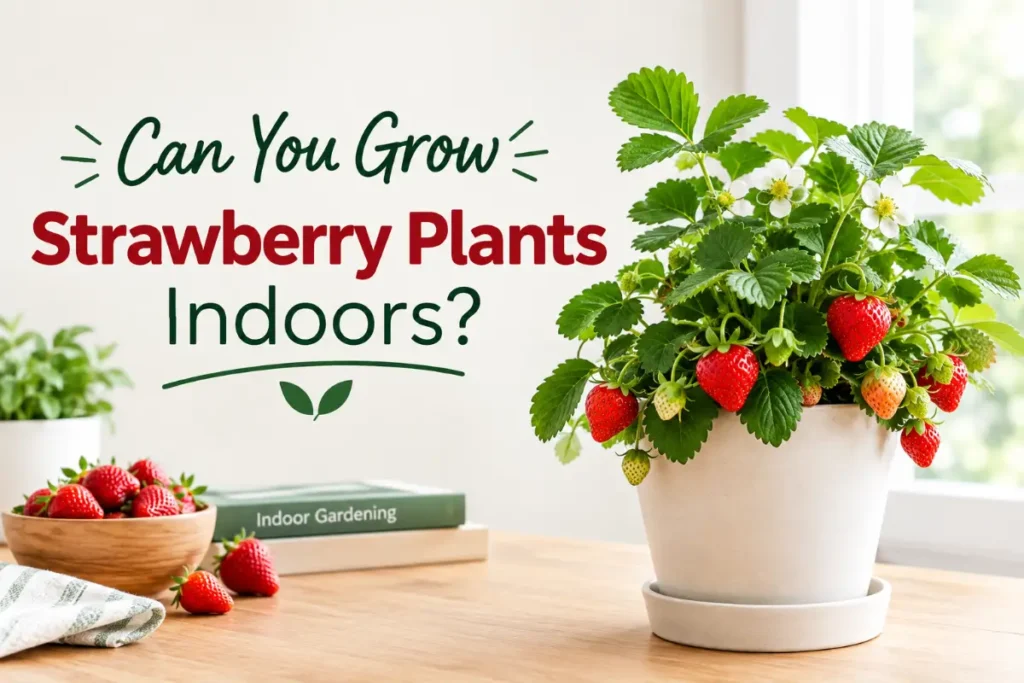
Can you grow strawberry plants indoors and actually harvest fruit worth eating? The short answer is yes, and thousands of home growers do it successfully every year without a garden, greenhouse, or outdoor space. Growing strawberries inside your home is not only possible but genuinely practical, provided you match the right variety to the right setup and give the plants what they need to flower and fruit.
Strawberries are naturally compact plants with shallow root systems, which makes them well suited to containers. Indoors, you control the light, temperature, and moisture in ways that outdoor growers simply cannot. That control means you can fruit strawberries in February when shops charge a premium for imported berries, or keep plants producing through winter when the outdoor season ended months ago.
This guide covers everything you need to know to get started, from choosing the best varieties and containers to managing light, pollination, and feeding so your plants deliver a regular crop of sweet, homegrown fruit.
Why Strawberries Work Well as Indoor Plants
Before getting into the specifics of how to grow them, it helps to understand why strawberries are a particularly good choice for indoor food growing compared to many other fruiting plants.
First, strawberries stay small. A mature plant typically spreads 20 to 30 centimetres wide and stands no more than 20 centimetres tall. You can fit several plants on a wide windowsill, across a shelf under grow lights, or on a tiered stand in a spare corner. The footprint is modest even when you grow enough plants to produce a meaningful harvest.
Second, strawberries have a relatively shallow root system. A pot 20 to 25 centimetres deep is genuinely sufficient for a productive plant, unlike tomatoes or peppers that demand deep, heavy containers. This makes strawberry setups lightweight, easy to move, and manageable in small spaces.
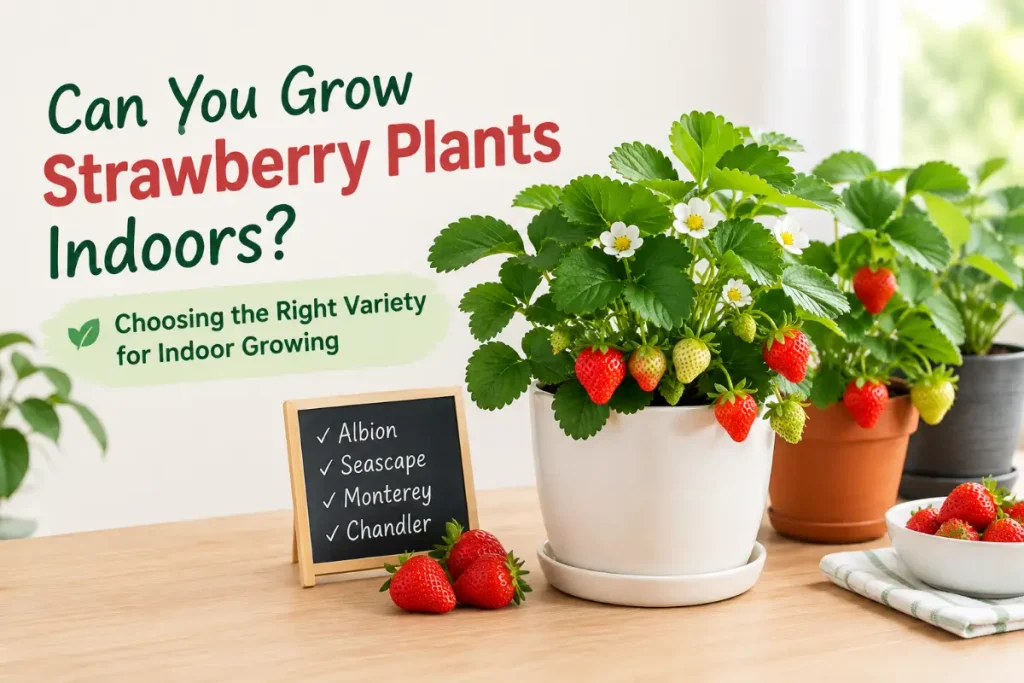
Third, everbearing and day-neutral varieties fruit continuously rather than all at once. While outdoor June-bearing strawberries give a single flush of fruit in early summer and then stop, day-neutral types like Albion or Seascape respond to consistent indoor conditions by producing flowers and fruit across many months. In a heated home with good lighting, some growers harvest from the same plants for nine to ten months of the year.
Fourth, strawberries have no complicated cold requirements that are difficult to simulate indoors. They thrive in the same temperature range most people find comfortable — 16 to 24 degrees Celsius — and respond quickly to adjustments in light and feeding.
Choosing the Right Variety for Indoor Growing
Variety selection is the single most important decision you will make for indoor strawberry growing. The wrong variety will fruit once, briefly, and then sit dormant for months. The right variety will produce steadily under your grow lights or on your brightest windowsill.
Everbearing varieties are the clear first choice for indoor growing. These produce multiple flushes of fruit throughout the growing season rather than a single concentrated crop. Under consistent indoor conditions, everbearers often fruit almost continuously. Recommended everbearing varieties include:
- Albion — a vigorous everbearing type producing large, firm, deeply flavoured berries. Performs exceptionally well under grow lights.
- Seascape — productive and disease-resistant, with excellent flavour. Handles indoor temperature fluctuations well.
- Tristar — a compact day-neutral variety particularly suited to container growing, with sweet berries and strong continuous production.
- Temptation — developed specifically for container and windowsill growing. Produces attractive fruit and handles lower light better than many other varieties.
Alpine strawberries (Fragaria vesca) deserve special mention for growers with limited light. These smaller-fruited types produce tiny, intensely flavoured berries and tolerate partial shade far better than standard strawberries. They don’t produce runners, making them easy to manage in pots, and they fruit prolifically from seed or established plants.
June-bearing varieties are not recommended for indoor growing. These produce one large crop triggered by long days and then stop. Indoors, you can manipulate light to extend the season somewhat, but you will never achieve the continuous production that everbearing types deliver naturally.
Purchase virus-free certified stock from a reputable nursery or garden centre. Plants labelled “certified virus-free” have been tested and propagated in controlled conditions, ensuring you start with vigorous, disease-free plants that establish quickly and fruit reliably.
Container and Compost Requirements
Container choice affects drainage, root health, and ultimately yield more than most growers expect. Strawberries are sensitive to waterlogged compost and will develop root rot surprisingly quickly if drainage is inadequate.
Choose containers with multiple drainage holes in the base. Terracotta pots work well because the porous walls allow air circulation around the root zone and prevent overwatering, though they dry out faster than plastic and need more frequent watering. Plastic pots retain moisture longer but require more careful watering discipline. Strawberry planters — the tall containers with multiple pocket openings around the sides — work well and allow you to grow several plants in a small footprint.
Pot size matters. For a single plant, a pot 20 to 25 centimetres in diameter gives adequate root space. Choose baskets at least 35 centimetres in diameter and plant three plants per basket to maximise production without overcrowding for hanging baskets.
For compost, use a peat-free multipurpose compost mixed with 20 to 30 percent perlite or coarse horticultural grit. This mixture drains freely while retaining enough moisture to sustain the plants between waterings. Strawberries prefer a slightly acidic pH of 5.5 to 6.5, so ericaceous compost blended with a small amount of multipurpose compost works particularly well.
Avoid garden soil entirely. It compacts quickly in containers, drains poorly, and often carries pests and diseases that spread rapidly in the confined environment of a pot.
Repot into fresh compost annually in early spring. Strawberry compost exhausts quickly, and fresh growing medium gives plants a significant productivity boost at the start of each growing season.
Light: The Most Critical Factor
Light is where most indoor strawberry attempts fail. Strawberries are not shade-tolerant plants. They need substantial light to initiate flowers, develop fruit, and produce berries with good flavour and sugar content.
A south-facing windowsill in summer may provide just enough light for strawberries to fruit modestly. In any other season, or in a room without direct south-facing sun, natural light alone will not be sufficient. Plants will produce leaves but refuse to flower, or will develop anaemic berries with poor flavour.
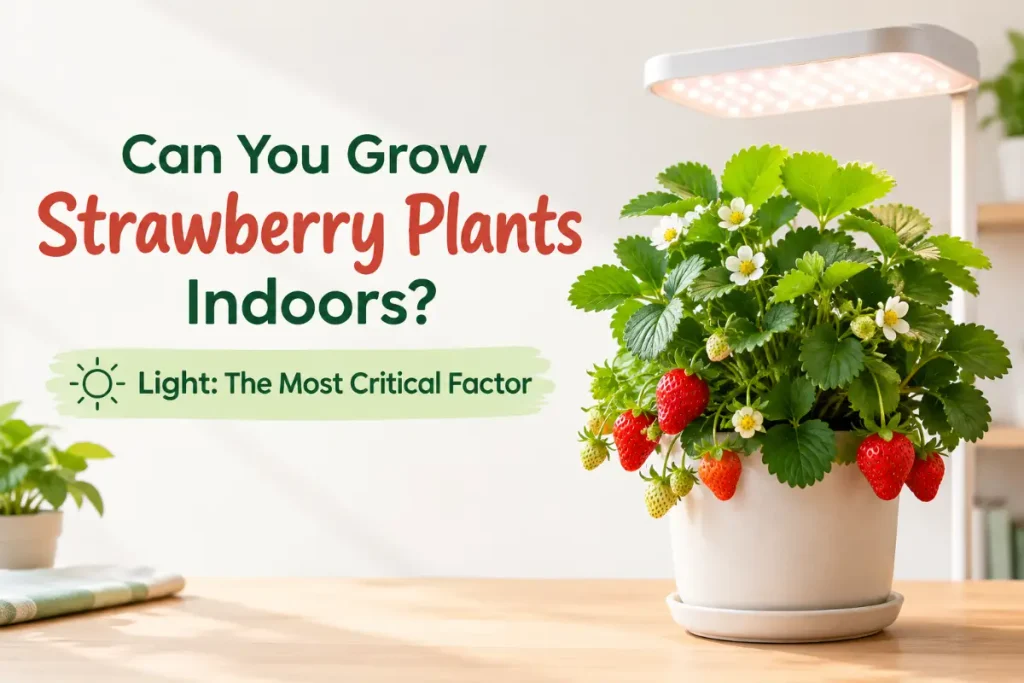
Grow lights solve this problem entirely and are the recommended approach for serious indoor strawberry growing. Full-spectrum LED panels designed for plant growing are energy-efficient, generate little heat, and provide the light spectrum strawberries need throughout the year.
Aim for 14 to 16 hours of light daily from your grow lights. Position the lights 20 to 30 centimetres above the plant canopy. Use a timer to maintain consistency — strawberries respond to regular light cycles and appreciate the predictability.
As a helpful reference for setting up your lighting correctly, this guide to grow lights for indoor tomato plants covers the key principles for fruiting food plants under artificial light, including light intensity, spectrum, and positioning guidance that applies equally well to strawberries.
When plants receive adequate light, you will notice compact, dark-green growth, regular flower production, and berries that colour fully and taste genuinely sweet. Plants receiving insufficient light show pale, elongated growth reaching toward the nearest light source, sparse or absent flowers, and small berries that fail to develop their full sweetness even when they do set.
Temperature and Humidity
Strawberries grow well across a broad temperature range, making them adaptable to most indoor environments. Ideal daytime temperatures fall between 18 and 24 degrees Celsius. Night temperatures can drop to 10 to 15 degrees Celsius without harming established plants, and a slight temperature drop at night can actually improve fruit colour and flavour.
Avoid placing plants directly beside radiators, heat vents, or other heat sources. Temperatures above 27 degrees Celsius cause flowers to drop before they can be pollinated, reducing yield significantly. During hot summer months, moving plants to a cooler room or positioning a small fan nearby helps manage heat at the canopy level.
Humidity requirements are modest. Strawberries prefer moderate humidity, roughly 50 to 70 percent, which is typical of most homes. Excessively humid conditions with poor air circulation encourage grey mould (Botrytis) on flowers and fruit, so ensure some air movement around plants, particularly when they are in flower and fruit.
Watering and Feeding
Getting watering right is critical for indoor strawberries. The compost should remain consistently moist but never saturated. Allow the top centimetre of compost to dry between waterings, then water thoroughly until water drains freely from the base of the pot. Empty saucers after 30 minutes to prevent roots sitting in standing water.
During active growth and fruiting, strawberries need watering every one to three days depending on pot size, temperature, and humidity. Smaller pots and terracotta containers dry out faster than larger plastic pots. In hot weather, daily watering may be needed. In cool periods with reduced light, every three to four days may suffice.
Water at the base of the plant rather than over the foliage. Wet leaves and fruit are susceptible to fungal disease, particularly in enclosed indoor environments with limited air movement.
Feeding drives production. During active growth, apply a balanced liquid fertiliser every two weeks at half the recommended strength. Once flower buds appear, switch to a high-potassium fertiliser — tomato feed works excellently for this purpose. Potassium drives flower development, fruit set, and sugar production in the berries. Continue feeding with a potassium-rich fertiliser every seven to ten days throughout the fruiting period.
Avoid overfeeding with nitrogen-rich fertilisers. Excess nitrogen produces lush, dark-green leafy growth at the expense of flowers and fruit. A plant that looks impressively bushy but refuses to flower is often receiving too much nitrogen.
During winter, when you allow plants a brief rest period, stop feeding entirely for four to six weeks. Resume feeding in late winter as day length increases and new growth emerges.
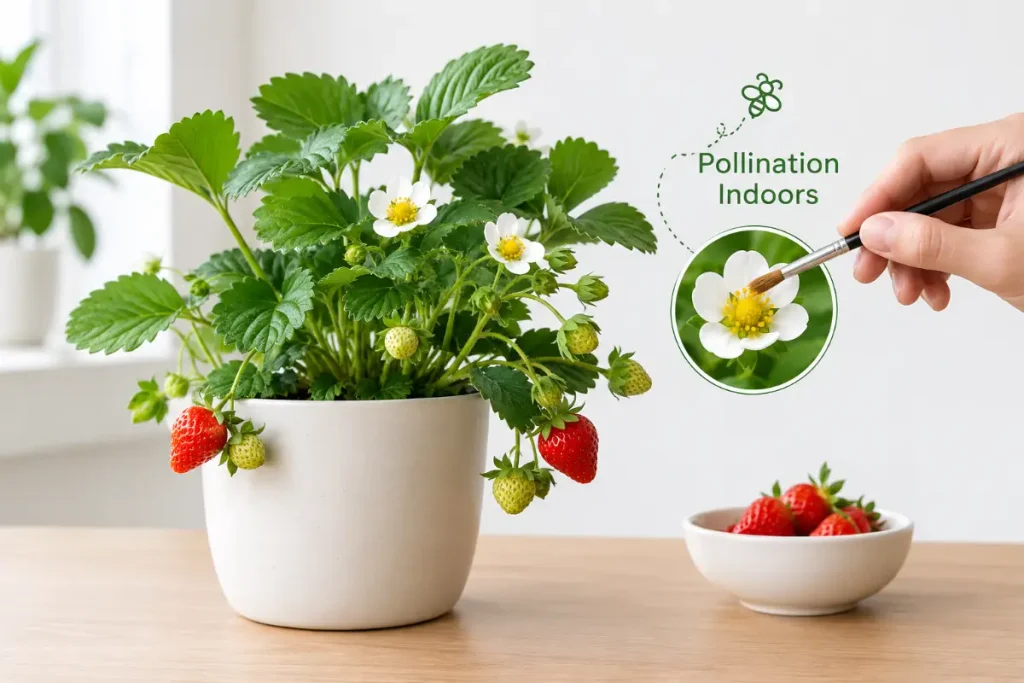
Pollination Indoors
Outdoors, bees, hoverflies, and other insects handle strawberry pollination automatically. Indoors, no insects are present, which means pollination requires a little assistance from you.
Hand-pollination is simple and takes only a few seconds per flower. Use a small, soft paintbrush or a cotton swab to transfer pollen between flowers. Gently brush the centre of each open flower, moving from flower to flower across the plant. Repeat this daily while flowers are open — typically for three to five days per flower.
You will know pollination has succeeded when the small green nub at the centre of the flower begins to swell and develop the characteristic strawberry shape over the following days. Failed pollination results in the flower dropping without developing, or in misshaped, knobbly fruit that fails to size up correctly.
Some growers place their indoor strawberry plants outside on warm days when bees are active, allowing natural pollination before returning plants indoors. This works well during spring and summer but is impractical in cold months when outdoor conditions are unsuitable for both bees and strawberry plants.
Harvesting and Ongoing Care
Harvest berries when they have coloured fully and pull free from the plant with a gentle tug. Indoors, berries develop more slowly than outdoors and may take longer to ripen than you expect. Resist picking early — flavour develops dramatically in the final days of ripening, and a berry picked two days too soon will be pale, acidic, and disappointing compared to one picked at peak ripeness.
Harvest regularly to encourage continuous production. Leaving ripe fruit on the plant signals it to slow down new flower production. Picking promptly keeps the plant focused on producing the next flush of flowers and fruit.
Remove any dead or dying leaves regularly to improve air circulation and reduce the risk of fungal disease. Runners — the long horizontal stems your plants send out — should be removed unless you are deliberately propagating new plants. Runners draw energy from the parent plant and reduce fruiting if left unchecked.
Check plants regularly for pests. Aphids, spider mites, and vine weevil grubs are the most common indoor strawberry pests. Address infestations early before they spread. Aphids and spider mites respond well to neem oil spray applied to leaves, while vine weevil grubs in the compost require biological control using nematodes.
Making the Most of Limited Indoor Space
One of the most common concerns among first-time indoor strawberry growers is space. Most homes do not have a dedicated growing room or conservatory, and finding room for six to eight plants alongside furniture, appliances, and daily life requires creative thinking.
Vertical growing strategies address this challenge directly. Tiered plant stands allow you to stack several rows of strawberry plants in the footprint of a single piece of furniture. A three-tier stand with three to four plants per level gives you nine to twelve plants in roughly half a square metre of floor space. Paired with an LED grow light positioned above the top tier and angled to illuminate lower levels, this setup produces a meaningful ongoing harvest from a genuinely compact arrangement.
Wall-mounted planter systems work well in kitchens and utility rooms where a bare wall might otherwise go unused. Purpose-made strawberry wall planters hold multiple plants in individual pockets arranged vertically, with drainage managed through the system. These planters look attractive, save floor and shelf space, and keep plants at a convenient height for daily care and harvesting.
Hanging baskets mounted from ceiling hooks or curtain rail brackets are another effective option. A 35 to 40 centimetre hanging basket planted with three everbearing strawberry plants trails runners attractively while producing steady fruit. Position the basket near a bright window and supplement with a clip-on grow light during darker months to maintain production.
Windowsill growing in long, rectangular troughs suits south-facing windows with wide sills. A trough 75 to 90 centimetres long accommodates three plants comfortably while leaving space for watering without spilling. This arrangement is the simplest to manage and requires no additional lighting during summer months when natural light is adequate.
Whatever space you work with, prioritise light access above all other factors when choosing where to position your plants. A well-lit corner with modest shelf space will always outperform a spacious but poorly lit room.
Common Mistakes to Avoid
Understanding what typically goes wrong for indoor strawberry growers helps you avoid the most predictable setbacks.
Starting with the wrong variety is the most frequent mistake. June-bearing strawberries produce a single annual crop outdoors and perform poorly indoors. Always choose an everbearing or day-neutral variety for indoor growing.
Underestimating light requirements causes more crop failures than any other factor. A plant that looks healthy and green but refuses to flower is almost always light-deprived. If you are relying on a windowsill, supplement with a grow light from September through April at minimum.
Overwatering is a consistent problem. Strawberry roots need air as much as moisture, and waterlogged compost causes root rot within days. Always ensure excellent drainage and allow the compost surface to dry slightly between waterings.
Skipping hand-pollination results in flower drop and no fruit. This is easy to forget, particularly during the early weeks when plants are just beginning to flower. Set a daily reminder if needed — it takes under two minutes per plant and makes the difference between fruit and disappointment.
Neglecting to harvest promptly slows production. Ripe fruit left on the plant signals it to stop investing in new flowers. Check plants daily during fruiting periods and pick every ripe berry immediately.
Allowing runners to develop unchecked drains energy from fruiting. Remove runners as they appear unless you are deliberately propagating new plants. Each runner you allow to develop represents energy diverted away from fruit production.
Conclusion
Can you grow strawberry plants indoors? Absolutely, and with the right setup the results are genuinely impressive. Choosing an everbearing or day-neutral variety, providing adequate light through a south-facing window or dedicated grow lights, maintaining consistent moisture, hand-pollinating the flowers, and feeding with a potassium-rich fertiliser through the fruiting period gives you a steady supply of fresh strawberries throughout the year.
Indoor strawberry growing rewards attention to detail. Plants that receive consistent care — appropriate light, disciplined watering, timely feeding, and regular harvesting — produce continuously and reliably. The learning curve is short, and the satisfaction of picking fresh, sun-bright berries from your own indoor setup in the middle of winter makes every small effort genuinely worthwhile.
FAQs
How many strawberry plants do I need indoors to get a decent harvest?
For a meaningful regular harvest, aim for at least six to eight everbearing plants. Three to four plants will produce occasional berries but rarely enough for a bowl. Six plants in 20 to 25 centimetre pots under a grow light provide a steady, usable harvest through the main growing season.
Can strawberry plants grow indoors without a grow light?
Yes, but only if you have a genuinely bright south-facing windowsill that receives several hours of direct sun daily. In most homes and during winter months, natural light alone is insufficient for reliable fruiting. A grow light makes a significant difference to yield and consistency.
How long do indoor strawberry plants last?
Individual strawberry plants are most productive in their first two to three years. Productivity declines after that, but you can propagate new plants from runners to replace older ones, keeping your indoor setup continuously productive without buying new plants.
Why are my indoor strawberry flowers not setting fruit?
The most likely cause is lack of pollination. Indoors, no insects are present to transfer pollen between flowers. Use a small paintbrush or cotton swab to hand-pollinate each flower daily while it is open. Insufficient light and temperatures above 27 degrees Celsius also cause flower drop.
Can I grow strawberries indoors in winter?
Yes. With a grow light providing 14 to 16 hours of light daily and indoor temperatures maintained above 15 degrees Celsius, everbearing strawberry varieties will continue to flower and fruit through winter. Allow plants a four to six week rest period in late autumn to reset their cycle, then resume normal care for a strong winter crop.