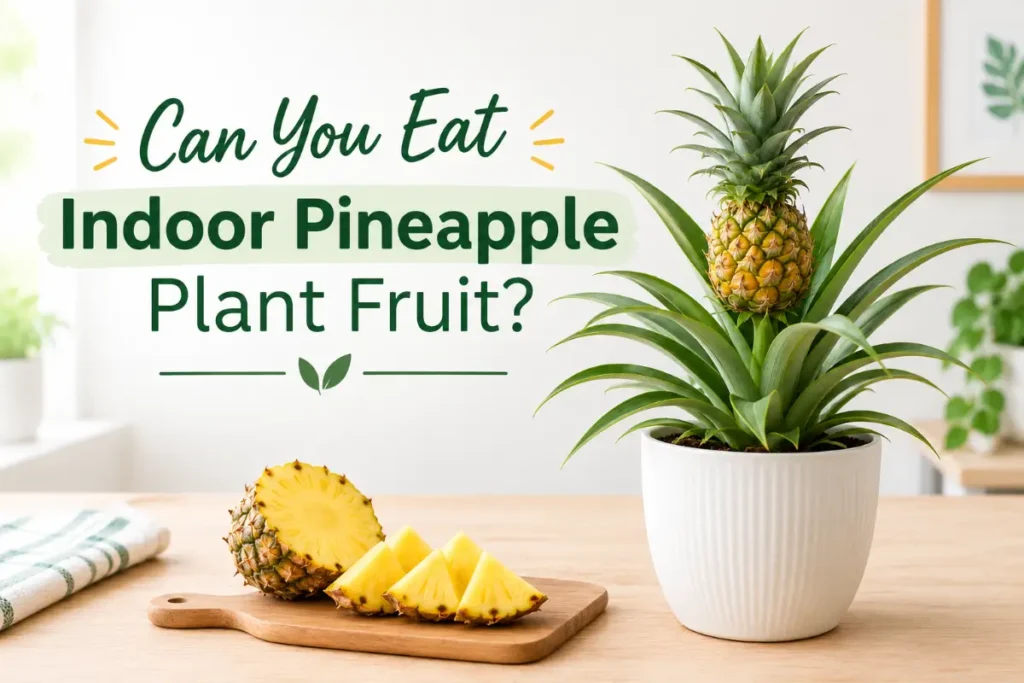
Can you eat indoor pineapple plant fruit? The answer is a genuine yes — and for anyone who has patiently grown a pineapple plant on a sunny windowsill or under a grow light, harvesting and eating that first homegrown fruit is one of the most satisfying moments in indoor food growing. The fruit produced by a well-managed indoor pineapple plant is fully edible, often sweeter and more intensely flavoured than shop-bought equivalents, and identical in composition and use to commercially grown pineapple.
The indoor pineapple (Ananas comosus) is a bromeliad — a tropical plant that stores water efficiently in its rosette of sword-shaped leaves and produces a single fruit on a central stalk after reaching maturity. Can you eat indoor pineapple plant fruit the same way you eat commercial pineapple? Absolutely — sliced fresh, blended, juiced, grilled, baked, or preserved, the fruit from an indoor plant is genuinely versatile and flavourful. The main difference from a commercial pineapple is scale: indoor fruit is typically smaller, usually 300 grams to 1 kilogram, but what it lacks in size it often makes up in sweetness.
This guide covers the complete journey from crown cutting to edible fruit, including the ethylene forcing technique that triggers flowering, how to recognise ripeness, and what to do with the harvest.
Understanding What You Are Growing
Before asking can you eat indoor pineapple plant fruit, it helps to understand exactly what kind of plant you are working with and why it behaves the way it does.
Ananas comosus is a perennial tropical bromeliad native to South America, specifically the regions that are now Brazil and Paraguay, from where it was spread throughout the tropical world by indigenous peoples long before European contact. The pineapple familiar from shops is the same species grown domestically and commercially, just in different conditions. An indoor plant produces the same fruit, in smaller quantity, through the same botanical process.
Pineapple is monocarpic — it flowers and fruits once from its main growing point, then that central stem begins to die back. However, it simultaneously produces side shoots (called ratoons or pups) from the base of the main plant, and these ratoons grow on to flower and fruit in turn. A single crown cutting can therefore become a multi-generation plant that produces repeated harvests over many years through successive ratoon development.
The fruit of an indoor pineapple plant is entirely safe to eat, contains the same bromelain enzyme as commercial pineapple, and has the same nutritional profile. There are no toxicity concerns with the fruit itself — though the sharp leaf spines should be handled with care during plant management.
Starting from a Pineapple Crown
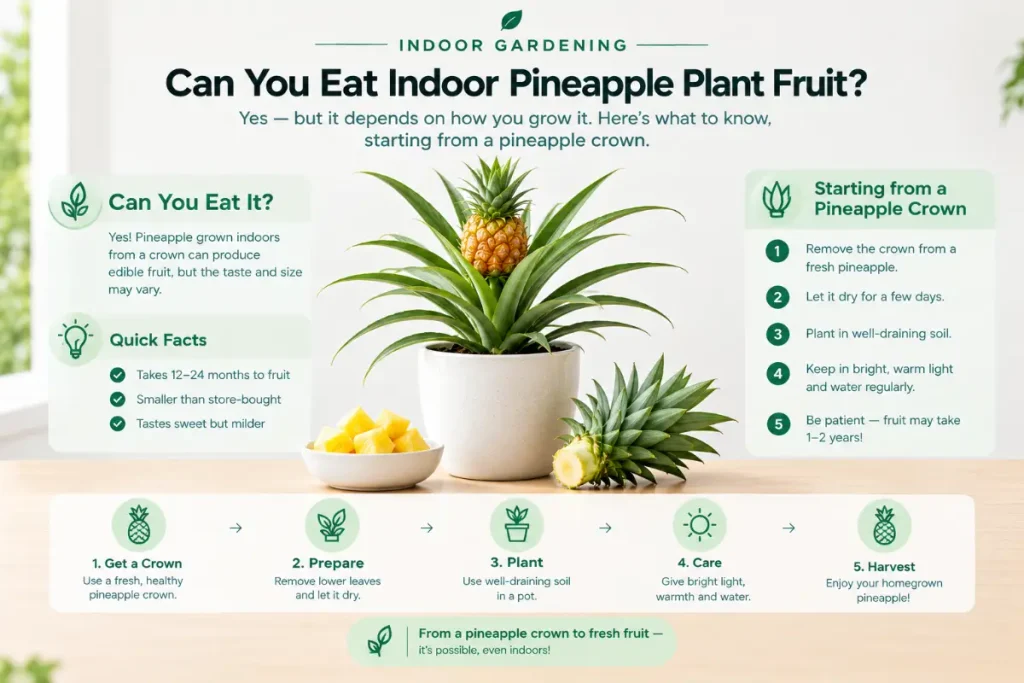
The most accessible way to answer can you eat indoor pineapple plant with your own hands is to start one from the crown of a shop-bought fruit. This is free, straightforward, and produces a plant genetically capable of fruiting again.
Select a healthy fresh pineapple with a green, upright crown. Grip the crown firmly and twist it free from the fruit body with a clean rotational pull — this separates at the natural junction. Remove the lower 3 to 4 centimetres of leaves from the crown stem to expose the stem tissue beneath, where small root initials are often already visible as brown nubs around the base. Allow the exposed stem to dry for one to three days before planting to reduce rot risk.
Plant the prepared crown in a free-draining compost — cactus and succulent mix, or standard compost blended with 30 percent perlite — in a 12 to 15 centimetre pot. Insert the stem so the base of the remaining leaves sits at the compost surface and firm gently. Water lightly and place in a warm, bright position. Rooting takes four to eight weeks; test by gently tugging the crown for resistance.
Once established and growing actively, move to a brighter position — the brightest available south-facing window, or under a full-spectrum grow light as detailed in the grow lights for indoor tomato plants guide, which applies equally well to other indoor food crops including pineapple.
Light, Temperature, and Watering for Edible Fruit
To answer can you eat indoor pineapple plant fruit confidently, you first need to grow a plant in conditions good enough to actually produce fruit. The three most important factors are light, temperature, and patient, consistent care.
Light: Pineapple is a full-sun tropical plant that needs direct sunlight for at least four to six hours daily. A south-facing window is the minimum — a grow light running 14 to 16 hours daily is better, particularly in winter. Without adequate light, the plant grows slowly, fails to reach flowering maturity, and produces no fruit regardless of other care.
Temperature: Pineapple thrives at 18 to 30 degrees Celsius and tolerates most indoor household temperatures well. It should not be exposed to temperatures below 10 degrees. Stable warmth accelerates growth toward the maturity needed for fruiting.
Watering: Pineapple is more drought-tolerant than most tropical plants. Allow the compost to dry fairly thoroughly between waterings — the plant handles dry periods better than waterlogging. Water the central cup of the leaf rosette as well as the compost, mimicking the plant’s natural rainfall-collection habit. Reduce watering in winter. Consistent but measured moisture is the target.
Triggering Flowering: The Ethylene Technique
The most exciting aspect of the indoor pineapple journey — and the step that determines whether can you eat indoor pineapple plant becomes a reality on your preferred schedule — is ethylene forcing. A mature plant (stem diameter 3 to 4 centimetres minimum, full robust leaf rosette) may flower naturally eventually, but ethylene forcing puts flowering timing in your hands.
Ethylene is a natural plant hormone that bromeliads respond to by initiating flower development. Apples produce ethylene as they ripen. The technique exploits this directly: place one or two ripe apples in the central cup of the pineapple plant, cover the entire plant and apples with a large sealed clear plastic bag, and leave in a warm position (above 21 degrees) for one week. Remove the bag and apples after the week. Within six to eight weeks, a small red or pink flower bud should emerge from the centre of the rosette — confirmation that flowering has been initiated.
If the first attempt produces no response, the plant may not yet be mature enough. Wait three to six months, allow further growth, and try again. Ethylene forcing only works once the plant has reached sufficient developmental maturity.
After the flower bud appears, the flower head develops over several weeks, producing the distinctive compact purple-flowered pineapple inflorescence. Individual flowers open progressively across the head — Ananas comosus self-pollinates in most cultivated forms, so no hand pollination is required for fruit to set. The small fruitlets that develop after each flower will fuse together to form the familiar composite pineapple fruit over the following four to five months.
Recognising and Harvesting Ripe Fruit
The fruit matures over four to five months from successful flowering. Monitoring it through this period is part of the pleasure. Can you eat indoor pineapple plant fruit before it is fully ripe? Technically yes — but underripe pineapple is sharp, acidic, and contains higher levels of bromelain that can cause mouth soreness. Waiting for full ripeness delivers the sweet, tropical flavour that makes homegrown pineapple worthwhile.
Signs of ripeness:
- The base of the fruit turns golden yellow while the upper portion may remain greener — colour change starts at the base and moves upward
- The skin develops a slight give under gentle pressure — very firm means underripe, soft means overripe
- The characteristic pineapple fragrance develops and becomes noticeable close to the fruit
- The small leaf-like bracts on the fruit skin begin to separate slightly
- A leaf from the crown of the fruit (the mini-crown on top of the fruit itself) pulls free with gentle pressure
Harvest by cutting the fruit stalk cleanly below the fruit with a sharp knife. If the fruit is marginally underripe on the plant, allow it to sit at room temperature for two to three days after harvest to complete ripening — colour and fragrance improve noticeably during this period.
Eating and Using Indoor Pineapple Fruit
Having established that yes, can you eat indoor pineapple plant fruit and the answer is absolutely, how you use a homegrown pineapple depends partly on its size and ripeness.
A fully ripe indoor pineapple is at its best eaten fresh — the flavour is sweetest and most complex immediately after cutting. Prepare exactly as you would a shop-bought pineapple: remove the crown, slice off the skin, remove the core if desired, and cut into rings or chunks. The fruit is denser and often more flavourful than commercial pineapple, which is harvested underripe for transport and never fully develops on the plant.
Culinary uses: fresh fruit salads, smoothies, juice, grilled with halloumi or pork, pizza topping (for those who go that way), caramelised in a pan with butter and brown sugar, incorporated into cakes, upside-down puddings, chutneys, and tropical salsas. The bromelain enzyme in fresh pineapple tenderises meat effectively — marinating chicken or pork in fresh pineapple juice for 30 to 60 minutes before cooking works better with fresh homegrown fruit than with canned pineapple, which is heat-treated and loses active bromelain.
If the harvest is very small — a particularly compact indoor fruit — use the more intensely flavoured portions (the sweeter base end) fresh and incorporate the firmer top portions into cooking where the slight acidity is an asset.
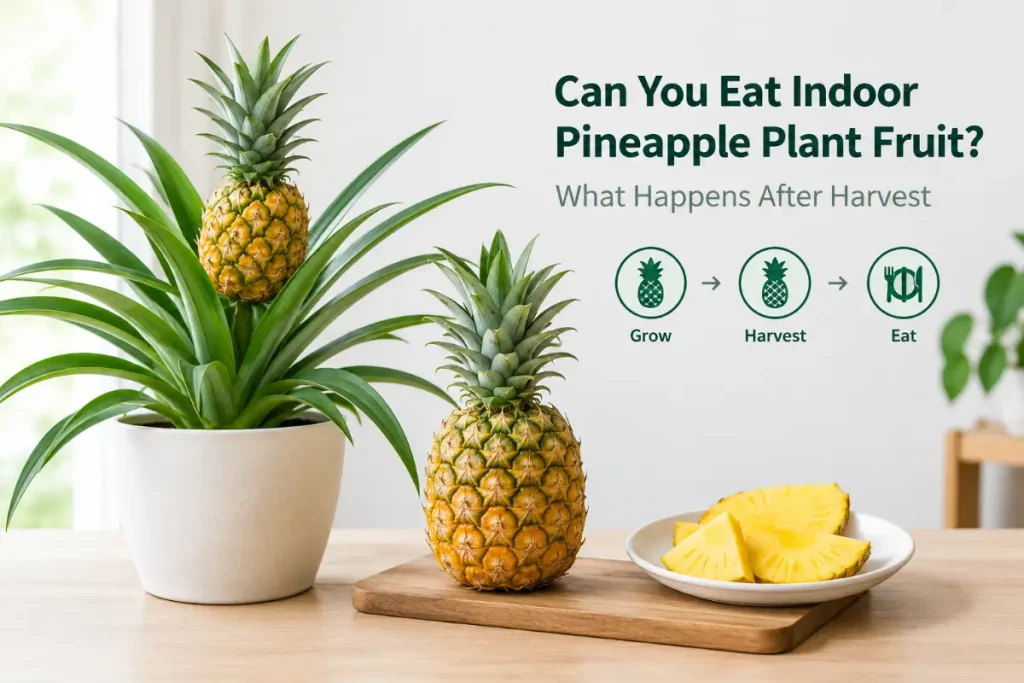
What Happens After Harvest
After fruiting, the main plant — the central rosette that produced the fruit — gradually declines. This is entirely normal and expected. Pineapple is monocarpic; the main growing point has completed its purpose.
However, during the fruiting period and shortly after, the base of the plant produces ratoon shoots (pups). These small side plants are genetic copies of the parent and will follow the same growing cycle to produce their own fruit. Allow each pup to develop until it is at least one-third the size of the parent plant before separating. Once separated with clean scissors or a sharp knife, pot each pup individually in fresh free-draining compost and care for it as you did the original crown cutting. In two to three years, each pup can produce its own answer to can you eat indoor pineapple plant — a self-renewing indoor fruit production cycle from a single original crown.
Choosing a Pineapple Variety for Edible Indoor Growing
Most people start an indoor pineapple from a supermarket crown without considering variety — and this produces perfectly edible results. But understanding that different pineapple varieties exist helps if you are sourcing plants from a specialist tropical nursery or want to select for specific fruiting characteristics.
Standard Ananas comosus (Smooth Cayenne type) is what most supermarket pineapples are — large, sweet, and with the classic pineapple flavour profile. Crown cuttings from these fruits root readily and the resulting plants produce true-to-type fruit. This is the most reliable starting point for first-time indoor pineapple growers.
Ananas comosus var. bracteatus (Red Pineapple) is an ornamental and edible variety with striking pink-flushed foliage and smaller red-tinged fruit. It is widely sold as a decorative houseplant but is fully edible. The fruit is smaller and less sweet than standard pineapple but entirely usable, and the plant itself is highly ornamental.
Dwarf pineapple varieties including ‘Champaka’ and similar compact cultivars are bred specifically for container growing and smaller spaces. They produce proportionally smaller fruit but reach fruiting maturity faster than full-size varieties and fit more comfortably on windowsills and in grow tent setups.
Ananas lucidus (Red Pineapple) has the practical advantage of spineless or reduced-spine leaves, making handling significantly less hazardous than standard pineapple. The fruit is smaller and more acidic, but the manageable leaves make it an attractive option for households where the sharp spines of standard pineapple are a concern.
For maximum flavour from an indoor plant, starting from a ripe, good-quality supermarket Smooth Cayenne pineapple crown remains the most practical approach — the fruit it eventually produces replicates the flavour profile of the parent plant.
Common Growing Problems and Their Solutions
No growth after planting the crown: The most common reason a pineapple crown fails to grow is rot at the base from planting before the cut surface dried adequately, or from overwatering during the rooting period. Ensure the base of the crown dries for at least one to three days before planting, water very sparingly until rooting is confirmed, and use free-draining compost.
Slow growth throughout the plant’s life: Almost always a light deficiency. Pineapple grows measurably faster under direct sun or a strong grow light than in indirect light. If the plant seems to be making no progress month after month, improve the light situation before any other adjustment.
Pale, yellowing leaves: Can indicate overwatering (the more common cause), nutrient deficiency, or insufficient light. Check drainage and watering frequency first. If watering is appropriate, a balanced liquid fertiliser at half strength may address deficiency. A copper or magnesium deficiency produces specific interveinal yellowing — a fertiliser with trace elements corrects this.
No flower development after ethylene treatment: The plant was not yet mature enough. This is not a failure of the technique but of timing. Allow three to six more months of growth, then repeat the forcing process. A plant that has been growing for less than 18 months from crown is unlikely to respond to forcing regardless of the technique applied.
Fruit splitting or developing unevenly: Often caused by inconsistent watering during fruit development — a period of drought followed by heavy watering causes uneven cell expansion. Using a consistent drip watering approach as described in the drip irrigation for indoor plants post prevents this effectively during the critical fruit development period.
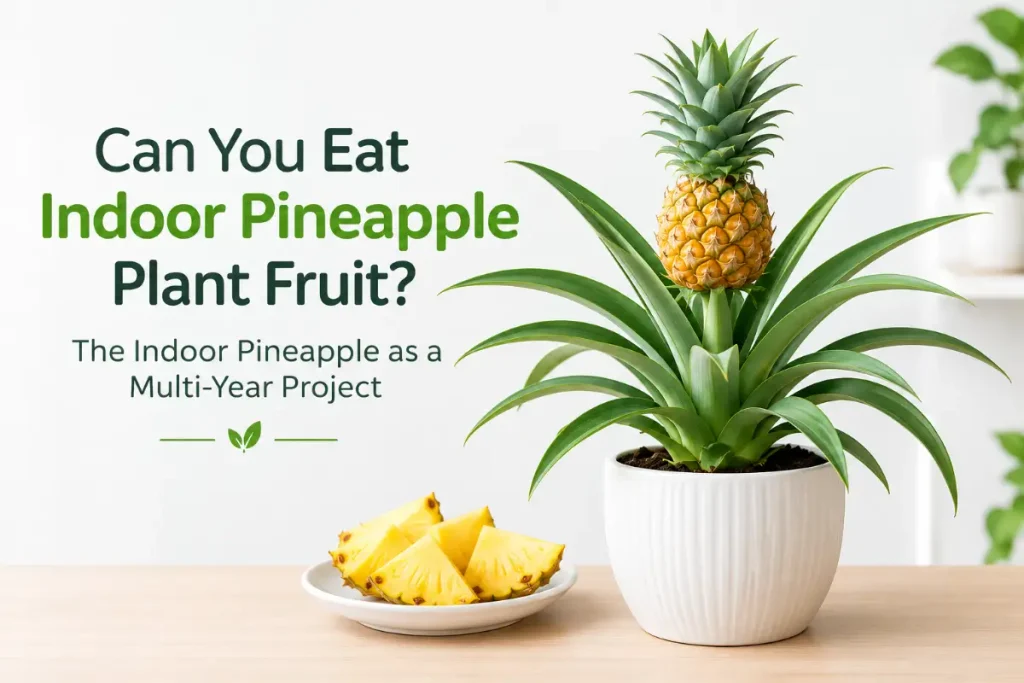
The Indoor Pineapple as a Multi-Year Project
Growing an indoor pineapple plant to the point of answering can you eat indoor pineapple plant fruit from your own harvest is genuinely a multi-year project — one of the longer commitments in indoor food growing. Understanding this timeline at the outset makes the process satisfying rather than frustrating.
Year one is establishment — the crown roots, the plant begins to grow, and you are learning its requirements and rhythms. Year two is development — the plant grows substantial, the stem thickens, the leaf rosette fills out to full size. By the end of year two or beginning of year three, the plant is approaching or at flowering maturity.
Year three (or sometimes year two for plants in ideal conditions) is when you attempt ethylene forcing, watch the flower develop through late spring and summer, and eventually harvest the fruit in autumn. The waiting and watching through these stages — checking the flower, monitoring the developing fruitlet, observing the colour change as ripening approaches — is itself part of the reward. Few indoor food crops require such close attention over such an extended timeline, and few deliver a harvest quite as dramatic.
After that first harvest, the ratoon cycle begins, and the project continues on its own self-renewing schedule. The original question — can you eat indoor pineapple plant fruit — transforms from a hypothetical into an annual or biannual reality.
Conclusion
Can you eat indoor pineapple plant fruit? Without doubt — and the experience of growing, forcing into flower, watching the fruit develop over months, and finally harvesting a homegrown pineapple is genuinely extraordinary. The fruit is fully edible, flavourful, and often superior to its shop-bought equivalent. For comprehensive cultivation guidance including variety selection and care schedules, the Royal Horticultural Society’s guide to growing pineapples provides authoritative reference for home pineapple growers. Growing indoor pineapple pairs naturally with other indoor food crop projects — the consistent watering approach described in the self watering system for indoor plants post is well suited to pineapple’s measured moisture needs, and the strawberry growing guide at can strawberry plants grow indoors makes an interesting companion read for indoor tropical fruit enthusiasts.
FAQs
Can you eat indoor pineapple plant fruit safely?
Yes, the fruit from an indoor pineapple plant is fully safe to eat and identical in composition to commercial pineapple. It contains the same bromelain enzyme and nutrients as shop-bought fruit. There are no safety concerns with the fruit of Ananas comosus grown indoors.
How long does it take to grow an edible pineapple indoors?
From planting a crown cutting, expect one to two years of vegetative growth to reach flowering maturity, then four to five months for the fruit to develop after flowering is triggered. Total time from crown to edible fruit is typically two to three years. Purchasing a more mature plant from a specialist nursery can reduce the wait.
Does indoor pineapple fruit taste different from shop-bought pineapple?
Often better — indoor-grown pineapple that is left to ripen fully on the plant develops more complex, sweeter flavour than commercial fruit harvested underripe for transport. The fruit is smaller but denser and frequently more flavourful than a supermarket pineapple.
Can you eat indoor pineapple plant leaves or other parts?
The fruit is the edible part. The leaves are fibrous and not eaten, though they are used in some cultures for fibre extraction. The core of the fruit is fully edible though tougher than the flesh — it can be blended or juiced if not eaten raw.
How do I know when indoor pineapple fruit is ready to eat?
The base of the fruit turns golden yellow, a sweet pineapple fragrance develops, the skin gives slightly under gentle pressure, and a crown leaf pulls free with gentle tugging. Colour change begins at the base and moves upward as the fruit ripens fully.
What do I do if my indoor pineapple fruit is small?
Small fruit from indoor plants is entirely normal and fully edible — use the sweetest base portions fresh and any firmer sections in cooking, smoothies, or marinades. The flavour of a small, fully ripe homegrown pineapple is often more concentrated than a larger commercial fruit.
Can you force an indoor pineapple plant to fruit?
Yes — the ethylene forcing technique using a ripe apple enclosed with the plant in a sealed bag for one week reliably triggers flowering in a mature plant. The plant must have reached sufficient maturity (stem diameter 3 to 4 centimetres minimum) for forcing to work. A plant that doesn’t respond simply needs more time to mature.
Does the indoor pineapple plant produce fruit more than once?
The main plant is monocarpic and fruits once. However, it produces side shoots (pups or ratoons) that can be separated and grown on individually, each eventually producing their own fruit. A single crown cutting can therefore produce fruit across multiple generations of ratoon plants over many years.
How many pineapples does an indoor plant produce?
Each main growing point produces one pineapple. The plant may subsequently produce two to five ratoon pups, each capable of producing one fruit after reaching maturity. A productive indoor pineapple growing setup with multiple plants at different stages can produce a small but steady supply of homegrown fruit over time.
Does indoor pineapple need much watering?
Less than most tropical food crops. Pineapple is a bromeliad adapted to variable rainfall and handles dry periods well. Allow the compost to dry fairly thoroughly between waterings. Water the central leaf cup as well as the compost. Consistent but moderate watering is the goal — overwatering causes root rot far more commonly than underwatering in indoor pineapple plants.