
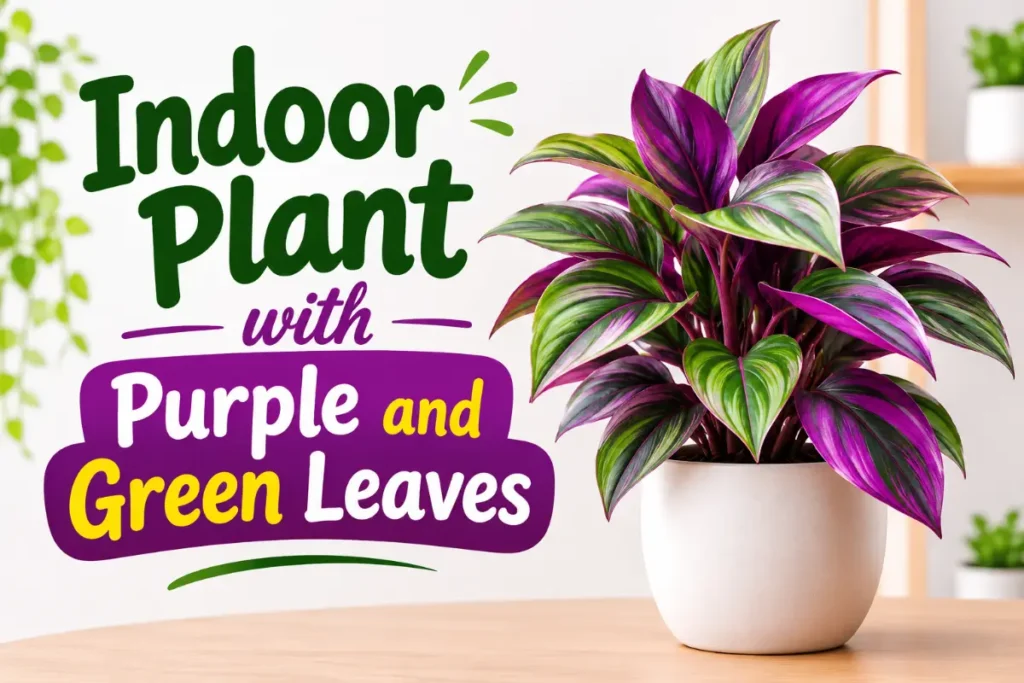
Two-toned foliage — the combination of purple and green on a single leaf — creates an effect that a purely green plant cannot achieve: depth, contrast, and a richness that makes a plant interesting from any angle. The undersides of leaves matter as much as the tops; a plant with green upper surfaces and purple undersides reveals its full palette only when the light catches the leaves at an angle or the plant moves in an air current.
This guide covers thirteen species with genuinely striking indoor plant with purple and green leaves combinations — from the ubiquitous tradescantia to the collector-favorite stromanthe — what makes the coloring appear, and how to keep it vivid.
Why Leaves Show Purple: The Role of Anthocyanins
The purple coloring in plant leaves comes from anthocyanins — pigments produced in response to environmental conditions or as a fixed genetic trait. Understanding this biology helps explain why the same plant can look more or less purple depending on where it is grown:
Light intensity: Many plants produce more anthocyanin (and therefore deeper purple) in higher light conditions. The purple in tradescantia, purple heart, and some calatheas deepens noticeably in brighter positions. In low light, the same plant may appear more predominantly green — the purple fades as the plant produces less protective pigment.
Genetic expression: Some purple-and-green coloration is fixed — the pattern and proportion of purple to green is encoded in the plant’s genetics regardless of conditions. Stromanthe ‘Tricolor’ and certain calathea cultivars maintain their pattern across a wide range of light levels.
Stress response: In some plants, purple coloration increases under mild environmental stress — cool temperatures, intense light, or minor drought. This is a survival mechanism, not a sign of damage. The purple pigment functions as a sunscreen and antioxidant.
Practical implication: most purple-and-green houseplants maintain better color in brighter (but still indirect) light than in dim positions.
13 Indoor Plants with Purple and Green Leaves
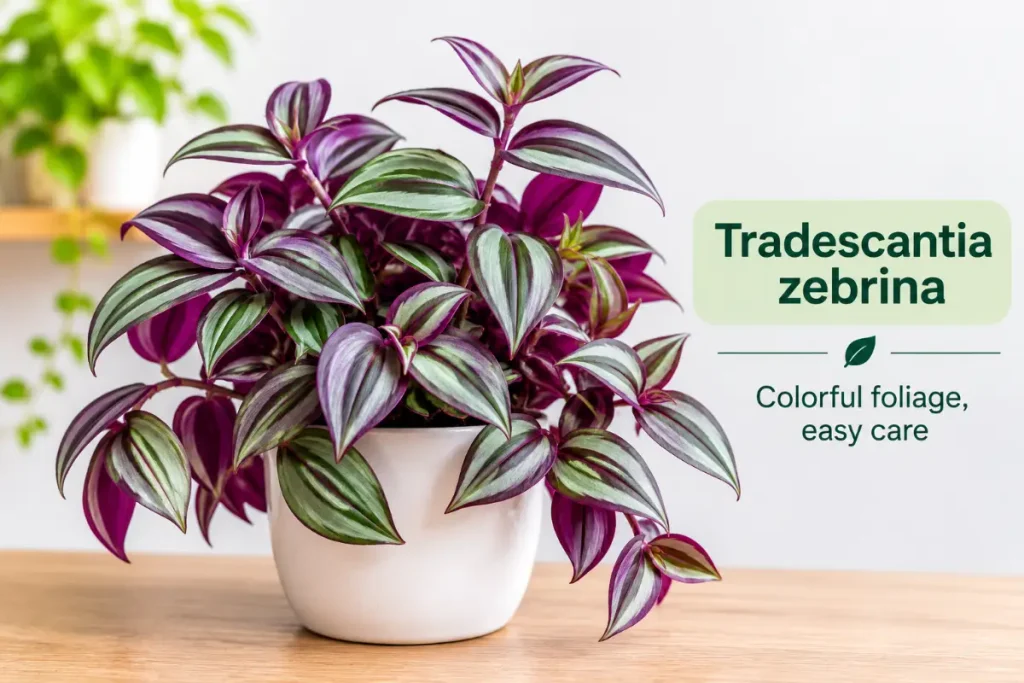
1. Tradescantia zebrina (Inch Plant / Wandering Dude)
Tradescantia zebrina is the benchmark purple-and-green indoor plant — widely available, extremely fast-growing, and producing leaves with a silver-green upper surface marked by two purple stripes, and a fully purple underside. The contrast between the two surfaces is striking, and the trailing stems make it one of the most effective plants for a hanging basket or elevated shelf.
Light: Bright indirect light produces the deepest color. In lower light, the silver-green becomes more olive and the purple fades. Avoid direct midday sun which scorches the leaves.
Water: Allow the top inch of potting mix to dry between waterings. Tradescantia tolerates some drought but grows fastest with consistent moisture.
Maintenance: Pinch stem tips regularly to prevent the plant from becoming bare and leggy at the base — the growing tips are the most colorful part. Pinched cuttings root easily in water.
Beginner-friendly: Among the easiest of all houseplants.
2. Purple Heart (Tradescantia pallida ‘Purpurea’)
Purple heart produces elongated, lance-shaped leaves in deep purple-violet rather than the striped pattern of T. zebrina. New growth emerges bright purple; older leaves develop a slight green or blue-green tint on the upper surface while remaining deep purple beneath. Small pink flowers appear in summer.
Light: Full sun to bright indirect light. In lower light, the purple fades significantly toward green — this species is one of the most light-dependent for maintaining its characteristic color.
Water: Drought-tolerant; allow to dry thoroughly between waterings.
Size: Can reach 12–18 inches tall and trail considerably from a hanging position.
3. Stromanthe sanguinea ‘Tricolor’
Stromanthe ‘Tricolor’ produces leaves with a three-way division of color — cream and light green on the upper surface with streaks and patches of deep pink-magenta, and a rich burgundy-purple underside that catches the light dramatically. It is one of the most colorful foliage plants available and a strong statement piece in any indoor collection.
Light: Bright indirect light; avoid direct sun which bleaches the cream sections and scorches the leaves.
Water: Keep evenly moist with filtered or standing water — stromanthe is sensitive to fluoride in tap water. Do not allow to dry out.
Humidity: Requires moderate to high humidity (50%+). Dry air causes brown leaf edges.
Difficulty: Moderate — more demanding than tradescantia but the foliage rewards the effort.
4. Calathea ‘Roseopicta’ (Rose-Painted Calathea)
Calathea roseopicta produces large oval leaves with a dark green upper surface marked with a pink-to-cream pattern along the midrib and leaf margin, and a solid deep purple underside. The purple underside is most visible when light passes through the leaves from below or when the plant’s nyctinastic movement (leaf-folding at night) exposes the undersides.
Light: Low to moderate indirect light — one of the more shade-tolerant of the purple-and-green species.
Water: Keep evenly moist with filtered water. Calathea is sensitive to tap water minerals; use filtered or overnight-standing water.
Humidity: High humidity preferred (60%+).
Movement: Folds leaves upward at night — this is normal and is actually a way to admire the purple undersides.
5. Rex Begonia (Begonia rex — Purple Varieties)
Rex begonias with purple-and-green coloration are available in dozens of cultivars — leaves may be spiraling, ruffled, or flat, with combinations of deep purple, silver-green, burgundy, and dark green. Cultivars like ‘Fireworks,’ ‘Black Velvet,’ and ‘Tornado’ all feature significant purple-green contrast.
Light: Bright indirect light; never direct sun.
Water: Allow the top half-inch of potting mix to dry before watering. Root rot is the primary cause of rex begonia failure.
Humidity: Moderate humidity helpful; do not mist directly as wet leaves promote powdery mildew.
Color maintenance: The purple and metallic silver tones in rex begonias are most vivid in bright indirect light — dim conditions cause leaves to become predominantly green.
6. Persian Shield (Strobilanthes dyerianus)
Persian shield is one of the most iridescent indoor plants with purple and green leaves available — leaves are a deep metallic purple-violet with green veining and margins, and the surface has a shimmering quality that shifts in color as the light angle changes. It is one of the few plants where “purple and green” understates the effect.
Light: Bright indirect light to some direct morning sun. The iridescence is most pronounced in good light; the plant becomes predominantly green in low-light positions.
Water: Keep evenly moist; does not tolerate drying out.
Temperature: Prefers warm conditions (65°F+); cold drafts cause leaf drop.
Availability: Less common than tradescantia — look for it at specialty plant retailers or online.
7. Coleus (Solenostemon scutellarioides — Purple and Green Varieties)
Coleus is one of the most variable foliage plants for color — hundreds of cultivars exist, many combining deep burgundy-purple with green, lime, or cream. ‘Purple Duckfoot,’ ‘Dark Star,’ and ‘Chocolate Mint’ are examples of cultivars with strong purple-green contrast.
Light: Bright indirect light to some direct sun (morning sun is ideal). In low light, coleus becomes predominantly green and grows leggy.
Water: Keep evenly moist; wilts quickly when dry but recovers well after watering.
Maintenance: Pinch flower buds as they appear — allowing coleus to flower causes the plant to decline and divert energy away from foliage production.
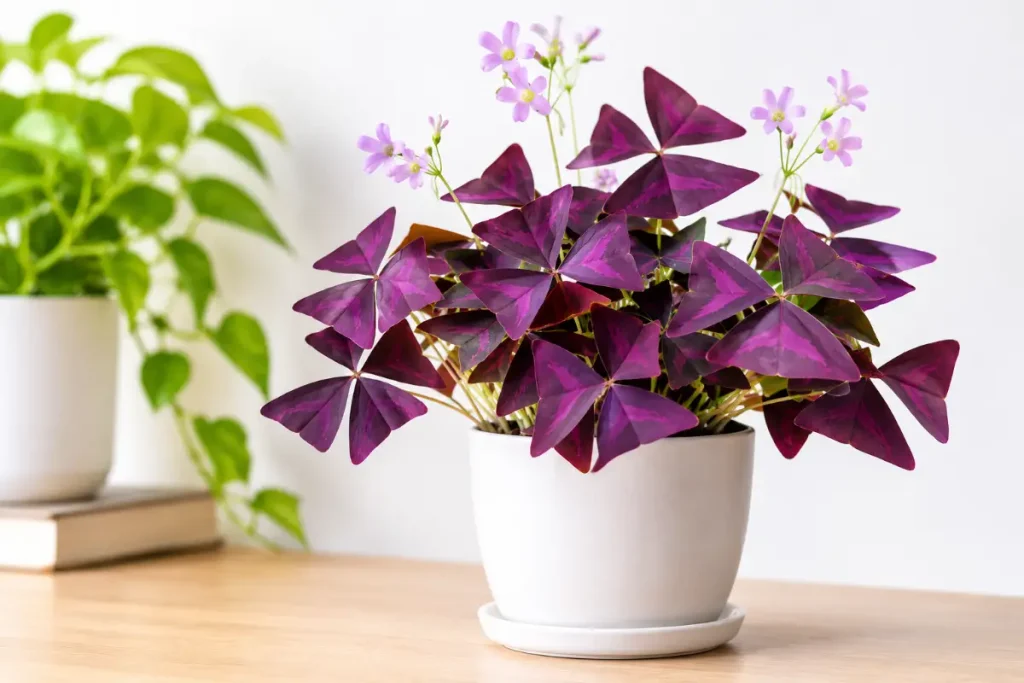
8. Purple Oxalis (Oxalis triangularis)
Purple oxalis produces three-parted leaves (shaped like a large clover) in deep purple-violet with a faint darker central triangle visible on each leaflet. It is one of the cleanest, most uniform purple-and-green plants — the purple is rich and consistent, and small pink or white flowers appear above the foliage through the growing season.
Light: Bright indirect light to some direct morning sun. More light deepens the purple; lower light produces a more brownish-purple.
Water: Keep evenly moist during active growth; reduce when the plant goes dormant (yellowing and dying back is normal — the bulbs are resting, not dead).
Dormancy: Oxalis grows from bulbs and will die back for 4–8 weeks, then re-emerge. Keep the pot in a cool location and resume watering when new growth appears.
9. Cordyline (Cordyline fruticosa — Purple Varieties)
Several cordyline cultivars produce long, strap-like leaves in combinations of deep purple, green, pink, and cream. ‘Purple Tower,’ ‘Tango,’ and ‘Red Star’ produce leaves that are deep burgundy-purple with green margins or green-purple combinations depending on maturity and light. Young plants tend toward deeper purple; older, lower leaves transition to greener tones.
Light: Bright indirect light to some direct morning sun. Direct afternoon sun bleaches the leaves.
Water: Allow the top inch to dry between waterings. Tolerates some drought.
Size: Can grow to 3–4 feet as a houseplant over several years — a substantial architectural plant.
10. Maranta leuconeura (Prayer Plant — Purple and Green Varieties)
Maranta leuconeura ‘Erythroneura’ (red prayer plant) and related varieties produce oval leaves with a herringbone pattern of red-pink veins over dark green surfaces, with a purple or burgundy underside. The leaf folds upward at night (like its relative, calathea) to reveal the colored undersides.
Light: Low to moderate indirect light — one of the best purple-and-green options for dim positions.
Water: Keep evenly moist with filtered water; sensitive to tap water minerals.
Humidity: Moderate to high humidity preferred.
11. Gynura aurantiaca (Purple Passion Plant / Velvet Plant)
Gynura aurantiaca produces green leaves covered densely in purple hairs — the overall effect is a deep purple-on-green coloration that changes with the viewing angle as the hairs catch and reflect light. The texture is velvety and distinctive; no other houseplant produces quite the same effect.
Light: Bright indirect light to some direct morning sun. The purple hair density increases in brighter light; dim conditions produce sparse purple coloring and a predominantly green appearance.
Water: Allow the top inch to dry between waterings; Gynura is prone to stem rot if overwatered.
Note: Small orange flowers appear in mature plants but have an unpleasant odor — most growers pinch them off.
12. Caladium (Purple and Green Varieties)
Caladiums produce large, paper-thin arrow-shaped leaves in a wider range of color combinations than almost any other houseplant. Purple-and-green varieties include ‘White Queen’ (white with green veins and purple spotting), ‘Candidum’ (white-green-purple), and various cultivars with solid purple-green bicoloring.
Light: Bright indirect light; avoid direct sun which scorches the thin leaves.
Water: Keep evenly moist during the growing season; allow to dry and go dormant in fall.
Dormancy: Caladiums are tuberous and go dormant in winter — store dry tubers at 60°F+ (they are cold-sensitive) and replant in spring.
13. Setcreasea / Tradescantia pallida ‘Purple Queen’
Often sold interchangeably with purple heart, ‘Purple Queen’ produces slightly smaller, more compact leaves in a similar deep purple-and-green combination. It is more compact and mounding than the trailing purple heart and suits a pot on a surface (rather than a hanging basket) more effectively.
Light: Bright light; the purple fades significantly in lower-light positions.
Water: Drought-tolerant; allow to dry between waterings.
Keeping the Purple Vivid: Light and Care Tips
The most common complaint with purple-and-green houseplants is that the plant “turned green” — the purple faded and the plant looks predominantly green. This almost always has one cause: insufficient light.
Move toward the window: Most purple-leaved plants produce anthocyanin pigment in response to light intensity. A plant that fades from purple to green in its current position needs more light — move it to the nearest bright window, or supplement with a grow light.
Avoid the opposite extreme: Direct midday summer sun scorches the leaves of most purple-and-green foliage plants. The goal is bright indirect light — within 2–3 feet of a window, ideally east or west-facing.
Water quality for calathea and stromanthe: These species fade and develop brown edges in response to tap water minerals even when light is adequate. Filtered or overnight-standing water makes a visible difference in leaf quality and color vibrancy.
Displaying Purple and Green Plants: Design Principles
An indoor plant with purple and green leaves works differently in a room than solid-colored plants — the two-tone contrast creates depth that a single-colored specimen cannot achieve. A few display principles make the most of the color contrast:
Pair with complementary tones: Purple and green sit opposite each other on the color wheel, which means purple-green foliage pairs naturally with warm yellows and oranges (terracotta pots, warm wood shelving, amber glass) and creates a dramatic contrast against white or light gray walls. A tradescantia zebrina in a terracotta pot on a white shelf is a classic combination that works in almost any room.
Underside visibility: Many purple-and-green plants — calathea, maranta, stromanthe — have green tops and purple undersides. Position these plants where light comes from below or at an angle (on a shelf with a light source lower than the plant, or near a lamp) to reveal the undersides and show the full palette. At eye height or below, viewers naturally see the top surface; elevated positions reveal both.
Group for impact: A single tradescantia is attractive; three tradescantias in different-sized pots on the same shelf create a cohesive, intentional display. Grouping plants from the same color family — all purple-and-green, for example — reads as a curated collection rather than a random arrangement.
Contrast with large green foliage: Small or medium purple-and-green plants placed next to or in front of large, solid-green foliage plants (monstera, rubber plant, bird of paradise) creates layered depth. The purple tones advance visually while the deep green recedes, giving the grouping a three-dimensional quality.
Propagating Purple and Green Houseplants
Many of the most popular purple-and-green plants propagate easily, making them excellent choices for building a collection or sharing with other growers.
Tradescantia zebrina and T. pallida: Stem cuttings root in water in 1–2 weeks. Take cuttings 4–6 inches long, remove the lower leaves, and place in a glass of water in a bright position. Once roots reach 1–2 inches, pot into standard potting mix.
Purple oxalis: Propagates by division — when repotting, separate the small bulbs and replant individually or in clusters. Each bulb produces a full plant within a few weeks of resuming watering after dormancy.
Rex begonias: Can be propagated by leaf cuttings — cut a healthy mature leaf into sections, each containing a portion of the main vein, and lay flat on moist potting mix. New plantlets emerge from the vein sections over 4–8 weeks. Alternatively, stem cuttings root readily in water or moist potting mix.
Coleus: Stem cuttings root in water within 7–10 days — one of the fastest-rooting houseplants. Take cuttings just below a leaf node, remove lower leaves, and place in water.
Cordyline: Propagate by stem sections — cut a mature stem into 4–6 inch sections and lay horizontally half-buried in moist potting mix. New shoots emerge from the nodes over 4–8 weeks.
Calathea and stromanthe: Propagate by division when repotting — separate clumps carefully at the root zone, ensuring each division has several healthy leaves and a portion of the root system. Divisions can take several weeks to settle and may look unhappy initially before pushing new growth.
Persian shield: Stem tip cuttings root in water or moist potting mix in 2–3 weeks. Take 3–4 inch tip cuttings and root in a warm, humid environment — a clear plastic bag loosely over the cutting helps maintain humidity during rooting.
Seasonal Care for Purple and Green Foliage Plants
Spring (March–May): Resume regular watering and feeding as growth accelerates. For calathea, stromanthe, and maranta, spring is when the most vivid new leaves emerge — the conditions of the prior winter (light, humidity, water quality) determine whether new leaves come out at full color or somewhat muted. Begin fertilizing with a balanced liquid fertilizer at half strength every 3–4 weeks.
Summer (June–September): Active growth period. Water more frequently as temperatures rise and evaporation increases. Monitor tradescantia and coleus for legginess — pinch tips regularly. Watch for spider mites on Persian shield and cordyline in hot, dry conditions; the underside of leaves is where they begin.
Fall (October–November): Reduce watering and stop fertilizing as growth slows. Caladiums begin to show signs of dormancy — yellowing foliage signals the tubers are preparing to rest. Oxalis may also begin dying back for its dormancy period.
Winter (December–February): Keep tropical purple-and-green plants above 55°F; most prefer 60°F+ at minimum. Reduce watering but do not allow calathea or stromanthe to dry out completely. The biggest winter challenge is the combination of low light and dry heating air — the former fades purple coloring, the latter causes leaf edge browning. A grow light on a 12-hour timer addresses both issues simultaneously for the most light-demanding species.
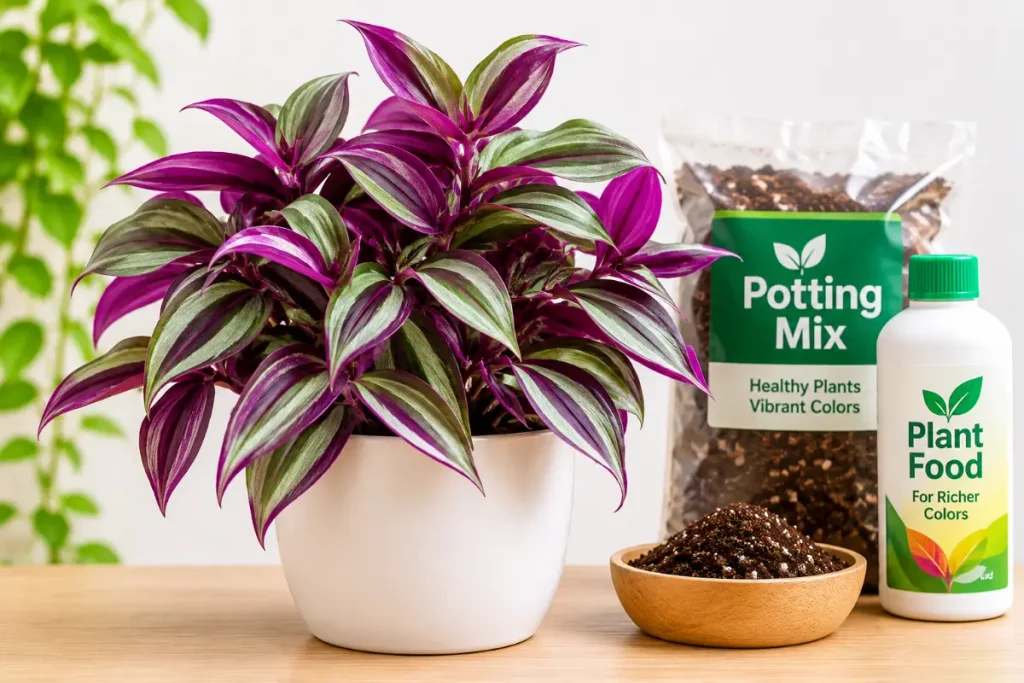
Potting Mix and Feeding for Best Color
Standard mix with perlite (tradescantia, coleus, Persian shield, gynura): A well-draining mix prevents root rot while retaining enough moisture for consistent growth. Use standard indoor potting mix cut with 20–25% perlite.
Moisture-retaining mix (calathea, maranta, stromanthe): These plants need consistent moisture — a denser mix with some coco coir or peat to retain moisture is appropriate, still with enough perlite to prevent waterlogging.
Succulent mix (purple oxalis during active growth, cordyline): Oxalis prefers a fast-draining mix; cordyline tolerates a wide range but does best with good drainage.
Fertilizer for best color: A balanced fertilizer (equal N-P-K) supports both foliage and root growth. For the most vivid purple-and-green coloring, avoid very high-nitrogen fertilizers — excessive nitrogen promotes fast, lush growth at the expense of color intensity, producing large but pale, predominantly green leaves. Half-strength balanced fertilizer every 3–4 weeks during the growing season is the right approach for most purple-and-green foliage plants.
Conclusion
Whether you choose the effortless tradescantia or the demanding stromanthe, an indoor plant with purple and green leaves brings a richness and depth to an indoor collection that purely green foliage cannot match. Light is the single most important variable — give purple-leaved plants the brightest indirect position available and the coloring will reward you. Calathea and stromanthe ask for filtered water and humidity on top of that, but the foliage quality justifies it. For any of the remaining species, standard indoor care in a bright position is enough to keep the two-toned display at its best.
For species identification and cultural guidance on tropical foliage houseplants, the University of Florida IFAS Extension foliage plant guide covers care requirements for many of the species in this guide.
FAQs
What is the easiest indoor plant with purple and green leaves?
Tradescantia zebrina is the easiest — fast-growing, tolerant of a wide range of conditions, inexpensive, and widely available. It propagates readily from cuttings and is very forgiving of irregular watering.
Why did my purple plant turn green?
Almost always caused by insufficient light. Most purple-leaved plants produce their color pigment (anthocyanin) in response to light intensity. Move the plant to a brighter position — within 2–3 feet of a bright window — and the purple color should deepen over several weeks of new growth.
Do purple and green plants need more light than all-green plants?
Generally yes — the plants that produce the best purple-and-green color tend to need at least bright indirect light. Low-light exceptions include calathea roseopicta and maranta, which maintain their patterning in dimmer conditions.
Is the purple tradescantia toxic to pets?
Yes — Tradescantia species (including T. zebrina and T. pallida) are mildly toxic to cats and dogs, causing skin irritation and mild gastrointestinal upset if ingested. Keep them out of reach of pets that tend to nibble plants.
How do I keep stromanthe ‘Tricolor’ looking its best?
Stromanthe needs three things above all: bright indirect light, consistent moisture with filtered water, and moderate-to-high humidity. The cream sections of the leaves bleach and turn brown at the edges when any of these three factors is insufficient. A pebble tray with water and filtered water for irrigation address two of the three easily.
Pingback: Indoor Plant with Round Leaves: 12 Species for a Softer Look - Plant Quill