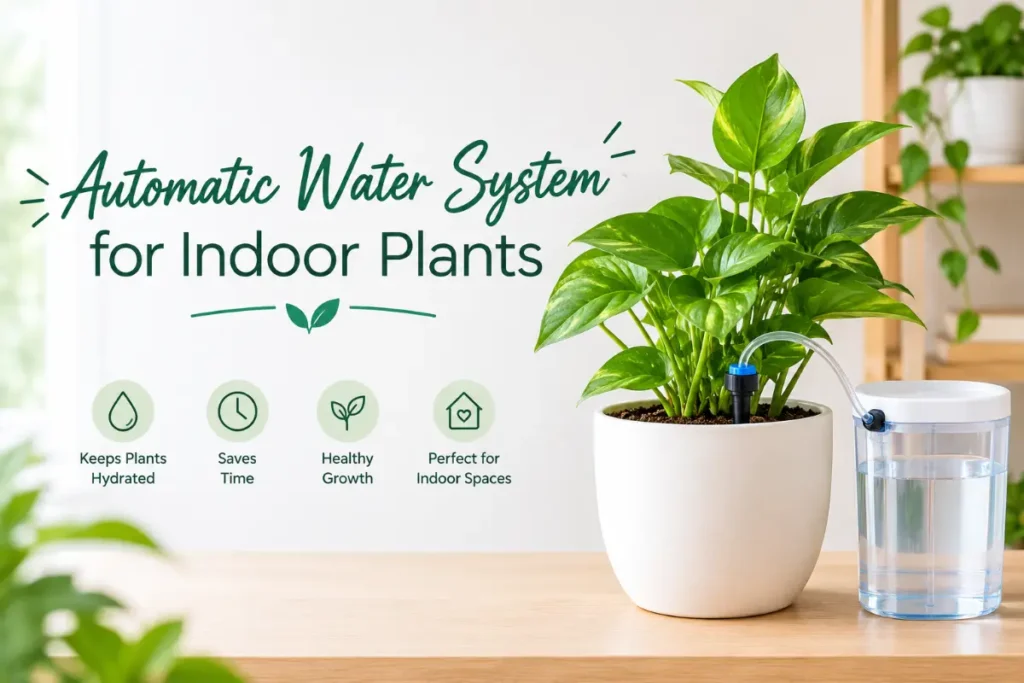
Walking back from two weeks away to find every pot bone dry — or coming home to a sodden, root-rotted collection because a neighbour over-watered — is one of the most preventable frustrations in indoor growing. An automatic water system for indoor plants solves both problems by delivering water on schedule, in the right quantity, without human intervention. This guide covers seven proven options, from the simplest gravity-fed spike to a fully programmable drip timer setup, so you can match the right system to your collection size, budget, and how long you need autonomous coverage.
Why Automated Watering Outperforms a Schedule
Most indoor plant problems — yellowing, wilting, root rot — trace back to inconsistent watering rather than wrong plant placement or bad compost. A manual schedule (every Sunday, every three days) ignores the fact that plant water demand shifts constantly with season, light level, and temperature. Automation removes that inconsistency: the system delivers water when programmed to, regardless of how busy the week has been.
The secondary benefit is data. Running an automated setup for one growing season teaches you exactly how much each plant drinks at each time of year — information that makes every future watering decision more accurate.
1. Battery-Powered Drip Timer (Best for Collections of 5+ Plants)
A battery-powered tap timer connected to micro-drip tubing is the most capable and scalable option. One timer — typically costing £15–30 — controls water delivery to 10, 20, or 30 pots simultaneously through 4 mm micro-tubing and adjustable drippers.
How it works: The timer attaches to a garden tap or an elevated reservoir. At the programmed time, the valve opens, water flows through the main 13 mm tubing and branches into 4 mm micro-tubes, each ending in an adjustable dripper staked into a pot. Run time of 1–60 minutes, frequency of once daily to once every 7 days.
Key spec to check: Minimum run time. Outdoor garden timers often start at 10–15 minutes — far too long for indoor pot volumes. Choose a timer with a 1-minute minimum.
Best for: Large collections, productive edible growing (tomatoes, herbs, salad crops), grow tent setups, holidays of any duration when connected to mains water.
Internal links for further reading: drip irrigation for indoor plants covers calibration and multi-plant layout in full detail; the moisture meter for indoor plants guide explains how to verify delivery is correct after setup.
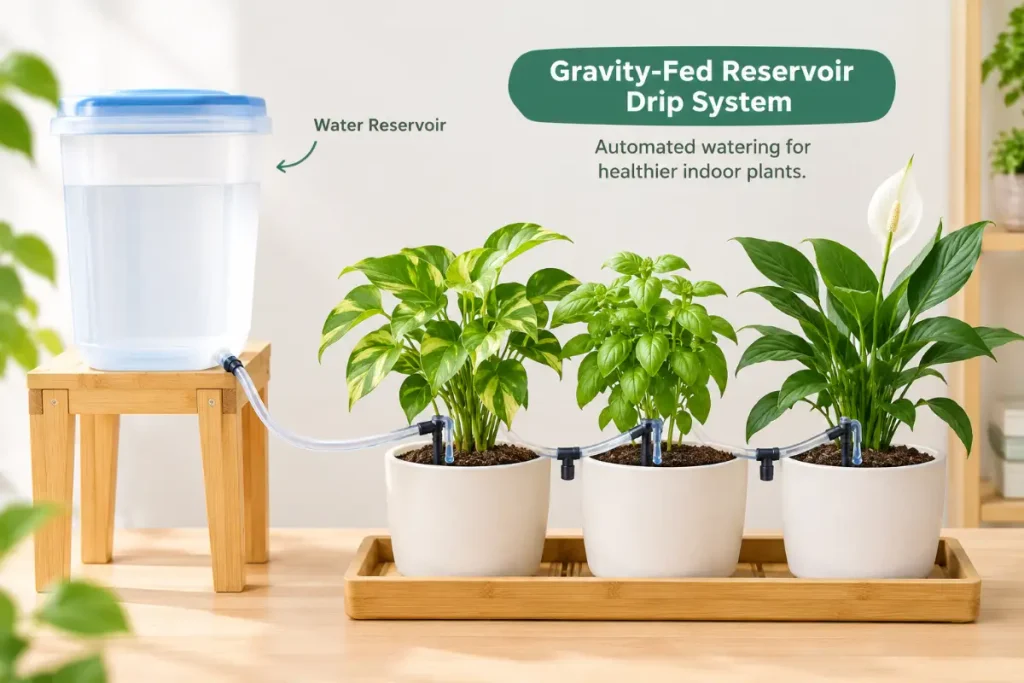
2. Gravity-Fed Reservoir Drip System (Best Without a Nearby Tap)
The same drip architecture as above, but fed from a raised reservoir container (a bucket or large water butt positioned 50–80 cm above the pots) rather than mains water. Lower pressure than a tap connection — requires drippers rated for gravity-feed, typically 0–4 litres per hour at low pressure.
Advantages: No tap needed in the room with the plants; portable; allows use of filtered or collected rainwater for hard-water-sensitive plants; easy to move between rooms or growing areas.
Limitation: Reservoir capacity limits autonomous run time. Calculate: daily flow per dripper × number of drippers × days of absence. A 20-litre bucket running ten 2 L/hr drippers for 5 minutes daily lasts approximately 12 days. For longer absences, connect to mains or increase reservoir volume.
3. Self-Watering Pots with Reservoirs (Best for Individual Moisture-Loving Plants)
Self-watering pots need no timer or tubing — a built-in reservoir beneath the growing medium delivers water upward by capillary action as roots absorb moisture from the compost above. No electricity, no programming: the plant controls its own intake rate.
Reservoir capacity by pot size:
- 15 cm pot: 400–600 ml → 5–14 days between refills
- 25 cm pot: 1.5–2.5 litres → 10–21 days
- 35 cm pot: 3–5 litres → 2–4 weeks
Best for: Herbs, peace lily, ferns, monstera, and any moisture-loving plant in a prominent display position. Not suitable for succulents, cacti, or orchids in bark — these need dry periods a reservoir pot cannot provide.
The guide to self-watering systems for indoor plants covers reservoir pot selection, growing medium compatibility, and seasonal adjustment in full.
4. Wicking Bottle System (Best Budget Option)
An inverted water bottle with a cotton wick threading from the water through the cap and into the growing medium — the simplest possible form of an automatic water system for indoor plants, built from household items.
Setup: Make a small hole in the bottle cap, thread 30–40 cm of cotton cord through it (leaving 5–8 cm extending from the cap), fill the bottle with water, and invert it over the pot with the wick pushed 5–8 cm into the growing medium. Prime the wick by soaking it thoroughly before use — a dry wick can take 12–24 hours to begin drawing.
Delivery duration: A 500 ml bottle lasts approximately 5–8 days for a 15 cm pot in spring; a 1-litre bottle lasts 7–14 days. Run a test before any holiday: install, leave for 3 days, check moisture level, adjust if needed.
Cost: Essentially zero — cotton cord and any plastic bottle you would otherwise recycle.
5. Terracotta Spikes (Best Self-Regulating Option)
Porous terracotta cones or stakes inserted into the growing medium, connected to a water bottle above. As compost dries, osmotic pressure draws water through the porous clay walls into the root zone. Flow accelerates when the compost is dry and slows as it moistens — a genuinely self-regulating delivery that no timer can replicate.
What to look for: Quality matters significantly. Test new spikes in a glass of water — look for a steady slow seep, not a rapid drip or no movement. Cheap terracotta either runs too fast or barely flows.
Best for: Individual plants where precise, need-responsive delivery matters — tropical aroids, ferns, moisture-sensitive edibles. One spike per pot up to approximately 20 cm diameter; larger pots benefit from two spikes.
6. Capillary Matting (Best for Seed Trays and Small Pot Collections)
Capillary matting is horticultural felt that absorbs and wicks water, delivering it upward into any pot placed on its surface. Lay the mat in a drip tray, keep the tray topped up with water, and every pot on the surface receives moisture automatically — no individual pot monitoring required.
Ideal applications: Seed trays during germination, windowsill herb collections, small pot groupings. A single tray of capillary mat covers 6–10 small pots simultaneously with one water top-up every 3–5 days.
Limitation: Only effective for pots in direct contact with the mat. Does not scale to larger pots or pots on multiple shelves. Needs replacing every season as the felt eventually compacts and wicks less effectively.
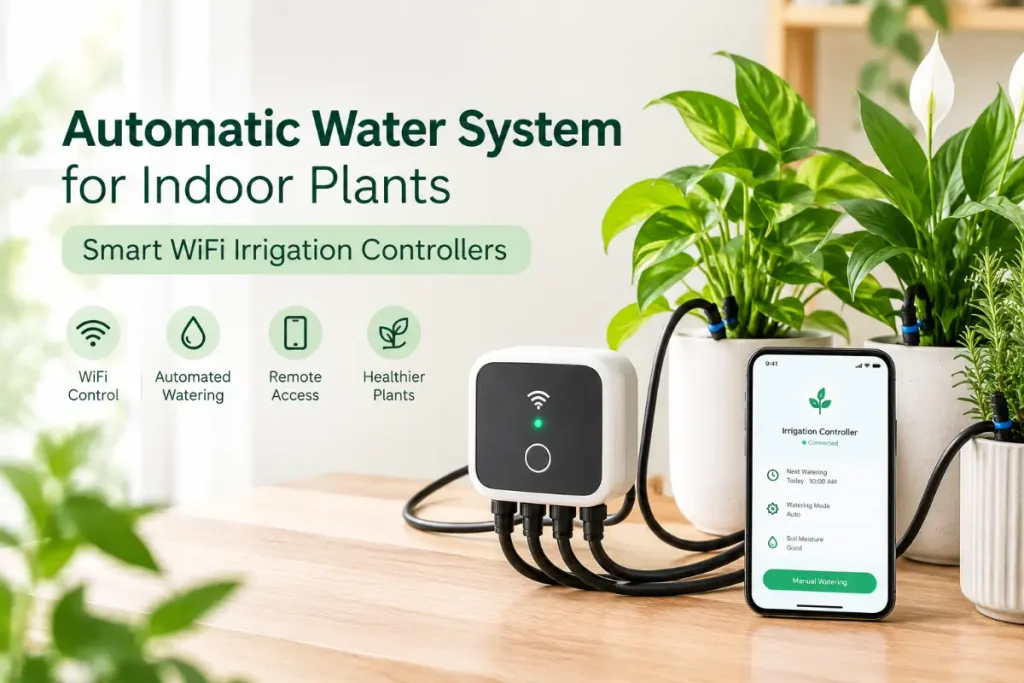
7. Smart WiFi Irrigation Controllers (Best for Tech-Forward Growers)
WiFi-connected irrigation controllers (brands including Gardena, Netro, and Rachio) allow programming, monitoring, and adjustment from a smartphone app — including remote override while away. Some models integrate with weather data, adjusting watering based on predicted conditions.
Indoor application: Connect to a tap in a utility room or kitchen and run tubing to plant growing areas. App control means watering schedules can be changed while travelling without asking anyone to visit the plants.
Cost: £40–120 for the controller, plus standard drip tubing components. Higher initial investment than a battery timer, offset by remote control flexibility and app-based monitoring.
Best for: Large, valuable collections; growers who travel frequently; heated conservatories or grow rooms where precise environmental control has meaningful impact on plant productivity.
Choosing the Right System: Quick Decision Guide
| Situation | Best option |
|---|---|
| 1–3 plants, weekend away | Wicking bottles or terracotta spikes |
| 4–10 plants, 1–2 week holiday | Self-watering pots + wicking bottles |
| 10+ plants, any duration | Drip timer (mains or gravity-fed) |
| Windowsill of small herb pots | Capillary matting |
| Frequent long travel | WiFi controller or mains drip timer |
| Zero budget | DIY wicking bottles |
| Maximum self-regulation | Terracotta spikes |
Installation Tips That Prevent the Most Common Failures
Test before you travel. Run any new system for at least 5 days before a holiday, checking moisture levels on days 2 and 5. A system that looks correct on day 1 may fail by day 4 if a wick dries out or a dripper blocks.
Replace timer batteries before long absences. Battery failure during a 2-week holiday is the single most common cause of automated watering failure. Replace regardless of apparent charge level if departure is more than 10 days.
Reduce frequency in winter. Plant water demand drops by 30–60% from summer to winter. An automatic water system for indoor plants set at summer rates will waterlog most plants by November. Adjust settings at the start of each season.
Use opaque tubing and reservoir containers. Algae grows wherever water meets light. Opaque components block that light, keeping tubing and reservoirs clear with minimal maintenance.
Water Quality and Automated Systems
What goes into the reservoir matters as much as the delivery mechanism. UK tap water is moderately to very hard in most regions — running hard water through the same system week after week deposits calcium and magnesium in tubing, drippers, terracotta pores, and the growing medium itself.
Effects of hard water in automated systems:
- Micro-drippers block over time as limescale accumulates inside the narrow bore — a blocked dripper delivers nothing, and the plant shows no signs until it wilts noticeably
- Terracotta spikes reduce flow rate progressively as mineral deposits fill pore spaces in the clay
- Growing medium pH rises gradually, reducing the availability of iron, manganese, and other micronutrients even when fertiliser is applied regularly
Practical management:
Use collected rainwater where possible — soft, slightly acidic, and free from the minerals that cause accumulation. The post on rainwater for indoor plants covers collection, storage, and when it matters most.
For mains-fed systems in hard water areas, a citric acid flush (5g per litre of water, run through the system for 10 minutes, then flushed with clean water) descales drippers and tubing effectively. Do this at the start and end of each growing season — two descales per year prevents the gradual blockage that hard water systems inevitably develop if untreated.
Seasonal Calibration: The Step Most Growers Skip
An automated system installed in April and left unchanged through to November will be watering at summer rates through the darker, cooler months of autumn — when most plants need 40–60% less water than at peak growing season.
Signs your system needs seasonal adjustment:
- Compost surface staying wet for more than 2 days after a watering cycle (in autumn/winter)
- Yellowing lower leaves on tropical houseplants from October onward
- Moss or algae appearing on the growing medium surface — a sign of consistently excessive moisture
Adjustment approach: At each season change, reduce either the timer frequency (from every 2 days to every 3 days) or the run duration (from 5 minutes to 3 minutes) — or both. Check root-zone moisture with a probe 24 hours after the adjusted cycle before trusting the new settings.
Self-watering pots self-regulate to some degree — the plant draws less, so the reservoir lasts longer — but still benefit from emptying the reservoir fully once between autumn refills to prevent stagnant water accumulating at the base.
Multi-Zone Setups for Mixed Collections
Most indoor plant collections are mixed — moisture-loving tropical plants alongside drought-tolerant succulents, productive edibles alongside low-maintenance foliage plants. A single timer running all pots at the same frequency will either underwater the moisture-lovers or overwater the drought-tolerant plants.
Two-zone approach: Run two separate drip lines from two timers (or a dual-zone timer) — one zone programmed for frequent, regular delivery to moisture-loving plants, a second zone programmed for infrequent delivery to cacti, succulents, and drought-tolerant plants. The additional cost is one more timer (£15–30) and a separate tubing run.
Dripper rate variation within one zone: Within a single zone (all pots on one timer), use different dripper flow rates to account for different pot sizes and plant types. A 0.5 L/hr dripper on a 10 cm succulent pot and a 4 L/hr dripper on a large monstera in a 25 cm pot — both receiving the same 5-minute cycle — deliver 42 ml and 333 ml respectively. This is a practical way to serve a mixed collection from a single timer without building a second zone.
Maintaining Your Automated System
A well-maintained system requires approximately 30 minutes of attention per season — a small investment to protect a collection that has grown over months or years.
Monthly: Check every dripper is flowing by observing the system during a cycle. Inspect tubing for kinks or disconnections at T-fittings. Check capillary mat moisture level if using one.
Each season change: Adjust timer frequency and duration for the new season. Flush tubing with clean water. Check battery level in timer — replace if travelling or if the timer will be unattended for more than 2 weeks. Inspect wicks for deterioration and replace cotton wicks every 3–4 months.
Annually: Full citric acid descale of drip tubing and drippers. Replace any tubing that has become brittle or permanently kinked. Clean self-watering pot reservoirs. Test timer accuracy — some cheaper models drift by 10–15 minutes over several months, which can be significant for short-duration cycles.
Pairing Automation with the Right Growing Medium
No automated system performs well in poorly draining compost. A peat-based mix that compacts over time, or a standard compost without enough perlite, holds water unevenly — the surface stays wet while the root zone remains dry, or vice versa. Automated delivery of water into dense compost accelerates root rot rather than preventing it.
The guide to drainage for indoor plants covers compost selection and amendment that makes any watering approach — manual or automated — work more predictably. Free-draining, well-structured growing medium is the foundation that automated delivery builds on.

Real-World Setup: A 12-Plant Indoor Growing Area
To make all of the above concrete, here is a practical setup for a typical UK indoor growing area — a south-facing spare bedroom used as a plant room, with 12 plants ranging from a large monstera to a windowsill of culinary herbs.
The collection:
- 1 × monstera deliciosa (25 cm pot)
- 2 × pothos in hanging pots (15 cm pots)
- 3 × culinary herbs on windowsill (12 cm pots each)
- 2 × philodendron (20 cm pots)
- 1 × peace lily (20 cm pot)
- 2 × cacti (10 cm pots)
- 1 × fiddle-leaf fig (30 cm pot)
Recommended setup:
Zone 1 — drip timer (moisture-loving plants): Battery timer connected to a 20-litre reservoir elevated 60 cm above the plants. One 4 mm micro-tube per plant, each with an adjustable dripper: 4 L/hr for the monstera and fiddle-leaf fig, 2 L/hr for philodendrons and peace lily, 1 L/hr for pothos. Timer set to run 4 minutes every 2 days in summer, 4 minutes every 3 days in autumn, 4 minutes every 4 days in winter.
Zone 2 — terracotta spikes (cacti): Two quality terracotta spikes, each with a 500 ml bottle. Replaced every 10–14 days in summer, every 3–4 weeks in winter. No timer needed — the spikes self-regulate within their bottle capacity.
Herbs (capillary mat): The three herb pots sit on a capillary mat in a drip tray on the windowsill. The tray is topped up with 200–300 ml every 4–5 days — the only manual step in the whole setup.
Total cost: Approximately £45–65 (timer £20, tubing and drippers £15, reservoir bucket £8, terracotta spikes £8, capillary mat £5).
Time investment: Initial setup 2 hours; ongoing maintenance 15 minutes per week.
This kind of split approach — drip timer for the main collection, passive methods for outliers — is more practical than trying to fit every plant onto a single system with a single schedule.
Conclusion
The right automated setup for your collection depends on scale, budget, and how long you need autonomous coverage. Wicking bottles and terracotta spikes solve the problem beautifully for small collections and short absences; a drip timer connected to mains covers any number of plants for any duration. For most UK indoor growers, a combination of self-watering pots for prominent display plants and a drip timer for the broader collection is the most practical and reliable long-term approach.
For an authoritative overview of irrigation principles applicable to indoor container growing, the RHS guidance on irrigation and water management is an excellent reference.
FAQs
What is the best automatic water system for indoor plants in the UK?
For most UK growers, a battery-powered drip timer connected to mains water provides the most reliable and scalable solution. It covers any number of plants for any duration and can be fine-tuned per plant by adjusting individual dripper flow rates.
How long can an automatic system keep plants watered?
A mains-connected drip timer can water plants indefinitely. Gravity-fed systems are limited by reservoir capacity. Self-watering pots last 5 days to 4 weeks between refills, depending on pot size and season.
Can I automate watering for succulents?
Yes, but with a timer set to very low frequency — once every 10–14 days in summer and every 21–28 days in winter — delivering a small quantity per cycle. Standard self-watering pots are not appropriate as they maintain too-consistent moisture.
Do I need a pressure reducer for a drip timer?
Yes, if connecting to mains water. Household pressure (3–5 bar) is far too high for micro-drippers and causes spraying rather than dripping. Most indoor drip kits include a pressure reducer; if not, purchase one separately — it is essential.
How do I stop algae in drip tubing?
Use black or grey opaque tubing (algae cannot grow without light), flush monthly with clean water, and descale with dilute citric acid solution at the start and end of each growing season.
What is the cheapest automatic watering solution?
A DIY cotton wick in an inverted bottle costs nothing beyond a piece of cord and delivers 5–14 days of autonomous watering per plant. Effective for small collections and short absences.
Will an automatic watering system work for edible indoor plants?
Yes — in fact edibles (tomatoes, herbs, chillies, lettuce) benefit most from automation because they need consistently moist conditions that are difficult to maintain with manual watering. A drip system or self-watering pot improves yield noticeably for productive indoor growing.