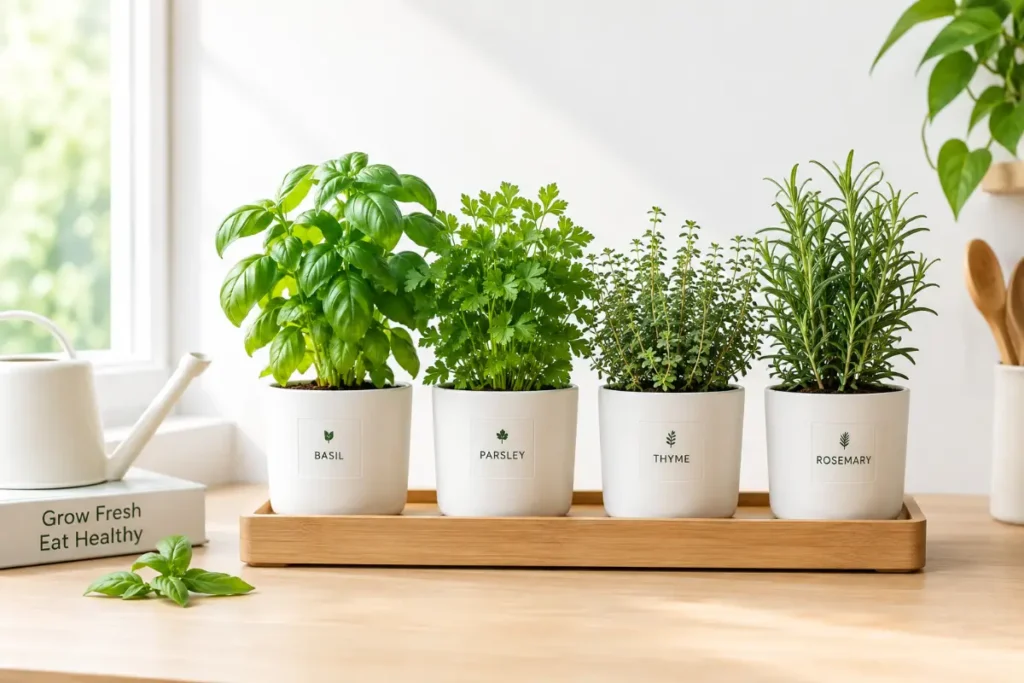
An indoor herb garden is one of the most practically rewarding indoor gardening projects because every harvest goes directly into your cooking. Unlike ornamental plants where the benefit is visual, an indoor herb garden delivers tangible culinary value every time you use a fresh herb that would otherwise require a grocery store trip or substitution with dried herbs that bear only a faint resemblance to the fresh version.
The challenge is that herbs cover an enormous range of care requirements. Rosemary, lavender, and thyme need direct south-facing sun and fast-draining soil. Mint needs consistent moisture and tolerates lower light. Basil needs warmth and regular pinching. Cilantro bolts quickly and needs succession sowing. Grouping herbs with similar requirements and understanding which herbs suit your available light produces a functional indoor herb garden. Grouping herbs with incompatible requirements in the same container produces a collection where one thrives while the others decline.
Quick Answer
A successful indoor herb garden groups herbs by care compatibility: Mediterranean herbs (rosemary, thyme, lavender, oregano, sage) together in south-facing sun with fast-draining soil and infrequent deep watering; moisture-loving herbs (mint, basil, parsley, chives) in bright indirect to east-facing light with consistently moist soil; and annual cool-season herbs (cilantro, dill) succession-sown in separate containers every three to four weeks. Choose herbs you actually cook with, match them to your available light, and harvest regularly to prevent legginess and bolting.
The Most Important Decision: Herbs That Match Your Light
This is where most indoor herb gardens fail. People choose herbs based on culinary preference or what looks attractive at the garden center without assessing whether their available light can support those herbs. The result is herbs that decline within weeks of bringing them home.
South-facing window with direct sun: The ideal position for Mediterranean herbs. Rosemary, thyme, lavender, oregano, and sage all need four to six or more hours of direct sun daily and actually prefer direct south-facing window light. These herbs fail in indirect light positions regardless of care quality.
East-facing window with morning sun: Suitable for basil, parsley, chives, and mint. These herbs prefer moderate to bright indirect light with some morning direct sun. East-facing light provides the light intensity they need without the intense afternoon heat that stresses them.
North-facing window with medium indirect light: The most limited light position for herbs. Mint is the most shade-tolerant common culinary herb and grows acceptably in north-facing windows. Chives tolerate medium indirect light reasonably well. Most other culinary herbs decline in north-facing positions without supplemental grow lighting.
Grow lights for any position: A full-spectrum LED grow light running 12 to 14 hours daily opens up indoor herb growing in any room regardless of natural light direction and provides the most consistent year-round results for any herb variety.
Grouping Herbs by Compatibility
Group 1: Mediterranean Herbs
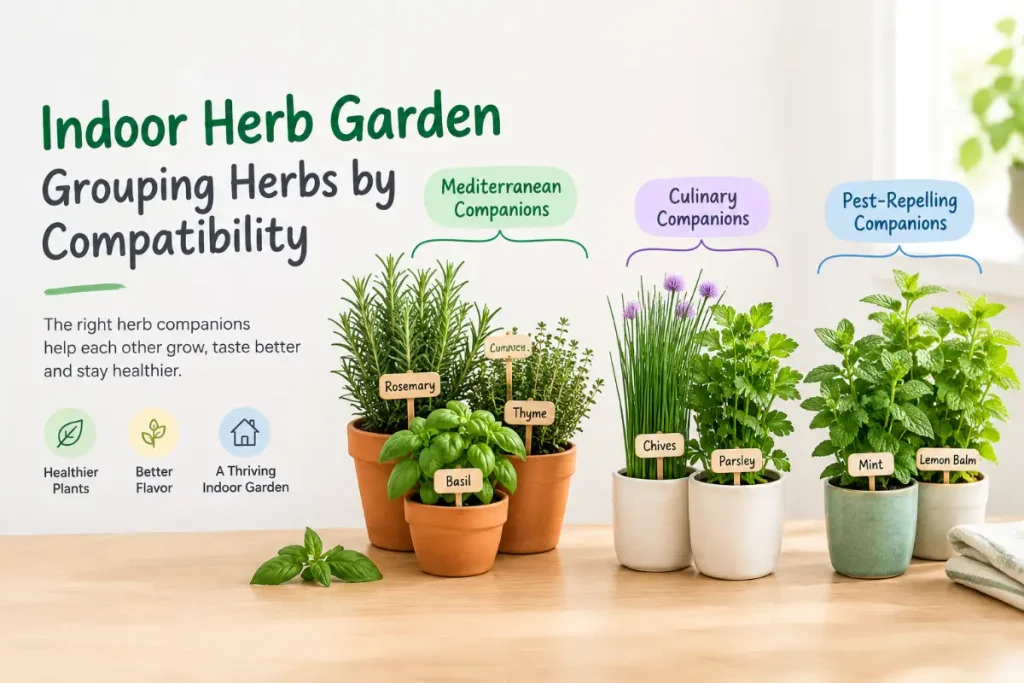
Rosemary, thyme, lavender, oregano, and sage share the same origin on dry Mediterranean hillsides and essentially identical care requirements. They are the natural first group for indoor herb gardening because their compatibility makes them manageable as a single-care routine.
Their shared needs: Direct south-facing sun for six or more hours. Fast-draining soil with 30 to 40% perlite. Watering only when two inches deep feel completely dry — every ten to sixteen days in summer. Cool to moderate temperatures (50 to 75 degrees Fahrenheit). Light fertilizing twice per year. Excellent air circulation to prevent the powdery mildew that kills Mediterranean herbs in still indoor air.
What to avoid: Grouping Mediterranean herbs with moisture-preferring herbs like mint and basil in the same container. Their diametrically opposite watering requirements mean that the moisture that mint and basil need kills rosemary and thyme, while the dryness that rosemary and thyme need stresses mint and basil. Separate containers for each group is the practical solution.
Container for the Mediterranean group: A wide terracotta window box with excellent drainage suits all five Mediterranean herbs simultaneously. Terracotta dries faster than plastic, complementing the Mediterranean group’s preference for soil that dries fully between waterings.
For the complete care guides on individual Mediterranean herbs, how to care for a rosemary plant indoors covers rosemary specifically and how to care for an indoor lavender plant covers lavender with the specific additional care considerations that distinguish these two from the more forgiving thyme and oregano.
Group 2: Moisture-Loving Herbs
Basil, mint, parsley, and chives share a preference for consistently moist soil and bright indirect to moderate direct light. They are more tolerant of the east-facing and less-intense light conditions of many kitchens than Mediterranean herbs, making them accessible for more indoor growing setups.
Their shared needs: Bright indirect light to four to six hours of moderate direct or morning sun. Consistent moisture, watering when the top half inch dries. Moderate temperatures between 60 and 80 degrees. Light fertilizing every two to four weeks through the growing season.
Individual differences within the group: Basil specifically needs warmth above 65 degrees and regular stem-tip pinching to prevent bolting. Mint spreads aggressively and benefits from its own separate container where its root spread does not crowd other herbs. Parsley is biennial and slower-growing, lasting two years before flowering and dying. Chives are perennial and the lowest-maintenance of the group, requiring only regular cutting to maintain productivity.
Container consideration: Individual pots for each herb in this group are more practical than a combined planter because their different growth habits — mint’s spreading rhizomes, parsley’s deep taproot, chive’s clumping base, basil’s upright annual habit — create management complications in shared containers. A collection of individual pots on a kitchen windowsill or shelf is more flexible and easier to manage than a single large mixed container.
For the complete care guides on the individual moisture-loving herbs, growing basil indoors covers basil’s specific light, temperature, and pinching requirements, and growing mint indoors covers mint’s moisture preferences and division management.
Group 3: Cool-Season Annual Herbs
Cilantro, dill, and fennel are annual herbs that complete their life cycle quickly in warm indoor conditions, bolting to seed within four to eight weeks of reaching usable size. They are not permanent kitchen herbs in the way that perennial rosemary and mint are, but managed as a succession-sown rotation they provide continuous fresh supply.
Their challenge: All three bolt (flower and become bitter or coarse) quickly in the warm temperatures and long light hours of typical indoor conditions. The bolting is triggered by warmth and day length rather than by inadequate care. No indoor care approach prevents cilantro from eventually bolting — the goal is to slow the process and maintain a continuous supply through succession sowing rather than trying to prevent the inevitable.
The succession approach: Sow a new small container every three to four weeks. Harvest from the oldest planting until it bolts, then discard and start the cycle with the next sowing already in progress. Two to three containers at different stages maintain continuous harvest without gaps.
Temperature management: Cilantro in particular lasts significantly longer in cooler conditions (60 to 65 degrees) than in warm conditions (70 to 75 degrees). Positioning in the coolest available kitchen location, away from ovens and heating vents, extends the productive life of each sowing by one to two weeks.
Setting Up Your Indoor Herb Garden: Practical Steps
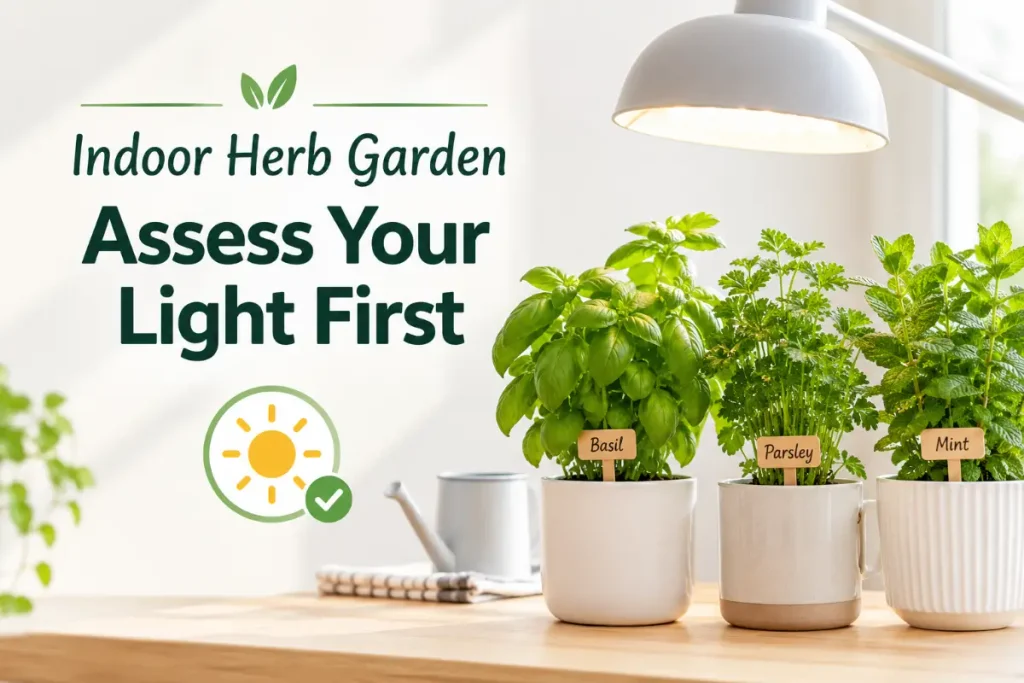
Assess Your Light First
Before purchasing any herbs, spend one clear day observing which positions in your kitchen or other intended herb garden location receive direct sun rays and for how many hours. Use a smartphone light meter app if available.
Write down: which windows are south, east, north, or west-facing. How many hours of direct sun each position receives. Which positions receive only ambient indirect light. This assessment takes thirty minutes and prevents weeks of disappointment from placing herbs in positions that cannot support them.
Choose Containers Appropriately
Individual pots for flexibility: The most practical indoor herb garden uses individual pots for each herb rather than combined planters. Individual pots allow you to move each herb to its ideal light position, replace individual herbs that decline without disrupting the entire garden, water each at its own appropriate frequency, and harvest without disturbing neighboring plants.
Combined herb planters: Visually attractive combined planters work well only when all herbs in the planter share identical care requirements (the Mediterranean group in a single box, for example). Mixed-requirement herbs in a combined planter invariably produce one healthy herb and several struggling ones.
Drainage throughout: Every herb container must have drainage holes. No herb in this cluster thrives in a pot without drainage regardless of how carefully you water. For decorative outer containers without holes, use a correctly-draining inner pot that can be removed for watering.
Build a Watering Routine That Respects Each Group
The most practical watering system for a mixed indoor herb garden checks soil moisture before every potential watering event rather than watering all herbs on the same schedule.
The check method: For Mediterranean herbs, push your finger two full inches into the soil before watering. Water only when that depth is completely dry. For moisture-loving herbs, check the top half inch only — water when that dries. For cool-season annuals, check the top half inch and water when dry.
The grouped schedule advantage: Once you have Mediterranean herbs together and moisture-loving herbs together, you can develop a rough schedule that works for each group: Mediterranean herbs every ten to sixteen days, moisture-loving herbs every three to five days. This is approximate and must still be checked rather than followed blindly, but it reduces the number of individual assessments.
Harvest Regularly as Management, Not Just Use
This applies to every herb in any indoor herb garden: regular harvesting is plant management, not just kitchen convenience. Unpruned herbs left to grow without harvesting become leggy, bolt, or become woody depending on species. Regular harvesting maintains the compact, productive form that makes each herb most attractive and most useful.
The universal rule: Never take more than one-third of any herb’s growth in a single harvest. Removing more than one-third weakens the plant’s photosynthetic capacity and slows recovery significantly. Regular small harvests produce more total yield than occasional large harvests.
Herbs Worth Including in Most Indoor Gardens
Always worth growing for most home cooks: Basil (for Italian, Thai, and Southeast Asian cooking), rosemary (for Mediterranean and roasted dishes), thyme (versatile in most savory applications), mint (for cocktails, tea, and garnish), chives (for finishing dishes and salads).
Worth growing for specific cuisines: Cilantro (for Mexican, Indian, and Southeast Asian cooking — succession-sow for continuous supply), parsley (for European and Middle Eastern cooking — slower to bolt than cilantro), oregano (for Italian and Greek cooking — easiest of the Mediterranean group).
Worth trying once your basics are established: Lemon verbena, tarragon, bay laurel, and lemongrass for more specialized culinary applications that round out a comprehensive indoor herb collection.
Skip for indoor growing: Dill and fennel are large plants that grow too tall for practical indoor container management and bolt too quickly to make succession sowing as worthwhile as with cilantro. Better grown outdoors in appropriate seasons.
Year-Round Herb Garden Management
Spring: The most active period. Divide crowded perennial herbs including mint and chives. Start fresh basil and succession-sow cilantro. Repot any Mediterranean herbs that have become root-bound. Begin fertilizing as growth accelerates.
Summer: Peak production for all warm-season herbs. Harvest frequently to prevent bolting in basil and manage legginess in rosemary and mint. Consider moving potted herbs to a shaded outdoor position for the enhanced light and air circulation that outdoor growing provides.
Fall: Reduce fertilizing as growth slows. Mediterranean herbs benefit from reduced watering as their growth slows in response to shorter days. Bring any outdoor-summered herbs inside before nighttime temperatures drop below 50 degrees. Inspect for pests before bringing indoors.
Winter: Maintenance mode for most herbs. Mediterranean herbs need minimal water — check every two to three weeks rather than weekly. Basil is the most cold-sensitive and needs warmth above 65 degrees throughout. Mint slows significantly and can be allowed to rest with minimal watering. Chives maintain slow but consistent growth with adequate light and monthly watering.
Troubleshooting Common Indoor Herb Garden Problems
All herbs declining despite adequate care: Check light first. If none of the herbs in any position are thriving, insufficient light for their specific requirements is almost certainly the cause. A light meter app confirms whether the positions are providing adequate foot-candles for the herb types you are growing.
Mediterranean herbs yellowing and dying: Overwatering in poorly draining soil. Check that soil drains freely and dries to two inches between waterings. Repot in faster-draining mix with more perlite if needed. These herbs kill from root rot far more readily than from drought.
Basil collapsing suddenly: Cold temperature shock from being near an air conditioning vent or cold window. Basil is more cold-sensitive than any other common culinary herb and collapses when cold air touches it. Move away from any cold air sources and maintain temperatures consistently above 65 degrees.
Mint taking over the entire container: Normal mint behavior. Separate the mint into its own container where its horizontal rhizome spread cannot crowd other herbs. Divide the mint root ball and repot fresh sections in individual containers. Remove all mint from any shared planter where it is crowding other herbs.
Cilantro bolting within weeks of purchase: Normal behavior in warm indoor conditions. Begin succession sowing immediately — start a new container every three to four weeks and accept that each sowing lasts four to six weeks before bolting. Position in the coolest available kitchen location to extend productive life slightly.
Herbs growing well but tasting weak: Insufficient light reducing essential oil production, or heavy fertilizing diluting essential oil concentration with rapid vegetative growth. Improve light. Reduce fertilizing to once-a-month at quarter rate. Essential oil concentration — which determines flavor intensity — is highest in plants growing in maximum appropriate light with moderate rather than heavy fertilizing.
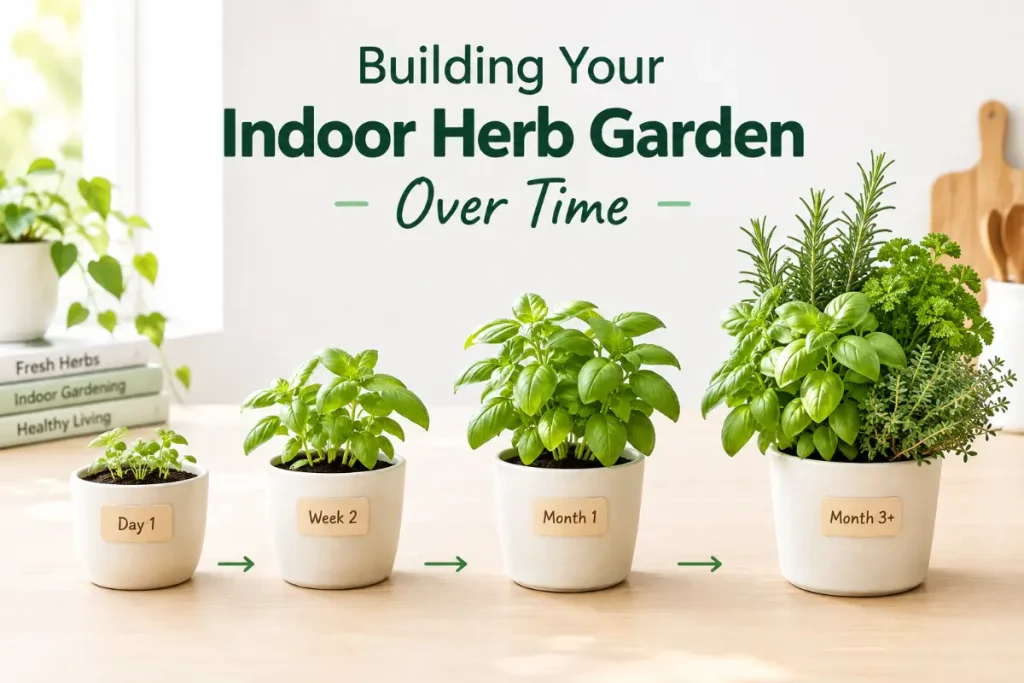
Building Your Indoor Herb Garden Over Time
The most practically productive indoor herb garden is typically built incrementally rather than purchased all at once. Starting with two to three herbs, mastering their care, and adding new herbs as confidence grows prevents the common experience of purchasing ten herbs simultaneously, being overwhelmed by incompatible care requirements, and having most of the collection fail within a month.
A suggested progression:
Month 1: Start with mint and chives. Both are forgiving, fast-growing, immediately useful, and tolerant of the learning process. Mint in a six-inch pot, chives in a six-inch pot. Practice the top-half-inch moisture check before every watering. Harvest regularly.
Month 2: Add basil once mint and chives are well-established and care routines feel comfortable. Practice the stem-pinching technique that prevents basil from bolting. Use basil immediately in cooking so the harvest motivation reinforces the care practice.
Month 3: Add one Mediterranean herb — thyme is the most forgiving of the group and the most versatile in cooking. Practice the two-inch soil check that Mediterranean herbs need. Notice the very different watering interval compared to mint and basil.
Month 4 and beyond: Add rosemary, oregano, parsley, and begin succession-sowing cilantro as your care confidence grows and your light assessment tells you which positions can support which herbs.
This incremental approach builds a genuinely functional indoor herb garden over four to six months rather than a collection of struggling herbs purchased all at once without the care knowledge to sustain them. For detailed care on the specific herbs most frequently included in indoor herb gardens, growing green onions indoors covers the allium addition that completes a comprehensive indoor kitchen herb and food garden with one of the fastest and most practically useful growing methods available.
Conclusion
An indoor herb garden that matches herbs to their actual light requirements, groups compatible herbs together, uses individual pots for flexibility, waters each group at its appropriate frequency, and harvests regularly for plant management as much as culinary use becomes one of the most reliably productive indoor food growing operations available.
The return on investment — in fresh culinary ingredients, in the fragrance that productive aromatic herbs contribute to a kitchen environment, and in the connection to growing food that even a small windowsill herb garden provides — justifies the initial effort of setup and the ongoing attention of regular watering, harvesting, and management more clearly than almost any other indoor growing project.
Frequently Asked Questions
What herbs grow best indoors?
Mint, chives, basil, thyme, oregano, and parsley are the most consistently productive indoor herbs for most homes. Mediterranean herbs including rosemary, thyme, oregano, and sage grow best in south-facing windows with direct sun. Mint and chives grow well in east and north-facing windows with indirect light. Basil needs warmth above 65 degrees and consistent pinching. Cilantro and dill require succession sowing every three to four weeks since they bolt quickly in indoor warmth.
Can you grow an indoor herb garden without a south-facing window?
Yes, with appropriate herb selection or grow lights. Mint and chives grow acceptably in north-facing windows. Basil, parsley, and chives do well in east-facing windows. For Mediterranean herbs including rosemary and thyme without a south-facing window, a full-spectrum LED grow light running 12 to 14 hours daily produces significantly better results than attempting these herbs in insufficient natural light. Choose herbs that match your actual light before purchasing.
How often should I water an indoor herb garden?
Watering frequency differs by herb group. Mediterranean herbs (rosemary, thyme, lavender) need water only when two inches deep feel completely dry — every ten to sixteen days in summer. Moisture-loving herbs (mint, basil, parsley, chives) need water when the top half inch dries — every three to five days. Check soil moisture before every watering rather than following a fixed schedule since seasonal and positional differences make fixed schedules unreliable.
Should I keep all my herbs in one pot?
Only if they share identical care requirements. The Mediterranean group (rosemary, thyme, oregano, sage) can share a container successfully since they have identical watering, light, and soil requirements. Mixing Mediterranean herbs with moisture-loving herbs like mint and basil in one container means either the Mediterranean herbs rot from too much moisture or the moisture-loving herbs dry out — one group always suffers. Individual pots for each herb or for each compatible group is the most practical approach.
How do I keep indoor herbs from getting leggy?
Harvest or prune the top third of stems every one to two weeks regardless of whether you need the material immediately. Regular tip removal prevents the stretching toward light that produces the leggy form and stimulates bushier branching at the cut points. Improving light simultaneously addresses the other primary cause of indoor herb legginess. Both practices together — regular harvesting and maximum light — maintain the compact, productive growth that makes indoor herbs most useful.
What is the easiest indoor herb to grow?
Mint is consistently the most forgiving culinary herb for indoor growing. It tolerates a wider range of light conditions than Mediterranean herbs, recovers quickly from irregular watering, propagates effortlessly from cuttings, and produces abundant harvestable material with minimal care. The main management requirements are regular harvesting to prevent legginess and flowering, and division every six to twelve months as the root system becomes root-bound. For the complete mint care guide, growing mint indoors covers every step of productive indoor mint management.