
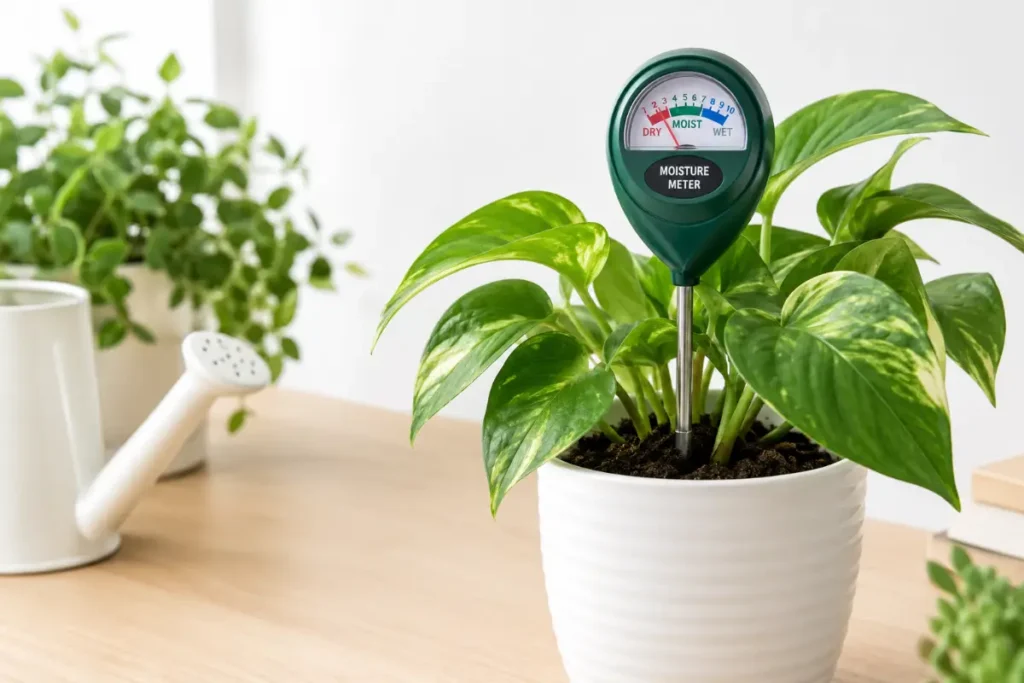
A moisture meter for indoor plants sounds like the perfect solution to the most common plant care problem: knowing when to water. If a device can tell you precisely when your soil is dry enough to water, the guesswork that leads to overwatering and underwatering should be eliminated entirely. The reality is more nuanced than this promise suggests, and whether a moisture meter is worth buying depends significantly on which plants you are using it for and how you use it.
This guide gives an honest assessment of moisture meters for indoor plants, covering how they actually work, where they provide genuine value, where they are limited or misleading, and what to look for if you decide to purchase one.
Quick Answer
Moisture meters for indoor plants are useful tools for beginner plant owners who are still developing the intuitive feel for soil moisture that experienced growers have, for large collections where individually checking each plant by hand is time-consuming, and for very large pots where surface moisture is a poor indicator of deep root zone moisture. They are less useful than their marketing suggests for drought-tolerant plants where the finger test at two to three inches is simpler and equally reliable, and they can give misleading readings in certain conditions. Quality matters significantly — cheap meters ($5 to $10) are often unreliable, while mid-range options ($15 to $30) provide much better accuracy.
How Moisture Meters Work
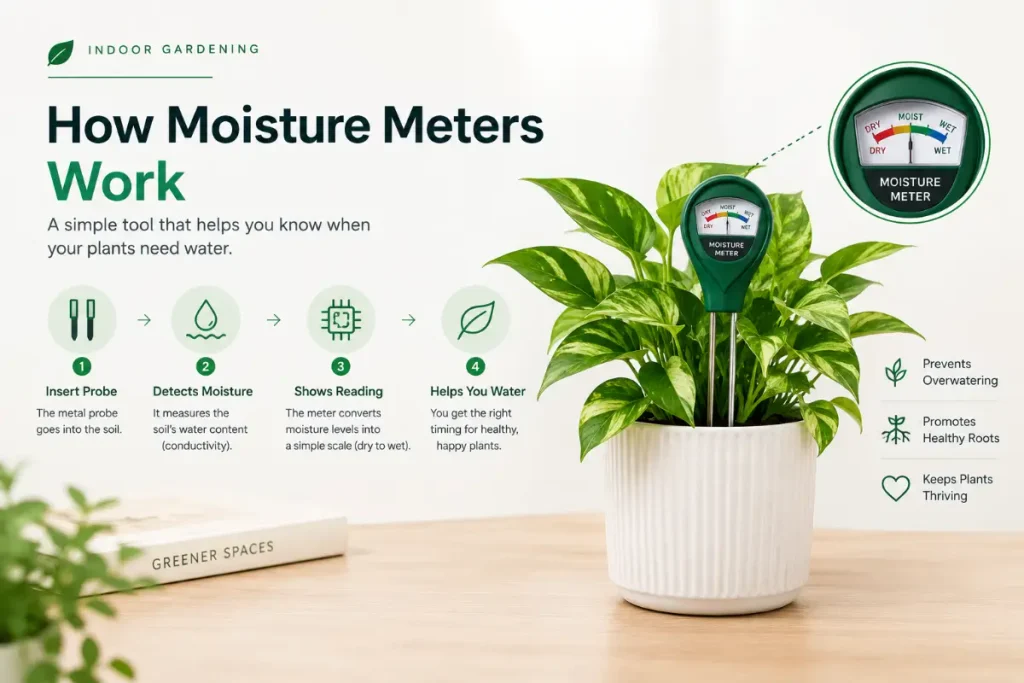
Understanding the mechanism helps you interpret moisture meter readings correctly and identify when readings may be inaccurate.
Electrical resistance measurement: Most consumer moisture meters measure soil moisture indirectly by measuring the electrical resistance between two metal probes inserted into the soil. Moist soil conducts electricity more readily than dry soil, so lower electrical resistance indicates higher moisture content. The meter converts this resistance reading into a moisture level display — either a numerical scale (1 to 10) or a three-zone indicator (dry, moist, wet).
The key limitation: This measurement method does not directly measure water content. It measures electrical conductivity, which is affected by water content but also by soil mineral content, fertilizer salt concentration, and soil composition. High mineral or fertilizer salt concentration in dry soil can produce a reading that suggests moisture when the soil is actually dry. Low mineral content in moist soil can produce a dry reading. These false readings are most common in heavily fertilized soil and in very pure growing media like perlite alone.
Probe depth and placement: The reading reflects conditions at the depth and location of the probe tips, not the average moisture of the entire pot. Inserting the probe to mid-depth in a large pot reads the moisture at that specific point, which may differ significantly from the moisture at the bottom where drought-tolerant plant roots concentrate or from the surface where moisture-loving plant roots are active. Multiple readings at different depths and locations in the same pot provide a more complete picture than a single center insertion.
Where Moisture Meters Provide Genuine Value
For beginner plant owners: New plant owners who have not yet developed the intuitive feel for soil moisture that experience provides find moisture meters genuinely helpful as a learning tool. Using the meter alongside manual soil checking (finger test at appropriate depth) builds the sensory calibration that makes the finger test intuitive over time. As a learning aid rather than a permanent dependency, a moisture meter is a worthwhile investment for beginners.
For large pots and statement plants: In very large pots (fourteen inches or more in diameter) and tall statement plant containers, the surface moisture level is a poor indicator of moisture conditions at depth where the majority of root activity occurs. A moisture meter probe inserted to twelve or more inches depth in a large statement plant pot provides meaningful information about deep root zone moisture that is difficult to assess by hand without disturbing the plant significantly.
For checking multiple plants quickly: A moisture meter speeds up the soil checking routine for large collections. Rather than inserting a finger into each pot, a quick probe insertion and reading takes two to three seconds per plant. For collections of thirty or more plants, this time saving adds up across watering sessions.
For checking self-watering pot growing medium: Self-watering pots maintain moisture primarily in the lower growing medium from reservoir wicking. A moisture meter inserted at mid-depth in a self-watering pot gives a more accurate picture of how the wicking is distributing moisture through the medium than a surface finger check that only reflects the drier surface layer.
Where Moisture Meters Are Limited or Misleading
For drought-tolerant plants: For cacti, succulents, and other drought-tolerant plants that need to dry to two to three inches before watering, the two-to-three-inch finger check provides the same information as a moisture meter more reliably because it is not affected by soil mineral content. The simplicity of the finger test at the appropriate depth makes the meter redundant for this plant category.
In freshly fertilized soil: High fertilizer salt concentration in soil raises electrical conductivity independently of moisture content. A moisture meter reading in freshly fertilized soil may indicate “moist” or even “wet” when the soil is actually at an appropriate dryness level for watering. Always water approximately two to three days after fertilizing before taking meter readings to avoid this misleading effect.
In pure perlite or coco coir: Perlite alone has very low electrical conductivity regardless of water content. Moisture meters in soil mixes with very high perlite content (above 50%) may consistently read “dry” even when the perlite is holding significant water. The finger check is more reliable for very fast-draining, high-perlite mixes.
Cheap meters with poor calibration: Moisture meters in the $5 to $10 price range frequently provide inconsistent readings that vary significantly between uses even in the same soil at the same moisture level. At this price point, the meter adds uncertainty rather than reducing it. Investing in a mid-range option ($15 to $30) with better calibration consistency provides readings that are reliable enough to act on.
Types of Moisture Meters
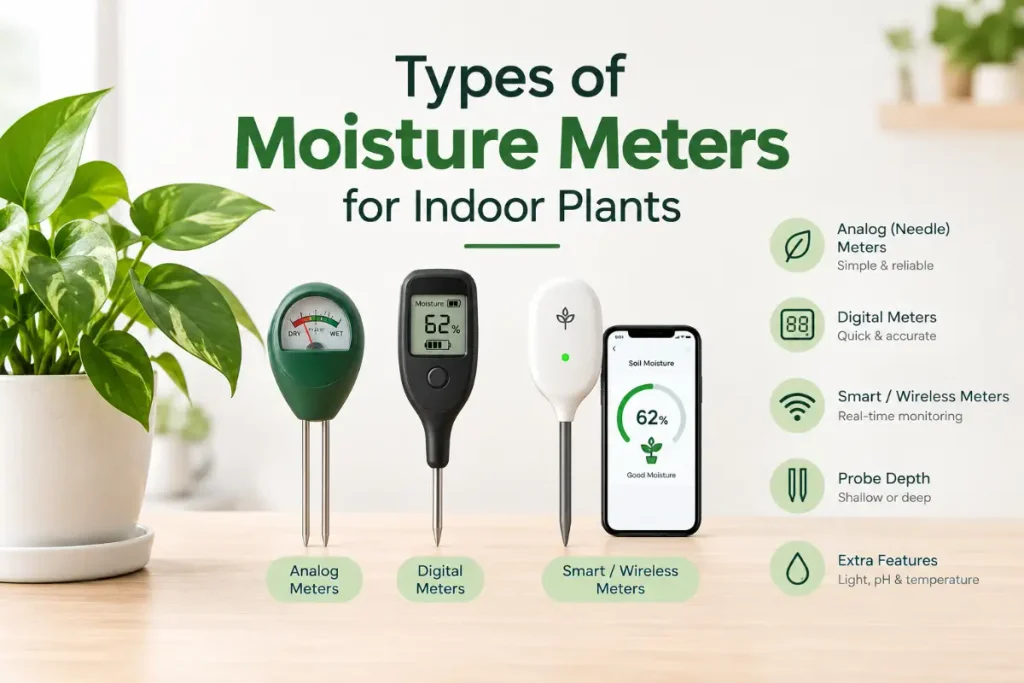
Basic moisture-only meters: A two-probe or single-probe meter that measures soil moisture and displays a reading on a numerical scale or three-zone indicator. The most common and least expensive type. Appropriate for most indoor plant watering decisions.
Three-in-one meters (moisture, pH, light): These meters include a light sensor alongside the moisture and pH measurement capability. The moisture and pH readings use the same electrical conductivity method. The light reading is a rough ambient light level measurement that is less accurate than a dedicated light meter but provides useful relative comparisons between positions. The most practical multi-function meter for indoor plant owners who want light level information alongside moisture.
Digital readout meters: A subset of basic meters with a digital numerical display rather than an analog dial. Not inherently more accurate than analog meters despite the digital display — accuracy depends on probe quality and calibration, not display type. The digital display is more precise in reading to one decimal place but this precision is only meaningful if the underlying measurement is accurate.
Soil temperature and moisture combination meters: Some meters include soil temperature measurement alongside moisture. Soil temperature is genuinely useful for seed starting and root crop growing where soil temperature significantly affects germination and root development. For general houseplant moisture monitoring, temperature measurement adds cost without significant benefit for most growers.
What to Look for When Buying
Probe length: Match the probe length to your typical pot depth. A six-inch probe is adequate for most standard houseplant pots up to ten inches deep. For large statement plants and floor pots above twelve inches deep, an eight-to-ten-inch probe reaches the critical deep root zone rather than only the upper growing medium.
Material quality: Stainless steel probes resist corrosion in consistently moist growing medium better than other metal alternatives. Check for rust or tarnishing in product reviews since corroded probes produce increasingly unreliable readings over time.
Scale and readout: A ten-point numerical scale provides more granular information than a three-zone dry/moist/wet indicator. Knowing that the reading is 3 out of 10 versus 5 out of 10 matters for plants with specific moisture preferences. Three-zone meters are simpler for beginners but provide less precision for developing nuanced watering decisions.
Battery or no battery: Most basic moisture meters do not require batteries and power from the electrical resistance measurement itself. Some digital meters require batteries. Battery-free designs are more convenient and never run out of power at an inopportune time.
Brand reputation and calibration consistency: Read reviews specifically for consistency of readings in the same soil between uses rather than just accuracy of the moisture level indicated. A meter that consistently gives different readings in the same soil at the same moisture level is not useful regardless of its absolute accuracy.
The Finger Test Versus the Moisture Meter
The honest comparison between the established finger test and a moisture meter is that both provide useful information and neither is definitively superior for all situations.
The finger test advantages: Free. Always available. Provides tactile information including temperature (moist soil feels cooler than dry soil) that a meter cannot. Works reliably in all soil types including high-perlite mixes where meters underperform. Provides information at any depth with direct contact. Not affected by fertilizer salt concentration.
The moisture meter advantages: Faster than the finger test for large collections. Provides readings at depths beyond comfortable finger reach in large pots. Useful for growers who want a quantified reading rather than a subjective tactile assessment. Accessible to people with reduced hand sensation or dexterity who find the finger test unreliable.
The practical recommendation: For most indoor plant owners with collections under twenty plants and typical pot sizes, the finger test at the appropriate depth for each plant type is the most reliable and most cost-effective soil moisture assessment method. For owners of large collections, very large pots, or beginners who want a learning tool alongside developing manual soil sensing, a mid-range moisture meter ($15 to $30) is a worthwhile addition to the plant care toolkit.
For the complete guide to the watering practices that moisture meter readings inform — including the soil check depths appropriate for different plant types and the seasonal adjustments that make any moisture monitoring method most useful, how often to water indoor plants covers the foundational framework within which moisture meter readings are most meaningfully interpreted and applied.
Common Moisture Meter Questions and Misconceptions
“My moisture meter says dry but the soil feels moist to my finger.” The meter may be reading lower than actual moisture due to low mineral/salt content in the growing medium (such as high-perlite mixes or freshly potted plants in fresh potting mix). Trust the finger test in this case. Meter readings become more reliable in established soil with normal mineral content from water and fertilizer accumulation.
“My moisture meter always reads high even though I haven’t watered recently.” High fertilizer salt concentration from recent fertilizing can elevate readings. Wait two to three days after fertilizing before taking meter readings. If high readings persist without recent fertilizing, the soil may genuinely be retaining more moisture than expected — check drainage and ensure saucers are emptied promptly after watering.
“I broke my meter after a few months.” Cheap meters are fragile. The thin probes of economy-grade meters bend and break easily. Mid-range meters with thicker, higher-quality probes last significantly longer under normal use. Store properly by removing from soil after each use and protecting the probe tips during storage.
Building a Complete Watering Toolkit
A moisture meter works best as part of a complete watering toolkit rather than as a standalone solution. Understanding how it complements other watering tools and practices helps you build the most effective overall watering system for your collection.
The core toolkit for most collections:
A quality long-spout gooseneck watering can (one to two liters) for precise water delivery to individual plants. This is the most foundational watering tool and the one that most directly affects the quality of each watering event. A moisture meter speeds up the checking routine but the watering can determines how well each plant is actually watered.
A moisture meter for collections above fifteen to twenty plants or for large deep pots where the finger test is impractical. At smaller collection sizes, the time saved by the meter over the finger test does not justify the cost for most growers.
Self-watering pots for the moisture-loving plants in the collection that most benefit from consistent moisture delivery. These eliminate the need for frequent moisture checking for the plants inside them, reducing the collection-wide moisture monitoring load.
The specialized additions:
A fine misting bottle for humidity management, foliar applications, and surface-wetting of cuttings during propagation. Not a watering tool in the primary sense but a moisture management tool that complements the watering routine for high-humidity plants.
A turkey baster or squeeze bottle for precision watering of very small pots, terrariums, and plants where even a narrow-spout watering can delivers too much volume. More precise volume control than any watering can for the smallest containers.
A rain gauge or measuring cup for growers who want to track water volume applied per plant over time. Useful for identifying which plants use more or less water than expected and for calibrating self-watering system delivery rates.
How the moisture meter fits: The moisture meter is most valuable as the checking tool that directs the watering can’s application — which plants get water today, in what order, and how urgently. It does not replace the watering can, the self-watering pot, or the finger test but adds checking speed and deep-pot accuracy to the system.
Caring for Your Moisture Meter
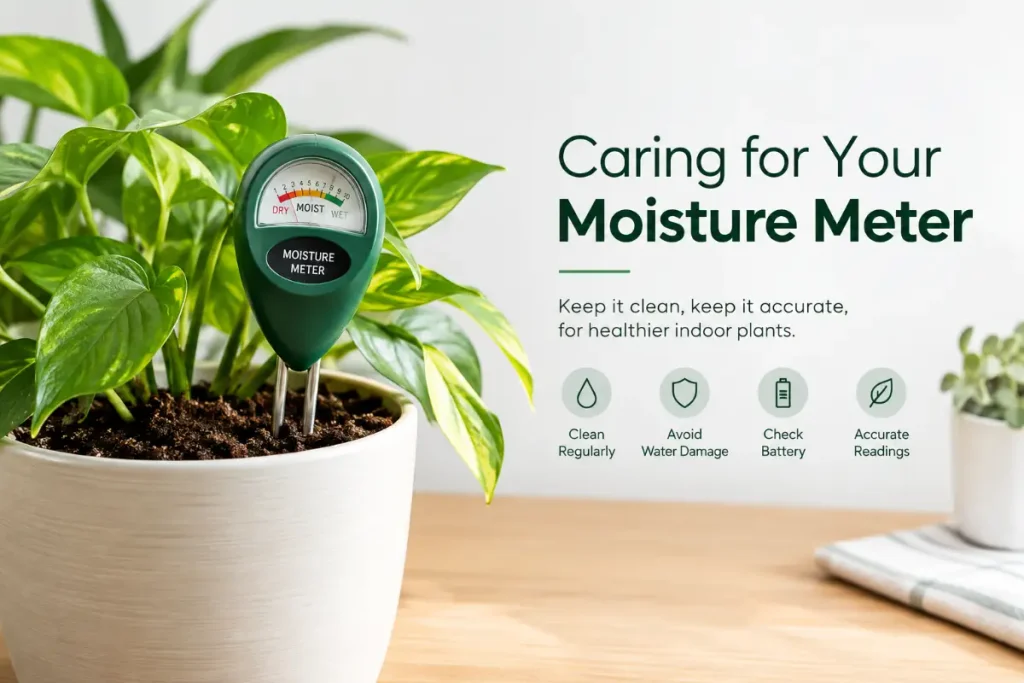
A moisture meter that is not maintained loses accuracy and durability faster than its design lifespan warrants.
After each use: Wipe the probes clean with a dry cloth or paper towel. Do not leave the meter in soil between uses since prolonged soil contact causes faster probe corrosion and inaccurate calibration drift over time. Remove and store the meter separately from your plant care toolkit in a position where the probe tips are protected from bending.
Monthly cleaning: Clean probe surfaces with a slightly damp cloth to remove mineral deposits and soil residue that accumulate on probe surfaces and affect electrical conductivity readings. For stubborn mineral deposits, a small amount of white vinegar on a cloth removes the deposits without damaging the stainless steel surface.
Storage: Store the meter with the probes protected from bending — either in the original packaging, a small fabric pouch, or with the probe tips inserted into a piece of foam. Bent probes cannot be reinserted into soil accurately and reduce reading quality.
Calibration checking: Periodically test the meter in distilled water (which should read at a specific conductivity level for your meter model) and in completely dry, clean sand (which should read at the dry end of the scale). If readings in these calibration media are significantly off from expected, the meter’s calibration has drifted and the readings for plant soil are correspondingly less reliable.
For the complete picture of how moisture meters, watering cans, self-watering pots, and vacation watering systems work together in a comprehensive indoor plant watering approach, how to water indoor plants while on vacation covers the vacation watering planning that relies on understanding current soil moisture levels — exactly the information a moisture meter provides most efficiently for large collections before a trip.
Conclusion
A moisture meter for indoor plants is a genuinely useful tool for the right grower and plant collection, but not the transformative device its marketing often suggests. For beginners developing soil moisture intuition, for large collections where individual checking is time-consuming, and for large pots where deep moisture is hard to assess manually, a mid-range moisture meter ($15 to $30) provides real value. For experienced growers with small to medium collections of standard-sized pots, the finger test at appropriate depth is simpler, more reliable in varied soil types, and free.
If you decide to purchase a moisture meter, invest in a mid-range option with stainless steel probes and a ten-point numerical scale rather than the cheapest available option. The accuracy and durability difference between economy and mid-range meters is substantial enough that the cheap option may actively mislead more than it helps.
Frequently Asked Questions
How accurate are moisture meters for indoor plants?
Mid-range moisture meters ($15 to $30) provide readings that are accurate enough for practical watering decisions in most common potting mixes under normal conditions. They are less accurate in high-perlite mixes, heavily fertilized soil, and very saline growing media where electrical conductivity is affected by mineral content independently of moisture. Economy meters ($5 to $10) have inconsistent calibration that reduces reliability significantly.
Where do you put a moisture meter in a plant pot?
Insert the probe to approximately two-thirds of the pot depth, avoiding touching the pot sides or bottom. For plants where you normally check moisture at one inch depth, the meter reading at two to three inches depth provides relevant information about root zone moisture. For plants where you check at two inches depth, inserting to four to five inches provides information about the lower root zone where drought-tolerant plants concentrate their roots.
Do I need a moisture meter for my indoor plants?
Not necessarily. The finger test at the appropriate depth for your plant type (half inch for moisture-loving plants, one inch for most tropicals, two inches for drought-tolerant plants) is free, reliable, and sufficient for most indoor plant collections. A moisture meter adds value for beginners building soil moisture intuition, large collections where checking speed matters, and very large pots where deep moisture is hard to assess manually.
Why does my moisture meter give different readings in the same pot?
Moisture distribution is not uniform throughout a pot. The soil surface is drier than deeper layers. The center of the pot may be drier than the edges or vice versa depending on where water was applied. Different probe depths and locations within the same pot legitimately produce different readings. Take multiple readings at different depths and locations to build a more complete picture of the pot’s overall moisture condition.
Can moisture meters damage plant roots?
Inserting the probe carefully to the appropriate depth does not cause significant root damage in most cases. The thin probe displaces roots rather than cutting them when inserted slowly and carefully. Avoid forcing the probe into compact or root-bound soil where greater resistance requires force that can damage roots. In very root-bound pots, limit probe insertions to one or two per watering check.
What is a good reading on a moisture meter for watering?
For moisture-loving plants (peace lily, ferns, calathea), water when the meter reads 2 to 3 on a 1 to 10 scale. For most common tropical houseplants (pothos, monstera, philodendron), water at 2 to 4. For drought-tolerant plants (cacti, succulents, snake plant), water only when the meter reads 1. These are starting points that should be calibrated to your specific meter, soil type, and plant response over several watering cycles.
Pingback: Best Watering Tools for Indoor Plants: 8 Must-Have Picks (2026) - Plant Quill