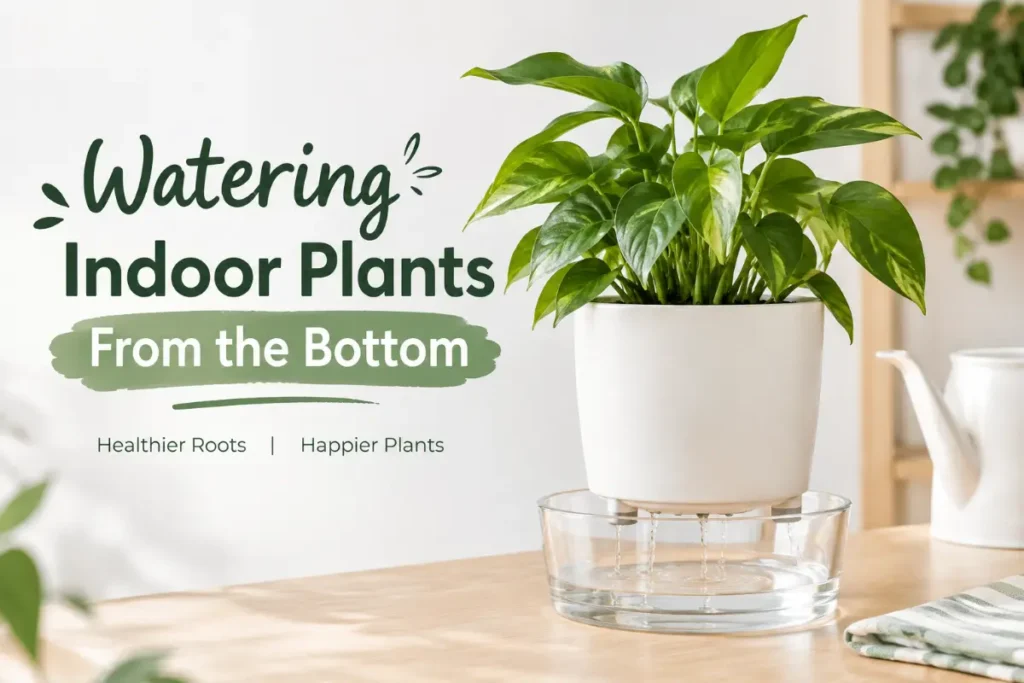
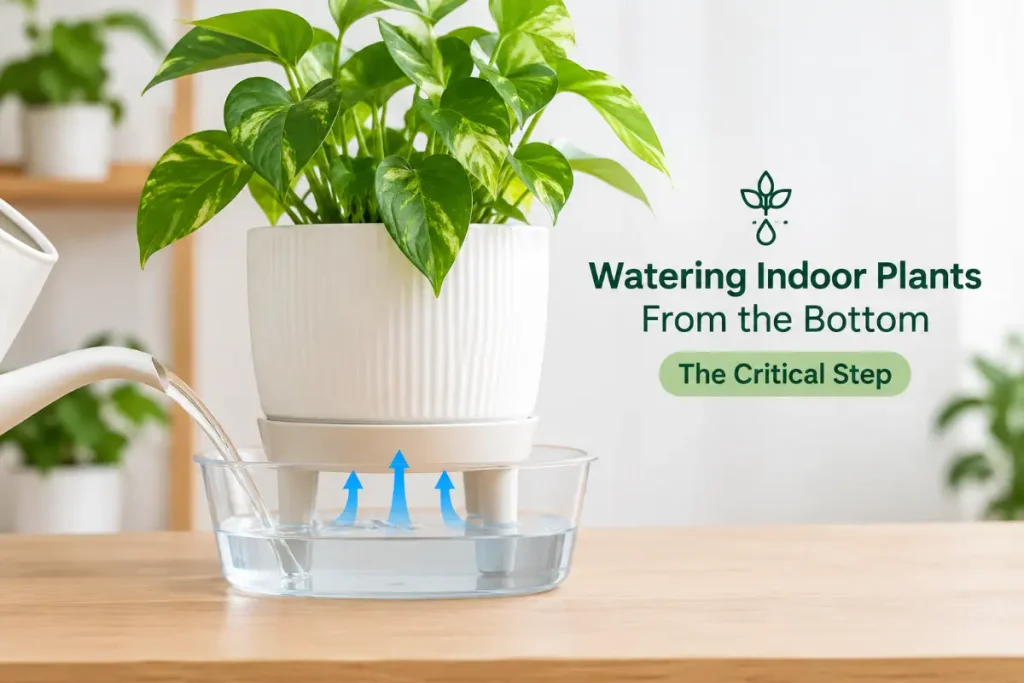
Watering indoor plants from the bottom is one of those care practices that experienced plant owners swear by for specific plants and dismiss entirely for others. The technique involves placing a pot in a shallow tray of water and allowing the soil to absorb moisture upward through drainage holes rather than pouring water from above. For the right plants in the right conditions, bottom watering produces noticeably better results than top watering. For others it is unnecessary effort that provides no meaningful benefit.
Understanding which category your plants fall into and how to bottom water correctly — including the one critical step most guides omit — produces the right practice for the right situation.
Quick Answer
Bottom watering works best for plants with sensitive crowns (African violets, cyclamen), plants where top watering tends to create dry pockets in the root ball (root-bound plants), seedlings and microgreens where surface disturbance is a problem, and plants in terracotta pots where top watering flows around the outside without fully penetrating a dried root ball. The critical step most guides skip is occasional top watering to flush accumulated mineral salts that bottom watering concentrates in the soil over time.
How Bottom Watering Works
Bottom watering exploits capillary action — the ability of water to move through small spaces against gravity due to the cohesive and adhesive properties of water molecules.
When a pot with drainage holes is placed in a shallow tray of water, the water contacts the soil through the holes at the pot base. The soil draws water upward through capillary action, moving moisture from the wet lower zone toward the drier upper zone. This upward movement continues until the soil moisture throughout the pot reaches equilibrium or until the water in the tray is exhausted.
The process is significantly slower than top watering — a four-inch pot may need twenty to thirty minutes to fully saturate in a water tray, while top watering the same pot takes thirty seconds. This slower pace is both an advantage and a limitation depending on the situation.
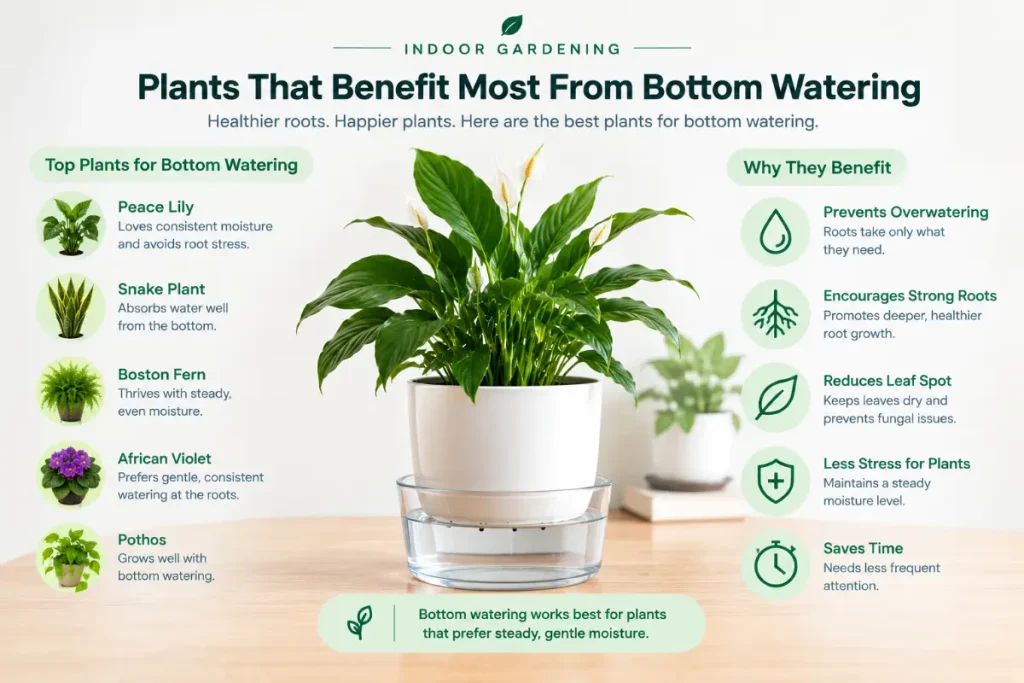
Plants That Benefit Most From Bottom Watering
African violets: The clearest case for bottom watering. Water contact with African violet leaves causes permanent brown spots due to the way water interacts with the leaf’s sensitive surface cells. Top watering African violets risks splashing water on leaves even with careful technique. Bottom watering eliminates leaf contact entirely, making it the standard watering method for this plant. African violets are the plant most commonly cited in the context of bottom watering for good reason.
Cyclamen: Like African violets, cyclamen develops rot problems when water contacts the central crown. Water in the crown encourages the fungal rot that is the most common cause of cyclamen death indoors. Bottom watering ensures the crown remains dry while roots receive adequate moisture. For the complete guide to cyclamen indoor care, care for cyclamen plant indoors covers every care step including this watering consideration.
Cacti and succulents: These plants often develop a hydrophobic (water-repelling) center to their root ball when they have been in a pot for extended periods without thorough saturation. Top watering a severely dried cactus or succulent often results in water running down the inside wall of the pot and out the drainage holes without penetrating the dried root ball center. Bottom watering allows slower, more complete penetration of the dried root ball — particularly effective for the deep bottom soaking used to rehydrate severely drought-stressed succulents.
Seedlings and microgreens: Surface disturbance from top watering displaces tiny seeds, knocks over fragile seedlings, and creates divots in seed starting medium that affect germination and early growth. Bottom watering through a tray provides moisture to the growing medium without any surface contact, making it the standard approach for seed starting and microgreen growing.
Root-bound plants: Plants that have become heavily root-bound (roots tightly packed throughout the pot with little soil between them) are notoriously difficult to water from the top because water follows root surfaces rather than penetrating the dense root mass. Bottom watering allows capillary action to draw water through the root mass more effectively than top watering can.
Plants that have developed hydrophobic soil: When potting mix has dried out severely and repeatedly, the organic matter becomes hydrophobic. Top watering runs down the gap between soil and pot without penetrating the dry root zone. Bottom watering bypasses the surface hydrophobicity by starting moisture movement from below where the soil-to-drainage-hole contact allows water to begin the capillary process before the hydrophobic surface can redirect it.
How to Bottom Water Correctly
Choose an appropriate tray or basin: The water container should be large enough to hold the pot with two to four inches of clearance on all sides. A shallow tray, a baking dish, a plastic storage bin, or a kitchen sink work well depending on pot size.
Add adequate water: Fill the tray with one to two inches of room temperature water. The water level should be well below the top of the pot — the drainage holes need to contact the water but water should not enter the pot from the top.
Place the pot and wait: Set the pot in the water. Allow twenty to thirty minutes for a small pot (up to four inches), thirty to forty-five minutes for a medium pot (six to eight inches), and forty-five to sixty minutes for a larger pot (ten to twelve inches). The pot is fully saturated when the soil surface feels moist and the pot feels heavier than when you placed it.
Check soil surface: After the waiting period, check the soil surface. If it feels moist, the saturation is complete. If still dry, return to the water for an additional ten to fifteen minutes.
Remove and drain: Remove the pot from the tray and place on a draining rack or in a sink for thirty minutes to allow excess water to drain from the drainage holes before returning to the display position or saucer.
Empty the tray: Discard the remaining water from the tray rather than reusing it for subsequent plants. Reused tray water accumulates mineral deposits, algae, and potentially disease organisms from one pot’s drainage.
The Critical Step: Occasional Top Watering to Flush Mineral Salts
This is the most commonly omitted aspect of bottom watering and the one that causes the most long-term problems for exclusive bottom waterers.
The salt accumulation problem: Top watering flushes mineral salts and fertilizer residues downward through the soil and out the drainage holes with each watering. Bottom watering draws water upward but leaves minerals behind as the water evaporates from the soil surface — the same process that creates the white mineral crust visible on pot rims and soil surfaces in plants that receive hard tap water.
Over months of exclusive bottom watering, mineral salt concentration builds progressively in the upper soil layers. The visible white crust on the soil surface is the accumulation of these deposits. At high concentrations, these salts create an osmotic environment that makes it difficult for roots to absorb water (osmotic stress) and burns root tips directly. Plants that have been exclusively bottom-watered for six to twelve months without flushing often show the progressive yellowing and tip browning associated with salt toxicity.
The flush schedule: Every four to six waterings (approximately every one to two months for plants watered weekly), water from the top with two to three times the normal water volume, allowing it to flow freely from the drainage holes. This top-down flush carries the accumulated surface mineral deposits downward and out of the pot, resetting the soil mineral balance.
For African violets and cyclamen: Top flush carefully to avoid wetting the crown or leaves. Water around the edge of the pot surface rather than over the center crown. A narrow-spout watering can aimed between the pot rim and the outer leaves delivers the flush without crown contact.
Bottom Watering Versus Top Watering: Which Is Better?
The honest answer is that neither is universally better — each has advantages in specific situations.
Top watering advantages: Faster. Flushes mineral salts naturally with each watering. Provides immediate feedback that watering is thorough when water appears at drainage holes. More appropriate for large pots where bottom saturation would require an impractically large tray or very long soak times.
Bottom watering advantages: No crown or leaf wetting for sensitive plants. More complete penetration of hydrophobic or root-bound root balls. Less surface disturbance for seedlings and microgreens. Better for plants in environments where top watering tends to pool on the soil surface before absorbing.
The combined approach: Most experienced plant owners use both methods contextually — bottom watering for plants where it provides specific benefits (African violets, seedlings, severely dried plants) and top watering for the majority of their collection where it is faster and provides the natural salt flushing that prevents mineral accumulation.
Common Bottom Watering Mistakes
Leaving pots in water too long: Leaving pots submerged in a tray of water for several hours or overnight creates the same overwatering conditions as any other form of excessive moisture. Thirty to sixty minutes is adequate for most pots. Remove and drain after the appropriate time regardless of whether the soil surface has fully moistened — return for a second soak if needed rather than leaving in water for extended periods.
Using cold water: Cold water creates temperature shock in tropical plant roots. Always use room temperature water for bottom watering. Fill the tray from the tap and allow it to sit for thirty minutes if cold tap water is all that is available.
Skipping the top flush: The mineral accumulation described above is the most common long-term problem with exclusive bottom watering. Schedule a top flush every four to six bottom waterings.
Using the same tray water for multiple plants: Reused tray water accumulates mineral deposits, algae, and potentially disease organisms from drainage. Use fresh water for each plant or empty and refill between uses.
Bottom watering drought-tolerant plants that need full drying cycles: Bottom watering cacti and succulents works well for the deep rehydration of severely dried plants but is not appropriate as the routine watering method for these plants since capillary uptake can maintain more moisture in the lower root zone than these plants want between waterings. Use bottom watering for initial deep saturation and allow to dry fully before the next watering.
For the complete guide to choosing between bottom and top watering based on plant type and the specific signs that indicate a plant would benefit from one approach over the other, how often to water indoor plants covers the full context of indoor plant watering including when and why different techniques produce different results for different plant categories.
Bottom Watering for Specific Plant Collections
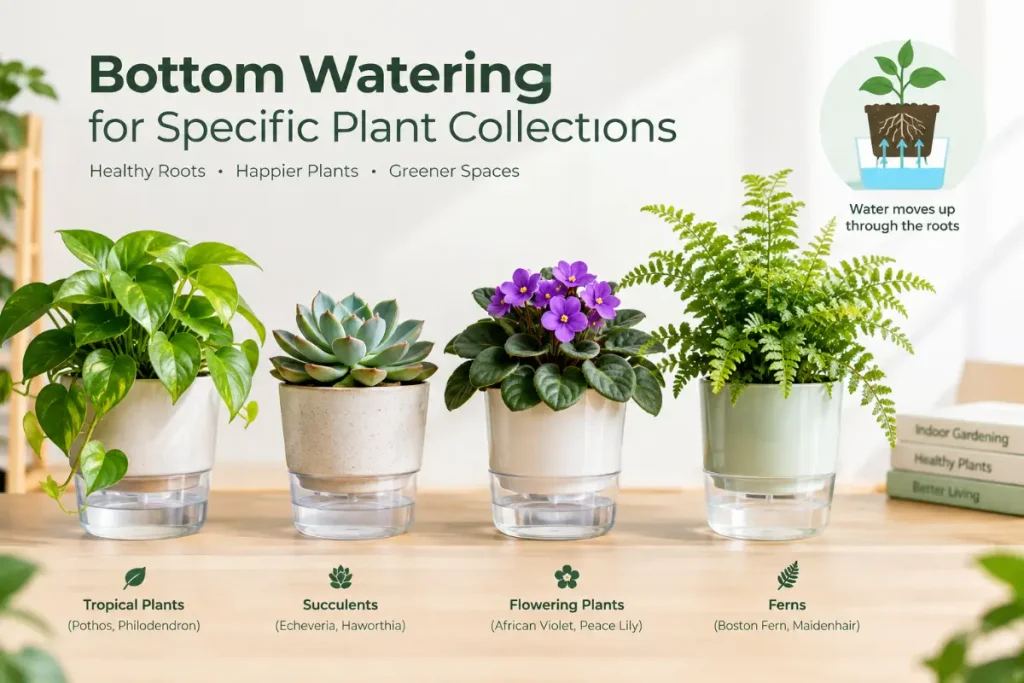
For African violet collections: Bottom watering is the standard method throughout the productive life of the plant. Use African violet-specific wicking pots that maintain continuous bottom moisture through a wick from a separate reservoir, or schedule weekly thirty-minute tray soaks. Flush from the top every six to eight weeks to manage salt accumulation.
For seed starting and microgreen operations: Use bottom trays specifically designed for seed starting where the flat with cells sits above a solid tray of water. This setup is commercially standard for good reason — it provides consistent moisture to all cells simultaneously without surface disturbance that would affect germination rates and seedling uniformity.
For cactus and succulent collections: Use bottom soaking for initial watering after a complete drying cycle. Place the pot in a tray of water for thirty to forty-five minutes, then remove and drain completely. Allow to dry fully to two to three inches depth before the next bottom soak. This deep-then-dry approach mimics the occasional heavy rainfall followed by extended drought of the plants’ natural desert habitat.
For herb collections: Mediterranean herbs in terracotta pots benefit from bottom watering when the soil has dried so thoroughly that top watering runs off rather than penetrating. A periodic bottom soak of twenty to thirty minutes restores even moisture distribution through the dried root ball. Return to top watering as the routine method once the root ball is adequately rehydrated.
The Science Behind Capillary Action in Bottom Watering
Understanding the physics of capillary action more deeply helps explain why bottom watering works the way it does and why certain conditions make it more or less effective.
Capillary tension and pore size: Capillary action is stronger in smaller pores than in larger ones. Fine-textured potting mix with small particles has stronger capillary action than coarse mixes with large particles. This means bottom watering is more effective in standard potting mix than in very coarse mixes like straight perlite or large-bark orchid medium. For orchids in chunky bark, bottom watering is less effective than for plants in standard potting mix because the large pore spaces between bark chunks have low capillary tension.
The saturation front: As water moves upward by capillary action, it creates a saturation front — a boundary between wet soil below and dry soil above. This front moves upward over time, eventually reaching the soil surface. The time to complete saturation depends on soil texture, pot depth, and how dry the soil was to begin with. Severely dried soil has lower initial capillary tension and may absorb water more slowly at first before the capillary movement accelerates once initial hydration is established.
Water quality and capillary action: Hard water with high mineral content has slightly different surface tension characteristics than pure water. In practice, the difference in capillary action between tap water and distilled water is negligible for bottom watering purposes. The mineral content matters more for accumulation effects over time than for the immediate efficiency of the capillary process.
Temperature and capillary action: Warmer water moves more readily through soil by capillary action than cold water because warmer water has lower viscosity (it flows more easily). This is another reason to use room temperature rather than cold tap water for bottom watering — it improves the speed and completeness of capillary saturation alongside reducing root temperature shock.
Wicking Systems: Bottom Watering Automation
For plants that benefit most from bottom watering, wicking systems automate the process without requiring manual tray soaking for every watering event.
How plant wicks work: A cotton or nylon rope connects a water reservoir positioned alongside or below the pot to the growing medium inside the pot through the drainage holes. Water moves continuously from the reservoir through the wick into the soil by the same capillary action as tray bottom watering, at approximately the rate the plant uses it. The reservoir is refilled every one to two weeks rather than requiring active watering of each plant.
Best applications for wicking systems: African violets benefit particularly well from continuous wicking since they prefer consistently moist soil and need bottom-only water delivery. Indoor herb gardens in dedicated herb planters with built-in wicking chambers are commercially available and provide the consistent moisture that basil and other moisture-loving herbs need without daily watering attention.
DIY wicking versus commercial: DIY wicking using cotton rope or yarn is inexpensive and effective. Commercial self-watering pots use wicking internally as their standard delivery mechanism. Both work through the same capillary principle. DIY systems require more setup and assessment to ensure the wick material and reservoir positioning are correct. Commercial systems provide engineered solutions with consistent performance at higher cost.
For the complete guide to commercial self-watering pot systems that use wicking as their primary moisture delivery mechanism, self-watering pots for indoor plants covers every aspect of self-watering pot selection and use, including how their internal wicking compares to the manual bottom watering described in this guide.
Conclusion
Watering indoor plants from the bottom is a genuinely useful technique for specific plants and situations rather than a universal improvement over top watering. African violets and cyclamen need it to protect sensitive crowns. Seedlings and microgreens benefit from the absence of surface disturbance. Severely dried plants or root-bound plants benefit from the more complete penetration that capillary action provides.
For most other common houseplants, top watering is faster, simpler, and provides the natural salt flushing that bottom watering requires supplemental top watering to achieve. The most practical approach combines bottom watering where it provides clear specific benefits with top watering as the routine method for the majority of a collection, and ensures that any plant receiving regular bottom watering is periodically top-flushed to prevent the mineral accumulation that exclusive bottom watering causes.
Frequently Asked Questions
Is bottom watering better than top watering for indoor plants?
Bottom watering is better for specific plants and situations: African violets and cyclamen where crown wetting causes problems, seedlings where surface disturbance is a concern, and severely dried plants where top watering does not penetrate the hydrophobic root ball. For most common houseplants, top watering is equally effective, faster, and provides natural mineral salt flushing that bottom watering does not.
How long should I leave my plant in water for bottom watering?
Twenty to thirty minutes for small pots up to four inches. Thirty to forty-five minutes for medium pots of six to eight inches. Forty-five to sixty minutes for larger pots of ten to twelve inches. Check the soil surface after the minimum time — if moist, remove and drain. If still dry, return for an additional ten to fifteen minutes. Never leave a pot soaking overnight.
Does bottom watering prevent overwatering?
Bottom watering reduces the risk of surface overwatering where water pools before draining, but does not eliminate overwatering risk entirely. Leaving pots in water too long or bottom watering too frequently creates the same chronically wet root conditions as top overwatering. The watering frequency principles — checking soil moisture before each watering — apply equally to bottom watering as to top watering.
Why does my soil have a white crust after bottom watering?
White crust on soil after bottom watering is mineral salt accumulation from hard tap water. These minerals are drawn upward with the water and left behind as the water evaporates from the soil surface. Flush the soil from the top with two to three times the normal water volume every four to six waterings to leach these accumulated minerals out through the drainage holes.
Can I bottom water succulents?
Yes, for deep rehydration after a complete drying cycle. Place the pot in two inches of water for thirty to forty-five minutes, then remove and drain completely. Allow to dry fully to two to three inches before the next watering. This deep-then-dry cycle mimics natural rainfall patterns. Do not use bottom watering as continuous routine maintenance for succulents since capillary action may maintain more moisture in the lower root zone than these plants tolerate between dry periods.
Which plants should never be bottom watered?
No plant is permanently harmed by occasional bottom watering, but plants that need their entire root zone to dry between waterings — cacti, succulents, Mediterranean herbs, snake plant — should not rely on bottom watering as their primary routine method since capillary moisture can maintain wet conditions at the pot base longer than these plants prefer. Use bottom watering for these plants only when severe drying requires deep rehydration, then return to top watering as the standard method.