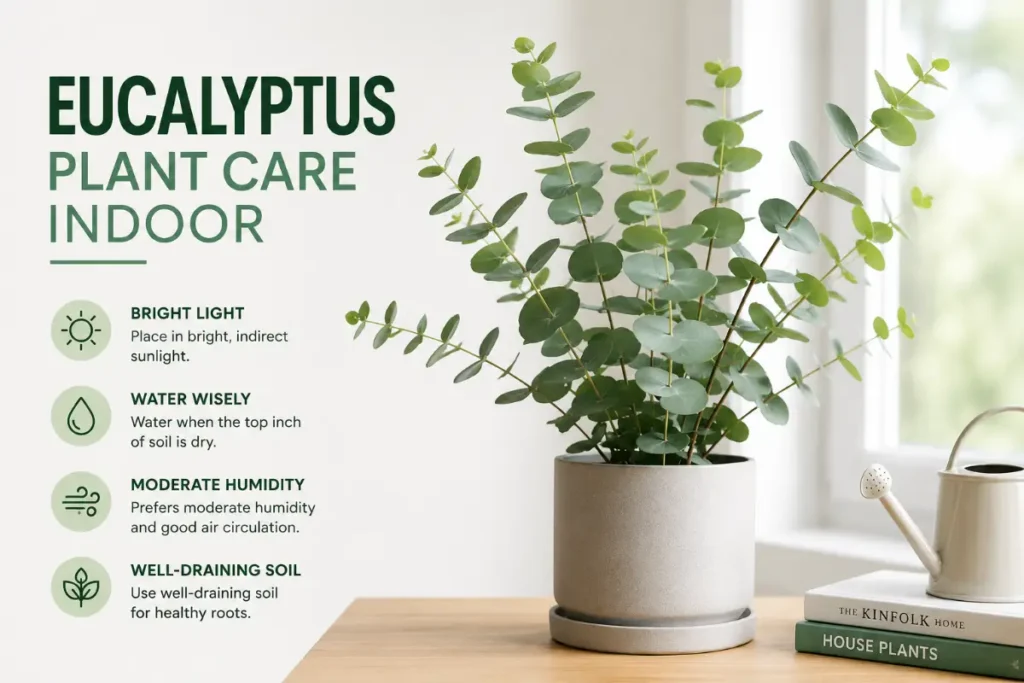
Eucalyptus plant care indoor requires an honest conversation before the care steps begin. Eucalyptus is one of the most searched indoor plant topics and also one of the most commonly purchased plants that fails quickly when people discover how specific its needs are. Most eucalyptus species grow into large outdoor trees in warm climates and are not genuinely suited to permanent indoor growing in most homes. But a handful of varieties can be grown indoors successfully, and cut eucalyptus branches can be maintained fresh for weeks with the right approach.
Understanding which category your situation falls into, true indoor cultivation versus fresh branch display, saves significant frustration and sets realistic expectations for what eucalyptus can deliver as an indoor plant.
Quick Answer
Eucalyptus plant care indoor requires maximum available direct sunlight for at least six hours daily, fast-draining soil similar to cactus mix, watering only when soil is completely dry, temperatures between 50 and 80 degrees Fahrenheit, good air circulation, very light fertilizing, and realistic expectations since most eucalyptus species grow quickly into large plants that outgrow indoor spaces within one to two years. Silver dollar eucalyptus (Eucalyptus cinerea) and lemon eucalyptus (Corymbia citriodora) are the most commonly grown indoor varieties. Cut branches in water with a few drops of glycerin last three to four weeks.
The Honest Truth About Growing Eucalyptus Indoors
Eucalyptus belongs to a genus of over 700 species, nearly all of which are large to very large trees native to Australia and nearby regions where they grow in full sun, nutrient-poor, well-draining soil with good air movement. The silver dollar eucalyptus (Eucalyptus cinerea) most commonly sold as a potted indoor plant in the US grows to 25 to 60 feet outdoors in appropriate climates and to six to eight feet indoors within two to three years with good care.
This means indoor eucalyptus growing is fundamentally a temporary endeavor for most people. You can grow eucalyptus in a pot indoors for one to three years before it outgrows the space, at which point it either transitions to an outdoor garden (in USDA zones 8 to 11 where it survives winters) or is replaced with a new small plant.
The other common use of eucalyptus indoors, displaying cut branches in water or dried, is often more practical and produces the aromatic, aesthetic result most people are actually seeking when they search for indoor eucalyptus care.
This guide covers both: care for potted eucalyptus plants during their indoor tenure and maintaining cut eucalyptus branches as long as possible indoors.
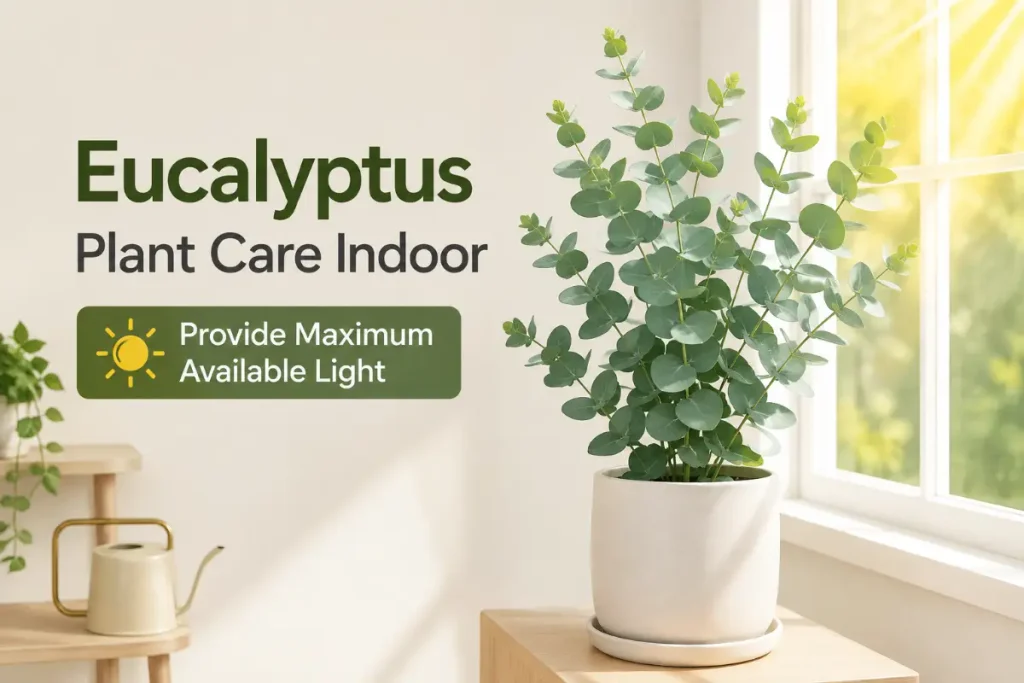
Step 1: Provide Maximum Available Light
Eucalyptus is among the most light-hungry plants commonly sold as indoor candidates. It evolved in the intense sunshine of the Australian bush and requires more direct sun than almost any other commonly grown indoor plant.
What it needs: Direct sunlight for six or more hours daily through a south-facing window. More is better. A sunroom, south-facing conservatory, or greenhouse is the ideal indoor environment. A south-facing window that receives direct sun from late morning through afternoon is the minimum viable position.
What happens in insufficient light: Eucalyptus in inadequate light grows tall, thin, and weak with progressively longer spaces between leaves on the stem, a growth pattern called etiolation. The plant stretches desperately toward any available light and produces leaves much smaller and less fragrant than those grown in adequate light. In insufficient light, eucalyptus declines slowly but consistently.
Grow lights: A very high-output LED grow light positioned close to the plant and running fourteen to sixteen hours daily can supplement natural light in homes without adequate south-facing window exposure. The light output needed for eucalyptus is higher than for most other indoor plants and a standard grow light may not be sufficient without supplementation from natural light.
Step 2: Use Fast-Draining Soil
Eucalyptus evolved in nutrient-poor, fast-draining Australian soils that dry completely between rainfall events. Standard potting mix holds far too much moisture for eucalyptus roots which are highly susceptible to root rot in wet conditions.
The right mix: Commercial cactus and succulent potting mix is the most convenient option and provides appropriate drainage without modification. Alternatively, mix 50% standard potting mix with 50% coarse perlite or coarse sand for a similar drainage profile.
Pot selection: Always use a pot with drainage holes. Terracotta pots dry faster than plastic or glazed ceramic due to their porous walls, which suits eucalyptus root systems well. Choose a pot that is appropriately sized for the current root ball without excessive extra soil volume that stays wet.
For the complete guide to building fast-draining soil mixes for drought-tolerant plants, soil mixture for indoor plants covers every component with guidance specific to plants with low moisture tolerance root systems similar to eucalyptus.
Step 3: Water Deeply But Infrequently
The watering approach for eucalyptus is the opposite of what works for moisture-loving tropical houseplants. Allow the soil to dry completely before watering, then water thoroughly.
The correct check: Push your finger two to three inches into the soil. Water only when that depth feels completely dry. In a bright sunny position this might mean watering every ten to fourteen days in summer. In lower light or winter, every two to three weeks or longer.
The thorough-then-dry cycle: When you water, water thoroughly until it flows from the drainage holes ensuring the entire root zone receives moisture. Then allow the soil to dry completely before the next watering. This replicates the natural rainfall pattern eucalyptus evolved alongside.
Signs of overwatering: Yellowing leaves, soft or mushy stem base near the soil, a musty smell from the pot. Root rot in eucalyptus progresses quickly and is often fatal once above-ground symptoms appear.
Signs of underwatering: Leaves that become slightly soft or lose their upright orientation. Brown dried leaf edges. The plant recovers quickly from mild underwatering with thorough watering but chronic severe drought causes permanent leaf loss.
Step 4: Maintain Appropriate Temperature
Eucalyptus handles a wider temperature range than most tropical houseplants but has specific limitations worth knowing.
Ideal range: 50 to 80 degrees Fahrenheit suits indoor eucalyptus growth well. Growth is most active in the upper portion of this range.
Cold tolerance: Silver dollar eucalyptus tolerates temperatures down to approximately 25 to 28 degrees Fahrenheit briefly, making it one of the hardier plants in this guide and suitable for outdoor placement in USDA zones 8 through 11. Indoors, it handles cool rooms and temperatures near windows in winter without significant damage in most cases.
Heat sensitivity: Eucalyptus handles heat well provided humidity is not extremely low and airflow is adequate. In very warm, still indoor air above 85 degrees, adequate watering becomes more critical since moisture loss through transpiration increases significantly.
Step 5: Ensure Good Air Circulation
In its native Australian habitat, eucalyptus grows in open, often breezy conditions with excellent natural air circulation. Indoors, stagnant air creates conditions for the powdery mildew and botrytis that occasionally affect eucalyptus in enclosed spaces.
Practical approach: Space eucalyptus away from walls and other plants so air circulates freely around all surfaces. Run a small fan nearby on low setting for several hours daily during warm months when windows are closed. Open windows periodically in mild weather to introduce fresh moving air.
Signs of air circulation problems: White powdery coating on leaves indicating powdery mildew. Soft, grey moldy patches on stems or leaves indicating botrytis. Both are preventable with adequate airflow and respond to neem oil spray treatment once established.
Step 6: Fertilize Lightly
Eucalyptus evolved in nutrient-poor Australian soils and does not need or benefit from the frequent heavy fertilizing appropriate for nutrient-hungry tropical houseplants. Heavy fertilizing drives soft, weak growth more susceptible to pest and disease problems.
What works: A balanced liquid fertilizer at quarter to half the label rate every four to six weeks through spring and summer only. This is significantly less frequent and less concentrated than most houseplant fertilizer recommendations and reflects eucalyptus’s adaptation to lean soil conditions.
What to avoid: High-nitrogen fertilizers at full rate. Monthly or biweekly fertilizing at standard rates. Both produce the soft, weak growth that makes eucalyptus more vulnerable to the problems it is susceptible to indoors.
Fall and winter: Stop fertilizing entirely when growth slows. Eucalyptus does not need supplemental nutrition during its slower growth period and salt accumulation from continued fertilizing in low-light winter conditions creates root zone problems.
Step 7: Plan for the Plant’s Growth and Transition
This step is unique to eucalyptus among the plants in this guide because it involves planning for the plant’s inevitable transition out of indoor space rather than planning for long-term indoor cultivation.
Growth rate: Silver dollar eucalyptus in good indoor conditions grows one to two feet per year. A plant purchased at two feet will reach four to five feet within two years. At six feet indoors the plant typically becomes too large for standard ceiling heights and challenging to manage in pot culture.
Outdoor transition in warm climates: In USDA zones 8 through 11 (much of California, the Gulf Coast, the Pacific Northwest coast, and Hawaii), silver dollar eucalyptus planted outdoors after indoor cultivation becomes a long-lived, spectacular garden tree. The transition from indoor pot to outdoor garden is the most positive long-term outcome for most indoor eucalyptus plants.
Annual replacement strategy: For indoor eucalyptus growers outside warm climate zones, treating the plant as a one to two year specimen that is replaced with a new small plant when it outgrows the space is the most practical approach. The fragrance, visual impact, and satisfying growth of a young indoor eucalyptus are fully available during this period even if the plant is not kept permanently.
Pruning for size management: Aggressive pruning keeps eucalyptus smaller than it would grow unpruned. Cut stems back by one-third to one-half to maintain a manageable size. Eucalyptus responds well to pruning and regenerates vigorously from the cut points. Pruned stems are fragrant and can be used as cut material for displays elsewhere in the home.
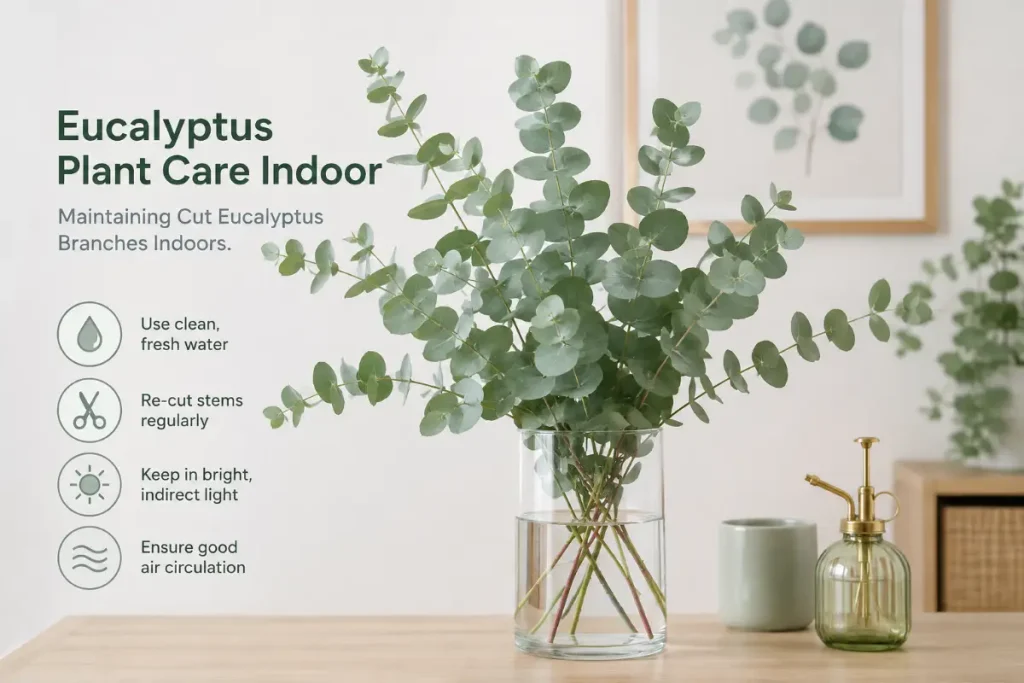
Maintaining Cut Eucalyptus Branches Indoors
For many people, the most practical and satisfying approach to indoor eucalyptus is maintaining cut branches as a long-lasting aromatic display rather than growing a potted plant. Cut eucalyptus properly maintained lasts three to six weeks in water and indefinitely when dried.
Fresh cut branches in water: Cut stems at a forty-five degree angle to maximize water uptake surface. Remove any leaves that would be submerged below the water line since these decompose and foul the water quickly. Add a few drops of glycerin to the water, which the stems absorb and distribute through the leaves, significantly extending their freshness. Change the water every three to four days and recut stems by half an inch at each water change. In a cool room away from direct sun and heating vents, fresh eucalyptus displays last three to five weeks.
Shower method: Hanging a bundle of fresh eucalyptus from the showerhead creates a steam-activated aromatherapy experience since the essential oils in eucalyptus leaves release dramatically in the warm humid steam of a shower. Bundles last two to three weeks before the leaves begin to dry and lose effectiveness.
Dried eucalyptus: Fresh eucalyptus left in a vase without water dries in place over two to three weeks maintaining its shape and silver-green color as a permanent dried display. Alternatively, hang bundles upside down in a warm airy location for two weeks for a more controlled drying process. Dried eucalyptus maintains its visual appeal and a reduced level of fragrance for months to years.
The Aromatic Benefits of Indoor Eucalyptus
Beyond its visual appeal, eucalyptus is one of the most actively aromatic plants you can bring indoors, and the compounds responsible for its distinctive scent have documented properties worth knowing.
Eucalyptus oil contains high concentrations of 1,8-cineole (eucalyptol), a compound with well-documented antimicrobial, anti-inflammatory, and decongestant properties. The passive release of eucalyptol from eucalyptus leaves and stems in an indoor space creates a naturally aromatic environment that many people find beneficial for respiratory comfort particularly during cold and allergy seasons.
The intensity of this aromatic benefit is highest from fresh cut branches, moderate from living potted plants in good growing conditions, and lower but still present from properly dried branches. For anyone interested in the air quality benefits of indoor plants more broadly, peace lily indoor plant benefits covers the documented indoor air quality research on houseplants that complements the aromatic air quality contribution of eucalyptus.
Pests on Indoor Eucalyptus
Eucalyptus grown indoors encounters fewer pest problems than many tropical houseplants, partly because the essential oils in its leaves have natural insect-repelling properties. However, a few specific pests do occasionally affect indoor eucalyptus in weakened or stressed conditions.
Spider mites appear in warm, dry indoor conditions particularly on plants in insufficient light or with inadequate airflow. The stippling pattern of mite feeding is visible on eucalyptus leaves as small pale dots and fine webbing appears between leaf axils and stems. Neem oil spray every seven days for three weeks handles active infestations. Maintaining good airflow prevents establishment in most cases.
Scale insects occasionally appear on eucalyptus stems in their characteristic brown or tan shell form. Remove manually with rubbing alcohol on a cotton swab and follow with neem oil spray. Scale on eucalyptus is less common than on some other indoor plants, partly because the aromatic oils in the bark and stems create a less hospitable surface than many other plants.
The natural pest-repellent properties of eucalyptus are one of the reasons it is sometimes recommended as a companion plant near other more pest-susceptible indoor plants. The aromatic compounds released continuously from eucalyptus foliage deter some soft-bodied insects from settling on nearby plants. For the complete guide to how aromatic plants including eucalyptus and rosemary function as pest deterrents in indoor plant collections, indoor plants that repel bugs covers the specific compounds responsible and how to position these plants for maximum deterrent effect.
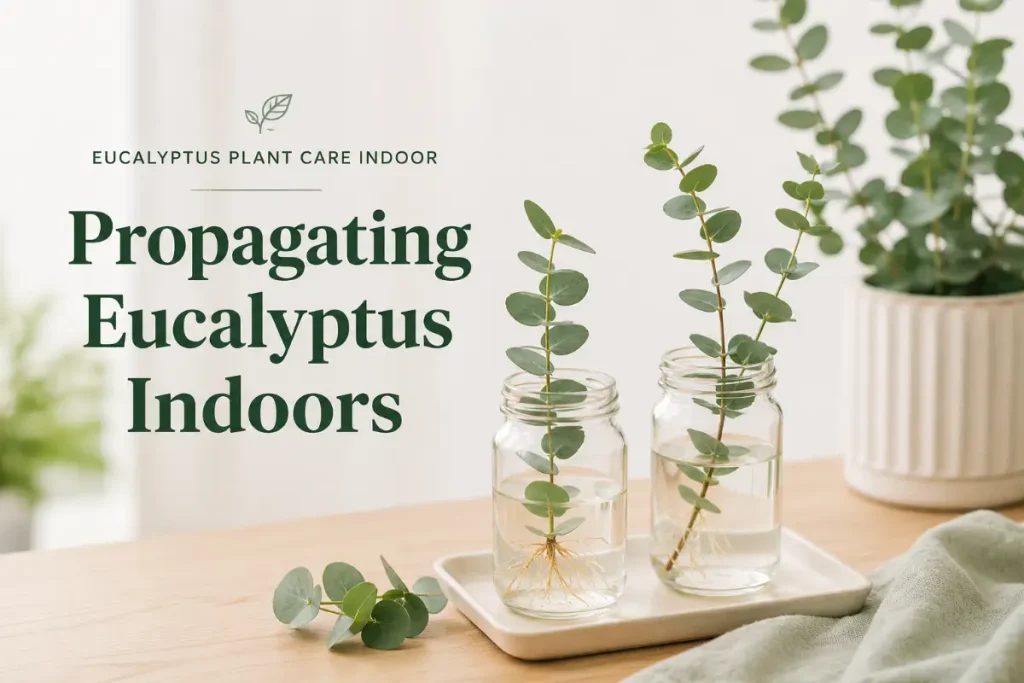
Propagating Eucalyptus Indoors
Eucalyptus can be propagated from stem cuttings taken during the active growing season, though success rates are more variable than with many other commonly propagated houseplants.
Stem cuttings: Cut four to six inch sections of semi-hardwood stem (growth that has started to firm up but is not yet fully woody) with clean sharp pruning shears. Remove leaves from the bottom two inches. Dip the cut end in rooting hormone powder or gel. Place in a mix of 50% perlite and 50% coarse sand kept barely moist. Cover with a clear plastic bag or humidity dome to maintain high humidity around the cutting. Rooting takes four to eight weeks and success rates vary from 30 to 70% depending on conditions.
From seed: Eucalyptus seeds germinate readily in moist seed starting mix and are the most reliable propagation method for starting new indoor plants. Sow seeds on the surface of moist seed starting mix, barely covering them since they need light to germinate. Germination occurs within two to three weeks at temperatures of 65 to 75 degrees. Seedlings grow rapidly once established and can be potted individually when they develop their first true leaves.
Starting new plants from seed annually is the most practical strategy for indoor eucalyptus growers who want to maintain a continuously attractive plant of manageable size without the challenges of keeping the same plant through its progression toward tree size.
Conclusion
Eucalyptus plant care indoor is most successful when approached with clear expectations about what this plant is and what it can realistically deliver in an indoor setting. Maximum direct sunlight. Fast-draining lean soil. Infrequent thorough watering. Good airflow. Light seasonal fertilizing. And a plan for the plant’s transition out of indoor space as it grows.
For the aromatic, visual experience most people seek from indoor eucalyptus, cut branches maintained in glycerin water provide the fragrance and appearance with none of the long-term management challenges of potted cultivation. For those committed to growing a potted eucalyptus plant, silver dollar eucalyptus in a south-facing window with appropriate soil and watering delivers a beautiful, fragrant, fast-growing plant for one to three years before transitioning to its best long-term home in an outdoor garden.
Frequently Asked Questions
Can eucalyptus grow indoors permanently?
Most eucalyptus species are large trees that outgrow indoor spaces within two to three years of potted cultivation. Silver dollar eucalyptus grows one to two feet per year indoors and typically reaches the ceiling height limit within two to three years of starting from a small potted plant. Permanent indoor cultivation requires aggressive pruning for size management or acceptance that the plant will be replaced with a new small plant when it outgrows the space. In USDA zones 8 through 11, outdoor garden transition after indoor cultivation provides the most satisfying long-term outcome.
Why is my indoor eucalyptus dying?
The most common causes of indoor eucalyptus decline are insufficient light, overwatering in poorly draining soil, and root rot. Eucalyptus needs direct sunlight for at least six hours daily and fast-draining soil that dries completely between waterings. In standard potting mix kept consistently moist, root rot develops rapidly. Check that soil drains freely, allow it to dry completely two to three inches down before watering, and ensure the plant receives maximum available direct sunlight.
How do I keep cut eucalyptus fresh longer indoors?
Cut stems at a forty-five degree angle, remove submerged leaves, add a few drops of glycerin to the water, change water every three to four days, and recut stems by half an inch at each water change. Keep in a cool location away from direct sun and heating vents. In these conditions cut eucalyptus lasts three to five weeks. For the shower hanging method, fresh bundles last two to three weeks before drying.
What is the best eucalyptus variety for indoor growing?
Silver dollar eucalyptus (Eucalyptus cinerea) is the most commonly available and best-adapted variety for indoor pot growing. Its compact juvenile leaf form with round, silver-green leaves is particularly attractive and aromatic. Baby blue eucalyptus (Eucalyptus pulverulenta) is another option with similar care requirements and similarly attractive foliage. Both are available as small potted plants at garden centers and online retailers.
Does eucalyptus purify indoor air?
Eucalyptus releases eucalyptol from its leaves which has antimicrobial properties and creates a pleasant, decongestant-friendly aromatic environment. It is not specifically documented in NASA air purification research the way some other houseplants are, but the aromatic compounds it releases passively contribute to a fresher-smelling indoor environment. The shower method of using fresh eucalyptus specifically activates the release of these compounds in the steam and is one of the most effective ways to experience eucalyptus aromatherapy indoors.
Is eucalyptus toxic to pets?
Yes. Eucalyptus is toxic to both cats and dogs. Ingestion causes vomiting, diarrhea, excessive drooling, weakness, and in larger amounts more serious symptoms. The essential oils in eucalyptus leaves are the toxic component and are present in concentrated form throughout the fresh and dried plant. Keep eucalyptus out of reach of pets entirely, both potted plants and cut branches in vases, in households with animals that interact with or chew on plant material.