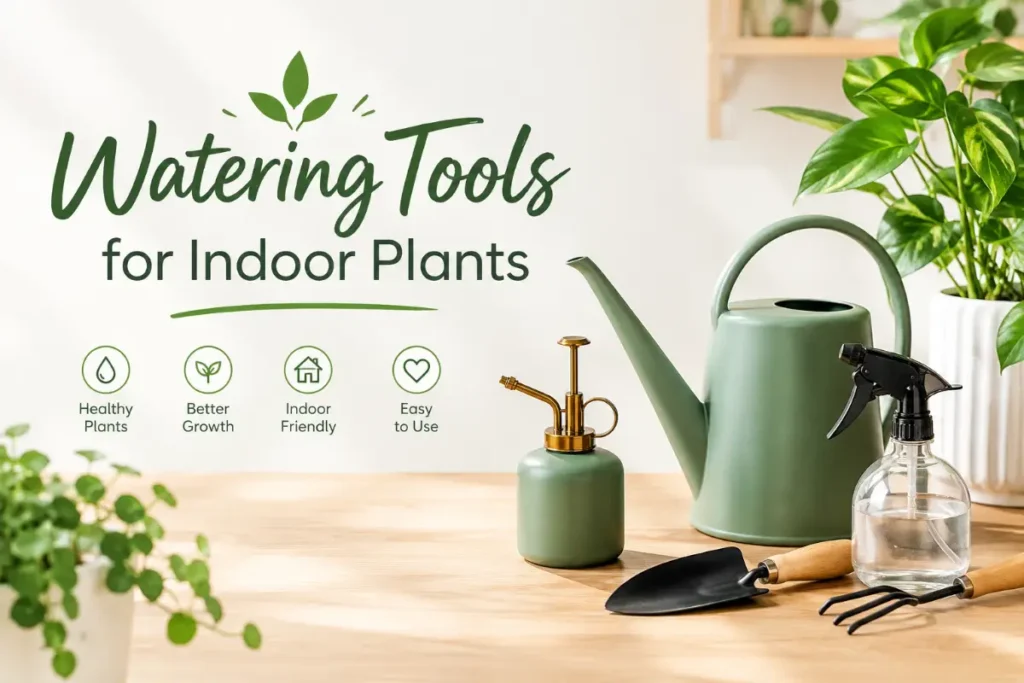
The right watering tools for indoor plants make the difference between a time-consuming guessing game and a fast, accurate routine that keeps every plant in your collection healthy. Most plant owners start with whatever watering can was available and never consider whether better tools would improve their results. Some would not. Others make a genuinely significant difference for specific plants or collection sizes.
This guide covers the eight most useful watering tools for indoor plant care, what each one actually does for your plants, who genuinely benefits from each, and which ones most home growers can skip without any real loss.
Quick Answer
The three tools that make the most difference for most indoor plant collections are a long-spout gooseneck watering can for precise delivery, a moisture meter or finger-test habit for checking soil dryness before each watering, and a fine-mist spray bottle for air plants and propagation cuttings. Everything else is useful for specific situations or collection sizes but not essential for the majority of indoor plant owners.
1. Long-Spout Gooseneck Watering Can
The gooseneck watering can with a long, narrow curved spout is the single most impactful watering tool upgrade for indoor plant owners. The long gooseneck spout allows precise water delivery directly to the soil at the base of the plant, avoiding leaf surfaces, getting under plant canopies without disturbing leaves, and reaching plants positioned at the back of shelves or inside decorative outer pots.
Why the spout shape matters: Standard wide-spout watering cans pour a wide arc of water that splashes leaves, disturbs the soil surface, and makes precision delivery to small or crowded pots difficult. The gooseneck spout delivers a controlled, directed stream that goes exactly where you aim it.
Capacity: One to two liters is the ideal range for most indoor plant collections. Smaller bottles require frequent refilling. Larger cans become heavy and awkward for extended watering sessions across a large collection.
Material: Stainless steel and copper gooseneck cans are durable and attractive display items. Plastic versions are lighter and less expensive with no functional difference. Matte black steel versions have become popular for their aesthetic in plant display setups.
Who needs it: Anyone with more than five indoor plants, anyone with plants in awkward positions on shelves or inside decorative sleeves, and anyone growing plants with sensitive crowns or leaves (African violets, succulents, orchids) that should not be wetted during watering. This is the most universally useful watering tool upgrade available.
2. Moisture Meter
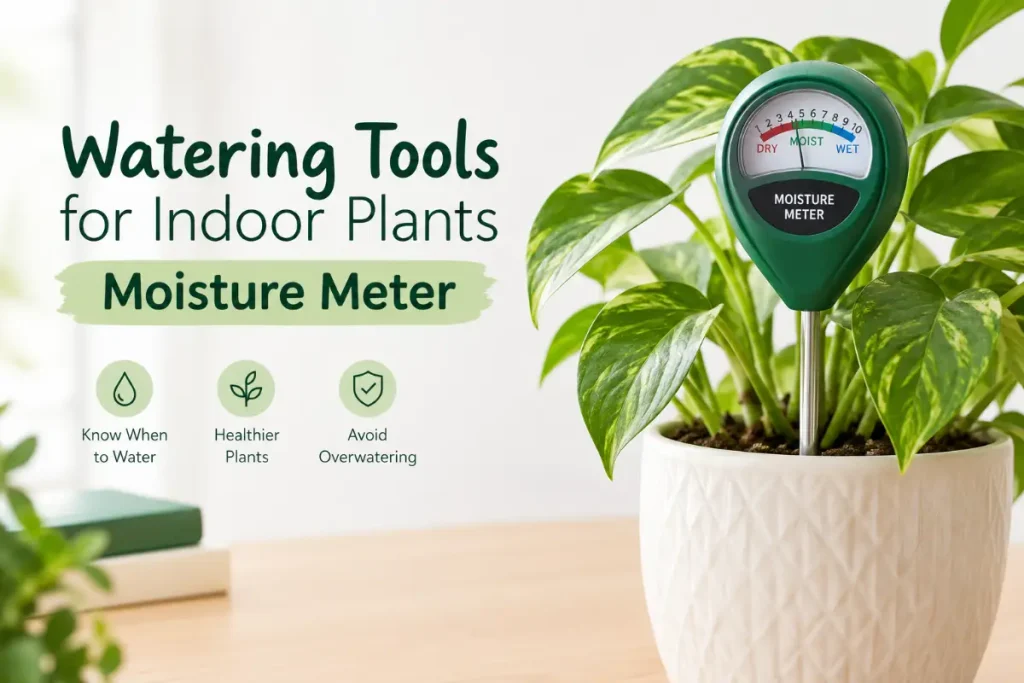
A moisture meter measures soil moisture at the probe depth through electrical conductivity, giving an instant reading of whether the soil is dry, moist, or wet. The most common type uses a simple dial or digital display with a one-to-ten scale.
When it is genuinely useful: Moisture meters add the most value for large collections (twenty or more plants) where the time required for individual finger tests of every pot becomes significant, for very large or deep pots where finger testing cannot reach the root zone, and for new plant owners who have not yet developed the tactile confidence to interpret finger test results accurately.
The limitation: Budget moisture meters (under fifteen dollars) vary in accuracy and consistency. High-quality meters from reputable manufacturers are more reliable but cost more. The finger test at the appropriate depth remains a reliable free alternative for collections under twenty plants.
What to look for: A probe long enough to reach six to eight inches into soil for large pots, a clear scale with defined wet, moist, and dry zones, and stainless steel probes that resist corrosion from repeated soil contact. Clean and dry the probes after each use to maintain accuracy.
For the complete guide to choosing and using moisture meters effectively, moisture meter for indoor plants covers every aspect of moisture meter selection and use in detail.
3. Fine Mist Spray Bottle
A spray bottle that produces a genuine fine mist (tiny droplets that disperse evenly rather than a coarse stream) has specific legitimate uses in indoor plant care that make it worth having in most collections.
Genuine uses: Hydrating air plants (which absorb moisture through their leaves rather than roots), maintaining surface moisture around propagation cuttings, cleaning large smooth leaves by misting and wiping, and applying diluted foliar fertilizers or pest treatments evenly across leaf surfaces.
Not useful for: Raising humidity for tropical plants in any meaningful sustained way — mist evaporates within twenty to sixty minutes and provides negligible lasting humidity benefit for most plants. For plants that genuinely need high humidity, a humidifier is the correct tool.
What to look for: An adjustable nozzle that switches between fine mist and stream settings, a capacity of 500ml to one liter, and a trigger mechanism comfortable for extended use. Compression pump sprayers that build pressure with a few pumps are more comfortable for larger collections or frequent use.
4. Self-Watering Pots and Planters
Self-watering pots use a reservoir and wicking system to deliver moisture to the root zone continuously from below, eliminating the need for frequent manual watering of the plants inside them.
Who benefits most: Plant owners who travel frequently, owners of moisture-loving plants that stress easily from inconsistent watering (peace lily, calathea, basil, and other herbs), and owners of large collections where daily watering attention is impractical.
The trade-off: Self-watering pots are not appropriate for all plants. Cacti, succulents, Mediterranean herbs, and other drought-tolerant plants need extended dry periods between waterings that self-watering systems do not provide. Use them selectively for moisture-loving plants rather than across an entire collection.
What to look for: A reservoir large enough to hold at least one week of water for the plant size, a clear water level indicator, and a design that allows the growing medium to dry partially between refills (the wick should deliver moisture, not keep the growing medium permanently saturated).
For the complete guide to self-watering pot selection and use, self-watering pots for indoor plants covers every type and application in detail.
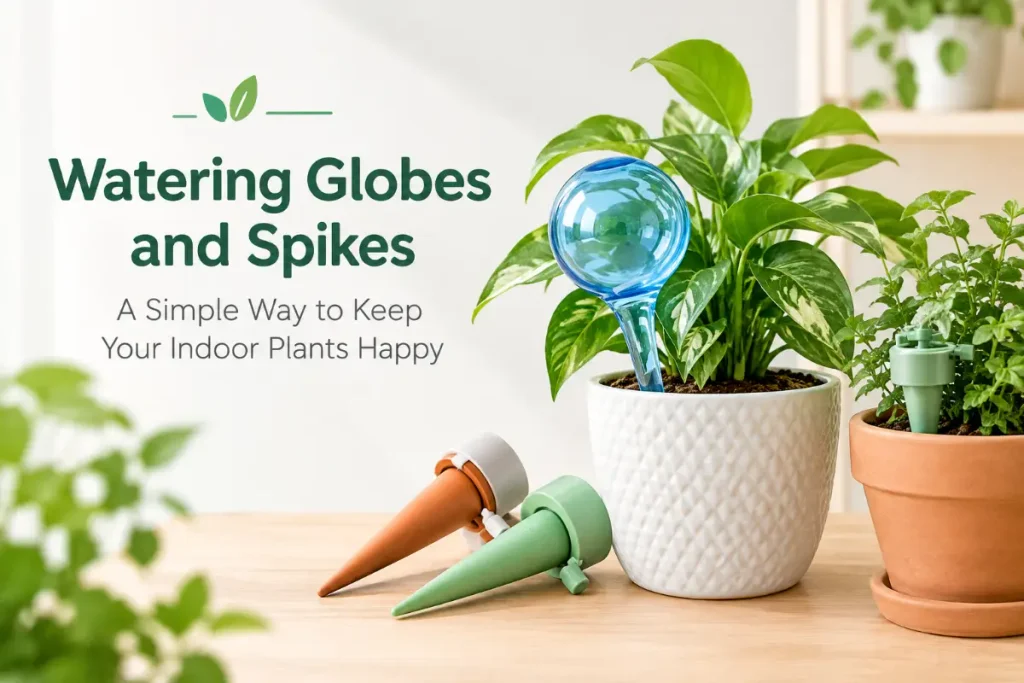
5. Watering Globes and Spikes
Watering globes (glass or plastic bulbs with a narrow neck) and watering spikes (ceramic or terracotta cones that connect to a water bottle) release water slowly into the soil over several days to a week, providing a slow-drip alternative to manual watering.
Genuine use case: Vacation watering for plants that need moisture while you are away for one to two weeks. These tools provide a simple, low-cost solution for short absences without requiring a fully automated system or plant-sitter.
Limitations: Water release rate is inconsistent and depends on soil porosity, pot size, and temperature — some spikes drain in two days while others last ten days in the same conditions. They are not reliable enough for precision moisture management as a regular watering method. Best used as vacation insurance rather than everyday tools.
What to look for: Terracotta spikes that release water more slowly and consistently than plastic versions. Globe size matched to pot size — a small globe in a large pot empties too quickly to be useful.
For the complete guide to vacation watering options including globes, spikes, and more reliable alternatives, how to water indoor plants while on vacation covers every method with honest assessments of reliability and appropriate use cases.
6. Turkey Baster or Squeeze Bottle
A standard kitchen turkey baster or a soft squeeze bottle with a narrow tip provides precision volume control for watering very small pots, terrariums, and plants where even a narrow-spout gooseneck can delivers too much water at once.
Who needs it: Owners of two-inch or three-inch pots where a standard watering can delivers water faster than the tiny pot can drain, owners of terrariums where precise small-volume watering prevents overwatering of shallow soil systems, and anyone propagating in small cell trays where controlled small-volume watering prevents disturbance of the growing medium.
Cost: A kitchen turkey baster costs two to five dollars and works identically to purpose-made plant watering syringes sold at plant specialty stores for several times the price.
7. Watering Can with Removable Rose Head
A rose head is a circular attachment with multiple small holes that breaks the water stream into a gentle shower, mimicking light rainfall rather than delivering a concentrated stream. Removable rose heads allow switching between shower delivery (for gentle surface watering of seedlings and delicate plants) and direct stream delivery (for watering larger established plants).
Who benefits: Seed starters and propagators who need gentle surface watering that does not displace seeds or knock over fragile seedlings. For established houseplants, the gooseneck spout provides more useful precision than a rose head for most applications.
What to look for: A rose head that attaches securely and can be removed easily without tools. Brass rose heads produce finer water droplets than plastic and distribute more evenly.
8. Drainage Saucers and Trays
Proper drainage saucers are watering tools in the sense that they are essential components of the complete watering system rather than purely decorative accessories. The right saucer makes consistent drainage management practical; the wrong size makes it awkward.
What makes a good saucer: Large enough to catch all drainage from a thorough watering without overflowing, deep enough to hold the drainage volume without spilling (at least half an inch deep for small pots, one inch or more for larger pots), and a material that does not wick moisture back into the pot base (glazed ceramic and plastic work better than unglazed terracotta saucers, which can absorb and reintroduce moisture).
The overlooked detail: Saucers must be emptied within thirty minutes of watering. A saucer that holds drainage water indefinitely re-introduces it to the pot through the drainage holes, creating the chronically wet root zone conditions that cause root rot. The saucer is only a useful watering tool when it is emptied promptly after each watering.
For the complete guide to how saucer management fits into the overall drainage system for indoor plants, drainage for indoor plants covers every component of the drainage system that makes correct watering possible.
Tools You Can Skip
Automatic drip irrigation systems for indoor plants: These systems work well in greenhouses and outdoor garden beds but are impractical for most indoor plant collections because they deliver water on a timer rather than in response to soil moisture. Indoor plants need moisture-responsive watering, not time-based delivery, making automatic systems a poor fit for most home collections.
Watering wands (long-handled spray heads): Designed for outdoor garden bed watering, these are awkward for the precision delivery that indoor potted plants need. The gooseneck can provides better precision in the indoor context.
pH and EC meters for tap water testing: Useful for hydroponic and semi-hydroponic setups but unnecessary for the vast majority of soil-based indoor plant collections. Standard tap water, filtered water, or rainwater provides adequate water quality for nearly all common indoor plants without chemical testing.
Building Your Watering Toolkit
For most indoor plant collections, three tools cover the complete watering routine effectively:
The starter toolkit (up to fifteen plants): A one-liter gooseneck watering can for precise delivery. A fine mist spray bottle for air plants, cuttings, and leaf cleaning. Appropriately sized glazed saucers with prompt emptying after each watering.
The expanded toolkit (fifteen to thirty plants): Everything above plus a moisture meter to speed up the soil checking routine across a larger collection. A turkey baster for small pots and terrariums. Watering globes or spikes for vacation coverage.
The serious collector toolkit (thirty or more plants): Everything above plus self-watering pots for the moisture-loving plants that benefit most. A compression pump sprayer for efficient misting of air plant collections or regular foliar treatments. A dedicated watering schedule or app to track which plants were checked and when.
The most important watering tool is not any physical item — it is the soil-checking habit that ensures watering happens in response to actual plant need rather than calendar schedule. For the complete guide to building that habit and the soil check method that makes every watering tool more effective, how often to water indoor plants covers the foundational practice that all of these tools support.
Maintaining Your Watering Tools
Watering tools last significantly longer and perform better with basic maintenance that most plant owners skip.
Gooseneck watering cans: Empty completely after each use and store upside down or on their side so residual water drains fully. Standing water in a watering can promotes algae growth that can clog the spout and introduce algae to soil. For stainless steel cans, dry the inside periodically to prevent water spots and mineral deposits near the spout opening. For plastic cans, rinse with diluted white vinegar monthly to prevent mineral buildup from hard tap water.
Moisture meters: Wipe probes with a dry cloth after every use and store with probes protected from bending. Clean with slightly damp cloth monthly to remove mineral deposits that affect conductivity readings. Store in the original packaging or a protective pouch to prevent probe damage. Replace when readings become inconsistent across multiple tests in the same medium.
Spray bottles: Rinse thoroughly with clean water after each use, especially after using fertilizer solutions or pest treatments. Disassemble the nozzle periodically and rinse all parts to prevent clogging. Store with the nozzle turned to the off position to prevent accidental discharge.
Saucers: Wash saucers monthly with diluted dish soap and rinse thoroughly. Mineral deposits and algae accumulate in saucers over time. White mineral crusts can be removed with a solution of equal parts white vinegar and water left to soak for thirty minutes before scrubbing. Clean saucers prevent the mineral accumulation and algae growth that can affect soil through re-entry of accumulated saucer water.
Watering globes and spikes: Clean with a bottle brush and warm water between uses. Terracotta spikes benefit from a vinegar soak to remove mineral deposits that build up in the pores and affect release rate consistency. Allow terracotta spikes to dry fully between uses to prevent mold growth in the pores.
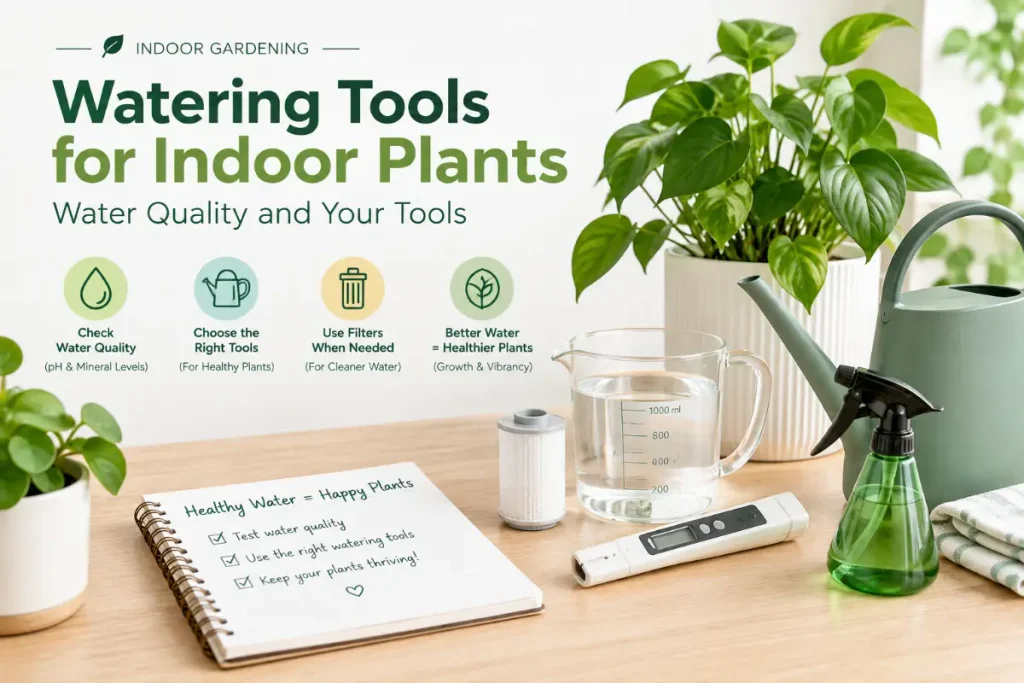
Water Quality and Your Tools
The water you use affects not just your plants but the longevity and performance of your watering tools.
Hard tap water: High mineral content in hard water accelerates mineral deposit buildup in watering can spouts, spray bottle nozzles, and terracotta saucer surfaces. Descale tools monthly with white vinegar solution if you use hard tap water regularly. Consider using filtered water for the plants most sensitive to mineral accumulation (calathea, peace lily, and other plants prone to tip browning from fluoride).
Rainwater: Soft and naturally free of the chlorine and fluoride present in treated tap water. Excellent for all indoor plants and gentle on tools. Collect in food-grade containers. Allow collected rainwater used in spray bottles to reach room temperature before use to avoid temperature shock on warm leaves.
Distilled water: The purest option for sensitive plants and for spray bottle use on plants where mineral spotting on leaves is a concern. Higher cost than other options makes it impractical for large collections but appropriate for a small number of sensitive plants.
For the complete guide to water quality and how different water types affect indoor plants, best water for indoor plants covers every water type with specific guidance on which plants benefit most from water quality upgrades and how to improve tap water quality at low cost for the most sensitive plants in your collection.
Conclusion
Watering tools for indoor plants range from genuinely transformative (the gooseneck watering can) to situationally useful (moisture meters, self-watering pots) to rarely necessary for typical home collections (automatic irrigation systems, pH meters). Matching your toolkit to your collection size, the specific plants you grow, and your watering routine gaps produces better results than acquiring every available tool.
Start with a quality gooseneck can and a spray bottle. Add a moisture meter when your collection grows past fifteen to twenty plants. Add self-watering pots for the plants that struggle most with inconsistent moisture. Everything else is optional and should be added only when a specific gap in your routine makes it genuinely useful.
Frequently Asked Questions
What is the most important watering tool for indoor plants?
A long-spout gooseneck watering can provides the most consistent improvement for the widest range of indoor plant owners. The precision delivery it allows — getting water directly to the soil base without wetting leaves, reaching plants in awkward positions, and controlling flow rate — addresses the most common practical challenges in indoor plant watering. After the watering can, the soil-checking habit (finger test or moisture meter) is the most important practice for preventing both overwatering and underwatering.
Do I need a moisture meter for indoor plants?
Not necessarily for smaller collections. The finger test at the appropriate depth (one inch for moisture-loving plants, two inches for most tropicals, two to three inches for drought-tolerant plants) is accurate and free. A moisture meter becomes genuinely useful for collections of twenty or more plants where individual finger tests of every pot require significant time, or for very large deep pots where finger testing cannot reach the root zone.
What size watering can is best for indoor plants?
One to two liters suits most indoor plant collections. This size is large enough to water multiple plants without refilling constantly but small enough to handle comfortably for extended watering sessions. The spout shape matters more than capacity — a gooseneck long spout provides precision that a wide-spout can of any size cannot match.
Are self-watering pots worth it for indoor plants?
Yes, for the right plants. Self-watering pots are genuinely valuable for moisture-loving plants that stress from inconsistent watering, for frequent travelers, and for large collections where daily watering attention is impractical. They are not appropriate for cacti, succulents, or drought-tolerant plants that need extended dry periods between waterings. Use them selectively rather than across an entire collection.
What should I use to water very small indoor plant pots?
A turkey baster or soft squeeze bottle with a narrow tip provides the precise small-volume control that standard watering cans cannot deliver for two-inch or three-inch pots. A standard watering can pour rate delivers more water than these tiny pots can drain quickly, making precision volume control essential for very small containers.
Is a spray bottle enough to water indoor plants?
No, for most plants. A spray bottle delivers surface moisture only and never saturates the root zone adequately for normal soil-based indoor plants. It is appropriate for air plants (which absorb moisture through leaves), propagation cuttings, and leaf cleaning, but not as a primary watering method for any plant growing in standard potting mix. Use a proper watering can for soil-based plants and reserve the spray bottle for its specific appropriate uses.